



The King (of Late Night) Is Dead
The Late Show
Charles: He was intelligent and he was funny. He was a good comedian; he was also a terrific journalist. If you wanted to see the most important Washington sound bite of the day, your best bet was to tune in to the Late Show with Stephen Colbert.
He had a special place in my heart, because he had great politics, because we are both the youngest, and because my seven minutes on The Colbert Report were my very best moments on television.
Last week CBS shuttered what had been the late night leader for nine seasons in a row, and threw away the 33-year-old show altogether, replacing it with an anodyne collection of second tier comedians.
For sixty years late night with Johnny or Dick or David or Stephen has been a little part of the glue that held America together. Joe and I were devoted fans; we both thought Colbert was the last network TV show that was really necessary.
But the atomization of network TV into YouTube atomized its audience and ruined the business model. At least that was the official story: CBS claimed Colbert was losing $40 million a year, although nobody outside the company could verify that number.
However, the chronology of its collapse proves the show’s profitability was hardly the main reason for killing it July 18 2025.

It was really all about billionaire Shari Redstone holding on to her billions. And it happened like this:
July 7, 2024, Redstone—who was at the time president and CEO—announces a deal to sell National Amusementsl to Skydance-RedBird, which would then merge Paramount with Skydance. Redstone has to sell the company she inherited from her father because it has reportedly accumulated $1 billion in debt. It controls Paramount and CBS.
Oct. 31, 2024, Donald Trump sues CBS News for $10 billion, claiming deceptive editing of a “60 Minutes” interview with Kamala Harris. No serious libel lawyer thinks Trump can prevail in court. 60 Minutes staffers pray their corporate parent will stand up to him.
Nov. 5, 2024: Trump is elected president for the second time.
Jan. 20, 2025, Trump is inaugurated as president and Brendan Carr becomes chairman of the Federal Communications Commission. Carr immediately reinstates an FCC investigation of alleged “news distortion” by 60 Minutes, putting the $8.4 billion Paramount merger in jeopardy.
July 1, 2025, Redstone caves and settles Trump’s case against 60 Minutes for $16 million. A grievous blow to the First Amendment, but she sees it as a pittance that will make sure her merger goes through.
Still thinking his ratings make him invulnerable, Colbert calls the settlement “a big fat bribe.” Two days later the empire strikes back—and his show is killed. This was the final lubricant Redstone’s lieutenants deemed necessary to make sure the merger went through: The slaying of a famous Trump enemy.
One week later the FCC approved the merger.
As usual, everything was for sale in the Trump administration.
Colbert’s show was a safe space for members of the Resistance: A place where you could rely on a really smart man to reassure us that there were still millions of Americans who agreed that this president was a surreal catastrophe. Annette Bening put it best: We spend every day watching the world fall apart, and then we tune in to you and you make everything better.
Especially after the monster returned to the White House, I worried that Stephen was the modern day emcee in Cabaret—the last man who could still get away with mocking fascism. Then my worst fear came true: Just like the Joel Grey character, Stephen had his time limit.
Howard Lutnick’s Epstein Class Maneuvers
New York Times
Scott: The timeline is simple and clear: Howard Lutnick made a $5 million donation to House Republicans on April 1—four weeks after his Epstein testimony before a congressional committee was on the books. But just a day after the quarterly filing deadline, ensuring the donation wouldn’t be disclosed before his testimony.
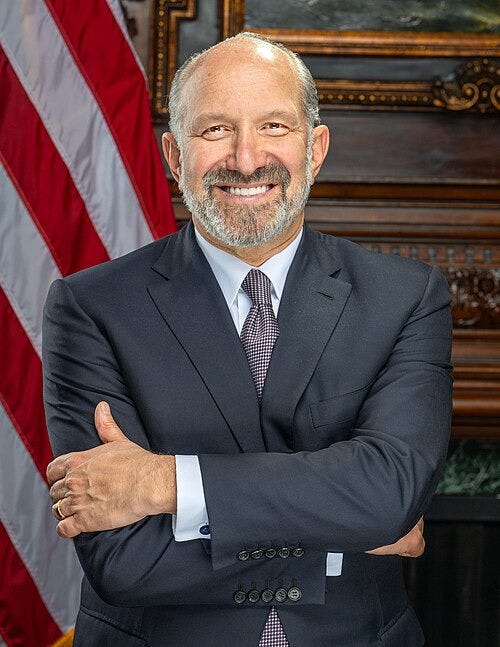
His objective: To insure a friendly, non-inquisitive reception. Which he secured.
This is a signature maneuver of the Epstein Class. It flows from a recognition that every man can be bought at the right price.
And for House Republicans it’s remarkably cheap.
Howard Lutnick, Donald Trump’s secretary of commerce, made a $5 million donation last month to a committee supporting House Republicans, an unusually large contribution for a sitting cabinet secretary.
The donation was made on April 1, four weeks after the House Oversight Committee arranged to interview Mr. Lutnick about his ties to the sex offender and financier Jeffrey Epstein. The closed-door interview took place on May 6.
Mr. Lutnick gave the money to the Congressional Leadership Fund, the main super PAC behind House Republicans and Speaker Mike Johnson, according to a new filing made public on Thursday. Mr. Lutnick has recently been a major Republican donor, but this was his first contribution since being named commerce secretary. It ties his largest-ever federal donation, $5 million he gave to Mr. Trump’s super PAC in 2024.
“Mr. Lutnick made a political donation in his personal capacity, just as many Cabinet Secretaries from both parties have done in the past,” said Kristen Eichamer, a spokeswoman for the Department of Commerce.
The Infantilism of An ‘Ungovernable’ Britain
Financial Times
Scott: The brilliant BBC series ‘House of Cards’ built on this inexorable truth: At the core of modern British parliamentary democracy are a group of people who like to behave like figures from William Shakespeare’s Macbeth. People who are driven by the basest of political motives and showing no respect for the spirit of democratic institutions.
This explains why 11th century Scotland was what it was—brutish, violent and bleak. But does it really provide a rational model for governance in a post-industrial democracy?
Of course not.
It’s not merely inefficient, it provides a steady stream of distraction from the nation’s real problems, economic and social. The Macbeth model of politics is extremely useful for amoral press lords like Rupert Murdoch, but not really for anyone else.
Martin Wolf here examines in some depth the economic challenges and how Britain’s political infantilism is bound to make them far worse, and Britons far poorer.
The United Kingdom has had six prime ministers since May 2010. In contrast, it had just four in the 31 years after Margaret Thatcher took office. Now the number seems set to rise to seven, as Keir Starmer, who won a huge majority less than two years ago, appears likely to lose his position as leader of the Labour Party. No wonder people call the country “ungovernable”. What has made British politics so capricious? What does this mean for the country’s future?
I would not claim that everything comes down to economics. People care about other things, too—immigration, crime, health, education and so forth. But a good economy—one with widely shared economic growth—is, I would argue, a necessary condition for political stability in a liberal democracy. The fundamental problem is that the UK has not had that for two decades. It is not alone in this. But the deterioration in its performance since 2007 has been enormous (as has been also true of other large European economies).
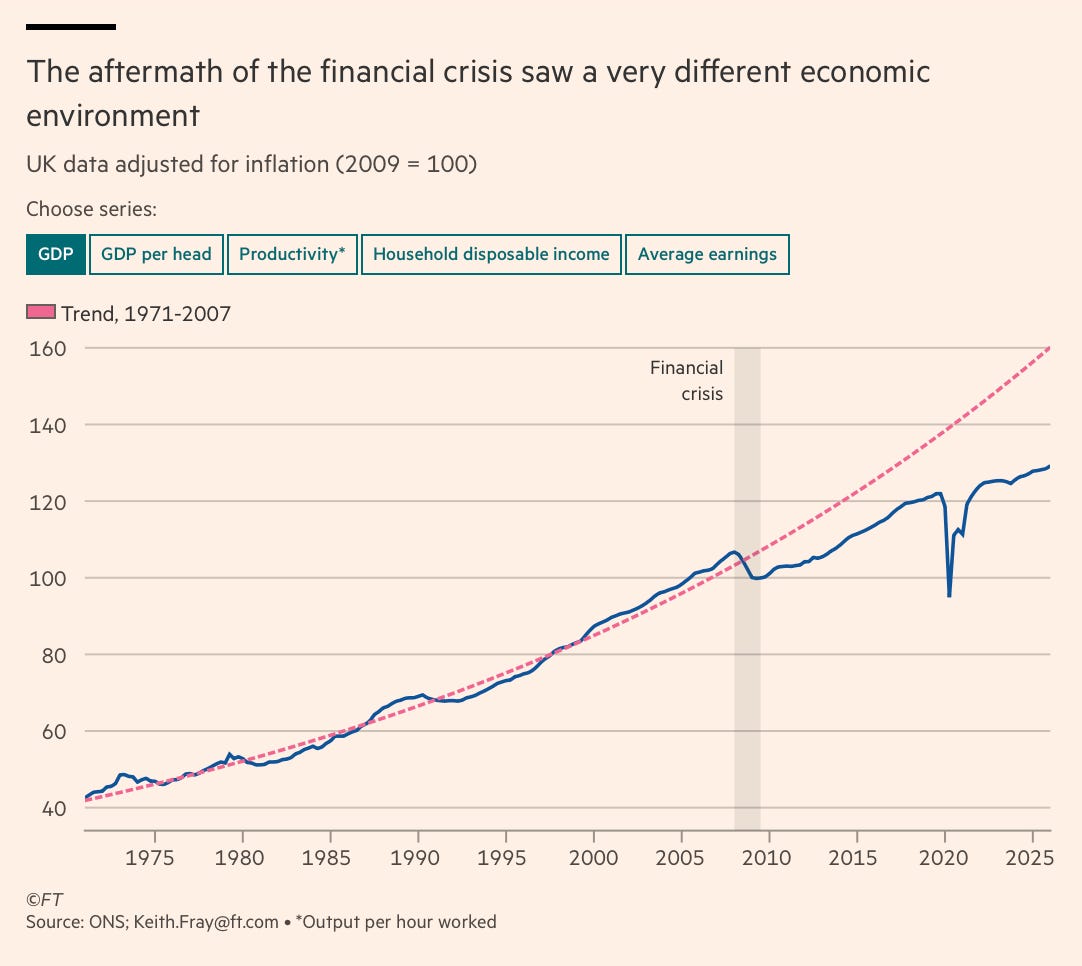
Put simply, a bad economy creates bad politics and bad politics create a bad economy. According to “The UK Productivity Slowdown” by Josh Martin, the slowdown in productivity growth began a year before the 2007 financial crisis. His conclusion is that in 1976-2006, trend annual growth in output per hour had been 1.9-2.1 per cent and, in the market sector, 2.2-2.4 per cent. The slowdown since then has been roughly 1.5 percentage points for the whole economy and 2 percentage points for the market sector.
This collapse in economic growth is the most important fact about British economics and politics. It has been made worse by the pressures of ageing and a succession of big shocks, from the global financial crisis to today’s closure of the Strait of Hormuz. It has in turn made politics a nightmare of fiscal pressures and “affordability crises”, without end.
LISTEN: The Alito Language That Allowed Racist Gerrymandering in the South With Dan Froomkin

The Horton-Kaiser Report is independent, we rely on generous support from readers like you.
The Horton-Kaiser Report is independent, we rely on generous support from readers like you.
Charles: As we explained in our statement of principles, we are above and beyond anything else relentless critics of the press who believe that the frank facism and shameless corruption of the Trump administration make the old customs of deference incompatible with the kind of journalism the United States needs right now.
Get a different perspective from The Horton-Kaiser Report in your inbox every morning, free for two weeks.
