Trump Offers his First Explanation for Iran War
MS NOW
Scott: Trump’s dramatically postured 19-minute address to the nation about the Iran War offered a jumbled take on the latest Gulf War with absolutely nothing new. The suggested surprise lines about NATO or a land invasion appeared nowhere in his remarks. He offered a long list of falsehoods to justify the war. His accomplishments, he said, were basically undoing the mistakes made by his predecessors, particularly the control agreement struck by Obama. “I was so proud to do it. I did what no other president was willing to do. They made mistakes, and I am correcting them.” But he offers no explanation for his decision to terminate the deal. We’ve only been battling Iran for 32 days, he says. “This is an investment in your children’s and your grandchildren’s future… We are free from Iranian aggression and the wickedness of Iranian nuclear blackmail.” Can anyone imagine Nixon, Reagan, McCain or either of the Bushes giving an erratic, confused blabberfest like this? I don’t think so.
But most significantly: no news on a settlement. No indication of how he plans to move forward in the coming weeks. No sign of any off ramp. Just lots and lots of words that frequently didn’t fit together.
ACLU 1, Solicitor General 0
The New York Times and The Hill
Charles: That is the considered judgement of the most seasoned court observers I know. The New York Times at least managed to suggest that in its lead:
A majority of the Supreme Court appeared skeptical of President Trump’s efforts to limit birthright citizenship during arguments on Wednesday.
Key conservative justices raised doubts about the constitutionality of the president’s executive order that would end automatic citizenship for children born on U.S. soil to undocumented immigrants and some temporary foreign visitors.
When a lawyer for the Trump administration suggested that the realities of modern migration required a new assessment of whether the Constitution guarantees birthright citizenship, Chief Justice John G. Roberts Jr., who is seen as a key vote, retorted: “It’s a new world. It’s the same Constitution.”
But the rest of the Times story, as well as those published by several of its competitors, failed to convey just how much better ACLU legal director Cecillia Wang did on her feet than her opponent, Solicitor General D. John Sauer. The lead story in the Times didn’t even mention Sauer’s most embarrassing moment, when he was unable to give an unambiguous answer when Justice Neil Gorsuch asked him whether Native Americans should be considered birthright citizens.
For the full exchange about that I had to turn to The Hill. Sauer responded to Gorsuch:
“I think so. I mean, obviously they’ve been granted citizenship by statute,” Sauer answered, referring to the Indian Citizenship Act of 1924.
Gorsuch directed him to put aside the statute.
“Do you think they’re birthright citizens?” the justice pressed again.
“No, I think the clear understanding that everybody agrees in the congressional debates is that the children of tribal Indians are not birthright citizens,” Sauer answered.
Gorsuch pressed for clarification, asking him to answer again based on the domicile of the parents.
“I think so, on our test. They’re lawfully domiciled here. I have to think that through, but that’s my reaction,” Sauer said.
Gorsuch responded, “I’ll take the yes.”
It’s usually a fool’s errand to make a confident prediction about the outcome of any case before the Supreme Court, but this time seven of the Justices were so skeptical toward the government’s arguments, the odds are good that the unambiguous constitutional guarantee of birthright citizenship will be affirmed by a vote of 7 to 2.
Trump’s Socks for the Initiates
Kommersant
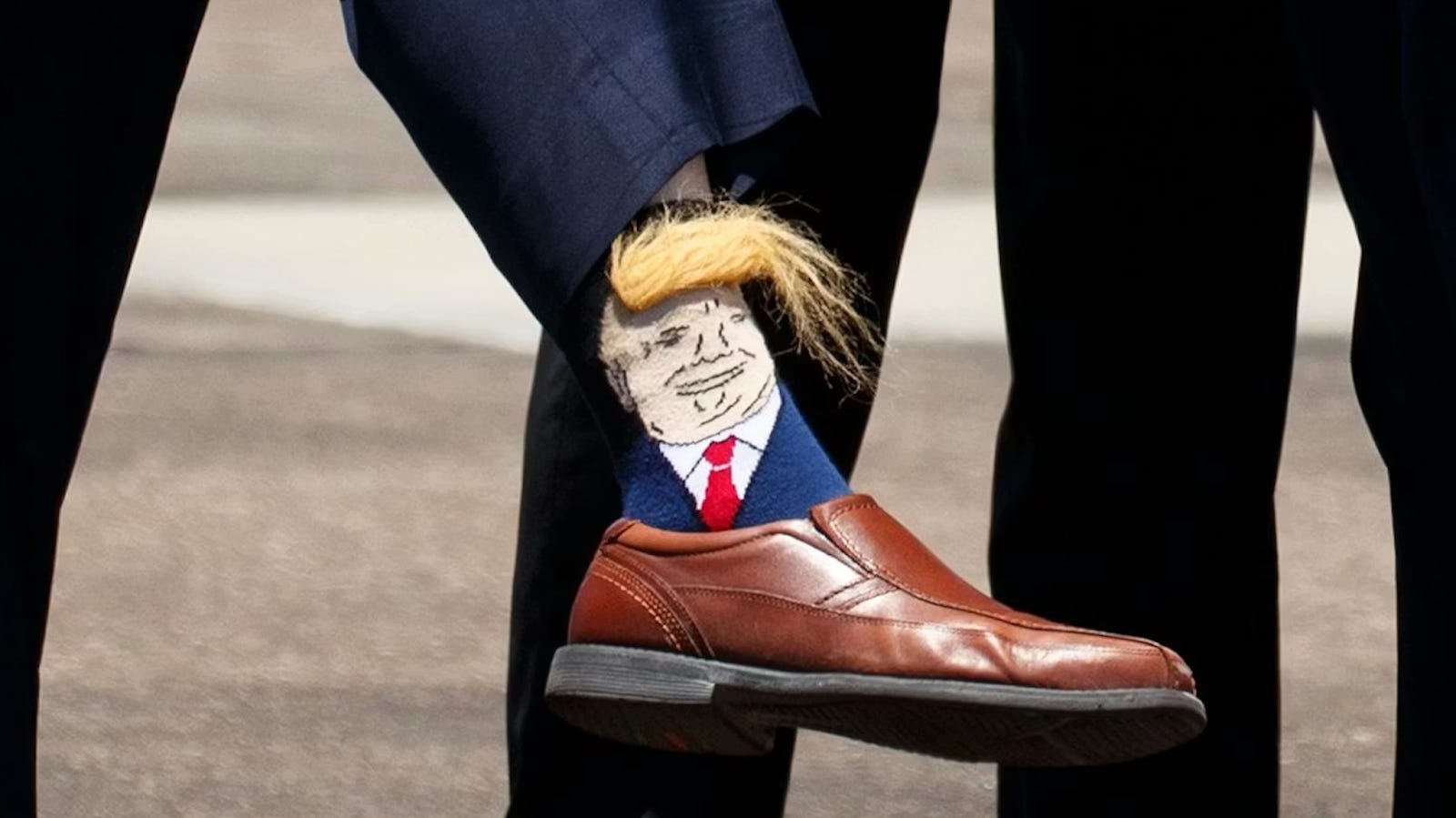
Scott: Donald Trump has a favorite gift for his most devoted followers—socks in his image. Moscow’s Kommersant reports that when a Russian parliamentary delegation visited Washington for meetings with Russia-friendly Republican congressmen led by Anna Paulina Luna (R-FL), Trump sent them socks with his effigy as a special token of esteem. The Russian delegation was led by Vyacheslav Nikonov, the grandson of Stalin’s foreign minister Vyacheslav Molotov.
This visit was the first full-fledged mission of Russian parliamentarians to Washington in 12 years. Lawmakers met with their colleagues, administration officials, and academics at the United States Institute of Peace (USIP), rather than in Congress itself. But the Russians also visited Capitol Hill: Congresswoman Anna Paulina Luna, who officially acted as convenor for the Russian delegation, also played the role of tour guide. As a result of the meetings, the Americans presented the Russian deputies with commemorative coins and socks with Trump’s image, to the great delight of Russian social media.
Happy Passover
Charles: My father was raised as an Orthodox Jew, my mother, a casual Congregationalist. As a child I thought their gods were Einstein and Freud, whose portraits hung in their bedroom. Our only reliable acknowledgement of religion came through faithful celebrations of the big eating holidays: Christmas and Passover.
My real indoctrination in Jewish customs was conducted by my father’s former camp counselor Sidney Korzenick. They had both attended a Jewish summer camp where Moss Hart was the social director. For twenty years, beginning with my freshman year at Columbia, I faithfully traveled to the Scarsdale home of Sidney and his wife Emily, who became one of the first women rabbis. Sidney was the greatest Seder leader of them all. He radiated warmth and wisdom; he was a magnificent scholar, and a genuine intellectual who taught me the most important thing I know about all the Jewish holidays.
The genius of our forefathers was to transform all of the pagan festivals by infusing them with ethical meaning.
In an era when Israel has become one of the principal makers of war in the world, the celebration of Passover is particularly complicated for anyone who believes that self-identification as a Jew comes with some very specific ethical responsibilities. As my good friend Boris Khmelnitskiy remarked last night, “I’m hosting a Seder that asks how Zionism managed to turn us into the Egyptians in the story. Abracadabra!”
So this is my Passover prayer for 2026: May the people of Israel finally rise up to expel Benjamin Netanyahu and all of his loathsome cronies from their government, because they have inflicted more death and misery on the Middle East than any ancient Pharaoh ever could.
Star Russian Journalist Gets a Four-Year Sentence
El País
Scott: Andrei Soldatov comes from a family with depth in the upper echelons of the Soviet (now Russian) intelligence services, but he pursued a career in journalism. Over time he emerged as the Tim Weiner of the Russian press. Soldatov revealed how the intelligence community transformed itself after the collapse of the Soviet Union, struggling at first, but over time achieving a budget and depth that surpassed anything of the Soviet era.
Their friendships crumbled as freedom in Russia crumbled. Journalists Irina Borogan (51, Moscow) and Andrei Soldatov (50, Moscow), who have been investigating the inner workings of the Russian security services for three decades, reflect in their latest book, Our Dear Friends in Moscow: The Inside Story of a Broken Generation, on how a well-educated, informed, and cosmopolitan generation embraced Putinism; and how democrats and authoritarians cannot coexist in the same society in the long run. Today, this couple lives in exile while their old friends have risen high within the Russian propaganda machine and government. A more comfortable life, but one tied to the future of the regime. And the future looks bleak: “The Russian intelligence services believe they are in an eternal war against the West, a struggle that will never end,” Borogan warns alongside Soldatov in a video conference interview.
Once the repressive machinery is unleashed, it will never stop on its own. This Monday, after this interview was conducted, the Russian justice system invoked its label of “foreign agents” to sentence Soldatov to four years in prison and prohibit him from managing the website of his own investigative platform. “This sentence is a clear attempt to silence me and force me to stop working as a journalist. I will continue to do so no matter what,” the expert told this newspaper by telephone.
Germany Rethinks Its Turn from Nuclear Power
Financial Times
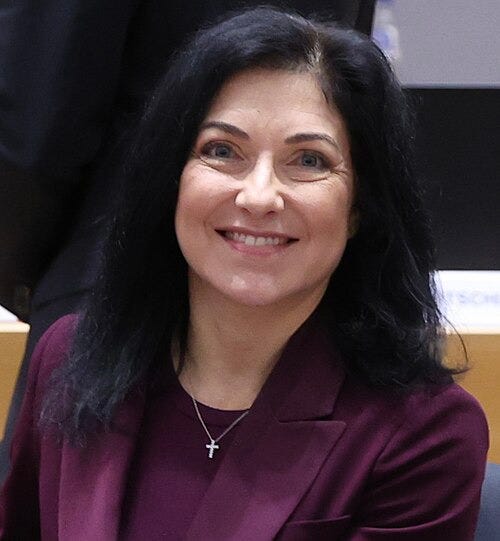
The anti-nuclear power movement (Atomkraft, nein danke!) dominated German politics for a generation, and ultimately forced the decommissioning of the country’s nuclear power plants. Now Germany’s economy minister Katherina Reiche says current problems surrounding fossil fuels mean there is no alternative but to reconsider this decision.
Germany’s economy minister has called for a rethink of her country’s opposition to nuclear power, warning that its reliance on gas leaves it vulnerable to energy shocks. Speaking as she launched a new investor conference to attract foreign capital to Europe’s largest economy, Katherina Reiche said previous governments’ decision to shut down Germany’s nuclear power plants meant there was now “no alternative” to gas to meet demand. “We need gas to secure our supply — that is the only baseload supply I have left,” she told the FT. “Politically speaking, I have no alternative.” Reiche’s comments reflect a deepening debate in Germany over the legacy of the nuclear phaseout, decided under former chancellor Angela Merkel in 2011 and completed under Olaf Scholz. While the policy was paired with an expansion of renewables, it has increased reliance on gas for baseload electricity.
The Claw and Bubble Nebulae

Explanation: What unexpected things do you see when you look up at the night sky? Today’s image resembles an abstract painting, with large swaths of color strewn across a cosmic canvas seemingly without design. Despite the image’s abstract nature, the human mind finds patterns, identifying a large claw reaching up towards a floating bubble. Embedded within these seemingly random structures are the physical laws that govern how light and matter interact. The Claw (Sh2-157) and Bubble (NGC 7635) Nebulae glow colors that are mapped to the yellow and blue shown, indicating the presence of hydrogen and oxygen ionized by the intense light emitted from stars several times the mass of the Sun. This image depicts both the chaos and structure of astronomical processes, showing that a common thread between art and science is to look for the unexpected.
Text: Keighley Rockcliffe (NASA GSFC, UMBC CSST, CRESST II)
Your Online Moment of Zen
Charles: Dayenu is my favorite Passover song. It means “that would have been enough,” and it’s a celebration of all of god’s blessings. I like the idea I just came across that it was written as a theological response to the medieval Christian Improperia, sung on Good Friday, which accused the Jews of being ungrateful to god, because they had crucified Christ after the lord had led them out of the land of Egypt.
Here’s the most famous modern interpretation of Dayenu from The Maccabeats.