



Is Operation Epic Surrender Nearing Its End?
New York Times
Scott: Donald Trump’s war on Iran of 2026 is one like no other in US history. Fought as a war of choice but without significant preparation, explanation or delineation of objectives, it stalled out in two months with Trump telling his entourage he was losing interest.
On Saturday, Trump announced he had “largely” completed a peace agreement with the Iranians, something against which the Iranians quickly pushed back. Its terms are less than sketchy, but Republican hawks surrounding Trump—from Lindsey Graham, to Roger Wicker and Mike Pompeo—immediately started expressing alarm, suggesting that the terms would leave the United States in a worse position than it had before the war.
So what is pressing Trump to make a deal on whatever terms Iran is prepared to offer?
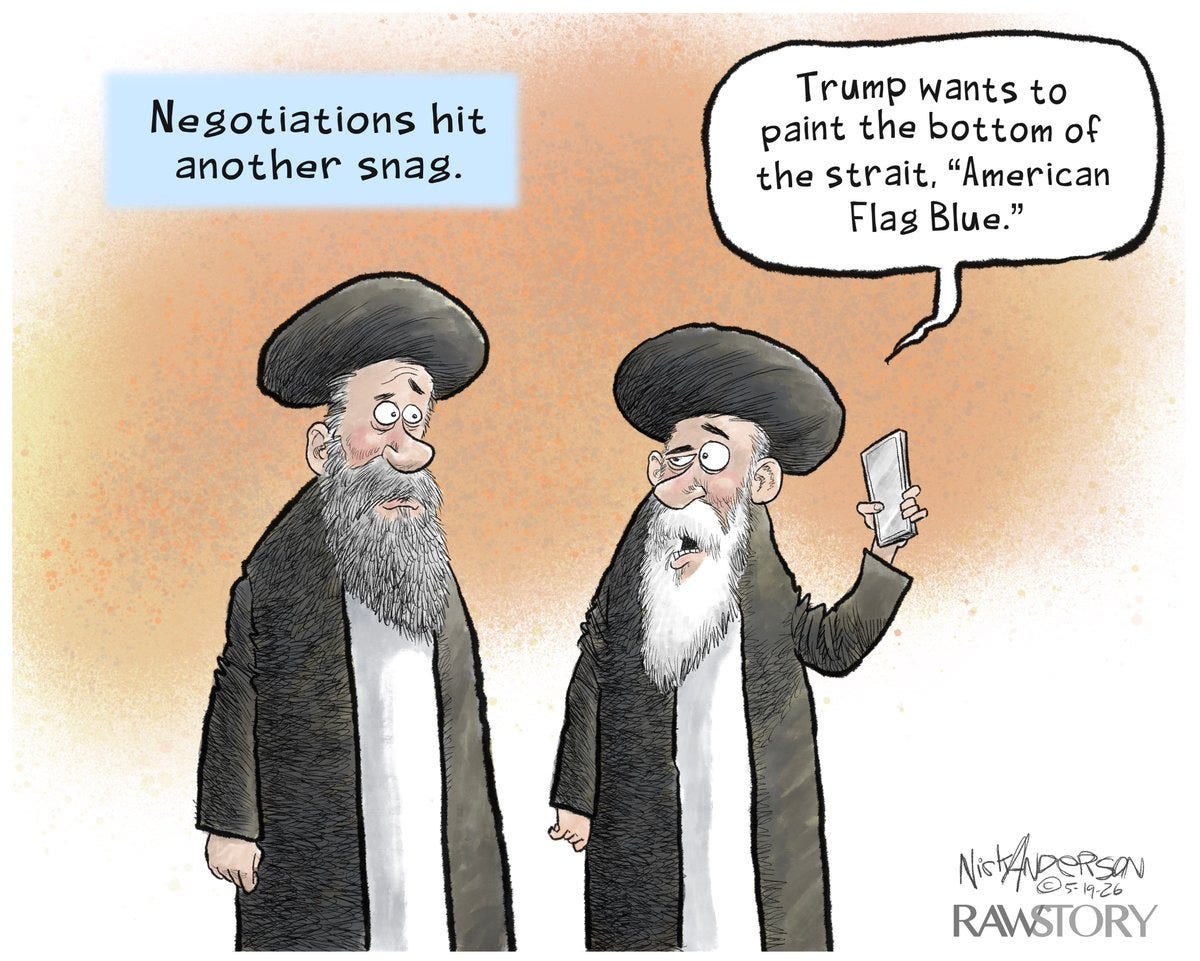
At this point three things appear to be driving Trump towards a peace deal:
Expiration of the War Powers Act authority, as defecting Republicans furnish an anti-war majority. A point dramatically brought home on Thursday when Speaker Mike Johnson cancelled an Iran War resolution vote after doing a count and seeing that Trump would lose. As he also did a few days earlier in the Senate.
Republican electoral anxiety about facing voters with $6–7 per gallon of gasoline.
And Gulf Arabs concluding that Trump is not a reliable or desirable partner and they would prefer to take their chances with the Iranians.
Maybe this peace effort will fail, but if it proceeds on the terms now being suggested, it would be the most clear-cut defeat for the United States in a military confrontation in modern times.
It will be the hallmark of Trump’s foreign policy.
The United States and Iran have agreed in principle to reopen the Strait of Hormuz with a commitment from Iran to dispose of its highly enriched uranium, although exactly how and when that would happen is still up in the air, a US official told reporters on Sunday.
The official said a formal deal has not yet been signed and is still subject to final approval from President Trump and Iran’s supreme leader, which could take days. The official said the US believes the supreme leader, Ayatollah Mojtaba Khamenei, has endorsed the broad template of the plan, but there is not yet a specific document for him to sign…
What have Trump and US officials said?
In his social media post, Mr. Trump said he had spoken by phone with the leaders of several Arab leaders, and the leaders of Pakistan and Turkey about a memorandum of understanding “pertaining to PEACE.” He said the agreement was “subject to finalization” by the United States, Iran and other countries, but did not provide any details.
Two U.S. officials, speaking on the condition of anonymity, said a key element of the proposed agreement was an apparent commitment by Tehran to give up its stockpile of highly enriched uranium. The officials said questions about how that would occur would be deferred to a later round of negotiations over Iran’s nuclear program…
What has Iran said?
Iran had not formally responded to Mr. Trump’s comments. But three senior Iranian officials, speaking on the condition of anonymity because they were not authorized to speak publicly, said that Tehran had agreed to a memorandum of understanding that would stop the fighting on all fronts, including Lebanon, where Israel is fighting with Hezbollah, an Iranian-backed militant group; reopen the Strait of Hormuz without any tolls; lift the US naval blockade on Iran; and release $25 billion in Iranian frozen assets.
It was unclear whether the proposal described by the Iranian officials was the same one Mr. Trump referred to in his social media post. The officials told The New York Times that the proposal said nothing about the fate of Iran’s nuclear program, only that a plan for dealing with the country’s highly enriched uranium would be negotiated within 30 to 60 days.
And here’s how the Kobeissi Letter summarizes the draft Memorandum of Understanding drawing on both Iranian and US sources:
1. Extension of Iran War ceasefire for another 60 days.
2. Strait of Hormuz reopened for the 60-day period.
3. Iran would be able to freely sell oil during the period.
4. US would lift blockade on Iranian ports and unfreeze some Iranian funds.
5. US would issue some sanction waivers on Iranian oil.
6. Draft MOU includes statement that war between Israel and Lebanon would end.
7. Negotiations would then be held regarding Iran’s nuclear program.
The situation remains fluid amid the high-stakes negotiations.
Then There Were Four
The Atlantic
Scott: Donald Trump has now ousted a fourth member of his cabinet, Director of National Intelligence Tulsi Gabbard. Her letter of resignation letter says she’s leaving as of the end of June in order to support her husband, who is suffering from a rare form of blood cancer—but Reuters quickly found a White House insider clarifying that no, she was fired just like the others.
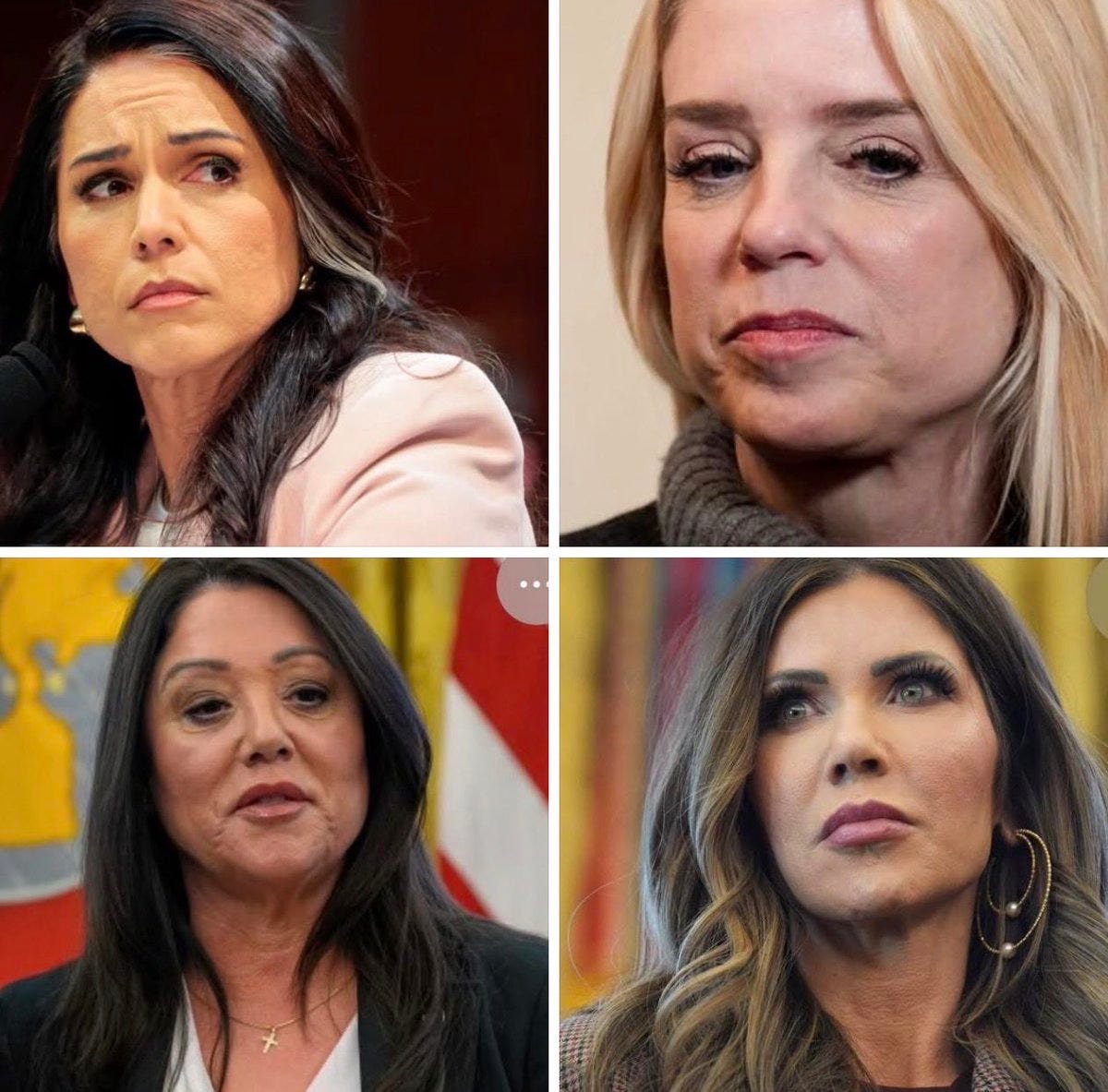
Gabbard had repeated friction with Trump and was sidelined, often simply searching for something to do. At one point she injected herself into an FBI scheme to seize ballots in Fulton County, GA. On no point did she and her staff differ more seriously than on the war on Iran, which she has long stridently opposed.
Scott Shane has chronicled Gabbard’s last days for The Atlantic:
It’s a measure of Trump’s low regard for the Office of the Director of National Intelligence, as well as its soon-to-be former occupant, that while the commander in chief was making final preparations to invade Venezuela and kidnap its president, Tulsi Gabbard was posting photos of herself from a beach in Hawaii.
Gabbard, who informed Trump of her resignation today, spent 15 months as the director of national intelligence—on paper, at least. By law, the DNI is supposed to serve as the president’s chief intelligence adviser. Gabbard never was, and many of her stances were at odds with administration actions. Trump was contemptuous of even her modest efforts to speak truth to power. In the spring of 2025, when Gabbard testified to the intelligence community’s consensus view that Iran “is not building a nuclear weapon,” Trump replied, “I don’t care what she said.” Gabbard has long opposed U.S. military intervention in Iran and did not publicly come out in support of Trump’s decision to go to war…
Because the president was not interested in Gabbard’s views on intelligence, she tried to get his attention in other ways. Gabbard accused former U.S. officials of mounting a “yearslong coup” against Trump. She railed against the so-called Russia Hoax and attempted to undermine the conclusion, by a bipartisan Senate committee, that Russia had indeed interfered in the 2016 presidential election. And she took revenge on Trump’s perceived political enemies by revoking the security clearances of current and former intelligence officials. None of this won the president’s public admiration, and it did lasting damage to the intelligence community. Gabbard’s decision to place politics ahead of objectivity has deterred intelligence analysts from making assertions that might run counter to the administration’s preferred storylines, current and former officials have told me.
To bolster her baseless claims, Gabbard declassified U.S. intelligence material—sometimes over the objections of the CIA—and publicly misrepresented what those documents actually said. Gabbard’s claim to have “uncovered weaponization” in the intelligence community gave Trump another dubious talking point in his unrelenting campaign of political revenge. Gabbard fired two senior intelligence analysts after they wrote an assessment that contradicted Trump’s efforts to link Venezuela’s president to a criminal gang. Trump’s tortured claims played a role in justifying his attack on Venezuela—a supreme irony for the supposedly anti-interventionist DNI.
The Horton-Kaiser Report is independent, we rely on generous support from readers like you.
Charles: As we explained in our statement of principles, we are above and beyond anything else relentless critics of the press who believe that the frank facism and shameless corruption of the Trump administration make the old customs of deference incompatible with the kind of journalism the United States needs right now.
Get a different perspective from The Horton-Kaiser Report in your inbox every morning, free for two weeks.
