



Netanyahu Ignored Explicit Warnings of an Imminent Attack / Merz’s CDU Might Ban the AfD / / Trump’s War On The Working Class /Mathematicians Are Skeptical of AI’s Latest Miracle / A 92-year-old Mathematician Is Still Mentoring A New Generation
Netanyahu Received Explicit Warnings Days Before October 7, Told Security Chiefs Nothing
Haaretz
Charles: In a bombshell report that might finally end Benjamin Netanyahu’s political career, Haaretz reported that UAE President Sheikh Mohamed bin Zayed warned the Israeli prime minister ten days before the October 7 attack that Hamas was planning a major attack on Israel that had the potential to upend the entire region.
The revelation is in a new book by Shlomi Eldar and Ruth Yuval, “Hostages: 843 Days of Abandonment.” The authors of the book also wrote the piece about it in Haaretz.
A Palestinian who had emigrated years ago from Gaza and maintained strong ties to the strip was also present during the conversation between the UAE president and the Israeli prime minister. The reporters’ sources said “the Emirati ruler impressed upon Netanyahu the need to prepare for the threat.”
The Emirati leader was surprised that the Israel prime minister reacted calmly and insisted Israel was ready for any scenario.
Zayed also shared with CIA director William Burns that “something there is about to explode.”
But the book says that neither the head of the Shin Bet, the head of Mossad, nor the Israeli Defense Forces chief of staff were informed of Zayed’s warning.
Netanyahu called the story “an absolute lie.” His office said “No warning was given to the Prime Minister from the United Arab Emirates before October 7th.”

Benjamin Netanyahu arrives in parliament in Jerusalem on July 16, 2026
Nevertheless, after the bombshell report was published opposition leaders declared the prime minister unfit to serve.
The book also said that Hamas and Israel were on the verge of concluding an agreement that would have allowed gas for Gaza, a gradual lifting of the blockade of Gaza and increasing the shipments of food and raw materials. The Egyptians were also willing to offer safe passage for Gaza residents on their way to the airport in Sham-el-Sheikh, which would give them an opening to the outside world.
By the summer of 2023 there was broad optimism that a new agreement could be reached. “However, Netanyahu repeatedly postponed convening the committee. Perhaps he did so out of fear of reaching an agreement with Hamas, or perhaps out of fear of the reaction from his extremist partners in his new government.”
Then the Hamas representative “simply vanished from our radar, evaporated,” because he had lost patience with the “Israelis’ pace.”
The Israelis were then told that if they didn’t make progress toward an agreement, they should “expect an earthquake.”
Yaha Sinwar then sent a message to the Emiratis that he was “preparing the mother of all surprises, a terrifying operation. Something extraordinary.” But the Emiratis hesitated about conveying the warning, thinking it might prompt a preemptive strike by Israel.
But on September 5 the warning was relayed to the head of Shin Bet, who called Netanyahu,and two days later he met with the defense minister and military intelligence representatives.
When the Emirati leader saw that the Israelis were not responding to the clear warning, he decided to speak to the Israeli prime minister for 45 minutes at the end of September. “A similar call reached the prime minister’s bureau from the Egyptian intelligence Chief, warning of “a terrifying operation” about to be launched by Hamas.
When Shit Bet recommended targeting senior Hamas officials, Netanyahnu gave the same response he had given before, “Prepare plans for me and I will consider them.”
“He never said no,” said a senior defense official. That was always his way of postponing dealing with the problem. And the prime minister never mentioned the warning calls he had received.
The book also said that Hamas had been willing to release all of the civilian hostages almost immediately. Their only conditions was to bring in an agreed-upon mediator. The Qatar prime minister told American secretary of state Antony Blinken he had offered the Israelis “a quick deal for their release, but they are not interested.”
Blinken reportedly suggested a three-day delay, which proved to be a disastrous suggestion. A senior official told the authors, “to be honest the issue of the hostages was not seriously on the agenda at this stage, and no one at the military or political level was open to discussing the proposal.”
Merz’s CDU in crisis after far-right victory in Saxony-Anhalt
Financial Times
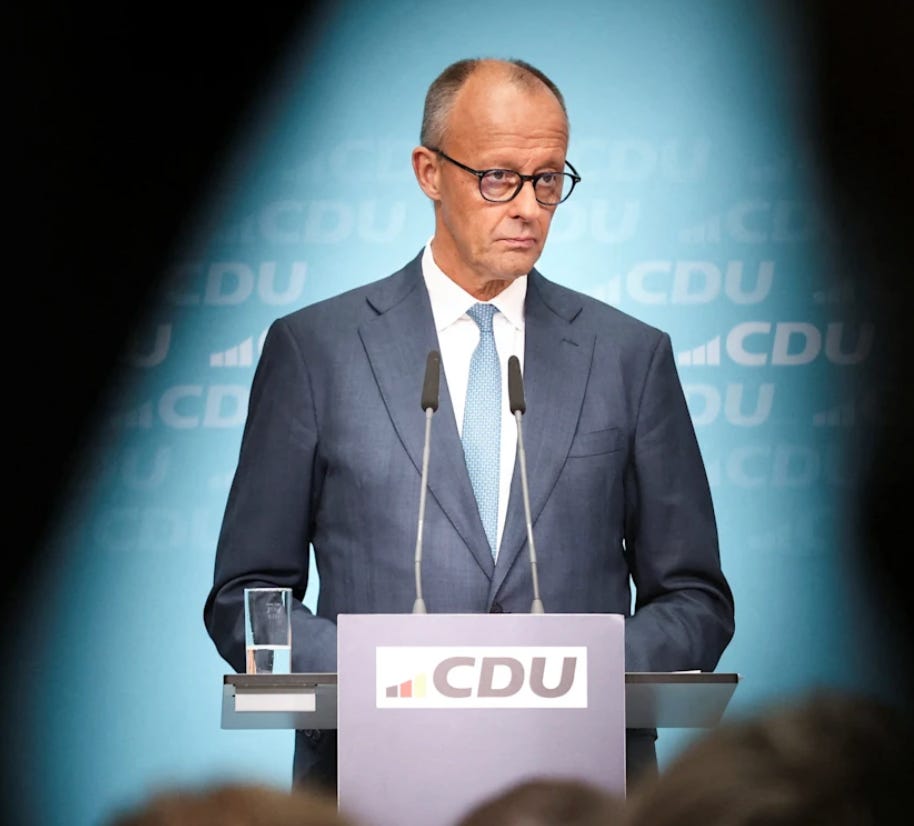
Scott: The object of Putin’s influence campaign targeting Germany is not to install AfD as a new, pro-Kremlin government in Berlin. He recognizes that this is not feasible. But it does aim to use every available lever of the apparatus of German democracy to create disorder, chaos and dissatisfaction with the central government. A next objective would be to bring down the chancellorship of Friedrich Merz (CDU) who is seen as distinctly hostile to the Kremlin. And a study recently completed in Poland shows how some of this works: AfD deputies, once elected to a legislative body, use their position to make parliamentary inquiries which are essentially little more than a wish list for the Russian intelligence services, collecting confidential and sensitive data that can be used to make hybrid attacks more effective by understanding the defenses and safeguards in place against them.
And this leaves the current CDU/CSU/SPD government in Berlin studying its options, including getting much tougher in its dealings with the AfD and its possible ally BWS. That may include litigation and a judicial application to have the party banned. And other options are even less palatable.
For German Chancellor Friedrich Merz, the far right’s crushing victory in Saxony-Anhalt on Sunday — and the drubbing it inflicted on his Christian Democratic Union — strikes close to home.
When he launched the first of three bids for the CDU leadership in 2018, returning to politics after a decade in business, Merz vowed to “halve” support for Alternative for Germany (AfD). His answer was to steer the CDU to the right, pairing a tougher line on immigration with pro-growth economic reforms.
Eight years on, and 16 months into his chancellorship, Merz has failed to deliver on that promise. The AfD is stronger than ever, displacing the CDU in an eastern stronghold it had dominated for more than two decades.
“It’s disastrous for the CDU,” said Andreas Rödder, a history professor at Mainz University, warning the party now faced an “existential risk”.
The scale of the defeat triggered crisis meetings at CDU headquarters in Berlin on Monday. Hours later, Saxony-Anhalt premier Sven Schulze resigned.
One party insider warned the result risked accelerating a downward spiral, with regional elections in Berlin and Mecklenburg-Vorpommern less than two weeks away.
Defeat in Saxony-Anhalt, a state of just 2.1mn people marked by the economic and social upheaval of reunification, had long been expected. But the scale of the loss has crystallised an unthinkable fear within the CDU: that the party of Konrad Adenauer could be reduced to political oblivion.
With just 17.2 per cent of the vote, the CDU recorded its worst result in Saxony-Anhalt since reunification. Until Sunday, the conservatives had led every state government there since 2002. Before that, the Social Democrats (SPD) — the other postwar Volkspartei — had governed for eight years.
The AfD secured nearly 44 per cent of the vote, the best result of any party in the eastern state since 1990.
Nationally, too, the CDU has slipped since the 2025 federal election, polling at about 20 per cent as the AfD has risen to 28 per cent, making it Germany’s most popular party…
One option is for Merz’s CDU to muddle through, pressing ahead with unpopular welfare reforms alongside its junior coalition partner, the SPD, whose poll ratings are also languishing. The hope would be that an economic recovery eventually restores voters’ trust, Rödder said.
Another would be to end the coalition and govern as a minority administration with the current Bundestag, freeing the CDU from having to dilute its policies to secure SPD backing. That would be a bold but “risky” course, Rödder said.
A third option would be to replace Merz with a more popular chancellor while keeping the coalition intact.
Hendrik Wüst, the 50-year-old premier of North Rhine-Westphalia, Germany’s most populous state, is frequently cited — including by CDU insiders — as the obvious chancellor-in-waiting. But replacing Merz would do little to resolve the party’s deeper dilemma over the Brandmauer against the AfD, Rödder said.
It would also require Merz to step aside. On Monday, he gave no indication he was prepared to relinquish the office he had coveted for so long.
The Historical Roots of the AfD: A Primer
Der Spiegel
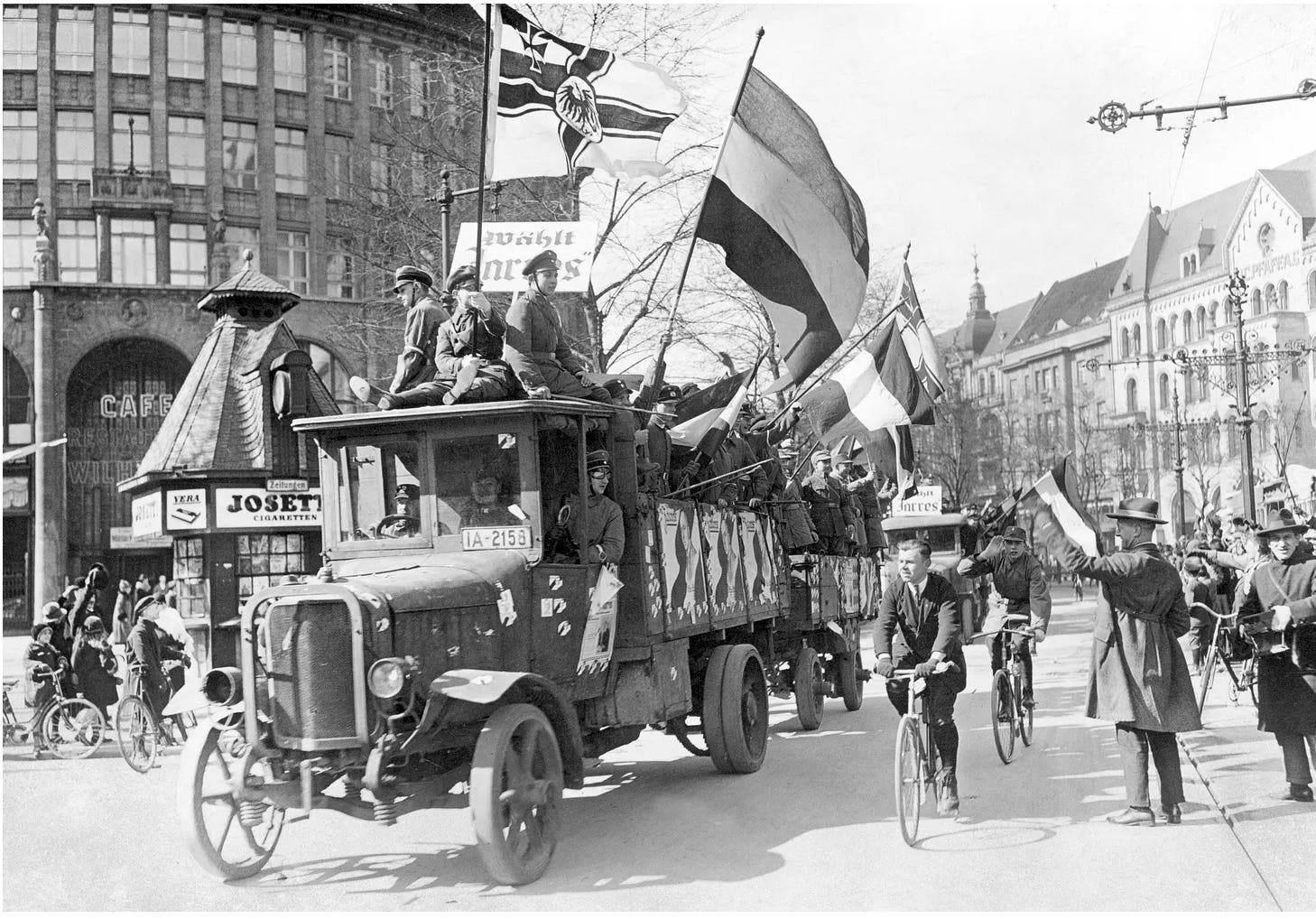
Campaigning for the right wing in 1925: The AfD’s roots go back to Weimar. (Photo: SZ Photo / picture alliance)
Scott: Is it fair to describe the AfD as a Neo Nazi Party? Historians are pretty broadly agreed on the answer to that question. The answer is “yes.” Under German law, the use of Nazi images and slogans is formally banned and even criminalized, which explains why the AfD must claim that it has no factual or intellectual connection to the Nazis. But anyone doing a consequential historical study would come to a different conclusion. Der Spiegel presents a definitive study of the roots of the AfD.
