



Kushner’s Diplomacy Is a Money Machine / Trump Slams His Black-Robed Capos / Another Reform Leader is a Criminal / Destroying the Air (again) / Saudi Prince Searches For New Allies / Russia is an FSB State
Jared Kushner Develops the Art of Diplomacy for Profit
The New Yorker
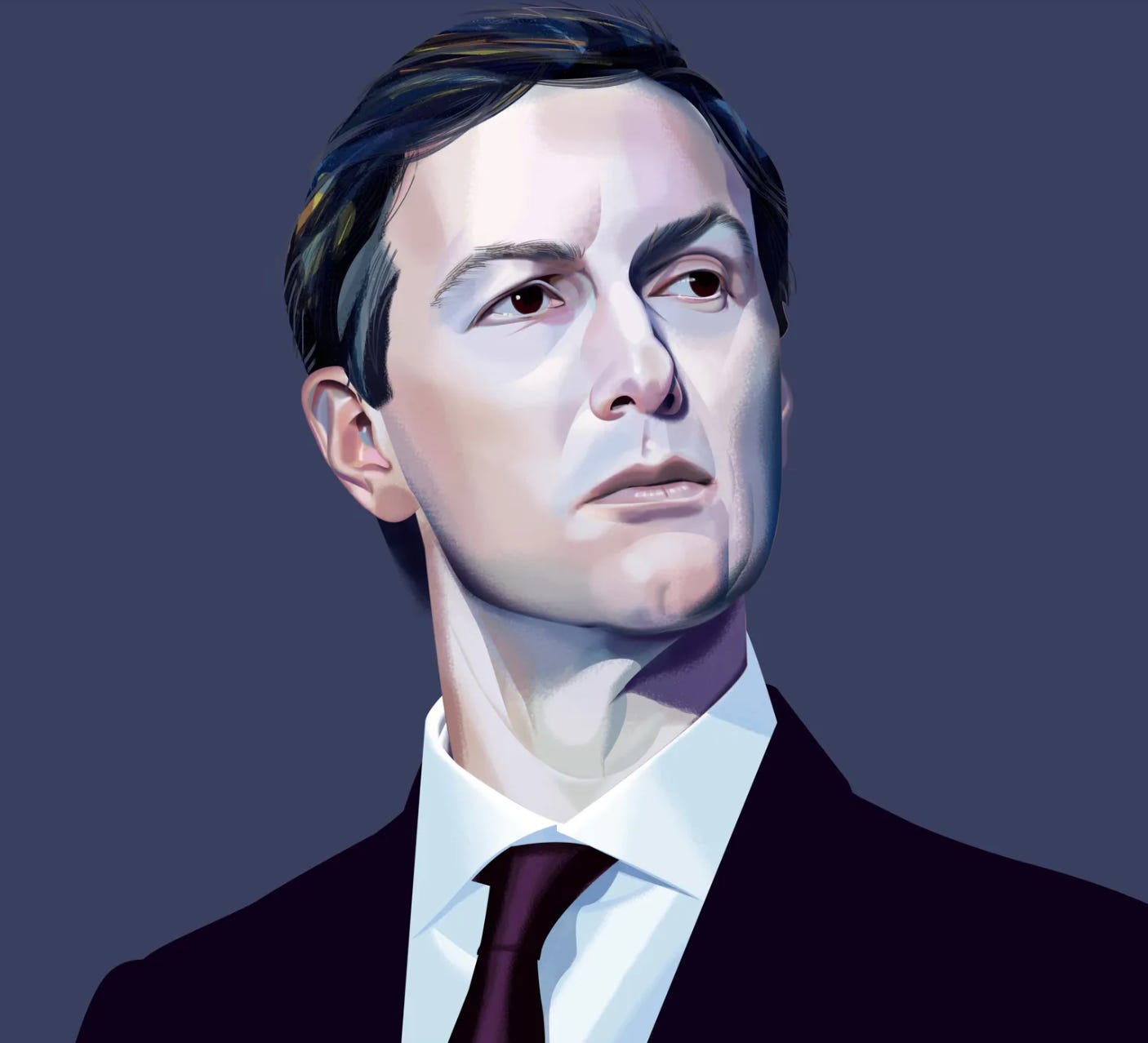
Scott: The New Yorker’s Dexter Filkins has produced the definitive piece on Jared Kushner’s and Steve Witkoff’s diplomacy for private profit—how it works, and what drives it. What we learn is that a subtle understanding of US interests in the Middle East and Europe barely even enters into the picture. Instead there are three major drivers: (1) the interests of Israel, as defined by Benjamin Netanyahu (a “friend of the family,” Jared says, who once even slept in his bedroom); (2) the interests of Saudi Arabia, as articulated by Crown Prince Bone Saw, the man who almost single handedly grew the net worth of the Kushners from a paltry few hundred millions to some six billion, mainly by using the Saudi sovereign wealth fund to stake Jared’s venture capital outfit; and (3) the commercial and financial interests of Jared Kushner, which easily supersede all the others.
We also learn in detail how his counterparts “negotiate” with Jared. They rarely engage in diplomatic talk. Instead, Kushner and Witkoff are deluged with blandishments and highly lucrative business offers in the expectation that thus sated, they will use their power and position to serve as advocates for the side that is bribing them. And Filkins has seen (as have I) copies of transcripts or summaries of WhatsApp conversations—prepared by Estonian, Polish, Danish and German intelligence services and circulated among NATO leadership minus the US—that Kushner and Witkoff have held with Russian interlocutors in which these deals are put on the table and actively entertained.
This is the highest order of corruption, certainly warranting a criminal investigation and potentially, prosecution.
Under Trump, America has no discernible foreign policy, prepared patiently on the basis of a deliberation of American interests, spelled out and advanced through diplomacy and military strategy. Instead, America is a kleptocracy and behaves on the global stage as such. It uses its awesome power ineptly, but consistently to advance the private wealth and power of the Trump dynasty. And Filkins has demonstrated this in the most compelling fashion.
A former diplomat briefed on the talks with Iran told me that, when the Iranian foreign minister, Abbas Araghchi, began offering concessions, the two Americans failed to grasp precisely what was on the table. They sought advice from Rafael Grossi, the head of the International Atomic Energy Agency, but Grossi was attending the talks as a neutral party. A former White House official who worked on the Iranian nuclear issue was aghast at the lack of preparation: “The Iranians come to you with a proposal. What does it actually mean? How much does it actually set them back—two months or two years? What are the work-arounds? For them not to have technical advisers there is just total malpractice.”
At a press conference afterward, Kushner argued that the Iranians were merely stalling. “They were just trying to buy time in order to preserve whatever they could, to get past the term of President Trump,” he said. Another former White House official I spoke to largely shared that assessment. “It was the same old game,” he said. “The Iranian position is: We get a shit ton of sanctions relief, and we do nothing to dismantle our nuclear infrastructure.” But some experts who followed the talks thought that Araghchi’s proposals were made in earnest. Among other things, the Iranians were offering to suspend nuclear enrichment entirely, which they had not done before, and to dilute the enriched uranium that they still retained.
At the press conference, the American negotiators made baffling statements. Witkoff accused the Iranians of using the Tehran Research Reactor, a facility that produces medical isotopes, to illegally enrich and stockpile uranium—even though repeated I.A.E.A. inspections had found no evidence of military use. “You can tell by what Kushner and Witkoff are saying that they don’t understand a lot of the technical issues,” Kelsey Davenport, a nonproliferation expert at the Arms Control Association, in Washington, D.C., told me. A friend of Kushner’s was blunter: “He’s a lovely guy, but he is way the fuck out of his depth.”
The host of the negotiations in Geneva—Oman’s foreign minister, Badr Albusaidi—was so alarmed by the proceedings that he flew to Washington to try to fend off a war. Unable to secure an audience with Trump, he met with Vice-President J. D. Vance, who opposed the conflict. Then, in a highly unusual move for a career diplomat, he appeared on CBS and issued a plea for patience, saying, “The peace deal is within our reach.”...
In the seven months since then, the Trump Administration has become mired in a costly war that seems to offer no easy exit. The U.S. has bombed civilian water supplies and accidentally struck a school for girls, killing more than a hundred children; it has squandered a huge proportion of its stockpiles of advanced missiles, weakening its ability to deter such adversaries as China and Russia. As Iran’s hard-line regime has given way to an even harder-line one, the Administration has effectively ceded control of the Strait of Hormuz, one of the world’s most significant waterways…
Trump’s second term has been marked by a radical diminishment of America’s role in the world—scaling back overseas commitments, insulting the country’s oldest allies, and gutting the diplomatic corps. In place of seasoned ambassadors, Kushner and Witkoff are dispatched to troubled places, rarely staying more than a night or two.
The men bring very different styles to the negotiating table. Witkoff, who made a fortune by buying distressed properties in New York—sometimes scouting seedy neighborhoods by night in a beat-up car—is known as a hands-on bargainer, less interested in the details of a proposal than in the person sitting across from him. “He’s literally a slumlord from the Bronx,” a longtime acquaintance of his told me. “He’s got this pleasant combination of street smarts and charm, a sort of Mediterranean warmth.”
Kushner, by contrast, is precise, detached, bloodless. Even his voice—high-pitched and crisp—can sound aloof. A former senior American official who worked with him on Middle East issues told me that Kushner sometimes seemed uneasy in the Arab world, where many senior leaders are demonstrative and physical. “Jared is not warm and fuzzy in that way, and of course the Arabs like a bit of that,” the former official said. “He didn’t come to hang out. He came to get business done.”...
Some observers suspect that Russia has effectively offered the Americans business deals in exchange for a favorable peace agreement. “This is the generally held view,” the former U.S. official in the region told me. A classified report produced by a European intelligence agency states that Trump and people around him have discussed several potential contracts in Russia. The report is not dated, but the European official who gave it to me said that the details were first discussed sometime after Trump invited Putin to Anchorage, in August, 2025. Twice that year, Kirill Dmitriev, the head of Russia’s sovereign wealth fund, was allowed to enter the U.S., where he talked about investment opportunities. “The privatization of American foreign policy is quite far along,” the official who gave me the report said. (A spokesman for Kushner denied that U.S. officials would profit from the deals under discussion.)
The document lists ten potential ventures, which it says appear to “have been originally designed by the Kremlin’s political and business elites.” They include reopening the Nord Stream 2 pipeline under American control, resuming ExxonMobil’s operations in Sakhalin, and drilling for oil in the Sea of Okhotsk. According to the report, there was discussion of unfreezing Russian assets that are held under American sanctions. The document mentions people who might participate, including Trump, Witkoff, and Kushner. It also names Richard Grenell, the former Presidential envoy, and Gentry Beach, a friend of Donald Trump, Jr.,’s who has secured advantageous contracts in places the Administration is negotiating. (Grenell denied any wrongdoing.) “The deals would be executed the moment Trump delivers a peace deal,” the European official told me…
Witkoff told me that he and Kushner don’t mind navigating tense and uncertain circumstances. “Jared and I both know what we don’t know,” he said. “We’re going to be O.K. not knowing something and then getting curious and getting smart on the issue.” When the two began work on Ukraine, they had very little understanding of the war, a former senior Trump foreign-policy official told me. Both believed that Vladimir Putin was “a good guy,” and that “the Russian Army is invincible,” the former official said, adding, “They think this is a real-estate deal. They don’t seem to understand this is a war.”
Trump Slams His Capos On The Court
Washington Post
Charles: Judging from the volume of Trump’s fury after the Supreme Court blocked him from using the Post Office to steal the midterms, this one-paragraph decision was clearly very important to democracy indeed.
In his usual mobster mode Trump attacked his own Supreme Court Justices like they were capos who had failed to deliver this week’s required tribute.
“These are not the people I interviewed to serve on the United States Supreme Court, they are merely a shell of their original selves,” Trump wrote.
Then he switched to one of his other favorites–projecting judgements about others that apply perfectly to himself:
“The Supreme Court has really let our Country down! It is a Court that will go down as having rendered some of the most destructive, hurtful, and damaging decisions in our Country’s history. …It is a big loss for Republicans, and America itself, and makes cheating by the Radical Left ‘Dumocrats,’ on Mail-In Ballots, a much easier thing to do - And now they have an open field to do so!
Reform’s Wales leader resigns after arrest for criminal assault
The Times
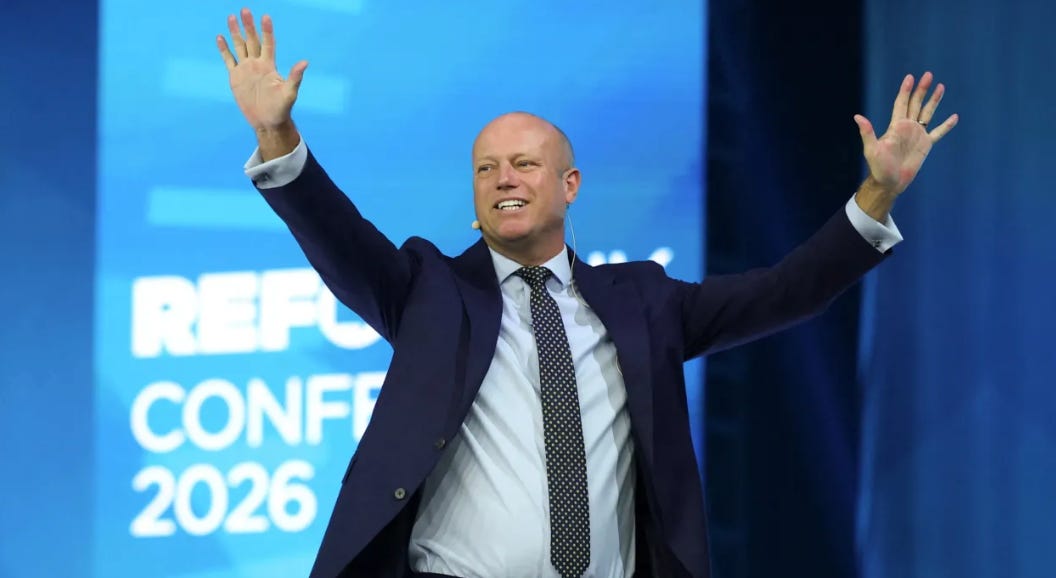
Scott: We’ve read pretty much this same headline several times through the summer. So does this mean all the leadership of Reform UK consists of thugs and crooks? Well, not all. But a very large number, yes. And the same is true for the other Russian-funded “populist” parties—in France, Germany, Austria and Sweden, for instance.
Thomas stood down from his role for “personal reasons” after Gwent police arrested a 45-year-old from Aberbargoed on Sunday.
Dan Thomas, leader of Reform UK Wales, waves with both hands after delivering his speech at the Reform UK’s annual party conference. Reform UK’s leader in Wales has stood down after his arrest over the weekend on suspicion of assault and engaging in coercive behaviour.
Dan Thomas, who was revealed as leader of the party by Nigel Farage in February, said that he was leaving his role “with deep regret” because of “personal reasons”.
He confirmed that he was reported to the police and released without charge.
Thomas said in a statement: “I stress that I have done nothing wrong, but I do not want the coming headlines to be a distraction from the fantastic work our Senedd team is doing in holding this government to account.”
He added: “I will continue to serve my constituents in Casnewydd Islwyn and will fully back whoever the group selects as its next leader.”
Destroy The Air and Poison The Water
Charles: Once again this week America was reeling from the havoc accelerated by man-made climate change, from the decimated beaches of Carlsbad, California to the flooded Post Road and submerged cars of Westport, Connecticut.
Naturally this was the moment Trump chose to begin a complete elimination of Federal regulations limiting carbon dioxide emissions from coal and gas power plants.
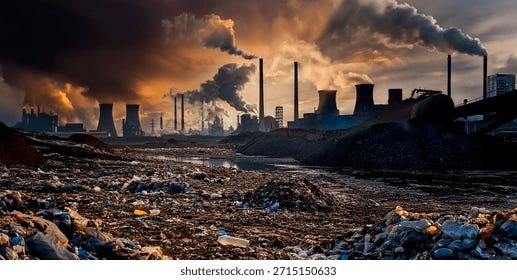
Because AI needs all of your power now!
The limits on power plants now revert to a weaker 2015 standard set under President Barack Obama, although the EPA proposed an additional regulation that when finalized would eliminate all previous greenhouse gas standards for power plants.
That proposal would further solidify the repeal in February of the agency’s “endangerment finding,” which states that climate-related emissions endanger human health. That policy underpinned the vast majority of the federal government’s climate policies.
The regulatory changes announced Monday apply only to greenhouse gas emissions and not to air emissions that are directly harmful for humans to breathe. The EPA has separately sought to weaken controls on toxic air pollution, including mercury and particulate matter.
Saudi Arabia turns to UK for help as Houthi offensive threatens Suez Canal
The Daily Telegraph
Scott: Trump says “no” to Saudi Arabia’s urgent pleas for help as Houthi troops advance, seizing the Red Sea littoral and drones from Iraq take out the vital Saudi East-West pipeline. US ambassador in Jerusalem Mike Huckabee says this is because the US has struck a peace deal with the Houthis, and they are abiding by its terms. So what’s the Saudi crown prince to do? He’s turning to the UK for help.
Yemen’s Iran-backed Houthis and Saudi Arabia have exchanged further strikes, amid signs that Tehran is ramping up the war against Riyadh to compensate for a stalemate in the Strait of Hormuz.
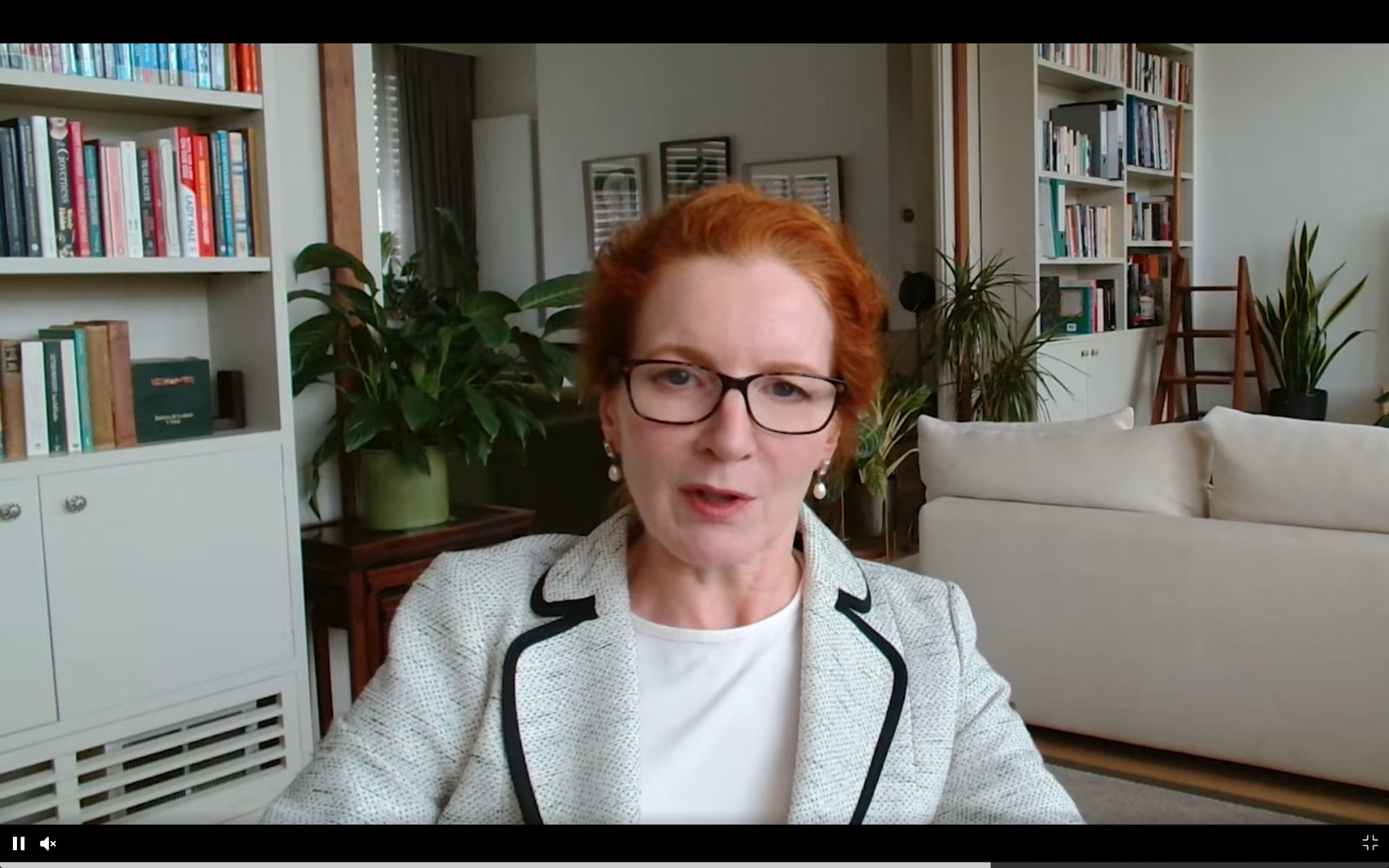
On today’s episode of Iran: The Latest, Venetia Rainey speaks with Arabist and Yemen expert Dr. Elisabeth Kendall (mistress of Girton College) to explain why the Houthis and Iraqi militias are part of a new Iranian Axis of Resistance.
They also discuss how Saudi leader Mohammed Bin Salman (MBS) is facing an existential crisis following devastating pipeline attacks and escalating violence, with missile alerts sounding as far as Jeddah. Following Donald Trump’s refusal to help, Saudi Arabia has called on the UK and Egypt while Iran turns to China. Who will step in?
