



The Emirates Search for a New Relationship with Iran
Financial Times
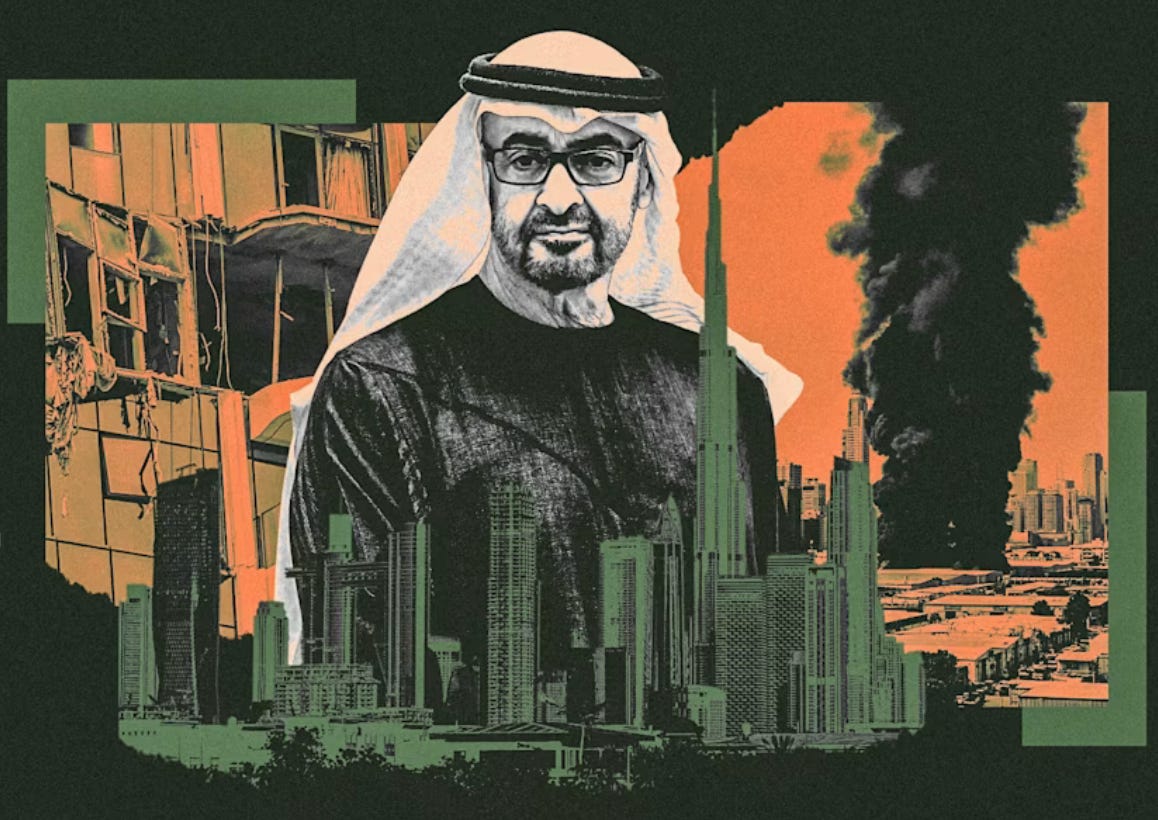
UAE president Sheikh Mohamed bin Zayed al-Nahyan has long prepared for the threat posed by Iran, but the ferocity of the assault on the Gulf states shocked the Emirates. Photo: Rory Griffiths/FT montage/Getty Images
Scott: Five months into the Iran War, rearrangements are occurring in the Gulf world that reflect a frank assessment of outcome. The emerging world is one in which the Gulf Arabs are under stress to find an accommodation with Iran, however they can. This shows a sense both that Iran has won the war for all practical purposes and that the United States has proven a neither very predictable nor reliable ally, though an ally it remains. No Gulf actor has made this assessment more apparent than the Emirates.
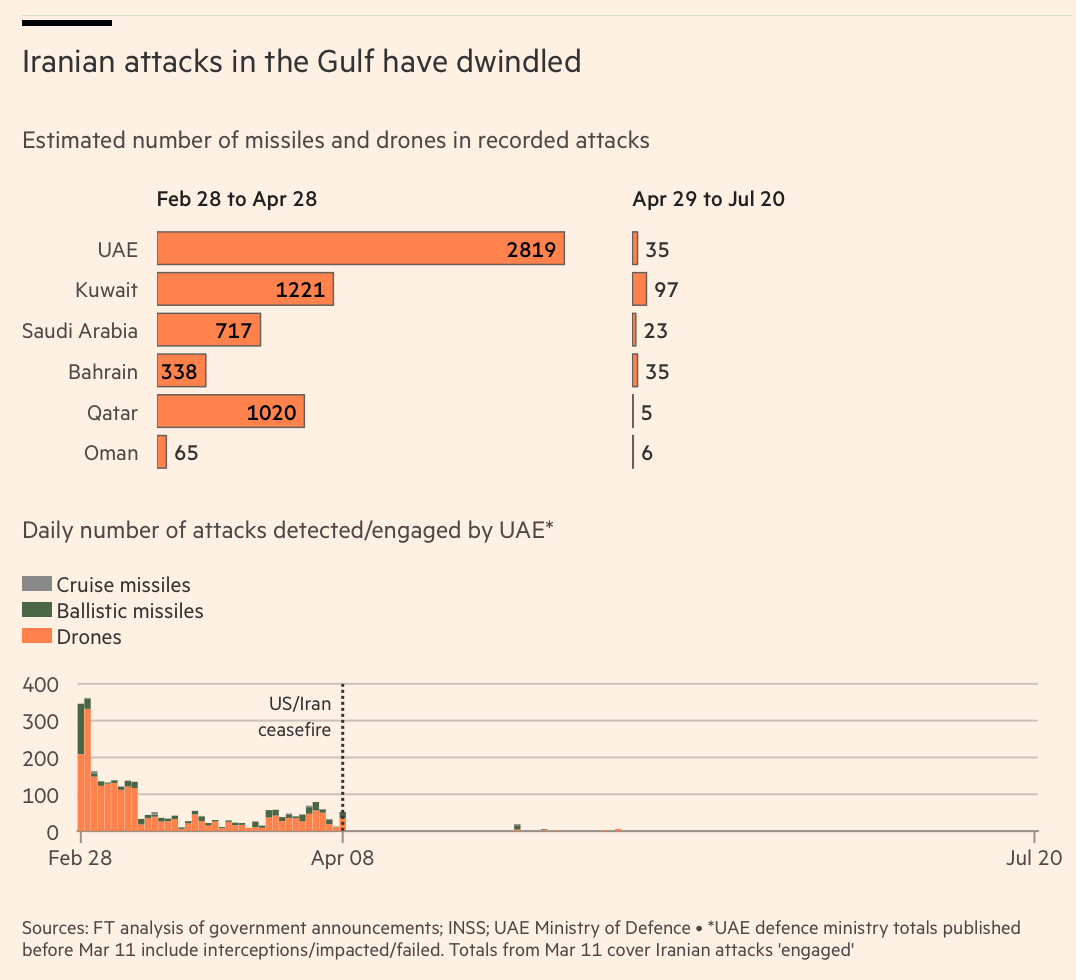
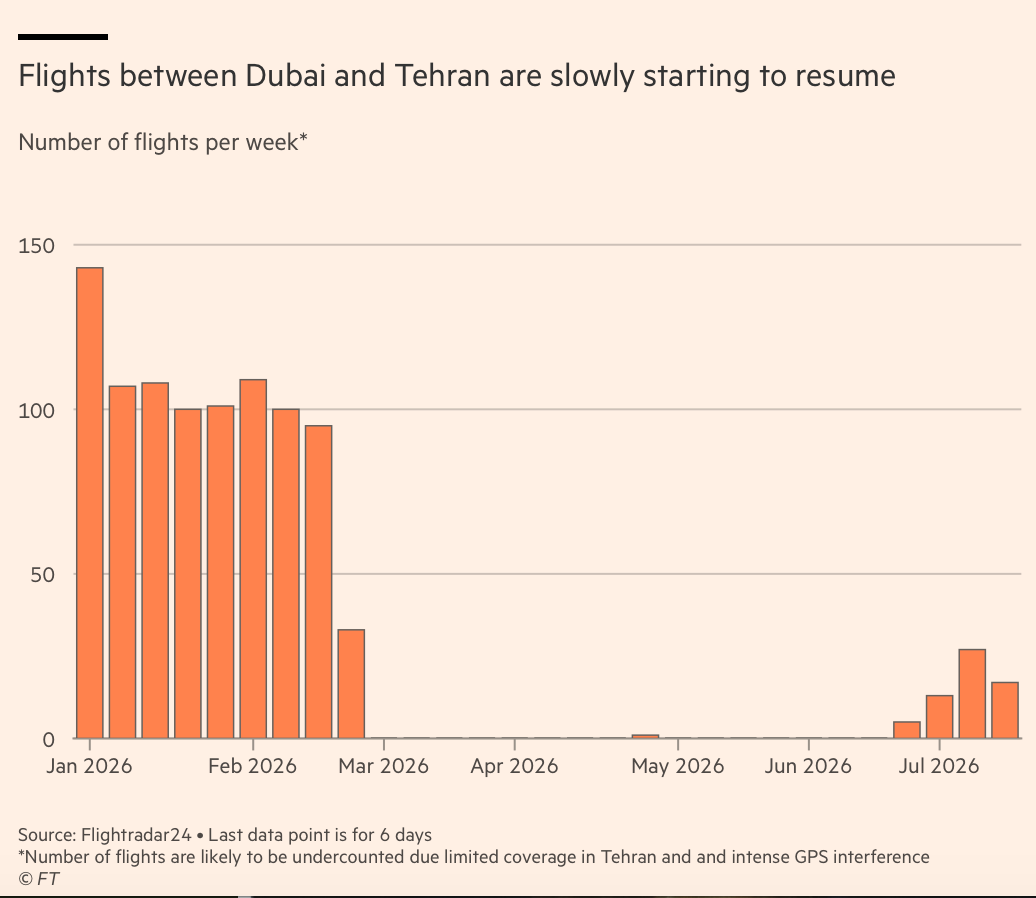
Five months after the threat of Iranian drones emptied Dubai’s financial district, the high-rise offices that are home to thousands of international bankers and asset managers have filled up again. Traditional dhows are once more sailing the Gulf’s turquoise waters to ferry goods to Iran from Dubai ports.
At Dubai’s airport, the first Iranian flights since the US-Israeli war against Tehran have quietly resumed, while Emirati authorities have started to allow the return of some 20,000 Iranians with United Arab Emirates residency who were outside the country when the war began. All are signs of how the UAE and Iran have sought to ease tensions, even as conflict has raged around them, with the UAE seeking to return to a semblance of normality after its biggest crisis since independence in 1971.
As a shaky US-Iran ceasefire has unravelled, the UAE has made a bold gambit: tentatively reactivating diplomatic and economic channels with Iran while doubling down on military ties with Israel and the US. In the first months of the war, the Gulf state bore the brunt of Tehran’s attacks on the US’s Arab allies, with almost 3,000 missile and drone assaults. The UAE responded with scores of its own strikes, taking the most hawkish stance towards Iran among its Gulf neighbours.
But since the US and Iran agreed their brittle truce in April, the UAE has sought to shift from hostility to détente with Tehran…
UAE president Sheikh Mohamed bin Zayed al-Nahyan has delegated the de-escalation with Iran to three of his brothers, say people familiar with the situation.
He has entrusted the delicate mission to Sheikh Mansour, one of the UAE’s vice-presidents; foreign minister Sheikh Abdullah; and national security adviser Sheikh Tahnoon, who is considered among the more pragmatic leaders in Abu Dhabi.
The first signs of rapprochement began with a call between Sheikh Mansour and Mohammad Bagher Ghalibaf, one of Iran’s top wartime civilian leaders and its lead negotiator with Washington, a week after the US-Iran truce. Last month, Sheikh Abdullah held his first call since the war with his Iranian counterpart Abbas Araghchi.
Abdulla, the Emirati academic, says Iran initiated the dialogue.
“Iran came and said ‘let’s talk’, and it would be foolish when your adversary comes to turn them down,” he says. “The second reason [for the de-escalation] is there was a realisation that after all this, war was not going to solve it — it’s not going to end the regime or defeat [Iran’s] Revolutionary Guards.”
The UAE has considered Iran a threat since the 1979 Islamic revolution, and its relationship with Tehran ever since has been a balance between the hawkish stance of Abu Dhabi and commercially oriented Dubai’s longstanding status as a vital hub for Iranian trade.
For two decades, Sheikh Mohamed, known as MBZ, had warned of, and prepared for, the threat posed by Iran’s huge arsenal of drones and missiles. But the UAE was still shocked by the ferocity of the assault.
MBZ privately hoped the war would significantly weaken the Islamic regime and its military capability, diplomats and analysts say. But he and his Gulf counterparts also knew they would have to pick up the pieces if Trump ended the war with the regime weakened but not defeated. The fear was that they would be left to manage a wounded but more bellicose adversary on their doorstep.
“The UAE finds itself in a difficult position: it has very little control over the dynamics that will profoundly affect its security and prosperity,” says Emile Hokayem at the International Institute for Strategic Studies. “They understand that the long-term impact will be significant and are moving fast to reassure investors, traders, operators and others.”...
As the conflict has morphed into a grey area of neither full-blown war nor peace, the buzzword in the UAE is “resilience”. Abu Dhabi wants not only to bolster its military hardware but also to address the vulnerabilities of vital infrastructure. Officials are discussing placing underground both the pipelines for oil that is the source of much of its current wealth and also the data centres that will support its future plans to be a global AI hub.
“Anything that we do that is critical will be protected. It will be protected by air-defence systems,” says the UAE official. “It’ll be protected because we will not depend on a single source, or it will be protected because we’ll have an alternative.”
A Lonely Fight for The First Amendment at West Point
The Washington Post
Charles: This week Washington Post reporter Hannah Natanson published 5,000 words about the lonely fight of the longest serving law professor at West Point to preserve his First Amendment right to give a speech or publish a paper without seeking prior approval from his employer.
Bakken is a civilian professor. At his confirmation hearings, Pete Hegseth, said West Point shouldn’t employ civilian professors, calling them “left-wing” and “woke.” In office, he later told cadets that the academy had “hired professors who advocated for anti-American ideologies right here in these halls. But no more.”
Since Hegseth became Secretary of Defense, every War College has experienced a poisonous new atmosphere, designed to stifle all traditions of academic freedom.
Natanson wrote:
Tim Bakken, speaking to dozens of colleagues at a faculty meeting, argued that none of them should be forced to seek approval before publishing papers or giving speeches, as a policy unveiled that day would require. “This violates the First Amendment,” he said, predicting an end to West Point’s professed tolerance for opposing views.
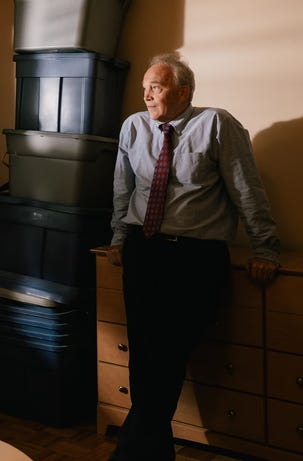
Tim Bakken, West Point’s longest-serving law professor, at home in Nyack, New York. (Paola Chapdelaine/For The Washington Post)
Col. E. John Gregory… didn’t want to hear it. “Stop talking,” Gregory, a deputy department head, said in a raised voice, “and sit down.”
Bakken, a 68-year-old who had never served in the military, did not sit down. He reminded the colonel that he had sworn an oath to uphold the U.S. Constitution when he accepted his teaching job. “It’s like how military officers must not follow illegal orders —” he began to say.
“We’re a military institution,” Gregory interrupted, according to Bakken and the other attendees. “We follow orders.”
President Donald Trump assumed power for the second time with an ambitious agenda to reshape norms and policies across government and throughout the private sector. His administration has moved swiftly to undo diversity initiatives that proliferated in prior years, reshape how U.S. history is taught in museums and parks, and assert a greater federal role in how universities hire and manage their funding.
To the president’s supporters, these efforts represent an overdue reset for liberal policies that had veered out of control. To many other Americans, they amount to ideological, and sometimes unconstitutional, overreach. In little more than 18 months, the administration has drawn a surge of lawsuits alleging violations of civil liberties or other essential freedoms, a Washington Post analysis of hundreds of thousands of court records found.
One of those was filed by Bakken.
He had long argued that a military culture of unquestioning obedience, coupled with an aversion to criticism and a sense of superiority, had caused the U.S. to lose every war it fought since 1945. “Inside America, the last seventy-five years of military intervention have unleashed a flood of incompetence, hubris, and denial,” he wrote in a 2020 book, “The Cost of Loyalty.” “I have been living at the headwaters.”
West Point officials hadn’t liked that book, or much of Bakken’s criticism. But they had never tried to silence him, he said — until Trump’s second presidency, when West Point revised its faculty speech rules.
On May 26, three days after West Point’s graduation, a Federal Judge ruled that Bakken’s case against the Trump administration’s new rules restraining fress speech could proceed. She also temporarily enjoined West Point from enforcing the academic engagement policy for civilian professors, forbidding the university from “prohibiting or restraining” Bakken from “expressing or offering his opinions, beliefs or views to his students” while the case moved forward.
The government could appeal Seibel’s interim ruling. It had until late July to decide. The case could drag on for months regardless, possibly even leading to a trial.
Iran releases video on ‘how to kill Melania Trump’
The Times

The IRGC issues a video with detailed instructions on how to assassinate Melania Trump.
Scott: Immanuel Kant thought that assassinations as a tool either of politics or of warfare were a foolish thing. They degrade the dignity and worth of human beings, and they never—either in the long or short term—lead to a sustainable peace. Time has shown that Kant is right. But in 2026, we’re in an age in which assassination is reached routinely with little discussion, thought, or after action critique. It has been the signature of Netanyahu’s wars in the Middle East. And increasingly, assassination strategies are very personal.
The US attack on Iran commenced with the most effective assassination strike in modern military history, carried out largely by Israeli forces. The Iranian Supreme Leader and his entire family were targeted, and speculation continues to this day that his son and successor was seriously wounded and may even be dead. Iran has responded not with its own assassination strikes, but with a great deal of noise about assassinations… identifying the alternative routes Trump takes from the airport to Mar-a-Lago, to his favorite golf courses, and in and around Washington… just in case someone might want to take a shot. And now specific videos have been issued targeting Melania and Barron, as well. This is laying the foundation for endless war.
They include both President Trump and his wife’s Secret Service callsigns and various luxury stores in Manhattan where she is known to shop — including Bergdorf Goodman and Saks Fifth Avenue. “Melania’s obsession with fashion has become her biggest weakness,” the text says, giving viewers advice on “the advanced signs indicating Melania will visit these centres”, such as public bins missing from street corners and manholes being welded shut.
The video, much of which appears AI-generated, goes on to list various methods by which someone could go about assassinating Melania Trump, such as advising staff at the luxury stores to “poison the clothes” with the nerve agent VX and offering “large sums of money” to “tempt” three of her named stylists.
It also gives the location of a nearby hospital, suggesting that “knowing the staff at these hospitals or being employed by them can provide you information about Melania’s presence”.
The White House and the first lady’s office were contacted for comment. The video comes soon after billboards featuring threats against the first family were erected around Tehran.
One shows images of Melania Trump, Barron Trump and Ivanka Trump, the president’s daughter, with their eyes edited shut and the word “KILLED” labelled over them. “Hey, terrorist! Get ready to die,” the billboard said.
Another, which was accompanied by the words “blood for blood”, demanded the death of Trump, his wife and all his children.
The US and Israel have foiled several attempts by Iranian agents to assassinate Trump. Iran has long vowed to retaliate against Trump for the assassination of Qasem Soleimani, a top general in the Islamic Revolutionary Guard Corps, in the president’s first term — and the killing of Ali Khamenei, Iran’s former supreme leader, in February.
In the latest known attempt, Israel shared intelligence with Washington in July indicating a fresh Iranian assassination plot to kill the president, the Wall Street Journal reported.
