



How Trump’s Tariffs Destroyed America’s Agricultural Primacy
Financial Times

Scott: Trump secured his electoral victory in 2024 with the support of America’s farm belt. But eighteen months into Trump’s second term, it is clear that Trump’s trade policies, and particularly his capricious imposition of tariffs against major US trading partners, have destroyed the leading position that America has enjoyed since the end of World War II as a purveyor of agricultural goods. But this has produced remarkably little appreciation in the American Great Plains, where few seem to understand the direct causal connections in play. In a feature essay, the Financial Times studies how Trump’s trade policy has affected the once privileged position of American agriculture around the world.
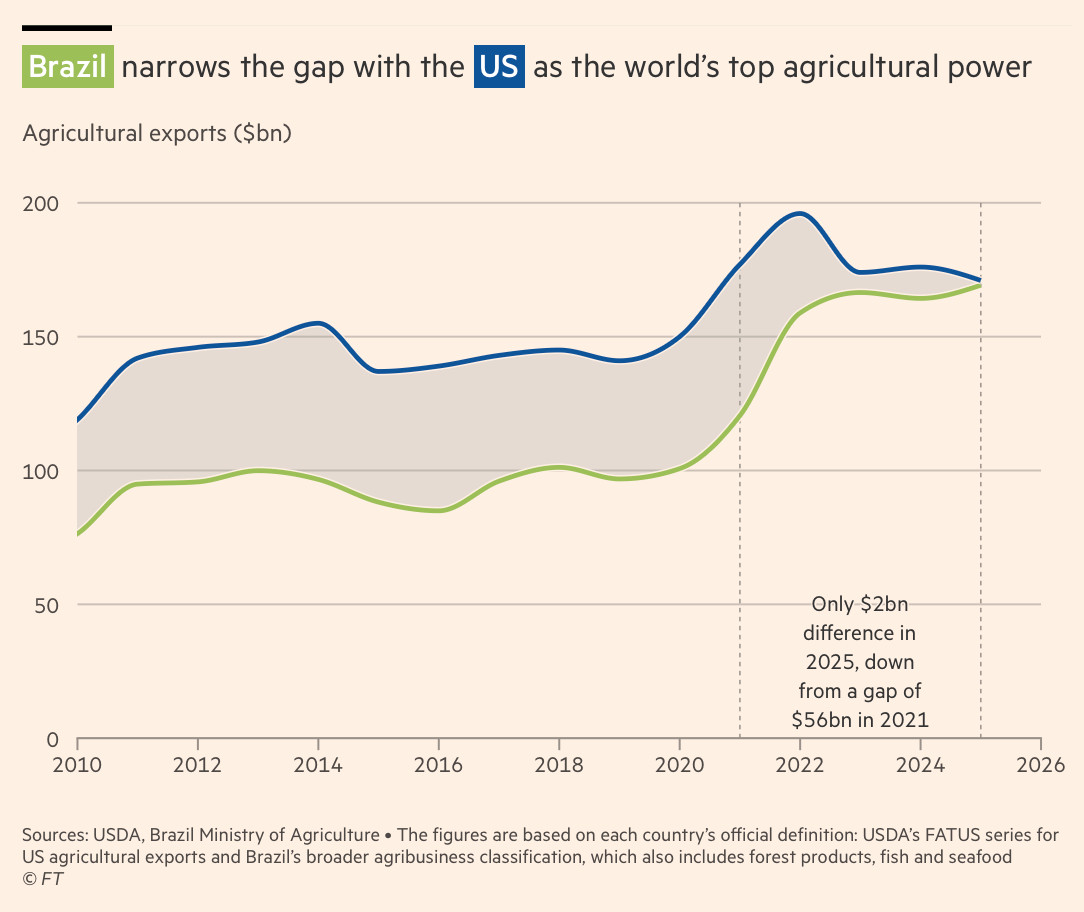
After more than a century the US is on the verge of losing its place as the world’s leading agricultural exporter.
Last year, the US exported $171bn of agricultural goods according to the Department of Agriculture, just $2bn more than the export total claimed by Brazil, which many analysts say has benefited from trade disruption set in train by President Donald Trump’s tariffs.
With US exports falling and Brazil’s rising — they increased 6 per cent in the first half of this year to hit a new record of $87bn — 2026 could prove the year in which America loses its agricultural ascendancy.
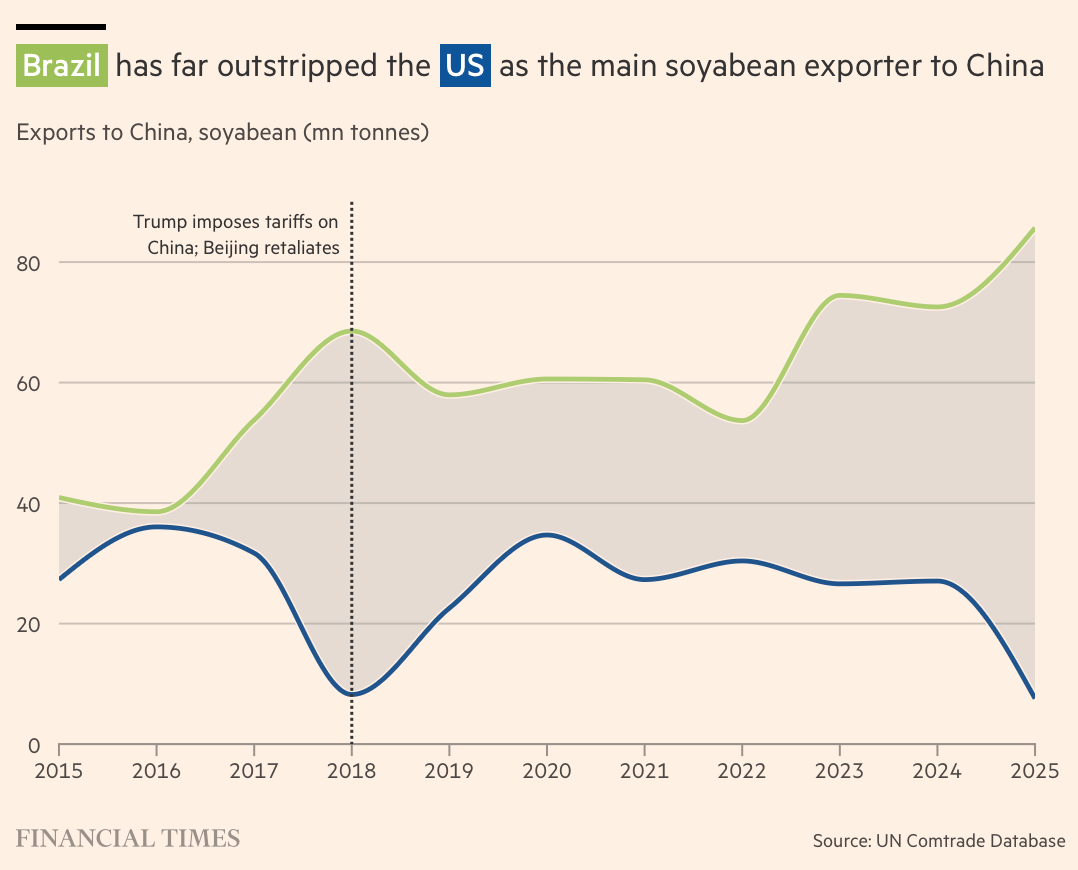
Brazil is already the world’s largest producer of soyabeans, beef and poultry and has also displaced the US as the top exporter of cotton, partly because of China switching purchases from one to the other.
This transfer of power is not only reshaping the agricultural sector in each country, with altered supply chains and investment patterns, it also has wider social and political repercussions.
America remains capable of producing extraordinary harvests but, increasingly on larger farms, for weaker returns and with greater dependence on government support. In Brazil, the growth of farming has created boom towns and transport and infrastructure bottlenecks, while fuelling environmental concerns.
US farmers may soon have to contend with being number two. “We’re no longer the world supplier of soyabeans; we’re the residual supplier of soyabeans,” Goodhue says. “[Customers] come here when Brazil runs out or Brazil has a problem . . . instead of the other way around.”
When China Looked Elsewhere, Brazil Gained the Upper Hand
Over the course of the 20th century, the US turned its fertile land, mechanised farms and dense network of elevators, railways, barges and ports into a tool of global trade dominance.
The system allowed the US to produce more grain than it could consume and move the surplus cheaply overseas.
China became the customer that made that system pay. As its population grew wealthier and ate more meat, the country’s livestock industry required enormous quantities of soya meal.
American farmers planted more beans and invested in machinery, storage and export terminals on the assumption that Chinese purchases would continue to rise.
That relationship fractured in 2018, when Trump imposed tariffs on hundreds of billions of dollars of Chinese goods. Beijing retaliated against products grown in states that had helped elect him, and purchases of American soyabeans collapsed.
“At a whim, our trade agreements are being altered, and all that hard work that has gone to build these relationships, to work in good faith, to try to work through problems, can be erased overnight,” says Aaron Lehman, president of the Iowa Farmers Union…
The political consequences are harder to measure in Iowa, a Republican-leaning state that plays a pivotal early role in the presidential nomination process.
Most farmers in Iowa supported Trump. They are also not necessarily opposed to tariffs. Lehman says many would accept a period of pain if it were part of a clear strategy to challenge unfair competition and build better markets. But he says that in Trump’s second term “we’re in a much worse situation on trade issues.” According to Johnson, many farmers initially assumed Trump’s disruption would eventually produce something better.
“Well, they must have done it for a reason,” she recalls people saying. “But the horizon keeps coming, and we are not seeing a lot of hope,” she added. “I don’t think politically you want farmers’ hope to dwindle in the Midwest.”
How SCOTUS Has Cratered Democracy Itself
Charles: Slate’s invaluable Mark Joseph Stern highlights a scathing assessment of the conservative majority on the US Supreme from Hawaii Supreme Court Justice Todd Eddins: how “One Judge Has the Guts to Put the Horror of This Supreme Court Term in Context.”
Eddins has often described the “horrors and treachery” of the six Republican Supreme Court Justices. But his latest opinion overturning a conviction based on false forensic evidence is particularly valuable because it “weaves together various threads from this term (and those preceding it) to show the entire web of ultrapartisan judicial policymaking in which the nation is now ensnared. This larger project can disappear from view when the court inundates us with so many radical rulings at once that they do not register as parts of a single scheme…State judiciaries harbor considerable authority to expand individual liberties and democratic guarantees beyond what SCOTUS requires. Far too many shrink from the task. Hawaii’s will not.”
Eddins was especially powerful about SCOTUS’s evisceration of civil rights laws and its catastrophic expansion of presidential power.
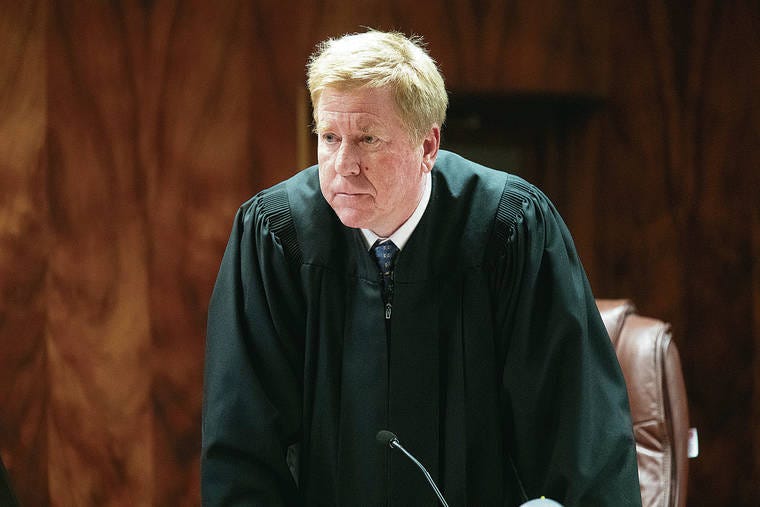
Hawaii Supreme Court Justice Todd Edins
The Hawaii Constitution “takes no instruction” from “hubristic originalists” who are “driven by agenda and intent on swiping power that belongs to the people.” A Supreme Court “that systematically dismantles democratic safeguards, steamrolls constitutional liberties, and tramples human dignitydoes not chart the course for the Hawaiʻi Constitution.
What this court has done to constitutional rights, democratic institutions, and the rule of law explains why Hawaiʻi’s Constitution takes no instruction from it..
The Hawaiʻi judiciary takes “no guidance on the meaning of due process from a court that gutted due process protections in Dobbs” by erasing a “generations-long constitutional right, stripping autonomy from half the population, and empowering states to force birth.” It “does not import that results-driven approach to due process. We follow principles, not agendas.” And so it “does not anchor Hawaiʻi’s due process rights to the federal floor. Especially one that keeps sinking
But “the Supreme Court’s imperious ideology,” Eddins continued, “does not stop at due process. The same jurisprudence has cratered democracy itself,” a process that accelerated over the term that just ended. Its “judicial demolition” of the Voting Rights Act culminated in Louisiana v. Callais, which “buried what remained of the crown jewel of the civil rights movement. Pretend law for a real statute.” The supermajority “then ditched its own thirty-two day default for releasing decisions and hustled out its judgment mid-primary, a favor granted over objection only twice in twenty-five years.” Just weeks later, “on its shadow docket, the court tossed an eleven-day trial record built on fifty-one witnesses, 790 exhibits, 2,600 pages of testimony, and a 270-page opinion by a three-judge court.” In the process, “it resurrected a tainted congressional map the three-judge factfinders found deliberately entrenched racial bias against Black voters.”
The Roberts court “sees only white. It refuses to acknowledge who the Equal Protection Clause was written to protect. The freed people, their descendants, and all others denied equal citizenship. It turns its back on what is in plain sight. The Fourteenth Amendment is not colorblind. It never was.
The court calls the Constitution colorblind while engineering the dilution of Black votes, the unraveling of hard-fought civil rights remedies, and the erasure of Black history. That is not blindness. That is white sight, by design. A Constitution interpreted this way is not colorblind. It is whatever the court needs it to be. A way to advance its partisan project.
This damage to democracy extends beyond the Voting Rights Act.” In upholding Donald Trump’s mass expulsion of Haitian immigrants, the court looked at “naked racism” and saw “none of it.” In gutting a federal religious liberty law, the court “forged the Spending Clause to reduce some of Congress’s greatest legislative achievements.” Days later, in Trump v. Slaughter, it used “a cherry-picked slice of history” to let Trump “fire at will” executive officials who are shielded from removal: “a century of settled practice recast as a mistake, competent governance sacrificed to the partisan cause.” Then, in the birthright citizenship case, “fair-weather textualists—living constitution originalists, really—deserted the text and our nation’s history the moment it promised citizenship, one vote from writing that right out of the Constitution.
Scott Horton With NPR’s Ian Masters on the FBI’s Village Idiot: Kash Patel
FBI Director Kash Patel will be going to Moscow in October just ahead of the elections as a guest of Putin’s FSB, the murderous the successor to the KGB. Listen here to THKR’s very own Scott Horton discussing with Ian Masters Russia’s penetration of U.S. industry, science and hi tech innovation as Trump’s buddies Putin and Xi provide Iran with targeting information to strike our military and intelligence assets in the Gulf killing U.S. service members.
Biden Knowingly Enabled Ethnic Cleansing in Gaza and the West Bank, and His Key Advisors Think He Could Have Stopped It
The New Yorker
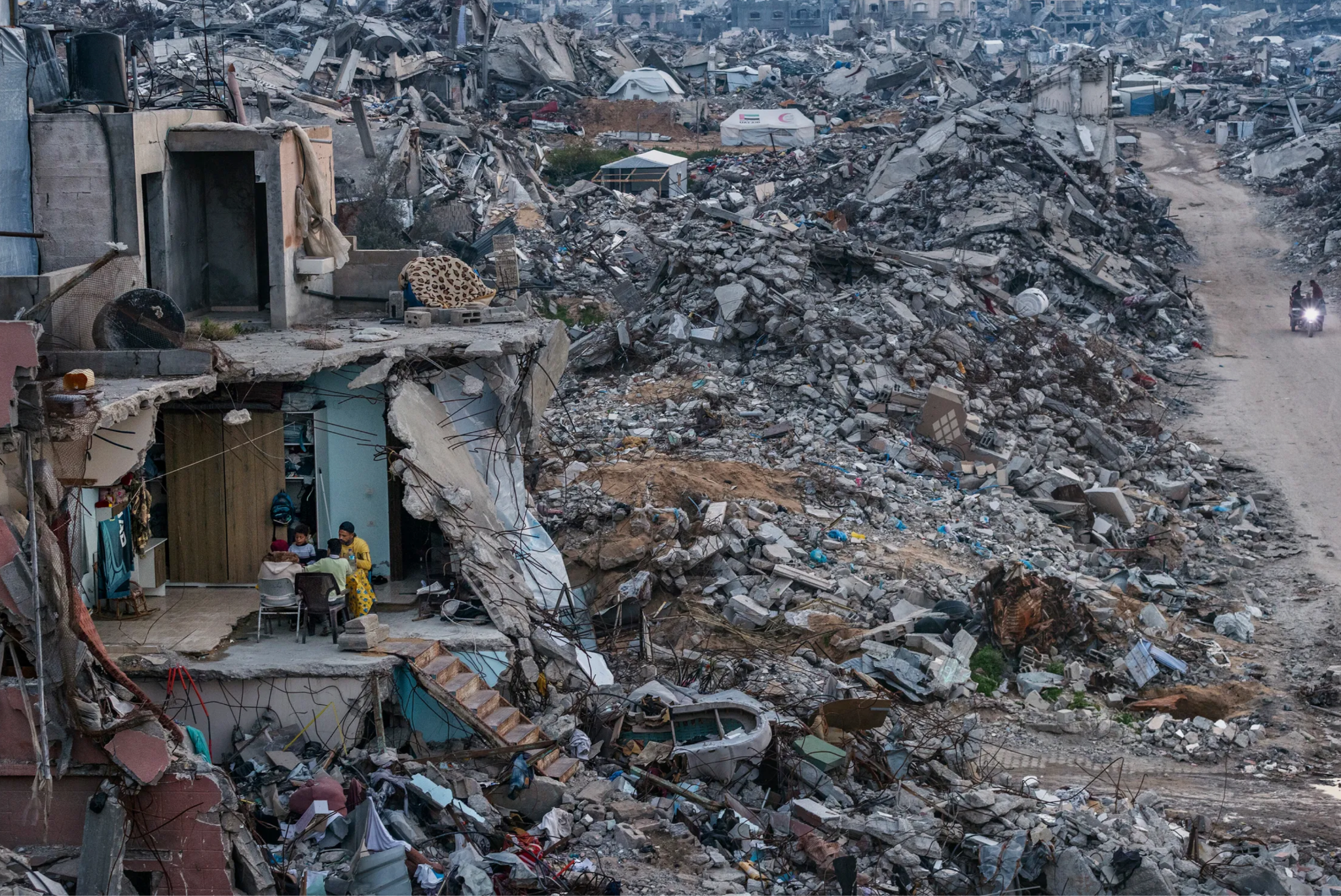
Photograph by Saher Alghorra / NYT
Scott: As the World Court genocide case against Israel grinds on, a major question relates to the potential liability of Israel’s enablers, and particularly the United States, in the event of a verdict against Israel. Today prosecutors have been handed a very powerful piece of evidence to use against the US in the form of a fascinating New Yorker article by David Kirkpatrick exploring the reactions and thoughts of senior advisors to Joe Biden as the Israeli operations in Gaza and the West Bank unfolded. The key points that emerge: (1) recognition that US arms and assistance were indispensable to performance of the Israeli operations; (2) recognition that Israel was looking at mass population displacement as a policy objective and pursuing specific techniques to achieve it (such as destruction of water supplies, residential buildings, public buildings and repeated demands that people move out of target areas); (3) acceptance that the US could have intervened to stop move of this conduct which constitutes ethnic cleansing or genocide, and opted not to do so. Eliciting all this information and presenting it in such a cogent form is the hallmark of superlative journalism, and it’s what Kirkpatrick is known for.
On March 5, 2024, five months into the war in Gaza, Mirjana Spoljaric, the president of the International Committee of the Red Cross, sent a confidential letter to President Joe Biden. Under the Geneva Conventions, the Red Cross holds a unique responsibility to counsel states about avoiding war crimes. In the letter, which I obtained from a former United States official, Spoljaric reminded Biden that the organization had condemned the “horrific” October 7th massacre of Israelis by Hamas, and remained “relentless” in pressing the group to release the hostages it had taken. But she was now appealing to Biden “with profound alarm” because Israel, which had been pummelling Gaza with heavy munitions since October, was ignoring the Red Cross as never before. “The way the hostilities are being conducted by Israel is incompatible” with the laws of armed conflict, she wrote, “particularly the obligations to protect civilians and distinguish between military targets and civilians or civilian infrastructure, to ensure dignified treatment of detainees and the dead, to protect medical installations and personnel, and to provide and enable access of humanitarian aid.”
Allowing the Red Cross to visit detainees during a war or an occupation is one of the brightest lines established by the Geneva Conventions. Yet, after October 7th, Israel, for perhaps the first time in its history, fully blocked the organization’s access to Palestinian detainees from Gaza and the West Bank, putting it in the company of pariah states such as North Korea and Eritrea; even the warring factions in Yemen allowed Red Cross visits. Spoljaric noted that humanitarian groups and journalists had reported a “massive surge” in the number of Palestinians in Israeli prisons. At least a thousand had been released back into Gaza, and many of them gave accounts of torture, even though the Israeli military had concluded that they were not Hamas fighters. The Times reported that one released detainee, a law student named Fadi Bakr, described being beaten so severely that his genitals turned blue and blood still appeared in his urine weeks later. He said that Israeli guards had played music so loudly that one of his ears bled. (An Israeli military spokesman told the Times that the captors followed “Israeli and international law” and played music at a “low volume,” to prevent detainees from coördinating.) But the Red Cross couldn’t address such allegations: Spoljaric said that Israel had suspended all “legal-operational dialogue.”
To try to influence Hamas to release hostages, Spoljaric had appealed to Qatar and other patrons of the group; she now implored Biden to “bring about an immediate change” in Israel’s conduct. An appendix to the letter cited U.S. laws and Administration policies that prohibited the transferring of weapons likely to be used in war crimes, and Spoljaric urged Biden to withhold weapons “that should not be used in densely populated areas, in light of their devastating humanitarian impacts.” She warned Biden that failing to “uphold minimum standards of humanity” would be a “moral defeat” that “future generations are unlikely to forgive us for failing to avert…”
The Biden Administration’s staunch public backing of Israel during the Gaza war had created what Philip Gordon, the national-security adviser to Vice-President Kamala Harris, described to me as a “moral hazard”—it had invited the Israeli Prime Minister, Benjamin Netanyahu, to try to expand the battle into a regional one. Even though Biden and his advisers privately told Netanyahu many times not to provoke Iran, the Israelis repeatedly blindsided the Americans by doing exactly that: a January, 2024, strike on Damascus killed five senior Iranian military advisers; an April, 2024, strike on an Iranian diplomatic mission in Syria killed more than a dozen; a July, 2024, strike in Tehran assassinated a top Hamas political leader; a September, 2024, operation in Lebanon detonated explosives planted in thousands of walkie-talkies and pagers carried by Hezbollah fighters; a subsequent air strike killed Hezbollah’s leader, Hassan Nasrallah.
The Israelis gave U.S. officials no meaningful warning in advance of these attacks, and, in what a former White House official called a “humiliation” of Biden, Netanyahu ordered the Nasrallah assassination just two days after the U.S., France, and several other allies called for Israel and Hezbollah to observe a three-week ceasefire. Yet the White House never publicly criticized Israel for acting unilaterally—and each time one of these actions triggered a clash the U.S. felt compelled to defend Israel. In April and October of 2024, the U.S. helped fend off Iranian counterstrikes so effectively that Israel suffered little harm. After the second round, Biden sent Israel about a hundred U.S. service members and a missile-defense system.
Some Biden advisers privately lamented the fact that U.S. protection was unintentionally encouraging Netanyahu’s brinkmanship. Gordon told me, “We could advise them very firmly—and Biden did that with Bibi repeatedly—‘Goddammit, take the win and don’t drag us into a further war.’ But the Israelis knew we were going to defend them.” Lloyd Austin, Biden’s Secretary of Defense, reportedly likened Netanyahu to a gambler “playing with house money…”
Jake Sullivan, Biden’s former national-security adviser, told me that Biden and his advisers had often privately debated ways to restrain Israel. Inside the Oval Office, Sullivan said, “we repeatedly raised and discussed options for withholding weapons,” but, excluding the suspension of one shipment of bombs, “the President always deferred on that decision, because we kept thinking that we were close to getting a deal” for a hostage release and a ceasefire. Sullivan said, “When you look back at it in the cold light of day, the trap in that kind of thinking is easier to recognize.” He added, “I will say straightforwardly—we should have put more pressure on Israel to take a different approach.”
Details of Criminal Charges Against the Tate Brothers Released: Will Trump Block Their Extradition?
The Times
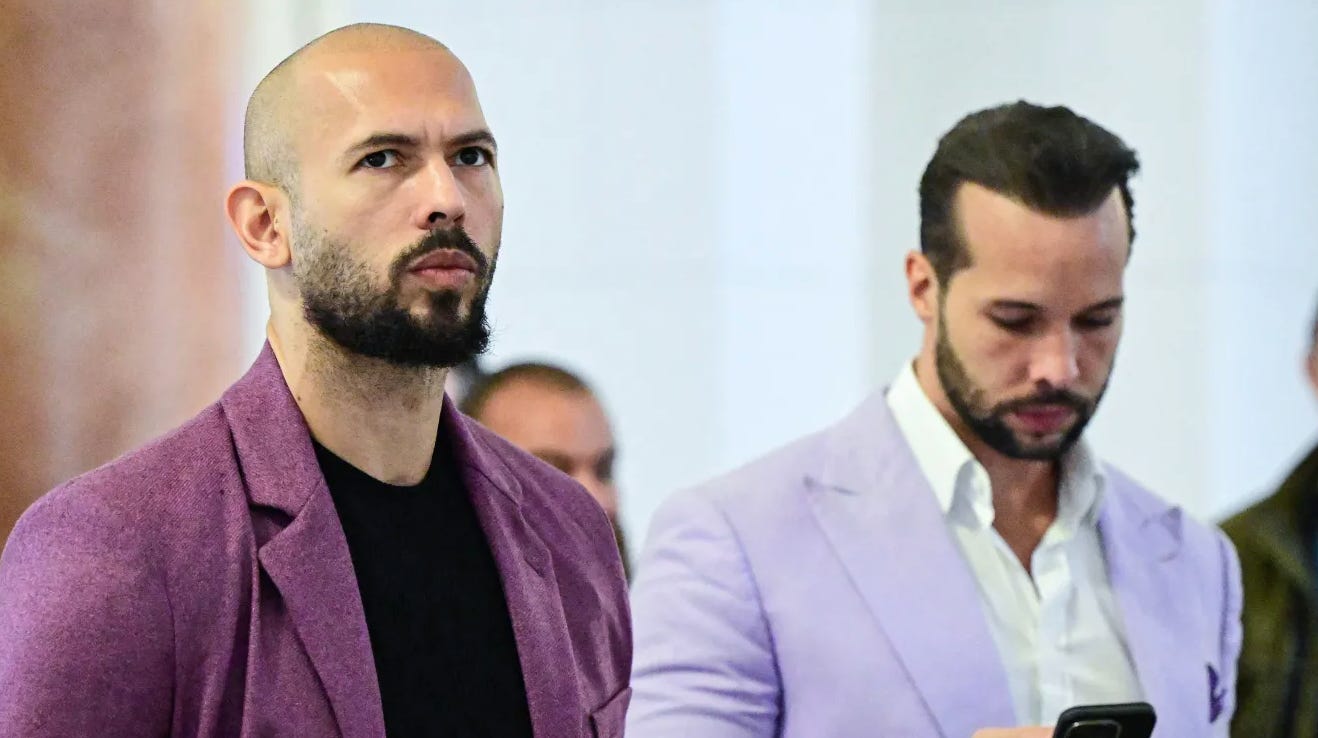
Andrew and Tristan Tate during a court appearance in Romania in 2024. JD Vance and US diplomats intervened to secure the Tates’ release from custody in Romania on Trump’s authority.
Scott: The Crown Prosecution Service is seeking to extradite the Tate brothers, who are firmly established as insiders of the Trump family entourage, on charges of rape, sexual trafficking and assault. They received bizarrely friendly treatment from the US Marshal’s Service, which allowed Andrew Tate to hand off his smartphone so it would not be seized. And now the question hovering over their case is a simple one: will Trump intervene to stop their extradition? They are after all not accused of anything that Trump hasn’t himself credibly been accused of doing.
The Tate brothers choked women to the point of unconsciousness before raping them, prosecutors in Britain allege in newly released court documents.
According to federal court complaints unsealed in the US on Monday night, Andrew Tate placed one woman in chokeholds until she passed out, then raped her, during an alleged attack at her home in 2015.
Another woman alleged she had consensual sex with Andrew Tate in 2014 after meeting on a dating app. During a later encounter, he visited her home in Manchester and choked her during intercourse.
The unsealed complaint against Tristan Tate alleged that he choked, beat and raped a woman between 2012 and 2013. She told the authorities that he regularly choked her to unconsciousness and whipped her with a belt on multiple occasions.
The brothers, who deny all allegations against them, appeared in court in Miami on Monday as they prepared to contest their extradition to the UK.
Trump seeks to block Ed Miliband’s appointment as foreign secretary
The Independent
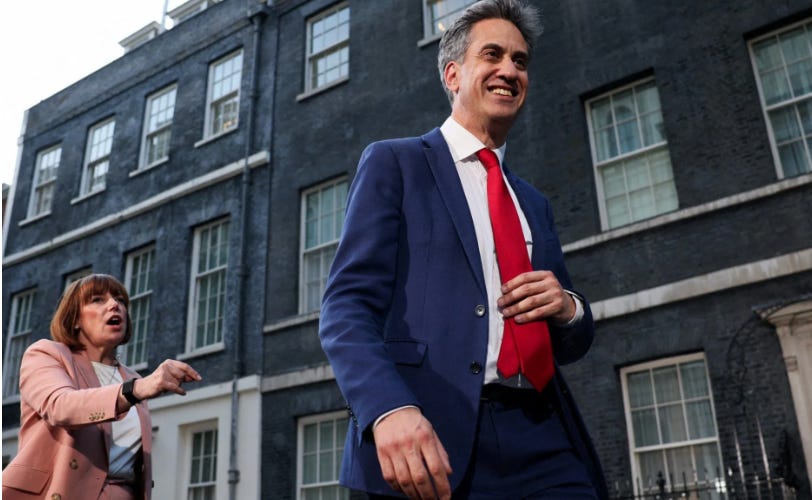
Scott: Donald Trump has reacted with furor at Andy Burnham’s selection of Ed Miliband to be the new British foreign secretary.
The White House is “deeply concerned” about Ed Miliband’s appointment as foreign secretary, with a warning that Donald Trump has not forgotten scathing remarks the former Labour leader has made about him in the past.
New prime minister Andy Burnham has been cautioned that Mr Miliband has some “serious diplomatic repair to undertake” in the US, after his promotion to the role on Monday sparked anger from the Trump administration.
The former energy secretary has previously clashed with Mr Trump over net zero and his attitudes to democracy and in 2016 he described the president as “a racist, misogynistic, self-confessed groper”.
French Parliament Adopts an Internet Ban for Juveniles of 15 and Younger
Le Monde

Scott: In a move fiercely contested by the tech bros, the French parliament has now adopted legislation designed to keep adolescents of 15 and younger off social media accounts. The move was propelled by a decision by Elon Musk to flood his social media platform X with AI-generated child pornography, and enjoyed broad support across the political spectrum.
Members of Parliament and senators have finally managed to reach an agreement. On Tuesday, July 21, both chambers approved the proposed law banning social media for those under 15 years old—by 243 votes in favor to 2 against in the Senate, then by 279 votes in favor and 81 against in the National Assembly. The timeline is tight, as the President of the Republic, Emmanuel Macron, who has been heavily involved in this issue, wants the measure to take effect as early as the start of the school year in September. “France is leading the way in Europe by being the first country to establish a digital age of majority to better protect our children online,” said the Minister for Digital Affairs, Anne Le Hénanff, before the senators shortly before their vote.
The lawmakers returned to a version of the text close to the one originally drafted by Marne MP Laure Miller (Renaissance) and adopted by the National Assembly in January. Senators had amended it by advocating the creation of a list of social media platforms deemed “harmful” to teenagers, which would be prohibited to them, while other platforms would remain accessible with parental consent. This version, adopted in March, was then reviewed by the European Commission, which requested that it be revised to fully comply with European law.
Psyche Approaches Mars

This composite of images taken by NASA’s Psyche mission shows the crescent of Mars growing as the spacecraft approached the planet for a gravity assist from May 2 to May 15, 2026. Because Psyche approached Mars from a high phase angle, the planet appeared as a thin crescent in the days running up to the close approach, lit by sunlight reflecting off its surface.
NASA/JPL-Caltech/ASU
This composite photo released on July 17, 2026, shows the crescent of Mars growing as NASA’s Psyche spacecraft approached the planet for a gravity assist.
Psyche flew by Mars on May 15, 2026, using the planet’s gravity to gain speed and slightly tilt its trajectory. The flyby also gave the team an opportunity to prep for the science they will be conducting when they reach the metal-rich asteroid Psyche in 2029.
Watch a timelapse of the encounter.
Your Online Moment of Zen
The Beatles’s film Help! is often derided as an inferior successor to the epic A Hard Day’s Night. But it still had a superb soundtrack. It was the first pop LP I ever bought from the record store on Gloucester Road in Kensington when I was a student at the American School In London. Best Beatles trivia: the movie’s original title was “Eight Arms to Hold You,’ until John Lennon penned what became its title song.
You’re Going to Lose That Girl was one of those tunes I played over and over again on my Garrard Lab 80 turntable.

<iframe width=”560” height=”315” src=”
title=”YouTube video player” frameborder=”0” allow=”accelerometer; autoplay; clipboard-write; encrypted-media; gyroscope; picture-in-picture; web-share” referrerpolicy=”strict-origin-when-cross-origin” allowfullscreen></iframe>