



A Heroic Israeli Attorney General / A Political Pope Who Hates Fascism / ICE Arrests are Quieter but Rampant / Newly Discovered Radio Signals Probably Aren’t From ET / Japan Converts Golf Courses Into Solar Farms
An Indomitable Attorney General Fights For Israeli Democracy
New York Times
Charles: David M. Halbfinger and Natan Odenheimer have written a superb profile of Israeli Attorney General Gali Baharav-Miara, giving us the kind of piece that reminds us why the Times at its best is still the most important newspaper in the world.
Bahara-Miara was appointed to a six-year term just before Benjamin Netanyahu began his latest stint as prime minister at the end of 2022. Since then she has defied his attempt to fire her and “almost single-handedly defeated many of the government’s efforts to undercut the Supreme Court, crack down on the news media and free itself of some of the biggest checks on its own power.”
The polar opposite of her appalling American counterpart, Todd Blanche, Baharav-Miara is exactly what America is most lacking right now: a fierce advocate for the rule of law with the ability to reign in some of the worst excesses of the current government.
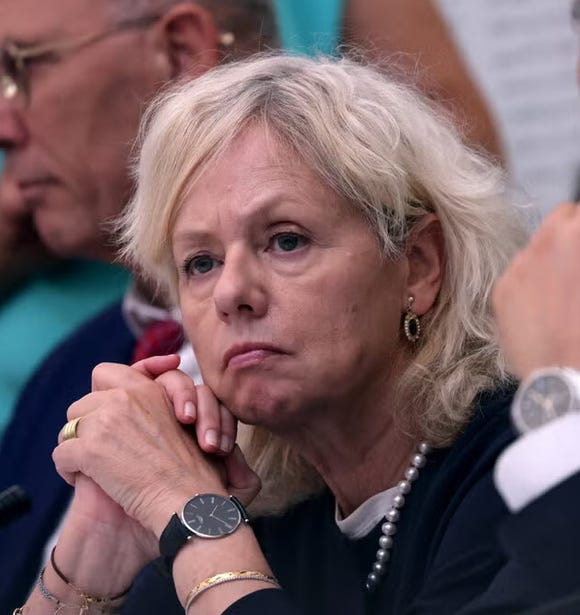
Gali Baharav-Miara, Israel’s attorney general, at a cabinet meeting in Jerusalem.
“She is very strong,” said Avichai Mandelblit, her predecessor, who was appointed under a previous Netanyahu government and later indicted him. “She will not be broken.”
Several friends said she had recalled how in one of Israel’s wars in her youth, she knew families who packed their things and flew abroad, fearing the worst. Some Israelis now talk of emigrating depending on the election’s outcome.
Ms. Baharav-Miara is not giving that a second’s thought, she has told friends: “I don’t ever pack a suitcase.”
Her personal life has made her persistence even more remarkable. During most of her term in office, her husband was battling A.L.S. ,and he died last year. “Two former colleagues said everyone knew about her husband’s illness but she never discussed it.”
Her first big battle with Bibi occurred right after he resumed office,
When he named Aryeh Deri, an ultra-Orthodox party leader recently convicted of tax fraud, as both interior and health minister. Bibi urged her not to oppose the appointment, but she refused his request. After the prime minister defied her, the Supreme Court ultimately backed her.
The profile is replete with reminders of all the similarities between the United States and Israel as both countries struggle to survive the anti-democratic impulses of their current leaders:
In a speech in May, she listed the damage already done to Israeli democracy: “Turning the law enforcement system into a tool for preserving government power and suppressing opponents of the regime. Deterrence of watchdogs, free media and civil society organizations. The potential to undermine the ability to hold fair elections.”
Opposition figures and independent analysts worry that the police could look the other way at pro-government violence on Election Day, or interfere with voting in Arab towns or liberal precincts considered hostile to Mr. Netanyahu and Mr. Ben-Gvir.
As they watched President Trump replace naysayers in the federal government, Mr. Netanyahu and his ministers aimed to do the same, by trying to oust the head of the Shin Bet, who eventually quit, and then firing Ms. Baharav-Miara.
Ms. Baharav-Miara sued to block her dismissal, and the Supreme Court backed her up. The government assailed both her and the court as standing in the way of democracy.
But besides celebrating the attorney general’s heroism, this nuanced profile is careful to point out there will be two sides to her legacy.
She chose to defend the government over its conduct in the war that followed the Oct. 7 attacks, its treatment of detainees and its refusal to let journalists into Gaza, according to Michael Sfard, an Israeli human rights lawyer. She also declined to prosecute officials and other public figures who openly called for committing what Mr. Sfard said would be war crimes in Gaza.
“Baharav-Miara for eternity will not only be the one courageous woman that stood against the authoritarian process, against fascism,” he said. “But she will also be the attorney general of the annihilation of Gaza, the starvation of Gaza, the torture of Palestinian prisoners. She is all of that.”
In Closing Remarks, Pope Warns Against ‘Lies and Deceit’ Poisoning European Politics
Le Monde
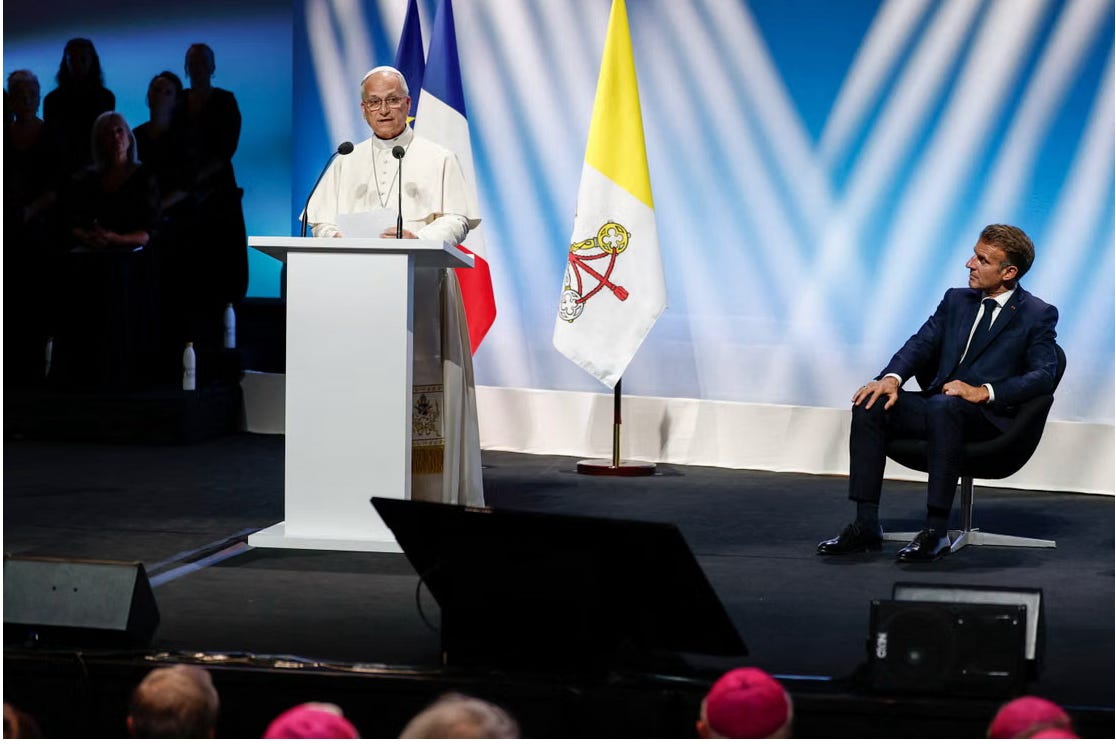
Pope Leo XIV speaks at an event entitled “At the Roots of Europe for Peace and Unity,” in Metz, France, on Monday, September 28, 2026. Photo: Benoît Tessier/Reuters
Scott: Like his earlier pastoral visit to Spain, Pope Leo’s four-day visit to France mixed conventional religious messages with commentary which was at times shockingly political… so much so that Le Monde speculated whether the Rassemblement national, which clearly was the target of much of his commentary, would object to the remarks as election interference. The pope’s comments serve to shore up a critical strategic alliance that has emerged between the pontiff and French president Emmanuel Macron. The French president made clear shortly before Leo’s arrival that he firmly supported the right of a woman to choose abortion as enshrined in article 34 of the French Constitution. And Leo made immediately clear that this difference of opinion did not stand in the way of the Vatican’s cooperation with the Élysée Palace on a long list of more urgent issues. Leo used his final speech, in the Robert Schuman center in Metz, to elaborate on exactly what that overtly political agenda entailed: ensuring that the political center holds across Europe, and that Europe remains a vessel of humanitarian values. And this in turn required that Europeans come together to battle the propagandistic wave of lies and deceit that is being spread by the continent’s “populist” parties—united in their enthusiasm for the Kremlin and in their hatred of immigrants.
Pope Leo XIV warned in France on Monday, September 28, that relations between nations were becoming “increasingly uncivilized,” with people boasting of “lies and deceit,” and urged Europe to help “break this cycle”and foster respect in international ties.
Speaking in the city of Metz near the border with Germany, where he was wrapping up his four-day visit to France, the first American pontiff also stressed the importance of compromise and patience to end war in Europe. “Relations between individuals and states are becoming increasingly uncivilised. The value of keeping one’s word is dismissed. Instead, people boast of lies and deceit,” the leader of the world’s 1.4 billion Catholics said in an address, with French President Emmanuel Macron in attendance.
“Europe can help to break this cycle through the respect for others that it has learned to cultivate and preserve,” Leo said, on the first official papal visit to the European nation in nearly two decades. Leo sees Europe as a counterweight to the world’s major powers and has in the past called on the European Union to overcome tensions and rediscover unity in pursuit of peace in Ukraine and beyond.
‘The greater good of peace’
Leo also urged “courage in negotiation” and compromise to put an end to war in Europe, in an apparent reference to Russia’s war against Ukraine, now in its fifth year. “Today, sadly, war has returned, even to Europe: a new ‘senseless slaughter,’ claiming countless civilian lives every day,” he said. “We need to commit ourselves to patient dialogue, to show courage in negotiation and to be willing to give up some positions for the greater good of peace,” the pontiff added.
Leo stressed the importance of unity on a continent where nationalist movements are gaining strength. France’s anti-immigration far right hopes to win next year’s presidential election and succeed Macron, a centrist.
The pontiff said Europe was “entering a new stage,” with the arrival of men and women fleeing war and persecution. “We must grasp the historical significance of what is taking place, namely an unprecedented encounter between peoples and cultures, which calls us to rediscover our roots in new and creative ways, while at the same time listening carefully to others.”
