A Blue Tsunami? / How Energy Prices Are Driving Voters To The Polls / The Capytistas Are About to Torture Elon and Friends / Justice Still Pressing its Fake Suit Against California / That Crypto Heist Was an Act of War / The Tech Bros Are Also on Today’s Ballots

Vote Today Like Our Whole World Depends On It
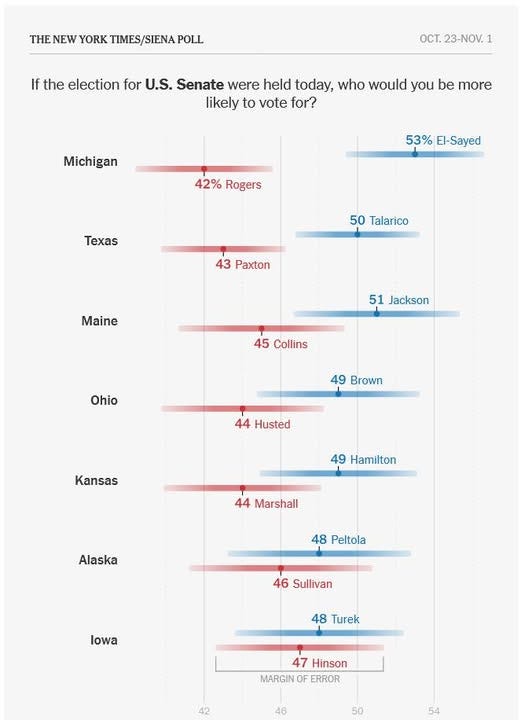
Charles: If the numbers in the final Times/Sienna poll published yesterday are correct, a blue Tsunami is about to inundate America.
Key reasons for optimism from the poll:
‘The Times previously polled all seven states in September. The Democrats improved in six of the states in the final poll (Iowa, Kansas, Maine, Michigan, Ohio and Texas) and lost ground in only one (Alaska).”
the Democratic resurgence was powered by a renewed strength among younger voters and Latinos, as well as the relative weakness Republicans have among the party’s base of white, working-class voters.
Democrats hold a nine-point advantage on the cost of living across the battlegrounds, and they led on this crucial measure in every single state.
Democratic candidates are leading with independent voters in every state surveyed.
On the Eve of Midterm Elections, the Costs of Trump’s Iran War Come Home to Roost
Financial Times
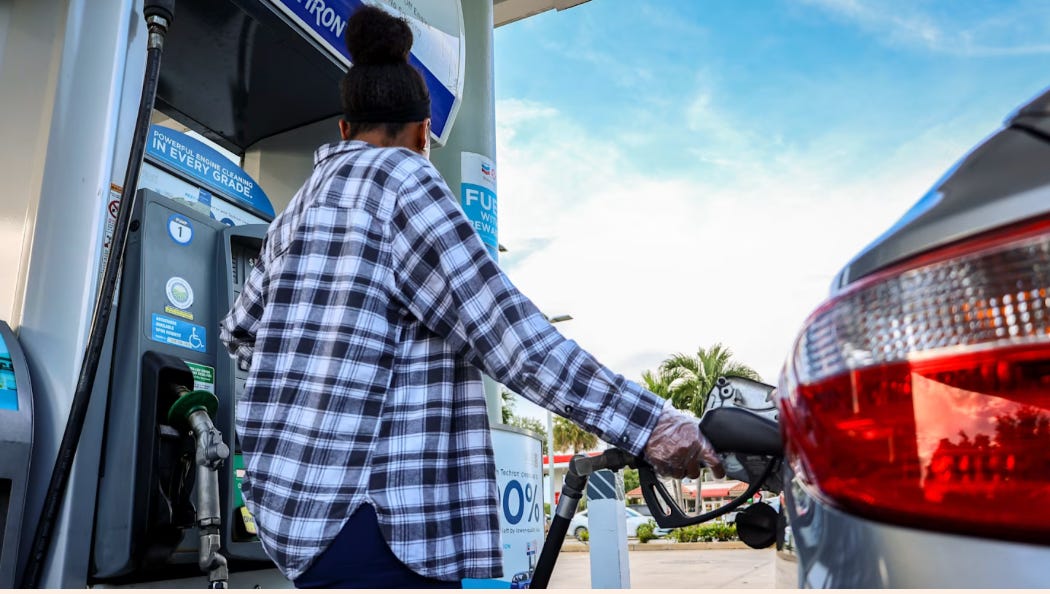
The price of diesel has risen more than 70% since Donald Trump returned to office in January last year. Photo: Zak Bennett/Bloomberg
Scott: Trump touts a major accomplishment in securing the resumption of oil transportation out of the Strait of Hormuz to roughly 90% of its historical levels. But what he fails to mention is that this resumption is achieved at an enormous cost which is taxed against the oil and gas—to the tune of more than $1 million per average tanker—producing a hefty price increase which is now being reflected at the pump in the United States. Trump’s incessant threat that he will resume bombing of Iran, deploying weapons he has not yet used in the war (which could mean GBU-43/B Massive Ordnance Air Blast (MOAB), but could also mean tactical nuclear weapons) is also unsettling the market and creating upwards price pressures.
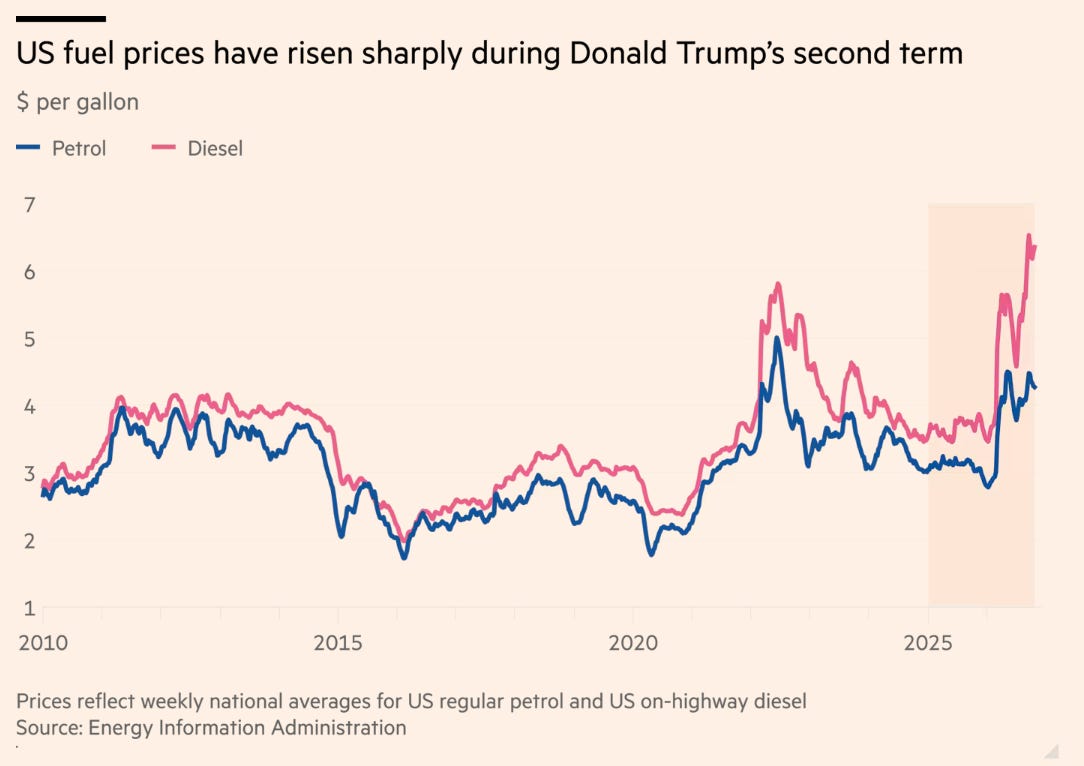
Petrol prices since Donald Trump returned to office are poised to set a record high for a US presidential administration just a day before Americans vote in midterm elections dominated by the rising cost of living.
An FT analysis of federal data shows that the average price of a gallon of petrol during Trump’s second term will top $3.46 a gallon on November 2, beating the previous average high set under Trump’s predecessor Joe Biden.
The US president’s unwelcome record comes as fuel costs — which have surged since he launched his war against Iran in February — have emerged as a major liability for Republicans ahead of this week’s vote.
“High energy prices are a key driver of the affordability concerns that are going to be top of mind for people at the polls,” said Jason Bordoff, head of Columbia University’s Center on Global Energy Policy. “And those energy prices are the result of self-inflicted wounds this administration has imposed on the country…”
On Friday, Exxon and Chevron warned the diesel crisis was here to stay as the US oil companies reported near-record profits worth a combined $25.3bn.
Trump has stirred up anger by hailing energy groups’ earnings as a boon for the US. “I don’t give a damn, I’m going to say it: we’re making a freaking fortune,” he told a crowd in Georgia, provoking a backlash in some parts of the country.
“Trump and his ultra-wealthy Big Oil buddies are popping champagne as they pocket billions off of Americans’ pain,” said Alex Glass at Climate Power, an environmental non-profit group.
How Fake is the Feds’Suit Against California? Let Us Count The Ways
Los Angeles Times
Charles: Having already been slapped down three times by a District Court Judge and the 9th Circuit Court of Appeals, Trump’s Department of Revenge requested an emergency injunction yesterday from the Supreme Court to set aside 20,000 votes the Feds are pretending might be from non-citizens.
It only took the court a couple of hours to tell Justice to fuck off:
The application for injunction pending appeal presented to Justice Kagan and by her referred to the Court is denied.
There were no recorded dissents.
How fake is this law suit?
Two statistics should suffice:
The first two hundred registrations from the Feds’ list examined by Los Angeles election officials showed that 71.2% had no record of ever voting.
A UCLA analysis of the 20,000 names found that more than 40 percent are not even on California’s current voter roll.
Anti-Oligarchy Activists Plan to Dox Elon Musk and the Tech Bros
Wired
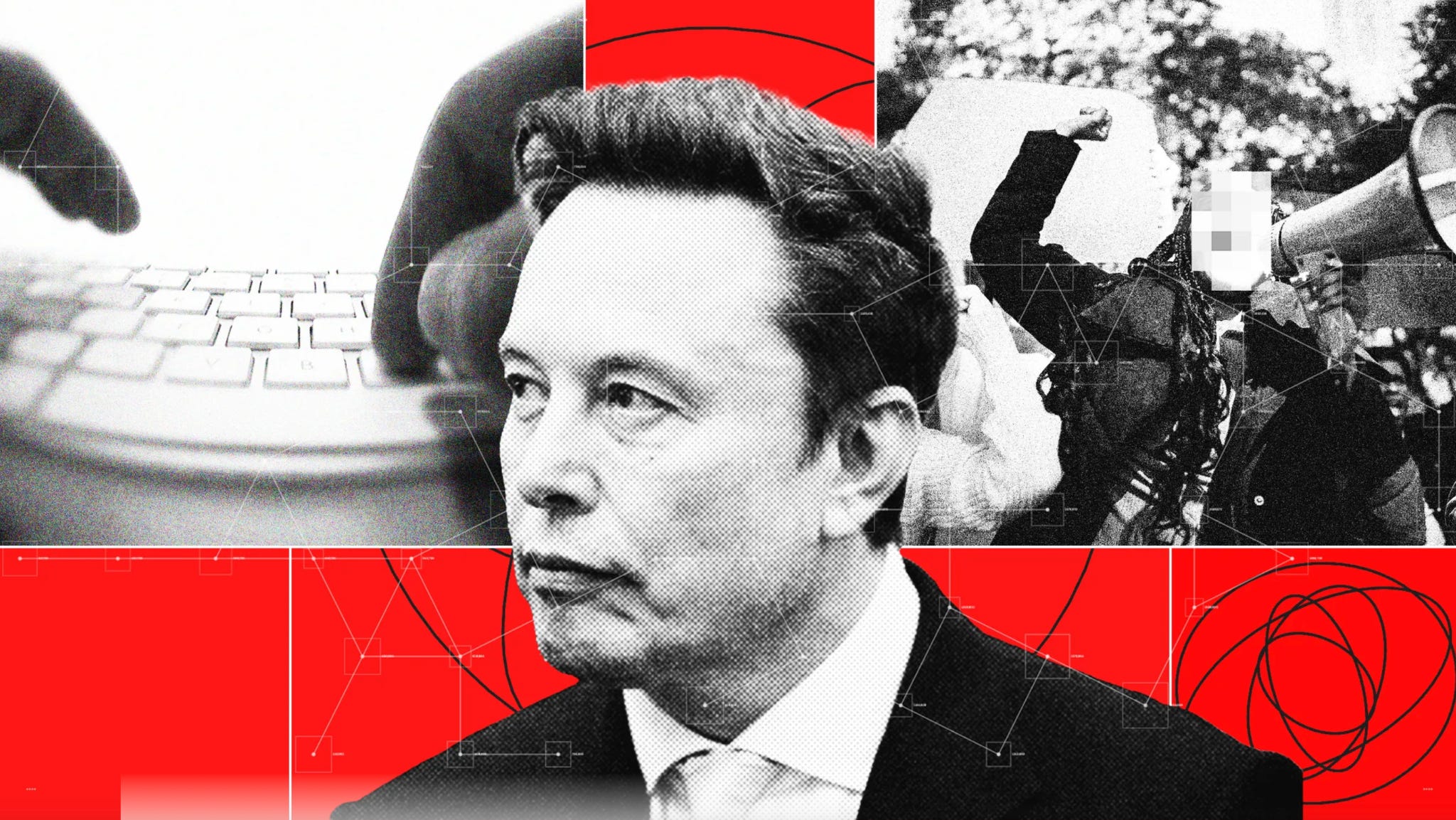
Scott: After the midterms, it’s clear that Elon Musk will be in the cross-hairs of congressional investigators. And the documentary Musk shows, over four hours, the massive crookedness he’s gotten away with—up to now. Coming to the US on a student visa to study in the Stanford Physics PhD program, and then not matriculating, for instance—a classic immigration fraud which historically has been overlooked in the case of successful entrepreneurs. But applying the far more stringent standards now used by Trump’s DHS, this fact alone would invalidate the subsequent visas he secured, his green card, and his ultimate securing of a US passport, alongside his Canadian and South African passports. And then there are the fairly audacious tax credit frauds he pulled off in California, health and safety violations, and a raft of securities frauds he appears to have committed with Boring, SpaceX and Tesla. All of this is likely to soon get close scrutiny for the first time.
But Musk has stirred the animosity of many groups beyond congressional Democrats. Tekkies who once idolized him now largely consider him to be pure evil. And some groups are planning to expose him to the sort of surveillance to which he exposes people who buy his products, as Wired reports.
An underground activist group says it plans to start openly doxing billionaires as part of a phased campaign against what it calls the American oligarchy—beginning this month with a release that maps the homes of Elon Musk, his brother Kimbal, and Tesla’s board, alongside investors and suppliers that keep the corporation afloat.
Two of its members, interviewed by WIRED on the condition of anonymity, say they spent the past year constructing dossiers on billionaires—and one trillionaire—and the people they consider their top lieutenants, using nearly every method available to a private investigator, and some that are not.
The pair say the group is international and includes grassroots activists, researchers, journalists, and artists, including some who received top honors in print, television, and digital media in their former careers. For security, many work in “silos” and do not know each other’s names. Through its connections, the group says it has raised more than $1.2 million from “a heartening number of wealthy class traitors” who share in the view that concentrations of extreme wealth and political power pose an “existential threat.”
In a press release Monday, the group says it intends to publish in coming releases more than 150 home addresses, most of them previously unreported. It also promises more than 3,500 records on people with a combined wealth of about $1.4 trillion, plus reporting on what the group alleges are “criminal exploits and security lapses.”
Members of the organization call themselves Capytistas, a play on Zapatistas, the Indigenous insurgents of southern Mexico.
The capybara, a placid rodent famous for getting along with almost any other animal, became the group’s avatar during the early days of Musk’s so-called Department of Government Efficiency, as a secret rival to the Shiba Inu—the Doge meme Musk used to brand the agency. (The meme has since been reclaimed by pro-Ukranian activists who post as cartoon dogs to mock Russian propaganda and raise money for the war.)
DPRK’s Hacker Army Scores a Huge Win in the Struggle to Liberate Crypto
Süddeutsche Zeitung

Photo: Ahn Young-joon/AP
Scott: Around the world, news editors don’t quite know what to do about the theft of $6.7 billion from the crypto wallets under the control of the Binance exchange. Is this a great diamond heist for the 2020s? Actually, it’s an entirely different kettle of fish, with significant portents for hybrid warfare as it is now being formulated in the Tehran-Moscow-Pyongyang axis. It needs to be appreciated in that context. The robbers are a military unit engaged in warfare, as they understand it. Their object is to “heighten the tensions inherent in capitalist systems” by exciting concerns about the stability and reliability of those systems. It’s not, in that sense, dramatically different from the Kremlin’s decade-long scheme involving Wirecard, which western financial journalists still haven’t figured out. But Süddeutsche Zeitung is on top of the North Koreans.
Kim Jong-un’s elite unit, Lazarus, has relieved the cryptocurrency exchange Binance of more than six billion dollars. A look at hackers from an isolated nation with grand ambitions.
Precise figures regarding the economic output of the Democratic People’s Republic of North Korea are scarce. Even the volume of its foreign trade is estimated rather than measured—thought to have hovered around three billion dollars annually in recent years. A few key details are known, however: China is the country’s largest trading partner, and its primary exports include wigs and false eyelashes. In total, North Korea’s recent exports of goods are estimated to be worth around 470 million dollars.
Yet, for years, North Korea’s most successful export has been something else entirely. The country deploys its hackers globally, and they bring money back home—as was the case this past Thursday. In a single 20-minute attack, these hackers stole approximately 6.3 billion dollars’ worth of cryptocurrency from the exchange Binance. The bulk of the stolen assets consisted of Ethereum, Bitcoin, and stablecoins issued by the crypto firms Tether and Circle.
According to the consensus among virtually all experts, the hack was carried out by a group known as “Tradertraitor”—a sub-unit of the North Korean state-sponsored hacking collective, Lazarus.
The victim is no minor player in the crypto sector. Along with Coinbase, Binance is considered a pillar of the cryptocurrency industry. Its founder, the Chinese-born Changpeng “CZ” Zhao, originally launched the company in his home country before moving it to Malta; since then, he has avoided establishing a permanent, official corporate headquarters. For years, regulatory authorities in Germany, the United Kingdom, and elsewhere have warned that Binance poses a risk to consumers due to its lack of compliance with established regulations…
The group has likely existed since 2009, but its legend truly began in 2014, when it hacked the film studio Sony Pictures—presumably as an act of revenge. The studio had produced the film “The Interview,” which depicts the assassination of North Korean leader Kim Jong-un. Calling themselves the “Guardians of Peace,” the hackers stole gigabytes of data from Sony and attempted to extort the studio, threatening, among other things, to carry out attacks on movie theaters and release the stolen data. The extortion worked; Sony initially canceled the film’s release. It was only much later that the movie finally made it to the big screen.
At the time, Republican Senator John McCain remarked that Sony’s hesitation—driven by fear—would only embolden the perpetrators to act even more aggressively in future hacking attempts. Twelve years later, it is clear that McCain was right. However, Lazarus stopped targeting film studios; instead, the group shifted its focus to a sector with far greater potential for profit: the crypto industry.
In 2024, a panel of experts appointed by the United Nations estimated that Lazarus had likely raked in at least $3 billion through crypto hacks between 2017 and 2023. Two years later, the blockchain analysis firm Chainalysis placed the figure at over $6 billion. On Thursday, that total grew by another $6 billion in a single stroke.
The final sum, however, is unlikely to remain that high. Shortly after the hack, the companies Tether and Circle—both issuers of stablecoins—froze approximately $2.4 billion of the stolen funds. Unlike traditional cryptocurrencies, stablecoin issuers retain control over all the coins in circulation. For this reason, they are often criticized by crypto enthusiasts, who argue that they betray the movement’s core principle of decentralization. In this case, one of the strengths of centralization becomes apparent: it allows money to remain under control even after it has been spent.
America’s Midterms Are a Referendum on the Tech Bros
Der Spiegel
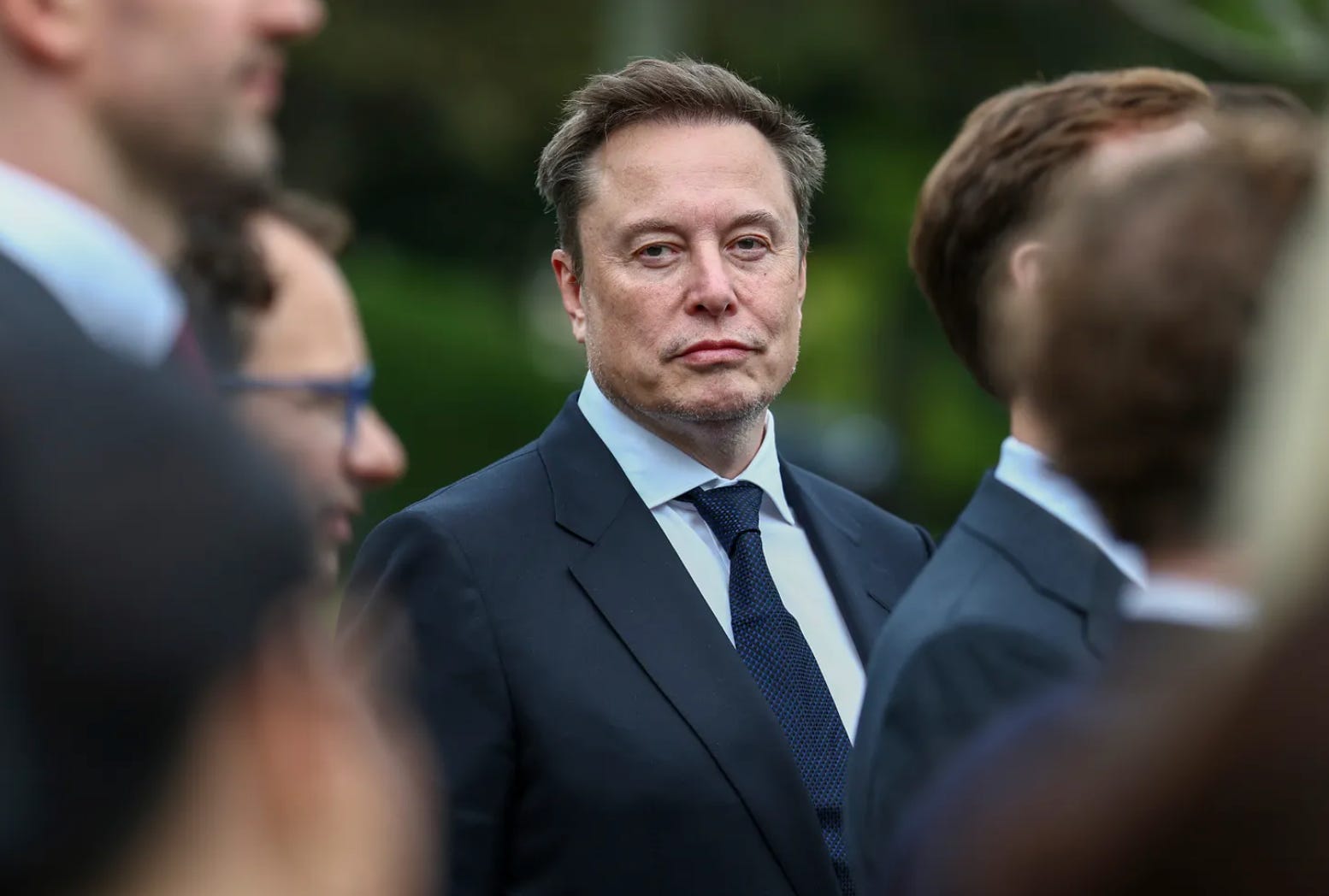
America has never seen a business executive more completely obsessed with politics than Elon Musk. He is obsessed with keeping the GOP in power. And he is joined by a number of other tech bros. Photo: Finn Gomez / Getty Images
Scott: In America, the architecture of democracy is in the midst of a radical transformation. The Republican Party no longer functions as a political party in the traditional sense. It no longer has party conventions that deliberate and agree upon a platform that assesses the issues facing the country and prescribes a program to address them. It was decapitated by Trump. Now it is a mass movement that follows its leader, and whatever he has to say. In 2024, the tech bros, led by Elon Musk fully appreciated this transformation and saw an opportunity in it: Trump could be bought, the GOP could be brought to heel and serve as a political vehicle for the exercise of unprecedented power and influence that would allow the tech bros to achieve their commercial, social and political objectives—with a slight appearance of democratic legitimacy. Consequently, as Americans go to the polls on Tuesday, the question is not simply rule by Trump, but also government of, by and for the tech bros.
Power in the 21st century has a face. It is almost ageless, unwrinkled, with a high forehead and a strong jaw. It belongs to the 55-year-old South African entrepreneur Elon Reeve Musk.
The richest man in the world does not merely command a fortune of unimaginable size – at one point, he was the first dollar trillionaire. He owns companies that are systemically important to our world. They play a decisive role in how we communicate (his platform X, formerly Twitter), how we get around on Earth (Tesla) and how we explore space (SpaceX).
Experts agree that NASA, the US space agency, is no longer able to function without the know-how of its contractor SpaceX. Musk recently throttled the services of the satellite service Starshield, an offshoot of his satellite internet service Starlink. If Starshield fails entirely or partially in Ukraine, that works to Vladimir Putin’s advantage.
In other words, should he so desires, Musk can also decide the course of wars.
American history is full of powerful tycoons. There was the robber baron John D. Rockefeller, who in the 19th century used oil money to subjugate large parts of the US economy. Later, the banker John Pierpont Morgan regarded the nation’s finances as his own monopoly.
But no one, on a global scale, has been as influential as Elon Musk.
That is because he controls far too much critical infrastructure. His empire – the term is not an exaggeration – shapes our everyday lives, molding and influencing societies and, with them, the public good. That is not good news. It is a public-private partnership working against us.
A Long Cloud on Mars

Explanation: What’s causing this unusually long cloud on Mars? Known as the Arsia Mons Elongated Cloud (AMEC) and first recorded by NASA’s Viking Orbiter 2 in 1977, the strange cloud has been imaged in greater detail more recently by ESA’s robotic Mars Express spacecraft. The featured image is from 2018. The cloud forms only during spring and summer seasons and then only during morning hours. Made of water-ice, the most familiar process that causes cloud crystals to form around bits of dust would fail due to the thinness and lack of dust high in the Martian atmosphere. Leading speculation holds that dust is not involved. After the cloud forms near the volcano Arsia Mons, wind blows the cloud downstream — creating a tail that can extend over 1500 kilometers. Efforts to better understand AMECs will continue, an understanding that may bolster a more complete view of cloud formation on Earth.
Photo: SA, DLR, Freie Universität Berlin;
Processing & License: J. Cowart
Your Online Moment of Zen
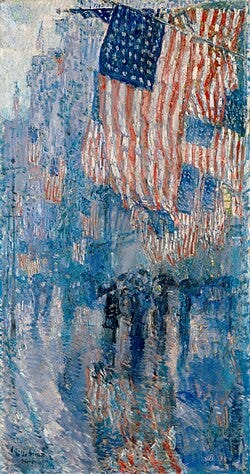
The Avenue In The Rain
1917
One of thirty paintings from Hassam’s “flag series.”
Donated to the White House in 1963 by Thomas Mellon Evans