



The Truth Social Pay-to-Play Grift
TIME
Scott: Now for a modest subscription fee, you, too, can have advance access to all the moves Trump is playing on the global commodities and domestic stock markets… enabling you to play the markets just like the Big Boys around Trump!
From announcements of U.S. military action to threats of tariffs on other nations, Donald Trump’s Truth Social has been a repository of market-moving statements—mostly from him—since the social media site’s launch in 2022. Now the U.S. President is courting more controversy by selling access to some of those posts in “milliseconds.”
Trump Media & Technology Group, the parent company of the microblogging platform, announced Thursday plans to launch “Truth API,” a data feed that provides what it calls the “fastest” real-time access to posts “from the highest-ranking Truth Social accounts.”
A company spokesperson told Reuters the paid-for, licensed data service will deliver posts from Truth Social’s 10 most influential accounts to customers significantly faster than the usual push notification. President Trump has 12.9 million followers on his Truth Social account and is the platform’s highest-profile user. The accounts of his sons, Donald Jr. and Eric, and the White House, similarly have millions of followers.
While the company has not publicly disclosed details about the service—including cost and exact posting latency—its revenues stand to benefit the Trump family, with the President himself owning about 41% of the publicly traded Trump Media through a revocable trust.
Companies and organizations generally offer application programming interfaces (APIs) for swift and reliable information transfer. Agencies across the U.S. government, like the Treasury Department and the Labor Department, share large financial and economic data through APIs.
But with Truth API, Wall Street trading firms and other institutions will have faster access to Truth Social posts, which could immediately influence how they trade and could maximize their profits.
How CNN and CNBC Fuel the Gambling Frenzy
Public Notice and Popular Information
Charles: America’s gambling craze is completely out of control, now that every single cell phone has been turned into a slot machine. Aaron Rupar and Judd Legum describe how CNBC and CNN are fuelling this catastrophe by collaborating with Kalshi, one of the two leading prediction markets.
In their story How Kalshi Infects The News. Rupar and Legum do a deep dive into the landmark deals both networks signed at the end of last year to promote Kalshi. Since then CNBC and CNN have promoted Kalshi assiduously–while disclosing their connections to it intermittently.
New York Times columnist and Squawk Box anchor Andrew Ross Sorkin has participated in the nearly-nonstop promotion of Kalshi–without always disclosing CNBC’s financial relationship with it.
Both networks run stories promoting Kalshi while neglecting its main competitor, Polymarket. So the deal is corrupting their news gathering as well.
Since December CNBC has published 58 articles that do little more than advertise the existence of a Kalshi market related to a news event. The headlines include “Traders predict Michael Jackson hits top Spotify after biopic,” “Kalshi traders don’t see Hormuz traffic normal until July,” and “Traders say Karen Bass and Spencer Pratt will advance to runoff in high-profile LA mayoral race.” (Pratt did not advance.)
Since April, CNBC has employed a dedicated reporter to produce these articles. CNBC also maintains a page on its website featuring Kalshi prediction markets selected by CNBC editors, along with its web coverage.
Some of CNBC’s reporting about Kalshi includes the disclosure, “CNBC and Kalshi have a commercial relationship that includes customer acquisition and a minority investment.” This means CNBC is paid every time it can convert a viewer to a Kalshi user. As an investor, the network also benefits if Kalshi’s overall valuation increases. CNBC is also paid directly by Kalshi for using its data, according to The Wrap.
In at least 22 cases, however, CNBC has written about Kalshi and not disclosed its financial conflict. In recent weeks CNBC has more frequently failed to include its Kalshi disclosure, including two pieces on June 10, one each on June 11, June 15, June 16, and June 23, three pieces on June 26, and one each on July 1, and July 2.
On air, where CNBC promotes Kalshi nearly every day, disclosure is also spotty.
On June 26, during a Squawk Box interview with California Republican gubernatorial candidate Steve Hilton, host Andrew Ross Sorkin brought up the fact that Kalshi gives Hilton a 9.5% chance of winning the election. Producers then cut to a Kalshi graphic depicting those odds while a Kalshi QR code was displayed on the screen. The hosts never acknowledged CNBC’s financial relationship with Kalshi during the segment.
Similarly, during a news rundown on June 23, CNBC correspondent Contessa Brewer claimed that “prediction markets are hot, hot, hot” and mentioned that in recent days Kalshi and Polymarket “handled billions of dollars in trading volume” without disclosing CNBC’s business relationship with Kalshi.
CNBC’s Fast Money and Squawk Box each recently hosted Kalshi co-founder and CEO Tarek Mansour for extended soft-focus interviews. On June 24, for example, Squawk Box host Joe Kernen gave Mansour an open mic to portray Kalshi as a “pro-regulation company” that has kept its hands clean as “our competitors” have been mired in insider trading scandals.
While the interview did include the standard CNBC disclosure, Kernen did not ask Mansour about Kalshi’s recent insider trading scandals. Earlier that month, NPR reported former Congressman George Santos was under Department of Justice investigation for allegedly being involved with insider trading on Kalshi. Other high-profile incidents of insider trading on Kalshi involved political candidates and a MrBeast editor.
Over at CNN Kalishi has been featured in a segment called “The Odds” at least 115 times in 2026.
Harry Enten, CNN’s chief data analyst, frequently suggests that Kalshi predictions are more accurate than other sources. While polling relies on volunteers, Enten repeatedly reminds CNN viewers that prediction markets are driven by people who “put their money where their mouth is.”
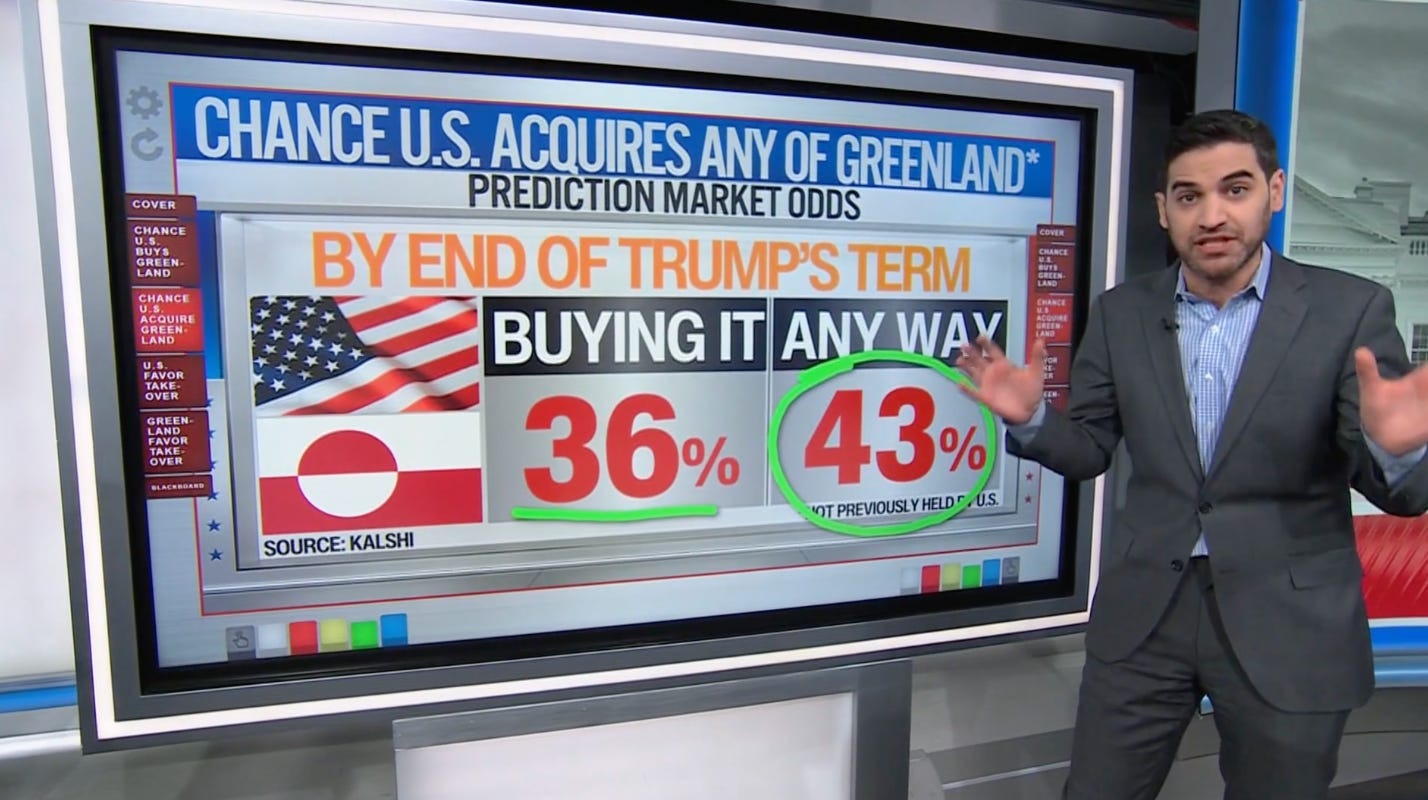
On January 7, Enten highlighted that, in six days, the odds on Kalshi that the United States would buy part of Greenland by the end of Trump’s first term increased from 12% to 36%. Enten said this was proof that “the people putting their money where their mouth is” are “absolutely taking this seriously.”
“Whoa… way up there now to 36%,” Enten exclaimed. “A tripling in less than a week. My goodness gracious.”
Enten and his co-host, John Berman, then discussed that another Kalshi market at the time showed a 43% chance that Trump would acquire part of Greenland by any means, including militarily. Berman described it as “a pretty high chance” and said that 43% odds on a Kalshi market meant “a lot of people made bets.” Enten agreed, calling it a “very high chance.”
Berman didn’t say how many people made bets because he does not know and that information is not disclosed by Kalshi. Politics markets represent just 4% of all trading on Kalshi, according to a May 2026 Pew Research study — a fact never mentioned on air. (Sports accounts for 80% of Kalshi trading volume.)
Enten and Berman promoted the 43% chance of Trump acquiring part of Greenland as reflective of people “putting their money where their mouth is.” But an analysis of Kalshi’s own data shows the price increased from 30% to 39% between January 3-5, 2026, on just $24,000 worth of “yes” trades. The market was so thin that, on January 4, the “yes” odds briefly spiked to 60%.
During most segments of “The Odds,” a special ticker scrolls across the bottom of the screen promoting Kalshi markets on a wide variety of topics.
According to reporting in The Wrap and The New Yorker, Kalshi pays for CNN to promote its data. The deal is exclusive, meaning that CNN cannot report on Polymarket odds, even though Polymarket has a much more robust market on political topics. These segments conclude with the tag, “The Odds, brought to you by Kalshi prediction market.”
That boilerplate language makes it sound like Kalshi is a typical advertiser, when its relationship with CNN is more extensive. Kalshi regularly clips and promotes CNN’s “The Odds” segments on X, but excludes CNN’s “brought to you by” tagline.
A Kalhi spokesman told reporters Rupar and Legum “we’ve always been open about our news partnerships, as have our news partners.” Kalshi, CNN, and CNBC have not disclosed the financial terms of their partnership. Asked for clarity, Kalshi said its deal with CNN involves “featuring our odds on Harry Enten’s show, along with other mentions across their programming” and its deal with CNBC involves “integration across their platforms.”
H/t Laura Fisher Kaiser
How Gambling Has Destroyed America
Charles: Enter those words on Google and here is what the AI summary spits back at you:
Financial Ruin and Debt
Surging Debt: The ease of tapping a screen has led to a spike in auto loan delinquencies, bankruptcies, and maxed-out credit cards.
Wealth Transfer: Unlike a traditional financial investment where value is created, gambling is a “zero-sum” game. The majority of gamblers lose their money, transferring wealth from working-class households to massive betting corporations. [1, 2, 3]
Public Health and Social Breakdown
Addiction Epidemic: The National Council on Problem Gambling estimates that up to 20 million Americans have or are at risk of developing a serious gambling problem. [1]
Spillover Harm: The addiction rarely affects only the gambler. Studies show it spills over into families, leading to a rise in domestic violence, child neglect, and divorce. [1, 2]
Mental Health Risks: The financial shame and stress of mounting debt contribute to a higher risk of severe depression and suicide. [1, 2, 3, 4]
The Corruption of Sports
Predatory Marketing: Aggressive advertising bombards fans, normalizing gambling as a casual part of daily life and targeting vulnerable, low-income communities. [1, 2]
Loss of Integrity: Fans increasingly suspect the outcomes of games, leading to widespread skepticism about whether players, referees, and coaches are throwing matches for betting payouts. [1]
Harassment of Athletes: Frustrated gamblers often resort to online and in-person abuse, threatening athletes and their families over lost bets. [1]
Lack of Support
Infrastructure Gap: While the government spends billions of dollars treating drug and alcohol addiction, resources and rehab options for problem gamblers remain drastically underfunded and scarce. [1]
Our New Gigantomachia, or, The War with the Tech Bros
Der Spiegel

Scott: For the ancient Greeks, the twilight conflict that hovered over humankind included the γιγαντομαχία or struggle with the giants, the ill-defined superhumans who struggled with humans and gods for supremacy on earth. In our day, journalists focused on conflicts the old way—war between hostile powers, political struggles, labor struggles, and commercial conflicts. But the real struggle that hides behind everything in our world today and somehow escapes being chronicled is the struggle of the tech bros for global suzerainty. This they propose to achieve largely through unseen means: capture of state institutions, bribery of political leaders, or even the establishment of a quasi religious cult… not to mention of course, AI. Now Spiegel offers a calendar of tech bros events that otherwise have escaped attention.
Darth Vader number one this week appears to be Elon Musk and his AI epicenter in Memphis. According to Reuters, Musk’s company xAI (or is that his kid’s name?) is running 59 unauthorized natural-gas powered turbines at the Colossus 2 site – a facility with the stated aim of developing future versions of the Grok chatbot, which has already distinguished itself by generating non-consensual sexually explicit deepfakes, producing anti-Semitic content and being a general AI A-hole. (When I asked Grok to fix that run-on sentence, it replied: “Do it yourself you prick!”)
But tech-bros in general appear to be under fire in the US and Europe, in large part because of the unholy alliance with US President Donald Trump that many of them have decided is the most direct path to yet more riches and power. Seriously, have YOU tried feeding a family on just a billion dollars?!
DER SPIEGEL’s Michael Sauga notes in his column this week that the trend of growing ire with oligarchs is a rare example of a socio-political trend reaching the US from Europe rather than the other way around.
“Hungary, Serbia, Albania: In many fragile democracies of the former Warsaw Pact countries, it is not parliaments that call the shots, but influential networks of political wire-pullers and oligarchs who fatten themselves on their countries’ posts, market positions and perks. These networks are under pressure in many places. In Hungary, the EU cut off funding to Orbán’s system of cronyism and thereby contributed significantly to its downfall. In countries such as Serbia and Albania, popular protest movements are turning not only against the governments in power but against the corrupt system itself. The activists have recognized that as long as politics and business remain chained together in a relationship of mutual advantage-taking, no functioning democracy can develop.”
Opposition is futile.
