Big Tech hides $3 trillion in AI spending / Trump’s Middle East Apocalypse / Gorgeous Architecture Across America / Jeffries on the Wrong Side of History / ICE Infiltrates the Resistance / The Kushners’ Albanian Disaster
Why Big Tech’s AI Spending Is $3 Trillion Higher Than It Seems
Wall Street Journal
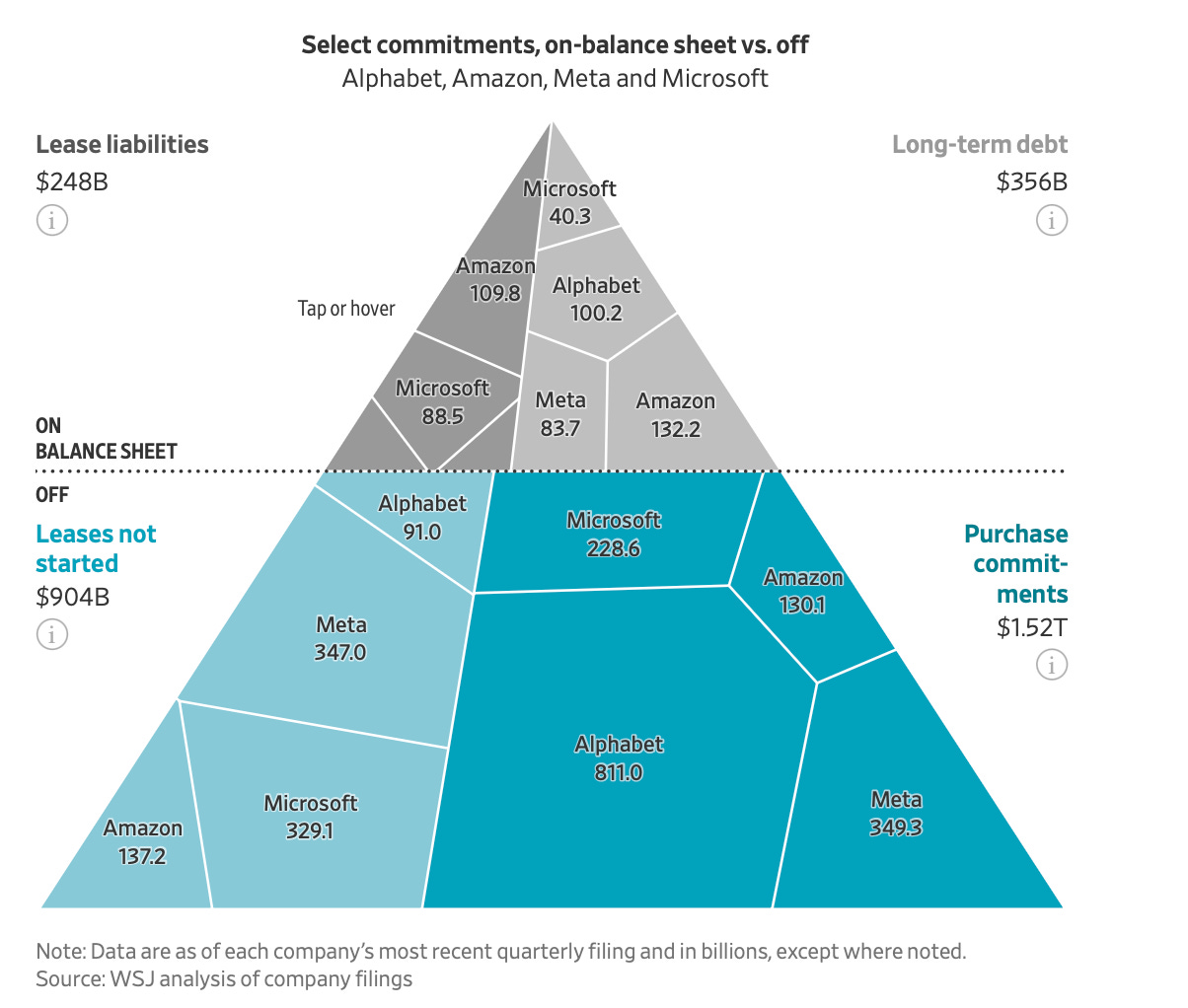
Scott: Big Tech now completely dominates the US stock market. And Big Tech is expending historically unprecedented sums in its quest for AI. It has also been playing some tricks with the books, struggling to keep its commitments off the books. Is this a good thing? Of course not. And if, or rather when, the AI bubble pops, it will be a catastrophic thing for US equity markets. WSJ reports and offers some excellent graphics:
Each quarter, big tech companies disclose their massive capital expenditures on artificial-intelligence infrastructure, from data centers to chips.
But those figures don’t come close to expressing the full extent of future spending to which Google parent Alphabet, Meta Platforms, Oracle and many others have committed. That is because a huge swath of their coming financial obligations aren’t reflected on their balance sheets.
Nine top tech companies had some $3 trillion of off-balance-sheet commitments mostly related to AI, according to a Wall Street Journal analysis of footnotes in their most recent securities filings. Those obligations are growing faster than traditional “capex,” which totaled about $600 billion over the past year they reported, and were about triple what the companies owe under their outstanding leases and long-term borrowings.
America’s blue-chip tech companies are placing these huge bets based on assumptions about what the demand for AI computing—and availability of AI hardware—will be in several years. Their hope is that they will easily meet all their obligations with future revenue as consumers and businesses adopt AI in every facet of American life.
If those assumptions about technology and demand prove wrong, these deals to clinch future capacity could become a monstrous burden for the tech companies and their investors.
Meta’s gigantic “Hyperion” data-center project in Louisiana, which is the size of about 1,700 football fields, helps explain how big obligations wind up off tech companies’ balance sheets.
Trump’s Disastrous Track Record in the Middle East
Le Monde
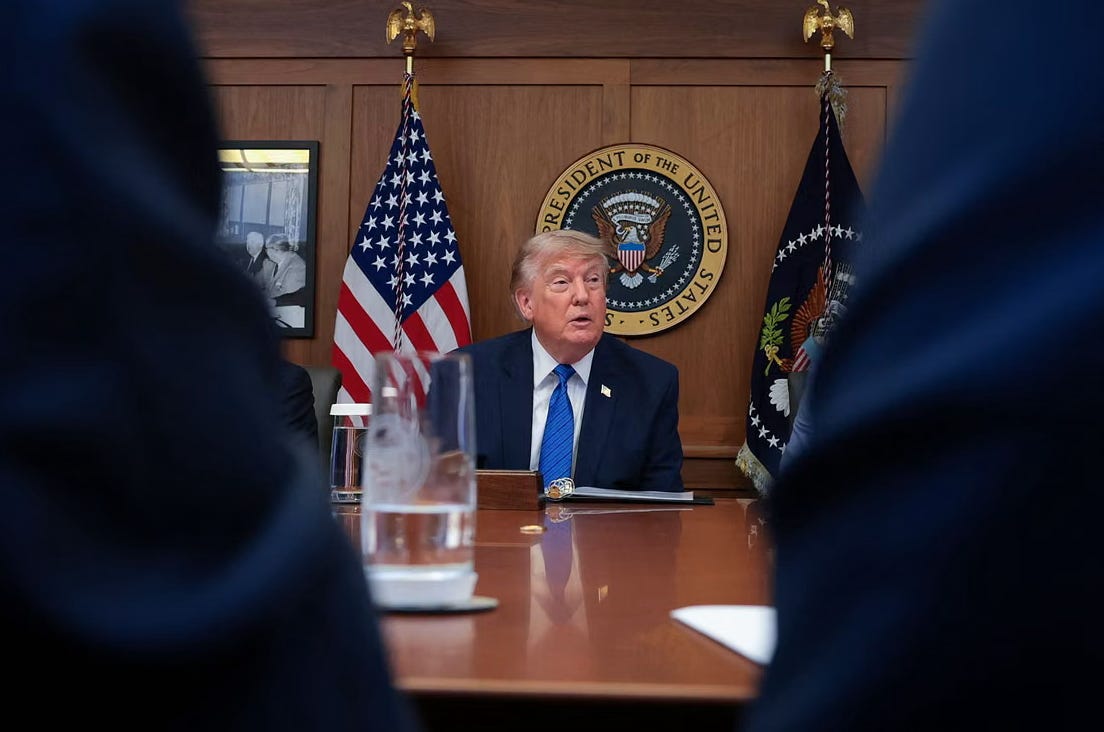
Trump during a meeting of his cabinet to discuss Middle East issues at Camp David (Maryland) on July 21, 2026. Photo: Anna Moneymaker/AFP
Scott: For many American presidents, conflict in the Middle East has proved a low point of their presidency. But none has acquitted himself with quite the level of catastrophic failure of Donald Trump. And it’s not over yet. The editors of Le Monde attempt an assessment of Trump’s achievements so far. He hasn’t yet turned to nuclear weapons, but before it’s over, who knows. Marjorie Taylor Green insists he’s been raising the prospect of using nukes on Iran with his advisors.
The Middle East has always revealed the true nature of an American president. In Donald Trump’s case, it has exposed his incompetence and lack of foresight. In less than two years, he has racked up a string of failures.
That is obviously the case for the war he launched against Iran, in partnership with Israel, whose most tangible result to date has been the closure of the strategic Strait of Hormuz. Before February 28, hundreds of container ships, oil tankers and gas carriers passed through it without incident. From the outset, the United States exposed the limits of the world’s most powerful military. Then, Washington resigned itself to signing an agreement with Iran, whose ambiguous wording allowed the Iranian regime to claim unprecedented control over the strait.
In response, the US hinted that it would resume fighting, only to later back down, likely under pressure from the Arab Gulf states, which were directly exposed to Iran’s retaliation for the US-Israeli intervention. The alarming state of US ammunition stockpiles for certain weapons systems, despite the administration’s denials, may also have played a part in this.
The intended show of force thus turned into an illustration of impotence. The US’s weakness also prompted three of its allies – Saudi Arabia, Pakistan and Turkey – to conclude a mutual defense pact, a clear rebuke of the US’s role as the historical protector of the Arabian Peninsula.
Israel, which clearly played a decisive role in convincing Trump to embark on this adventure, is also responsible for the other major deadlock in which Trump has become entangled: the Palestinian issue.
The Horton-Kaiser Book Report
Out There: New Architecture Across America
Charles: This gorgeous new 500-page encyclopedia of American architecture between the coasts is exactly what everyone needs right now: 170 new reasons to celebrate our country. Written by Cathleen McGuigan, Robert Ivy and Peter MacKeith, the book profiles 170 projects and fifty US architectural practices, including Observation Studio (Oregon), Modus Studio (Arkansas), Rand Elliott Architects (Oklahoma), Renée del Gaudio Architecture (Colorado), Salmela Architect (Minnesota), and Duvall Decker (Mississippi), winner of the 2026 AIA Architecture Firm Award.
Perusing these pages will renew your faith in the possibilities of American invention. The book weaves together “an architectural tapestry that reflects the breadth and diversity of the American landscape.”

As co-author McGuigan explains, these are the
groundbreakers who did not succumb to the thrall of past ‘isms,’ eschewing postmodernism, deconstructivism, and contemporary corporate modernism, and who have avoided the heroic, shape-shifting formalism in architecture that seems to be a magnet for public attention.
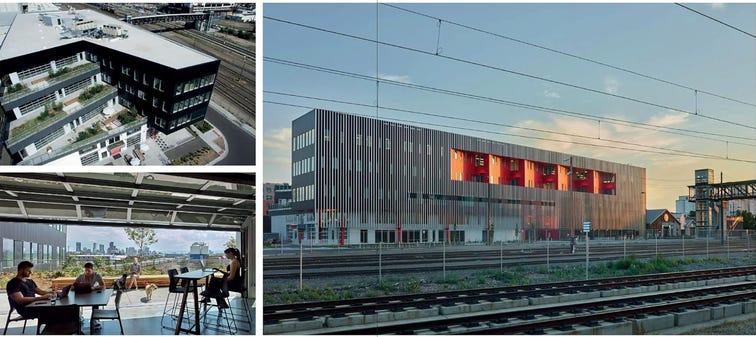
But they also avoid imitation and slavish historicism: while their designs connect, at some level, to their localities, their most innovative projects interpret their context in ingenious ways, to create unique works of architecture that clearly belong to our time. They reject the vernacular or reinvent it as an abstraction, as Blackwell has put it: “We are transgressing the vernacular—breaking it down and re-presenting it.”

Here are dozens of professionals of the next generation, who often came to appreciate the values of placemaking and sustainable architecture through their education and their own apprenticeships. Emerging technologies and research, particularly about the environment ,have greatly affected contemporary architecture, but the underlying values of place-based design, especially in flyover country, remain; originality and honesty, in the hands of the best up-and-coming architects “out there,” are part of a tradition and lineage that extend back decades. It is an approach to architecture that remains a bulwark against the homogenization of global culture, a sensibility that respects wide-ranging, diverse communities everywhere, by both fitting in and standing out.