



Putin Confesses His Love for Musk / Darkness Lingers Over The City of Light / Another Federal Judge Throws the Book At Justice / The Deluisons of American Power / Trump Is Building A Giant Police State / And much more…
At the Moscow Africa Summit, Putin Opens Up About His Special Relationship with Elon Musk
Kommersant
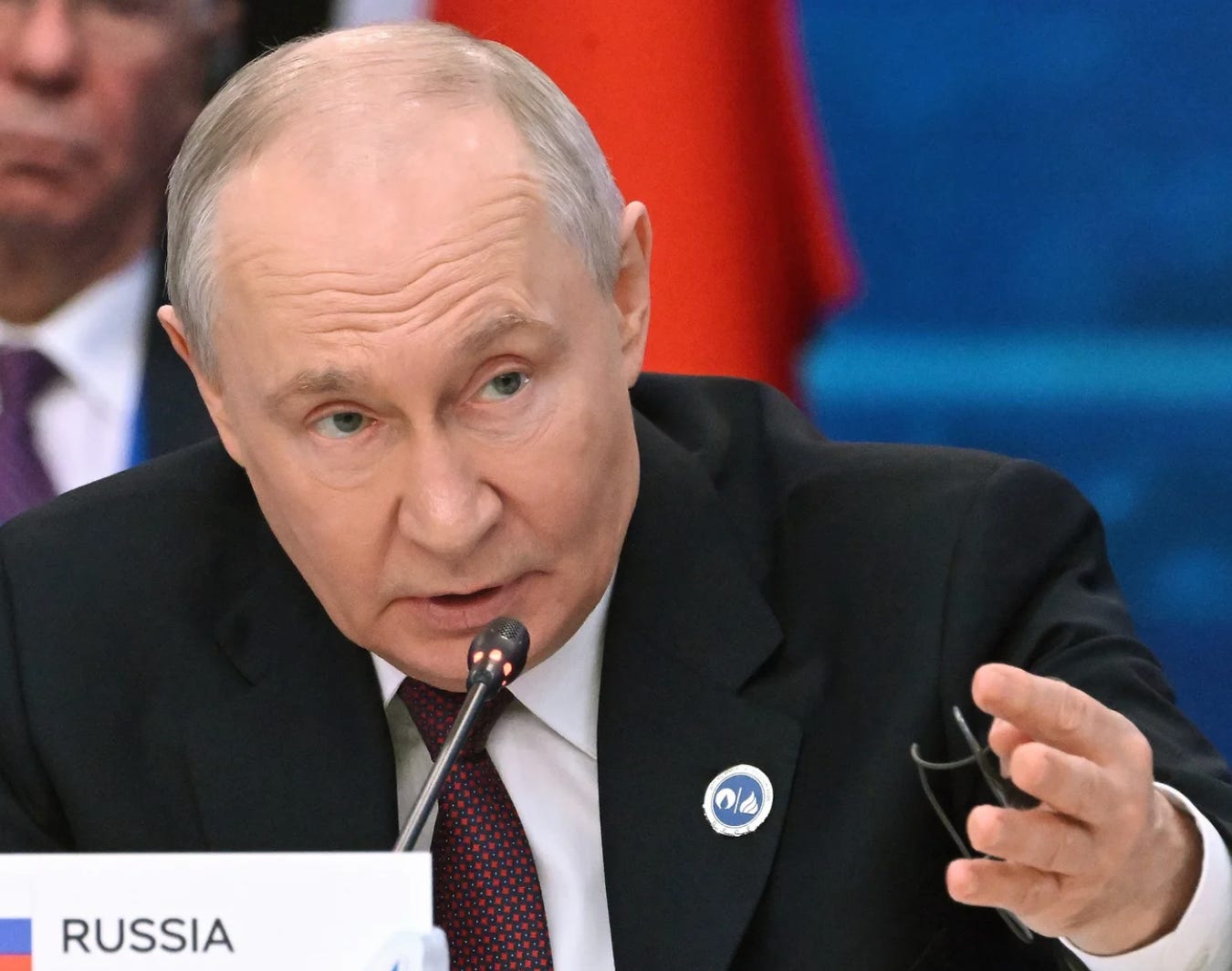
At the Russia-Africa Summit in Moscow, Putin waxes poetic on his friend Elon Musk, and how he has helped Russia in a time of need
Scott: As ZDF revealed in its documentary “Putins Helfer,” the Russian intelligence services ran an influence operation targeting Elon Musk for more than a decade. It started with a psychological profile that concluded that Musk was a drug addict with sociopathic tendencies, incapable of forming normal social relationships with women and fellow business figures, obsessed with self-aggrandizement and being portrayed as a genius—and most importantly, he was likely to betray the United States, and therefore a prime target for a recruitment-style operation. The US FBI learned that Putin himself supervised this operation, which included deploying Russian assets as prostitutes in honeytrap operations, as drug dealers to feed his habits, as gamblers, and as would-be friends to help his business operations. The Russians were particularly keen to penetrate SpaceX because of its access to supersensitive US government secrets. The whole operation was deemed by the Russians as fantastically successful, something we know among other things through the fact that it culminated in the establishment of direct communications between Musk and Putin—leading to a regular dialogue between them.
What exactly did Putin ask of Musk, and what did he deliver? We know much less about this, though details are now flooding in. For instance, it became apparent that Putin asked Musk to stop Starlink support to Ukrainian amphibious operations targeting Crimea, and Musk happily agreed—to the shock and consternation both of the Ukrainians and the Pentagon. More recently, Musk has throttled StarLink and StarShield support to Ukraine with his actions often times to directly overlap with Putin’s ballistic missile attacks on Ukrainian cities, effectively disabling Ukrainian defenses and multiplying the number of civilian casualties. Musk issued four responses to criticisms of this move, each of which effectively contradicted its predecessor—highlighting his highly dishonest public posture.
And today in the midst of his high profile Russia-Africa conference, Putin made praise and thanks to Musk the centerpiece of his conference remarks, suggesting in the process areas in which Musk was supporting the Kremlin; a true friend, ally and recruit for the Kremlin. US corporate media has collectively looked the other way in response.
Putin: Elon Musk is a Genius of the Highest Order. Russia is in closest contact with the United States—especially SpaceX founder Elon Musk—regarding space-related matters, President Vladimir Putin stated at the Russia–Africa summit. According to him, the agenda includes issues concerning low-Earth orbit (LEO) satellite constellations.
“We are in close contact with our American partners, including Mr. Musk, because it is crucial that we do not interfere with one another while in orbit; we must maintain a certain level of discipline and order,” Vladimir Putin explained. He noted that Roscosmos and other companies continue to cooperate with their American counterparts, despite political differences.
The “Rassvet” (Dawn) LEO satellite constellation is being developed by the Russian company “Bureau 1440” (part of IKS Holding). In March, 16 spacecraft from this constellation were launched into orbit.
Vladimir Putin pointed out that Russia is currently developing its own equivalent to Starlink—the “Rassvet” LEO satellite constellation—designed to provide broadband internet access. “Elon Musk is a brilliant man—truly brilliant. Just look at how many such satellites he has in orbit—over five thousand. We, meanwhile, are only taking our first steps,” said Vladimir Putin.
“I want to be a part of something that changes the world.”
1/23
Elon Reeve Musk was born in Pretoria, South Africa, on June 28, 1971, into a Canadian-South African family. He acquired his first computer at the age of ten, and two years later, he earned his first money by selling a game he had created, *Blastar*, for $500. He invested the proceeds into the shares of a pharmaceutical company. At the age of 17, he emigrated to Canada, where he enrolled at Queen’s University in Ontario. In 1992, he moved to the United States.
Darnkness Lingers Over the City of Light
Los Angeles Times
Charles: Reporting from Les Halles, one of the epicenters of the ongoing unrest in Paris, Michael Finnegan does what he does best: making the reader feel like he is part of the fabric of the story Finnegan is reporting on.
As the turmoil has grown, Paris has been the setting of odd contrasts.
As boulevard barricades were burning Oct. 17 in Les Halles, the lilting harmonies of a roving choir singing a peace ballad were soothing passersby shopping for cheese and wine a few blocks away.
Hours later, vandals smashed scores of windows around the corner and ransacked stores as neighbors watched in horror from apartments above. Unchecked by police, looters returned the next night.
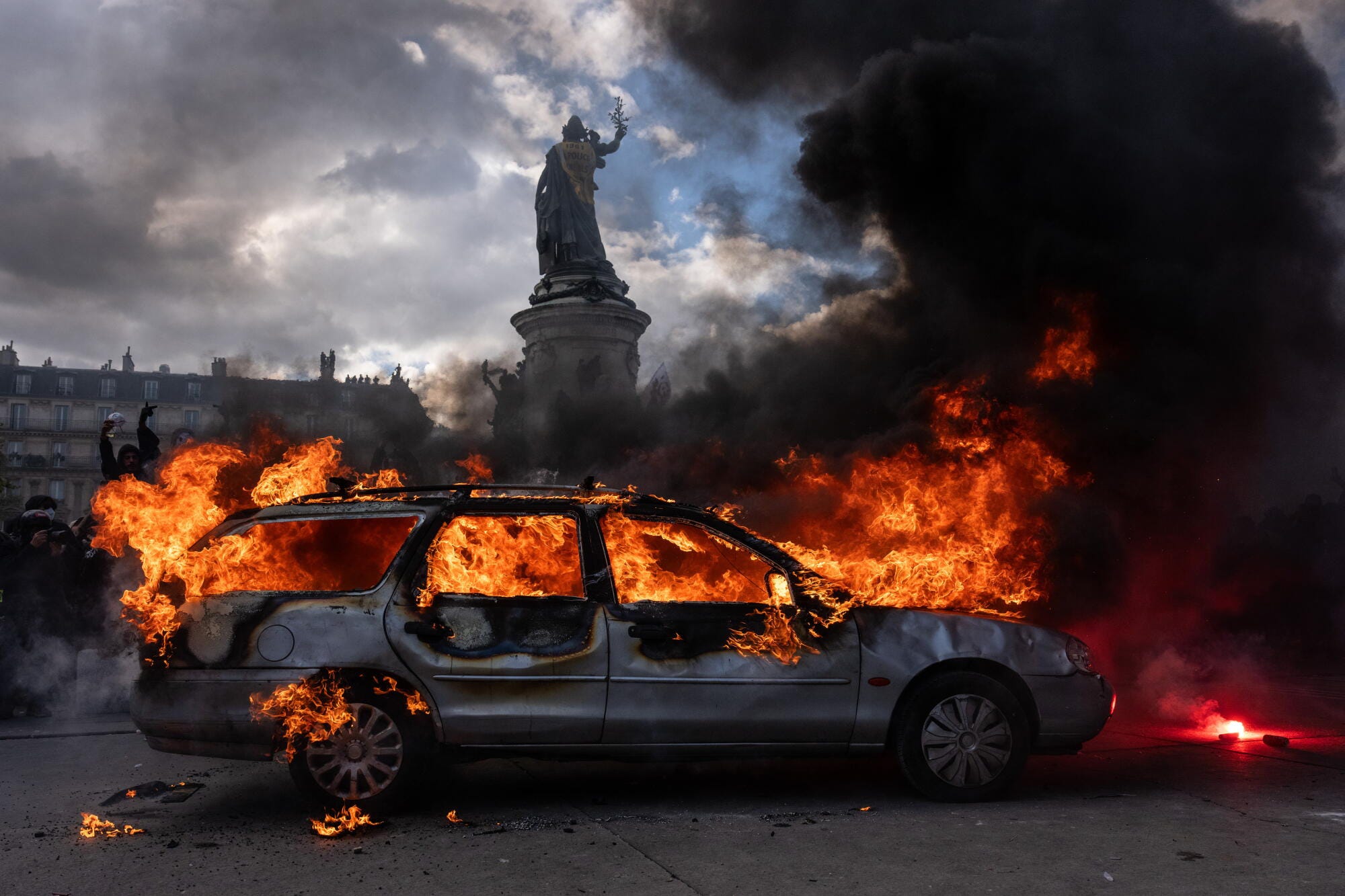
A car is engulfed in flames during demonstrations on Oct. 17 in Paris.(Carl Court / Getty Images)
Arnaud, 24, a pastry chef who works at a bakery and declined to share his last name, bought tear gas Friday “to neutralize someone if need be.”
“It’s incredible that it’s come to this,” he said as he left Gollety’s shop. “I think we’ve reached that limit where the French are saying, ‘OK, the state isn’t protecting me, I’m going to try to protect myself until the state protects me.’”
Chloé Brani, a 21-year-old student from the suburbs, carried a sign that summed it up: “We’re all fed up.”
She blamed inequalities in France on “elites who don’t care.”
If military and police money “were simply put back into the causes we’re asking for — a normal salary, normal living conditions for workers in every possible profession, and high schools in good condition — there actually wouldn’t be a problem,” she said as she marched. “It’s the distribution of wealth that’s unjust.”
District Court Judge Throws the Book at Justice, Again
Los Angeles Times
Charles: In a superb and blistering opinion, U.S. District Judge David O. Carter threw out the Justice’s Department’s latest obscene attempt to fuck up the election process five days before the election.
The Judge said the Feds’ allegations that there could be 20,000 noncitizens on California’s voting rolls were “not credible” and that the intervention it sought would violate a host of federal laws, sow chaos in the ongoing midterm election, likely lead to the disenfranchisement of legitimate voters and foster future political meddling in elections.
“This request violates longstanding constitutional principles mandating that states have control over their elections,” Carter wrote. “If [the Trump administration’s] last-minute request for relief were granted, either party could create chaos for their own political purposes to disrupt the election process.”
Carter, an appointee of President Clinton, wrote that never in American history “has the federal government, on the eve of an election, sought to coerce a state and local government to abandon their own Constitutional elections procedures and bend to the will of the Executive Branch,” and that, in bringing its suit, the Trump administration was asking the court to “believe that it reigns as a sole sovereign.”
“But California and its people are sovereign, too,” Carter wrote.
Carter’s ruling was the second to deny the Trump administration a temporary restraining order against the state and Los Angeles County this week, after a three-judge panel of the U.S. 9th Circuit Court of Appeals denied the government’s emergency request in a separate order Monday.
First Assistant U.S. Atty. Bill Essayli — who is the top federal prosecutor in L.A. and argued for the Trump administration at Tuesday’s hearing — wrote on X that his office had already filed notice of appeal and “will immediately seek an emergency order” reversing Carter back in the 9th Circuit.
“Every day, more ballots are processed by election officials. This ongoing emergency disenfranchises American citizens through dilution,” Essayli wrote.
State elections officials, other state leaders, voting rights advocates and election experts all cheered the ruling.
The long term solution for this chicanery is simple. First Assistant U.S. Attorney Bill Essayli and every other Justice Department official with their name on these outrageous documents should be referred to their local bar associations and disbarred for life.
The Delusions of American Power
Foreign Affairs
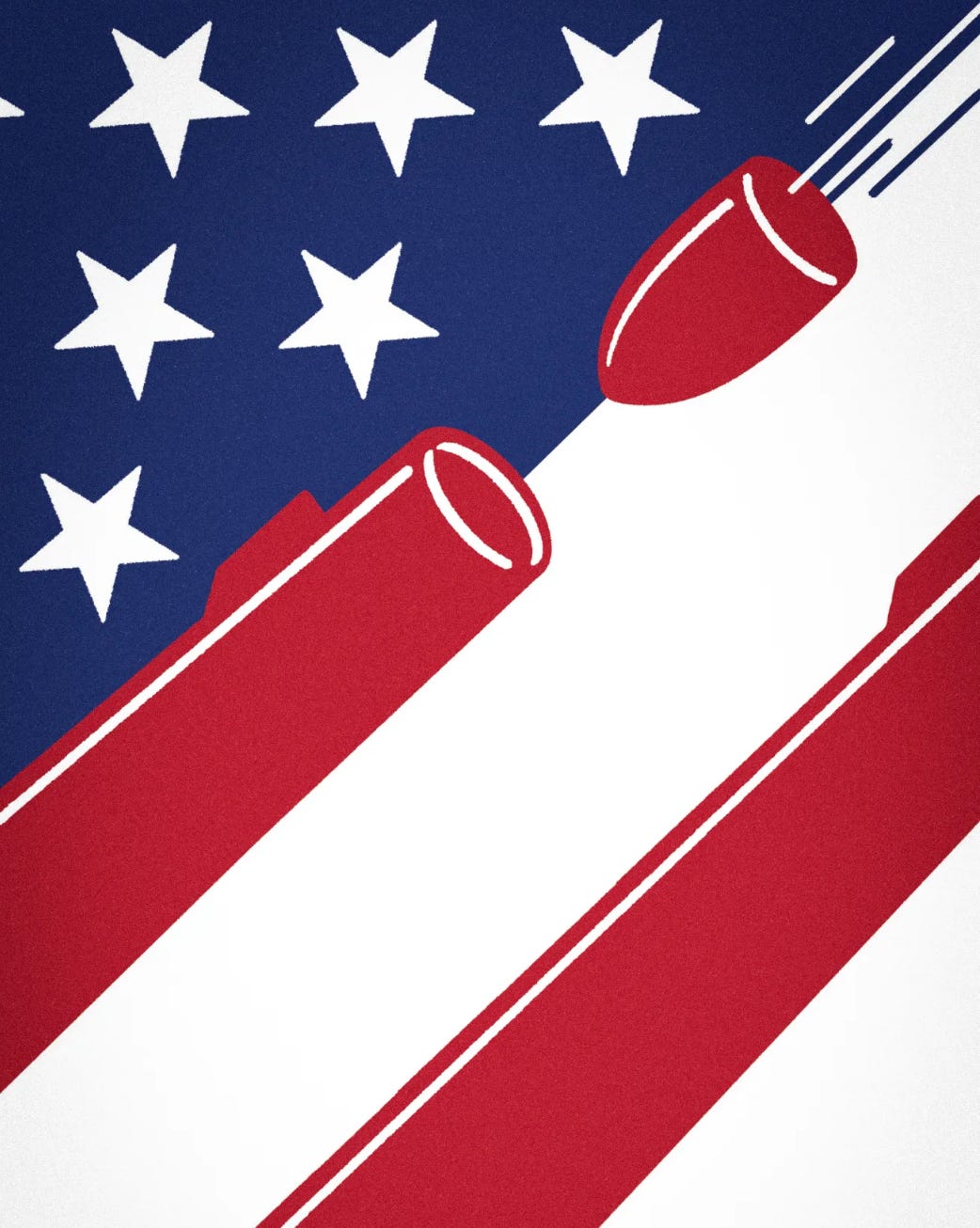
Scott: In a sweeping essay in Foreign Affairs, Bill McRaven channels a bit of Thucydides to explore the hubris that is so often found in American decisions to go to war, but notes that the Trump decision to wade into Iran is far worse than hubris—it’s blind stupidity. The US faces numerous tactical and strategic problems in the exercise of its war-making powers, but the most severe and unnecessary in the current environment is the installation of grossly incompetent leadership in the White House and the Pentagon.
The war in Iran is far from the first time that U.S. policymakers have failed to appreciate the limits of American power. But the Trump administration’s use of military force against the Islamic Republic since February 28 offers a particularly glaring example of a mistake that has often characterized American strategy in recent decades. The war was launched without a clear rationale and with a constantly shifting set of objectives—from changing Tehran’s regime and squelching its nuclear ambitions to, more recently, reopening the Strait of Hormuz, which wasn’t closed until the war started. The results, not surprisingly, have been bad both for U.S. interests and for the Middle East.
Still, to focus only on the blunders in Iran is to miss a deeper problem in U.S. foreign policy—one that preceded and will outlast Donald Trump’s presidency. Although the particular missteps in Iran may stem from the shortcomings of this president and the team around him, the overestimation of the potential of military force has been a growing feature of American strategy since at least the end of World War II. A tendency to wish away the limits of power accounted for some of the greatest mistakes of U.S. statecraft during the Cold War, with Vietnam the clearest and most consequential example. Yet despite an apparent commitment to internalizing the lessons of that overreach, this American delusion—our excessive faith in the capacity of military power to achieve victory and thereby fundamentally political ends—has gotten worse rather than better, especially in the past quarter century.
And unfortunately, there is good reason to worry that the delusion will deepen in the years ahead. Presidential power is becoming increasingly personalized as the constraints on it continue to erode. The politicization of the military (along with the diplomatic corps and intelligence communities) is making it less likely that policymakers will receive the best advice, including frank warnings about risks and costs. And the rise of artificial intelligence and new weapons technologies reinforces a sense of complete battlefield awareness and mastery, feeding superpower hubris. The risk of overreach has never been higher, at a time when the damage from overreach is becoming more difficult to repair…
Given the fall of the Assad government in Syria, the destruction of Hamas’s power in Gaza, the crippling of Hezbollah in Lebanon, and a weakened supreme leader in Iran itself, it is easy to appreciate the allure of trying to change the Iranian regime. What’s more, coming off the dramatic capture of President Nicolás Maduro in Venezuela, where the U.S. military exercised remarkable speed, lethality, and courage to overcome a very sophisticated defense, it was all too easy for U.S. policymakers to assume once again that the power of our technology and the courage and experience of our soldiers made us virtually invincible. But there is a reason no U.S. president has attempted to change the regime in Iran since 1979, and it has little to do with determination or political will. The challenges of legitimacy, coalition building, and geography; the will of the enemy; and the reality that it would be necessary to put American boots on the ground to achieve such an ambitious end all argued against it.
From the start of the Iran war, there was no attempt to build international legitimacy. It began on February 28 with a U.S.-Israeli strike. To make matters worse, an early airstrike went awry and hit an Iranian elementary school, resulting in the deaths of 120 students. Mistakes happen in war, but not acknowledging our error added to the sense of illegitimacy and vindictiveness, losing whatever moral high ground we might have had. The Trump administration failed to notify any U.S. allies of the impending strike, most notably neighboring Arab states, which resulted in a lack of regional trust from the outset. Later, when the president sought allied support to open the Strait of Hormuz, he was met with an international cold shoulder. This refusal came as no surprise: Trump had been notoriously caustic with European leaders.
There was never a clear understanding of the goals. The administration at first said it wanted regime change. But later Trump told reporters that he never cared about regime change. The administration claimed the urgency of preempting an imminent Iranian nuclear weapon. But when pressed, Trump later dismissed such concerns as inconsequential, since there was little left in Iran but “nuclear dust.” After Iran closed the strait, and reopening it to shipping became the primary focus of both military strategy and diplomacy, Trump told the world that it mattered little since the United States didn’t need the oil. The objectives seemed to change by the day. I have no doubt that American military planners understood the limits of airpower when it came to achieving U.S. aims in Iran; this should have been a signal to the White House that unless the military planned to invade Iran, victory was unlikely.
Geography was always going to be a limiting factor. In my almost 40 years of military service, much of that time in the Middle East, no general or admiral I ever met talked about Iran without talking about the Strait of Hormuz. It was the Iranians’ weapon of mass destruction, their bulwark against invasion, their ace in the hole no matter the game. Additionally, the Iranian leadership was in the position of the defenders: they only had to preserve and protect themselves to win. And protect they have. At this point, it is highly unlikely the U.S. military will ever stand on the ground they hold dear and call it our own.
To Build a Police State, Trump Starts With a Secret Police
Wired
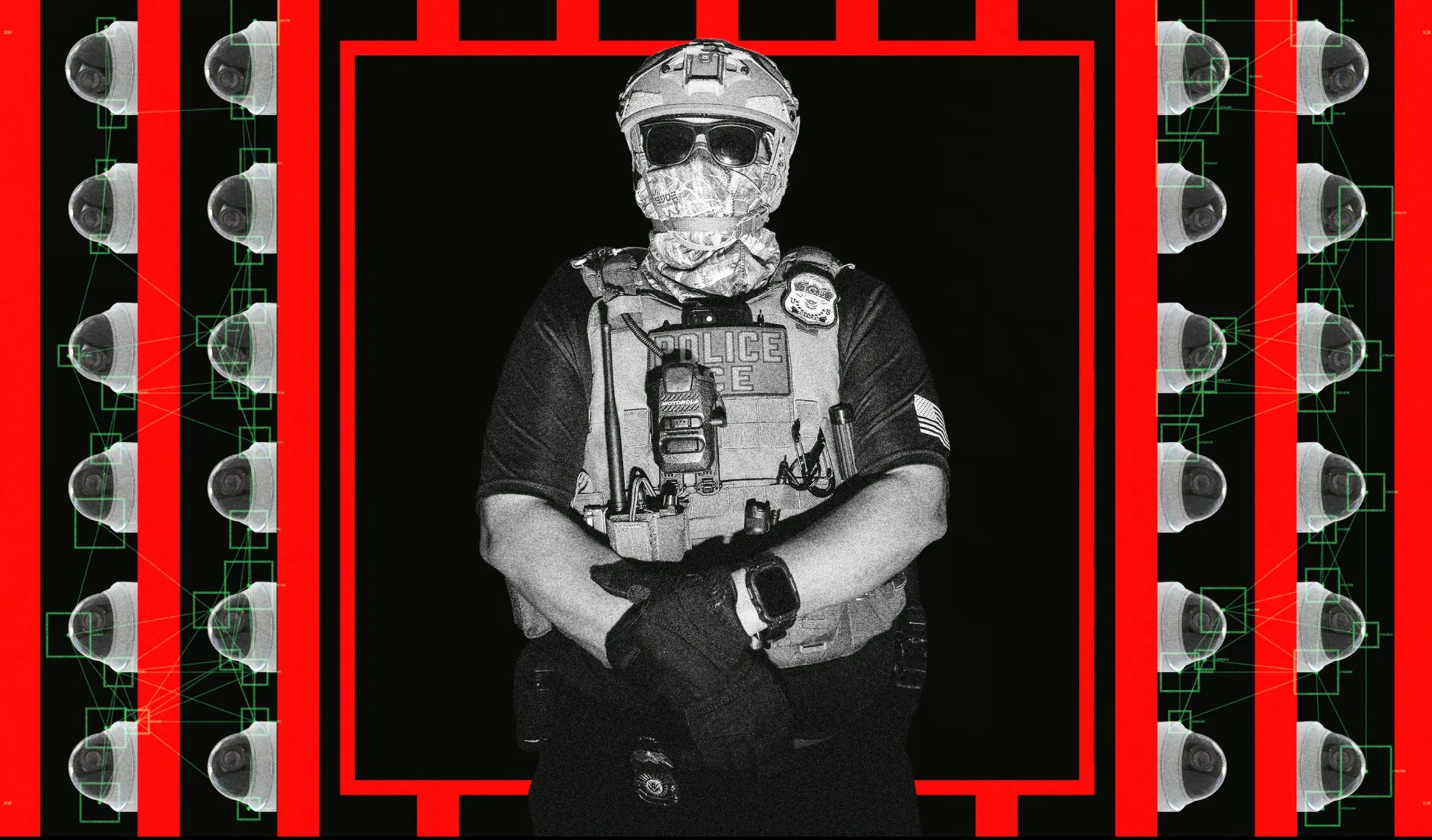
Scott: Discovery in litigation involving 15 persecuted protesters in Minneapolis has revealed something dramatic, but not really surprising. Trump secured a massive $115 billion budget to handle his immigration enforcement program from Congress: a sum that exceeds the total defense spending of each of America’s NATO allies. But the discovery shows that most of this money is not being spent on immigration enforcement at all. Instead, it is being diverted into the formation of a massive secret police operation with state of the art surveillance capacity targeting US citizens who are deemed hostile to Trump and his object of dictatorial rule. Wired offers an excellent discussion.
Attorneys for 15 Minnesota residents facing federal conspiracy charges have obtained evidence of a sweeping, possibly unconstitutional spying operation carried out by Immigration and Customs Enforcement against left-wing social movements in Minnesota and beyond.
The high-profile Minnesota 15 prosecution makes clear that the Department of Homeland Security (DHS), flush with federal funds and newly hired personnel, is now President Donald Trump’s primary tool against dissent, with a powerful array of post-9/11 investigative authorities brought to bear against everyday Americans organizing their communities.
Nothing of this scale has been seen in the United States, experts say, since the federal government’s counterinsurgency against the New Left and the anti-war movement in the 1960s and 1970s.
Among the records revealed during the discovery process in these cases are dozens of reports, audio transcripts, emails, intercepted Signal chats, photographs, database queries, and more. They reveal the inner workings of the domestic terrorism investigations, running under the names Project Whipple Shield and Operation Puppet Master, authorized by the controversial National Security Presidential Memorandum 7.
Published following Charlie Kirk’s assassination in September of last year, NSPM 7 instructs federal law enforcement to use every tool available against organizations and people who criticize the administration’s policies and espouse “anti-Christian” ideas. The full scope and extent of the investigations it authorizes remains unknown.
Defense attorneys for the Minnesota 15 claim that the prosecution stems from a broader nationwide surveillance operation aimed at opponents of the Trump administration’s immigration policies. One attorney in the case directly compares the DHS-run campaign to the FBI’s infamous Counterintelligence Program, or COINTELPRO, which unconstitutionally surveilled, infiltrated, and blackmailed racial justice, civil rights, and anti-war movements from the 1950s through the early 1970s.
Three former law enforcement officials who reviewed filings concur, telling WIRED that the case is almost certainly part of a wider intelligence-gathering operation that began long before the administration invaded Minnesota in December 2025.
Dueling motions in the case over discovery of DHS’s surveillance program reveal that personnel with Homeland Security Investigations—one of ICE’s two components—repurposed funding mechanisms and investigative tools for serious criminal probes and turned them on domestic dissenters. Operation Keyhole, the HSI undercover program that bankrolled the Minnesota 15 prosecution, dates back to 2008. As of June 2026, it was underwriting a half dozen active undercover investigations in the Minneapolis–Saint Paul area.
Around 120 HSI agents, many drawn from specialized units across the country that have served as the leading edge of the administration’s militarized immigration enforcement operations, were assigned to the case—including 11 undercovers. They used highly invasive surveillance techniques, including the deployment of Reaper drones and Patriot Act tools usually restricted to money laundering and terrorism investigations. Undercover operatives also infiltrated churches in apparent violation of a court order.
The Minnesota 15 indictment stems from the Trump administration’s demand that the Justice Department “go big and go loud” to crack down on community response networks during last winter’s Operation Metro Surge. Twin Cities activists organized volunteers to monitor DHS agents and their vehicles using encrypted Signal groups, homebuilt vehicle databases, and a centralized dispatch system. Government prosecutors claim that this amounts to a criminal conspiracy to block immigration enforcement, unlawfully identify and stalk federal agents, and even assault them.
Wall Street’s AI Debt Machine Is Starting to Choke on Supply
Bloomberg News
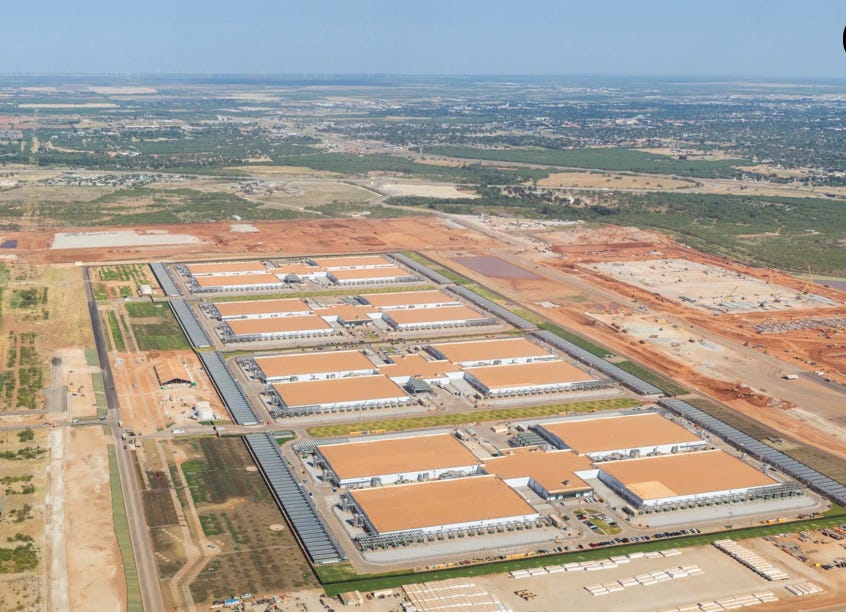
The Stargate Oracle AI data center campus in Abilene, Texas, on Aug. 26. Photo: Brandon Bell/Getty Images.
Scott: AI bubble pop watch is now underway.
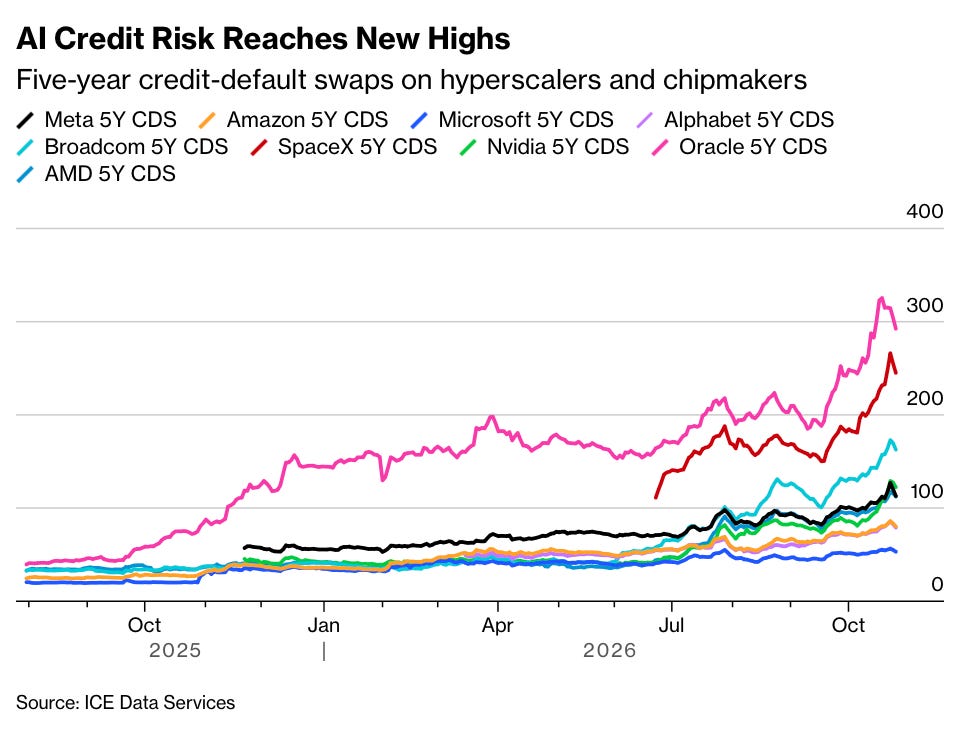
A new anxiety is gripping Wall Street as it bankrolls the vast network of data centers and chips behind the artificial intelligence boom: Early signs suggest that the credit market is approaching the limits of how much more debt it can absorb.
One after another, yields are soaring into the double digits on bonds and loans funding the AI infrastructure buildout. Bankers are finding it more difficult to offload risk to insurers and other investors. Elon Musk himself warned the other day that hundreds of so-called neoclouds risk going under as firms get cut off from fresh financing.
With those jitters growing louder each week — and spurring, in turn, angst about the potential economic fallout — Citadel Securities is cautioning clients that even the biggest names in tech could get ensnared as they put their balance sheets behind scores of projects critical to their AI ambitions. That risk is increasingly becoming evident in the market for credit default swaps, where banks and other lenders hedge their exposure. The cost of insuring against losses on the debt of companies from Broadcom to SpaceX and Oracle has spiked in recent days, reaching levels more typical of junk-rated borrowers. And the damage is already starting to spread to broader credit markets.
Citadel, to be clear, isn’t predicting an imminent credit crunch, and tech giants have managed to cobble together tens of billions of new financing this week alone. But in some ways that’s beside the point. The concern is that, with trillions more in debt needed over the coming years, there appears to be a growing disconnect between what Silicon Valley’s top executives believe can be raised, what financiers say they can deliver, and what money managers are willing to take down.
“When you have such a large quantum of debt coming, at some point the challenge could be less about finding an investment-grade backstop, and more about finding the actual buyers willing to absorb more of the risk coming from the same handful of investment-grade backstop providers,” said Citadel analyst Tucker Roberts.
In conversations with more than 30 bankers, money managers, private equity executives and others involved in recent and current data center financing talks, all acknowledged that raising cash has become significantly more difficult than it was just months ago.
A key reason is the growing concern among investors over cancellation rights and other contractual off-ramps that could leave them exposed if a major customer walks away. Those worries only intensified after Oracle issued a force-majeure notice last month seeking to defer payments if a massive New Mexico data center were delayed.
One hedge fund said it turned down a recent data center deal when it discovered that the firm under contract had the option to back out if the project were delayed by more than three months. Partners at a top 10 law firm who’ve worked on development financing for data centers have seen deals where compute customers can walk away if there are holdups of 180 days or more.
Webb Sees Turbulent Star Nursery

ESA/Webb, NASA & CSA, E. Sabbi, M. Zamani (ESA/Webb); Acknowledgement: M. H. Özsaraç
In this Webb image released on Oct. 22, 2026, we see a turbulent cauldron of star formation filled with dense clumps of gas. This region is named N159 and is located 161,000 light-years away in the Large Magellanic Cloud, one of the satellite galaxies orbiting the Milky Way galaxy.
This region has a lower metallicity (proportion of elements that are heavier than helium and hydrogen) than the Milky Way, giving astronomers an opportunity to learn more about conditions found in the early universe and how stars formed under those conditions.
Your Online Moment of Zen
Before The Deluge
Written by Jackson Browne
First released on his third studio album Late for the Sky, September 13, 1974.
This verion from the legndary No Nukes Concert in Central Park in 1979.
You can stram the whole fabulous evening here.
<iframe width=”560” height=”315” src=”
title=”YouTube video player” frameborder=”0” allow=”accelerometer; autoplay; clipboard-write; encrypted-media; gyroscope; picture-in-picture; web-share” referrerpolicy=”strict-origin-when-cross-origin” allowfullscreen></iframe>