



Is Trump Policy to Slow Nuclear Proliferation in the Middle East, or to Accelerate It?
New York Times
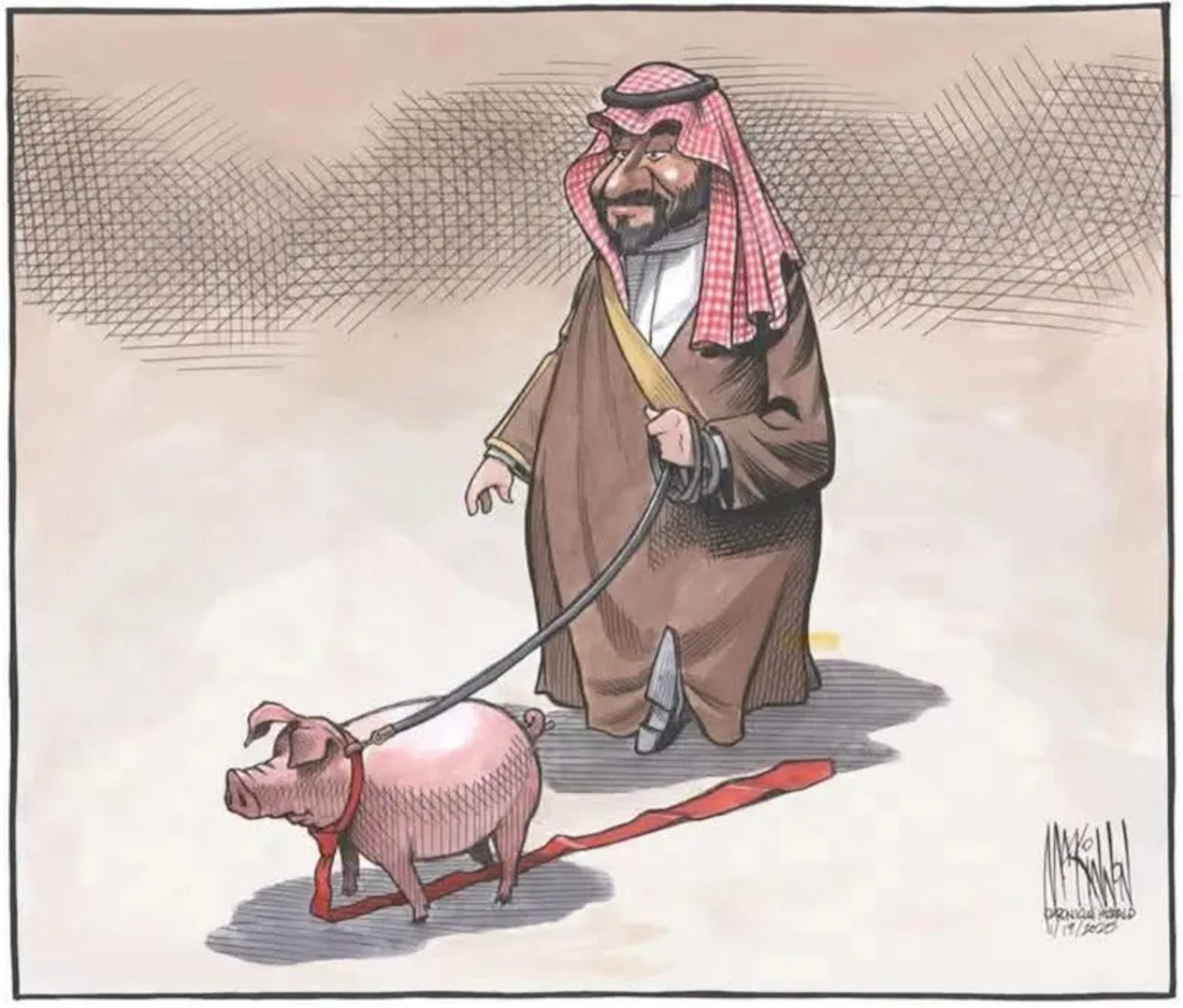
Bruce MacKinnon, Halifax Chronicle Herald
Scott: Trump launched a massive war of choice in the Gulf in the end of February in order to assure, as he said, that Iran would never have a nuclear weapon (after assuring Americans the prior summer that his strikes on Iran had “obliterated” the country’s nuclear capacity). So how to interpret Trump’s decision, overriding long-standing US national security analysis, to give Saudi Arabia a 1-2-3 agreement that includes the transfer of technology needed to enrich Uranium? The analysis I am hearing out of the region is consistent: Trump recognizes that he has failed in his efforts to stop Iran from developing a bomb. So he has shifted to a pro-nuclear proliferation policy that will now, within a matter of years, raise the number of nuclear powers on the Gulf littoral to two (Iran and Saudi Arabia), and in the broader region to six (India, Iran, Israel, Pakistan, Russia and Saudi Arabia). It is hard to imagine that other nations in the region with the obvious wherewithal—Egypt, the Emirates and Turkey, for instance—will refrain from doing so as well.
Let us now revisit the Doomsday clock. Trump is making the risk of a nuclear incident—an exchange in anger, or simply a “mistake”— in this terrorism-beset region exponentially more probable. And why?
At the end of the day, the Saudi decision to lavish billions on Donald Trump and his son-in-law is being rewarded. This bargain is not simply foolish from the perspective of peace and security, it is fundamentally corrupt. We must not lose sight of that fact.
Saudi Arabia signed a long-sought deal to obtain American nuclear technology on Wednesday, deepening its ties with the United States at a time of war and uncertainty across the Middle East.
The civilian nuclear deal, which would allow Saudi Arabia to enrich uranium on its soil, represents a triumph for the kingdom’s crown prince, Mohammed bin Salman. He has been trying to seal such an agreement for more than five years, pushing against opposition from American officials and experts who have raised concerns that the Persian Gulf nation could use the technology to pursue a nuclear weapon, spurring a new Middle East arms race.
The deal is also a signal that the Saudi leadership still views their alliance with the United States as essential and is eager to deepen American involvement in their country despite tensions stoked by the U.S. war with Iran. The joint U.S.-Israel war on Iran spurred a series of Iranian attacks on Saudi Arabia and other Persian Gulf countries, which host American military installations.
Nuclear reactors can take more than 10 years to build, and the deal could lock the kingdom into using American nuclear technology for decades to come, strengthening U.S.-Saudi security ties as well as commercial ones.
Note how NYT runs this “analysis” using all the talking points the White House gave them, ignoring the long-standing prior policy against the transfer of Uranium enrichment technologies into the region, and ignoring the financial underpinnings of Trump’s special relationship with the Crown Prince. This is some analysis.
Is There Any Limit To How Many Things Donald Trump Can Destroy?
New York Times
Charles: Yesterday afternoon Trump was promising a new surge of nuclear proliferation in the Middle East, in exchange for a series of huge payments to his family (See Scott above.) Yesterday morning, the front page of The New York Times provided an excellent summary of the havoc he is creating everywhere else.
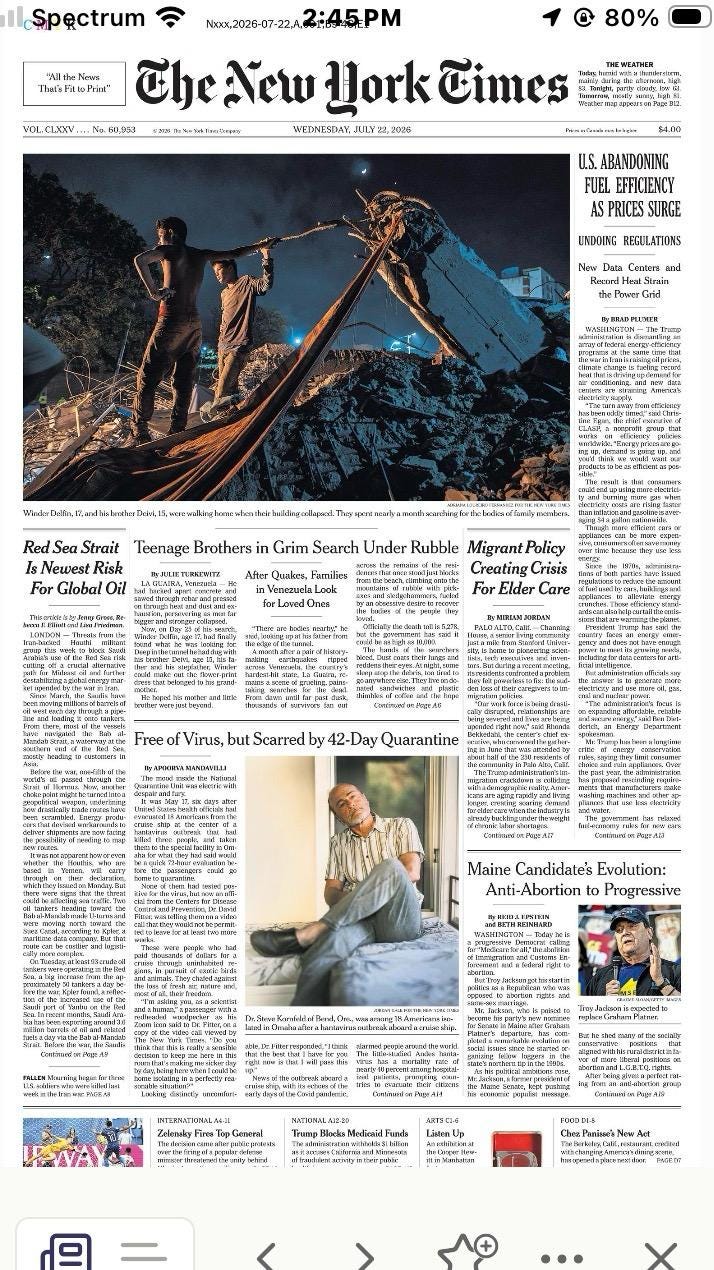
All above the fold were these stories, from left to right:
Red Sea Strait Is Newest Risk For Global Oil
Migrant Policy Creating Crisis for Elder Care
US Abandoning Fuel Efficiency As Prices Surge
Everything Trump and his minions touch turns to dust.
Mamdani on Netanyahu: The Mayor Gets the Law Right
Scott: Media reporting about Mayor Mamdani’s statement on arresting Benjamin Netanyahu is consistent in its flabby misunderstanding of international criminal law and mischaracterization of the proceedings before the International Criminal Court. But Mamdani’s statement is precise and correct: (1) Benjamin Netanyahu is an indicted war criminal; (2) the United States is not a party to the ICC, and thus is not obligated to arrest Netanyahu and render him to The Hague for trial; (3) nevertheless, the United States has the right if it wishes to arrest him and render him to justice, and indeed, the US has rendered prior indicted war criminals in just this manner; (4) Trump has announced that he will not do this; (5) hence, until the US Government changes its view, law enforcement authorities in New York City cannot arrest Netanyahu when he arrives to address the UN General Assembly in September. These points are simple and not really controversial, yet you can scour major American media to find any paper or broadcaster who reports them accurately. They routinely talk about “head of state immunity” and diplomatic immunity for visits to the UN in New York. But neither of these presumed immunities exist for indicted war criminals.
