



Pay for Play at the Pentagon / Meta’s Mega Settlement / Israel’s AI-Driven PR Campaign / Trade War Drives Up Toilet Paper Prices / A New Gigantic Telescope / After The Gold Rush
Trump Corruption Watch
Boss of Trump Jr-backed start-up donated to Republicans after winning US contract
Financial Times
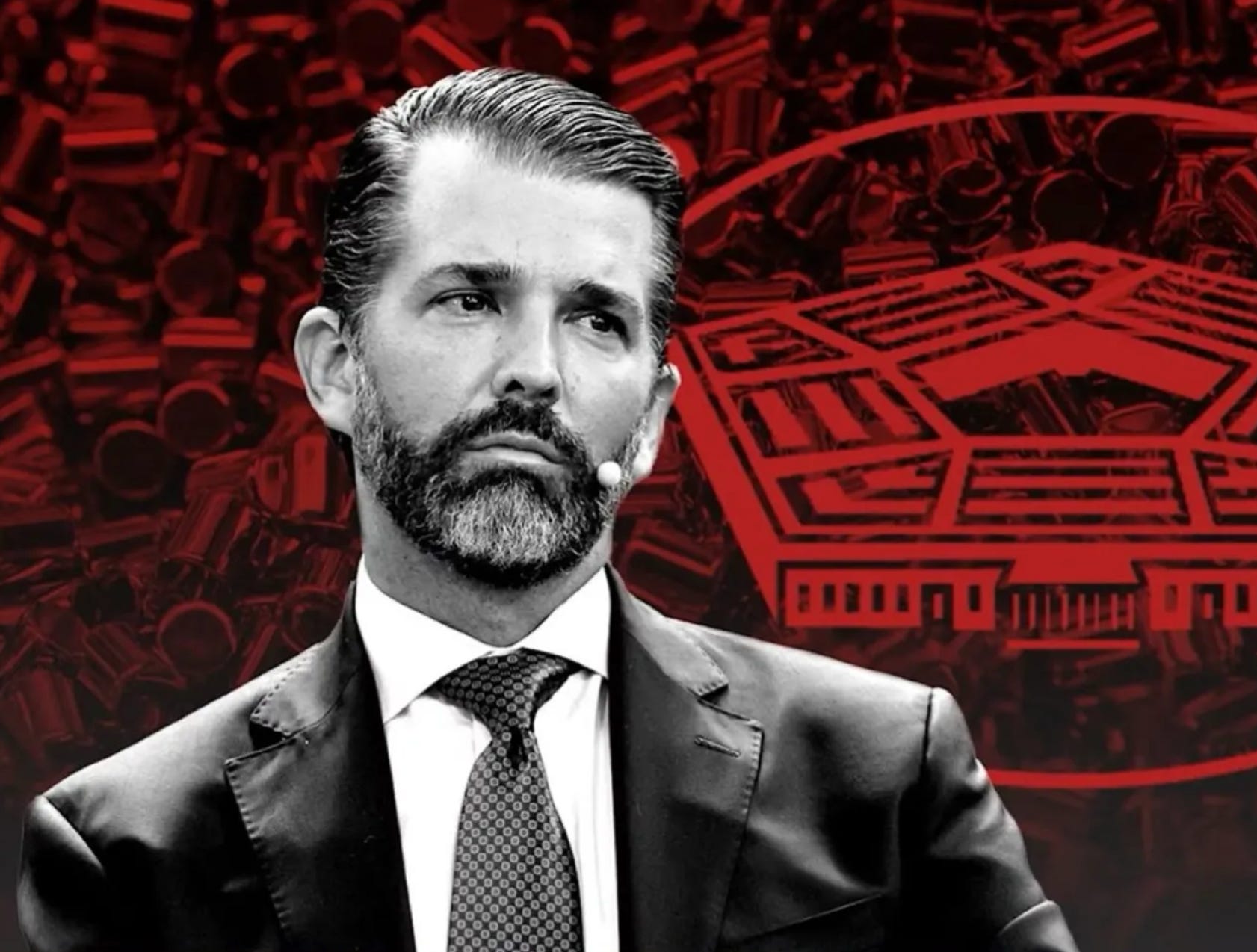
Scott: Pay-to-play in the Trump administration. This is how it works. And this is how Pete Hegseth holds on to his job, even as he is considered the worst performing secretary of defense in US history.
The boss of a defence manufacturing start-up backed by Donald Trump Jr’s investment firm donated almost $450,000 to Republican causes just months after winning a $900mn contract from the US government.
Hadrian chief executive Chris Power gave the maximum individual donation allowed to a number of Republican National Committee entities in July, after Trump Jr’s firm increased its investment in the company as part of a $1.4bn funding round.
Other executives at Trump Jr’s firm, 1789 Capital — whose portfolio companies have won several government contracts — gave a combined $300,000 to the RNC in the same month.
Hadrian is the latest 1789-linked company to prosper since Donald Trump won re-election as US president. At least four of 1789’s other portfolio companies have won contracts from Trump’s administration, while other groups backed by the president’s eldest son Donald Jr have received regulatory relief.
Last year, the FT reported that a little-known rare earths start-up, Vulcan Elements, secured a $620mn loan from the Pentagon, three months after 1789 invested in the company. Vulcan’s chief executive and officials at the Pentagon and commerce department said Trump Jr was not involved in the company’s deal with the government. Trump Jr told the FT he had no involvement in negotiations with the government on behalf of 1789’s portfolio companies.
Rocket propulsion start-up Firehawk Aerospace, backed by 1789, received more than $10mn worth of contracts from the US Air Force, while AI group Cerebras Systems, another 1789-backed company, signed a $45mn deal with the Pentagon. Quantum computing company PsiQuantum — a 1789 investment — also won more than $10mn in air force contracts last year, and this year secured a $100mn equity stake from the Trump administration.
Last October, the FT revealed drone maker Unusual Machines, in which Trump Jr held a multimillion-dollar stake, won its biggest contract from the Pentagon. Unusual Machines said Trump Jr was not involved in the deal. Representatives for the president’s son have repeatedly said he is not involved in any contract negotiations with the US government.
META Settles Landmark Suit For $18 Billion
The Wall Street Journal
Charles: In a landmark settlement which marks the first time a social media company has agreed to nationwide guardrails in America for users under the age of 18, Meta platforms will pay up to $18 billion to 48 state attorneys general because of social media’s harm to teenagers.
The company will pay $12.1 billion over ten years to end the trial that started last week, accusing it of purposely designing its platforms to addict children. The company will pay an additional $5 billion if its competitors agree to a similar settlement.
Meta’s chief legal officer, C.J.Mahoney, called on YouTube, TikTok and other social media platforms to follow Meta’s example and agree to the same restrictions, because it “will only work if all our peers join us. Because teens move fluidly across dozens of apps, we need an industry-wide solution.”
The company agreed to an additional payment of more than $1 billion to Texas, and a $459 million settlement to end outstanding privacy claims from the Cambridge Analytica scandal.
The key app changes required by the settlement included
A default two-hour daily time limit and nighttime blocks on the apps for users under 18
Muting all platform notifications by default during school hours
Strict new “age assurance” technology to keep children under 13 off the platforms entirely
Limiting Meta features that psychologists link to negative social comparisons, such as beauty filters and a tallying of the “like” button clicks.
Bringing in an outside auditor to guarantee long-term safety compliance.
“Today, we have secured a settlement with Meta that will make social media less dangerous for our kids and make a world of a difference for children and their families,” said Rob Bonta, the attorney general of California. “Meta has agreed to make massive transformations that will reduce the risk of harm from its platforms – and will do it within months.”
The settlement is the latest example of state attorneys general assuming the regulatory role which has been completely abandoned by the Federal government under the Trump administration. Big Tech companies have proven that the right amount of money contributed to enough Trump-related entities can prevent nearly all Federal regulation of their industry.
Meta had many reasons to seek a settlement to end the trial before Federal District Court Judge Yvonne Gonzalez Rogers in Oakland, California. Last month, it disclosed that it had spent about $2 billion in the second quarter alone to handle its legal challenges. And New Mexico Attorney General Raúl Torrez had previously convinced a Santa Fe jury that the company was liable for 75,000 violations of the state’s consumer protection law and ordered it to pay $375 million in civil penalties. A judge added another $567 million in August after ruling that Meta had created a “public nuisance” similar to air pollution, bringing New Mexico’s tally against the company to roughly $942 million.
In a separate Los Angeles trial earlier this year Meta and Google’s YouTube were jointly ordered to pay a 20 year-old plaintiff $6 million. She claimed that addictive platform features like infinite scrolling and video autoplay led to compulsive use resulting in severe depression, anxiety, and body dysmorphia.
The case settled yesterday was brought by the state attorneys general of California, Kentucky, New Jersey and Colorado. It sought $200 billion and alleged that Meta violated their states’ consumer-protection laws and the federal Children’s Online Privacy Protection Act of 1998, commonly known as COPPA, by knowingly making its platforms addictive and going after young users.
The Wall Street Journal noted the company is still facing thousands of lawsuits that have been filed by school districts and individual plaintiffs alleging social-media harms. The suits are aimed at holding it accountable for the design of its products, Instagram and Facebook, via a novel legal product-liability argument.
Israel’s Latest PR Operation Targeting Americans Features AI and Bots
The Guardian

A crow perches on an Israeli flag near an empty beach along the Tel Aviv coastline in April 2026.
Photograph: Ahmad Gharabli/AFP/Getty Images
Scott: Recognizing that it faces an increasingly difficult time with US voters, and particularly with youth, Israel has strongly increased its spending on US influence campaigns. One of its latest projects involves a fake US think tank called the Hanover Institute for Public Policy. The Guardian takes us on a tour of this effort, which is heavily driven by AI.
A pro-Israel messaging website badged with the name of a thinktank that does not exist has published more than half a million words in nine days, built on a commercial platform that promises to optimize content so that AI chatbots will cite it.
The site gives Israel’s position on subjects including the torture of Palestinian prisoners, Israeli war crimes and whether Israel has deliberately starvedPalestinians in Gaza, all presented as neutral research.
