



The $1.8 billion slush fund is dead!
Except, it isn’t.
The Guardian
Charles: Todd Blanche, the most proudly duplicitous acting Attorney General in American history, grabbed the news cycle yesterday by teliing Congress, “We’re not moving forward with the fund, period.”
That was the first sentence of the second graph of the story in The Times, which did the worst job of covering this story.
By announcing the end of a nearly $1.8 billion slush fund to pay off convicted criminals who also happen to be Trump supporters, Blanche spared Republican Senators the possibility of the harshest attack ads, which had inspired some of them to actually disagree with something done by the Trump administration.
But beyond noting that Blanche refused to put his promise in writing, the lead story in the Times completely missed the meaninglessness of his testimony.
The Guardian and The Washington Post did not make that mistake.
The Guardian explained:
Even though the federal government is scrapping its plans to create the fund, individual victims may be able to seek compensation by filing administrative claims for damages against the government. The justice department has broad discretion to choose how to settle those cases, so January 6 and other defendants could still conceivably receive compensation. Enrique Tarrio, the former leader of the far-right Proud Boys who was convicted of seditious conspiracy, told a reporter for PBS News Hour that was a possible path for January 6 defendants to continue to pursue compensation.
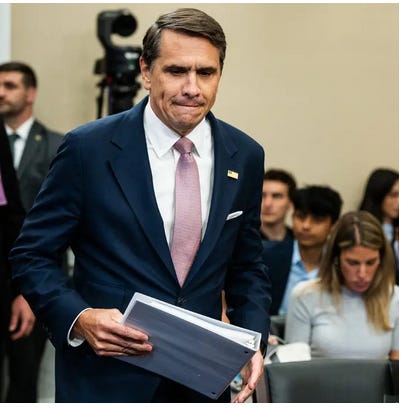
Acting Attorney General Todd Blanche
And The Washington Post made the even more important point that despite the supposed demise of the fund, all of its intended beneficiaries could still be paid off–in secret:
Even if the administration follows through with abandoning the fund, Trump could find other ways to reward allies who claim they were victims of a weaponized Justice Department.
For example, under the Federal Tort Claims Act, people are entitled to file claims against the federal government if they think they were wrongly hurt by government actions. Thousands of such claims are filed each year, including many that have come from Jan. 6 defendants.
Those claims have kept coming amid the uncertainty on the payout fund. Peter Ticktin, an attorney who has filed for compensation on behalf of Jan. 6 defendants, said he sought payments Friday for nine more clients, arguing in a court filing that each was owed more than $1 million for medical bills, lost income, pain and suffering, emotional distress, loss of liberty, and damage to their reputations.
“If there’s a fund, that makes it all a little bit easier,” Ticktin said. “But if there’s no such fund at all, the government needs to settle these lawsuits.”
The Justice Department could decide to settle such claims before they are brought to court, effectively deciding who deserves to be paid for damages by the federal government. That claims process is typically not made public.
The one thing that all three newspapers made clear was that Trump and his family retain the most outrageous benefit of the “settlement” between two different sets of lawyers, all of whom were working for the president. Nothing has changed with the order Blanche signed last month blocking all previous IRS audits of Trump, his company, and his family. After analyzing Trump’s tax returns in 2020, the Times guessed that he might have owed as much as $100 million in back taxes.
The Post noted that several Democrats pointed out Blanche’s outrageous conflict of interest, since he was Trump’s personal lawyer in multiple matters in the period between his two presidencies. With his usual glibness Blanche asked his interrogators:
“What are you saying is a conflict of interest? The fact that I used to have a job, and I now have a current job?”
The only answer is “yes.”
Epstein’s Modeling Machine
Süddeutsche Zeitung
Scott: In what capacity, exactly, was the Slovene model Melanija Knauvs introduced by Jeffrey Epstein to Donald Trump?
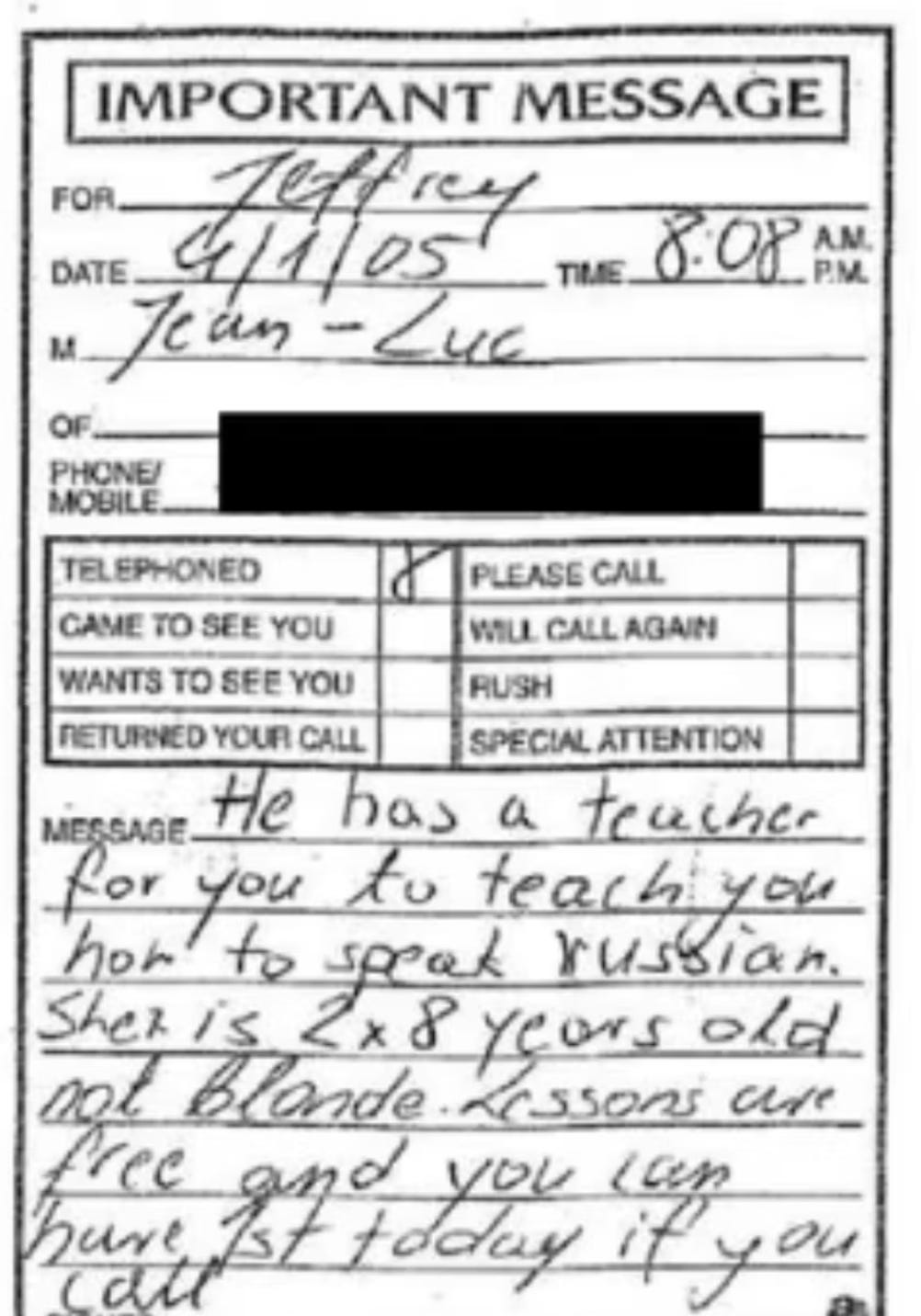
Among the materials that should have been released by the Department of Justice, but which mysteriously disappeared, related to an investigation into Jean-Luc Brunel and his modeling agency. Brunel trafficked many Eastern European women to Paris, and then to New York—where they found themselves ‘entangled in the web of Jeffrey Epstein,’ as Süddeutsche Zeitung’s exposé puts it.
One of these women was Melania. And much of the Brunel operation with Epstein sits at the heart of a criminal inquiry that Paris prosecutors are now pursuing, and with which Trump’s Justice Department is declining to cooperate.
Jean-Luc Brunel had become one of Epstein’s key accomplices in the recruitment of young women from Europe. He would later deny having supplied women to Epstein for sexual exploitation. Yet the narrative of his life can hardly be interpreted any other way.
When the two men first met—sometime in the late eighties or early nineties—Brunel was already an internationally successful modeling agent who liked to claim credit for having launched the careers of Monica Bellucci, Milla Jovovich, and Sharon Stone.
Brunel was famous for his parties at nightclubs such as “Les Bains Douches” and “Folies Pigalle,” and Paris was, at the time, still the undisputed fashion capital of the world. The most beautiful girls in the world flocked there; it was where supermodels were made—at least, that is, if they were also available at night, as a critical documentary produced by the American television network CBS in 1988 revealed.
“It’s a meat market,” an American model states in the film. She claims that at Brunel’s parties, the girls were present solely so that someone could take them home. “He has the agency; he has the girls. People ask him: ‘Jean-Luc, we’re partying tonight—can you bring a few girls along?’” If you said no, the model adds, “then you wouldn’t get any work.”
Even back then, the allegations involved far more serious matters: Another model, interviewed anonymously in the documentary, accused Brunel of having slipped drugs into her drink and subsequently raped her. Thysia Huisman, however, was unaware of this documentary when she accepted Jean-Luc Brunel’s invitation to Paris in 1991.
On a rainy Friday afternoon in May, Huisman sits at her high kitchen table in a spacious modern home in a suburb of Amsterdam. Now 53, she is a successful TV director; her bracelets jingle, and occasionally, as she speaks, her large rings tap against the marble tabletop.
Jean-Luc Brunel had taken notice of her through her modeling agency in Brussels, she recounts, and had invited her to come to Paris.
The Dutchwoman was eighteen years old at the time—in the autumn of 1991. The fact that she was expected to sleep in Brunel’s own apartment struck her as odd, Huisman says; yet her agency boss reassured her. It was an honor, she had said. Brunel—a friend—would take especially good care of her.
“Take care”—of all phrases, that was precisely how she had put it.
Knowledge Is Power
Scott: I believe passionately that one of the really poor items in media coverage in the United States is science reporting.
I am routinely pulling things out from major science journals that are significant news in themselves but haven’t really been covered as news.
Try getting the news you need from Charles and I, free for two weeks.
