



Money Talks, National Security Walks / Howard Lutnick Wears Kryptonite / Dummymandering Triumphs in North Carolina / This Land Is Your Land
Trump Reinstalls Jensen Huang at Nvidia, Launching Corporate Governance and National Security Chaos
Financial Times
Scott: Through the weekend, three major papers (WSJ, FT and NYT) were busy with exposés that demonstrated beyond any reasonable doubt (1) that Chinese intelligence had launched a major project over a period of two years to secure Nvidia’s state-of-the-art chip technology, principally for Chinese military use; (2) that Jensen Huang was in the crosshairs of this operation; (3) that Alice Huang and her Megaspeed operation were a principal vehicle of the operation; (4) that the operation was highly successful; and (5) that Trump himself was repeatedly briefed on all of this. At the same time, Trump was revving up a campaign to restore Jensen Huang as Nvidia CEO, and someone was busy buying Nvidia contracts in large volume at the market close on Friday with the expectation of making a killing as soon as Huang returned to Nvidia on Monday morning. Trump’s operation reached its successful conclusion when the Nvidia board, after listening to Trump directly, honored his demand and restored Huang as the company’s CEO.
These developments have provoked an unprecedented crisis at the intersection of corporate governance and national security. What’s at stake? Trump is engineering a new approach to corporate governance under which his role—that of the US government—is maximized, the role of traditional corporate governance rules, designed to ensure the integrity of the marketplace, is thrown out the window, and the role of the corporate board is moved into the twilight. Gone are basic norms of market economics. In their place, we see markets run through a duopoly of the state (now embodied in Trump) and the techbros, who are argued to be indispensable and beyond the effective reach of the law. And what does this mean for national security? That also is fairly simple. All concepts of national security are now subordinated to the economic interests of Trump and his entourage. The traditional process of national security policy formulation and implementation has simply been suspended.
All of this has come about because the traditional agencies of oversight and control—market mechanisms, government regulators, and the Congress—have been brought to heel by Trump’s alliance with the tech bros. And Trump is no doubt accelerating the process because he fears what may happen when the new Congress convenes on Jan 3. Will Congress rise to the occasion before the new year? It would be foolish to expect that.
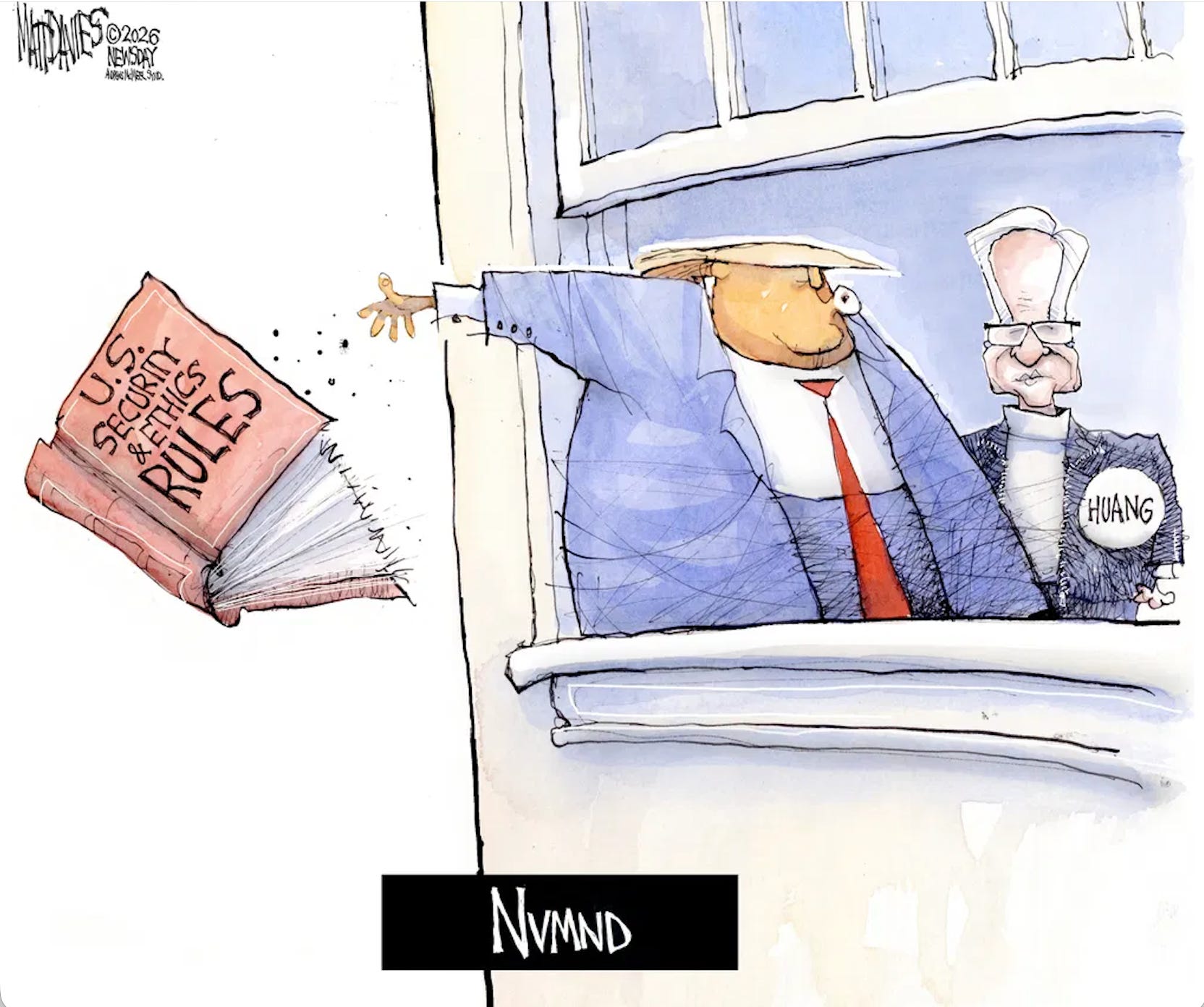
Matt Davies, Newsday
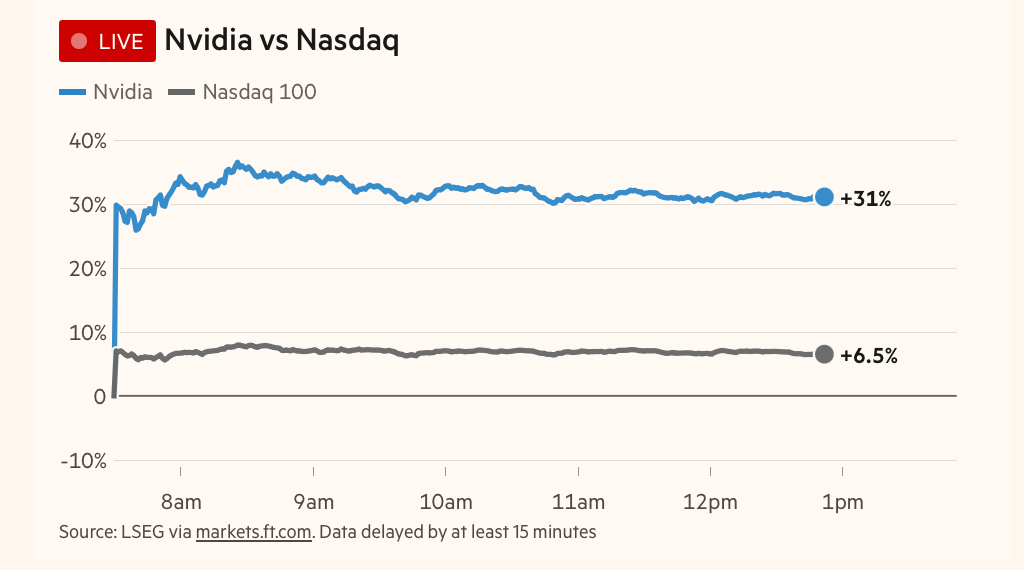
US stock markets leapt higher on Monday as the AI trade reignited following the return of Jensen Huang as Nvidia chief executive.
The Nasdaq 100 was up 7 per cent at midday in New York, reversing all of its losses from Friday’s brutal rout. The S&P 500 jumped as much as 5.6 per cent.
Nvidia shares climbed more than 30 per cent.
US President Donald Trump said he spoke to Nvidia’s board and “convinced them” to reinstate Huang.
“I spoke to them, let me just put it that way. And I convinced them,” Trump told CNBC.
In a statement on Monday, Nvidia said its board had voted unanimously to reinstate Huang “following a series of discussions and meetings . . . after which the board was satisfied with respect to Huang’s candour and ability to lead Nvidia”.
“This is a remarkable U-turn and should come as a considerable relief for Nvidia shareholders,” said Amish Patel, head of equity research at wealth manager Raymond James.
“There are very few companies where one individual is so closely associated with the strategy and success of the business, and Jensen Huang has been central to Nvidia’s transformation into the leading company of the AI era,” he added.
“The return of Jensen comes as a material surprise to consensus,” said Seb Barker, chief market strategist at Marshall Wace. “His return should help ease some of the AI panic which his exit contributed to, but was not solely responsible for.”
Howard Lutnick Is the Ultimate Survivor in the Trump Administration
Wall Street Journal
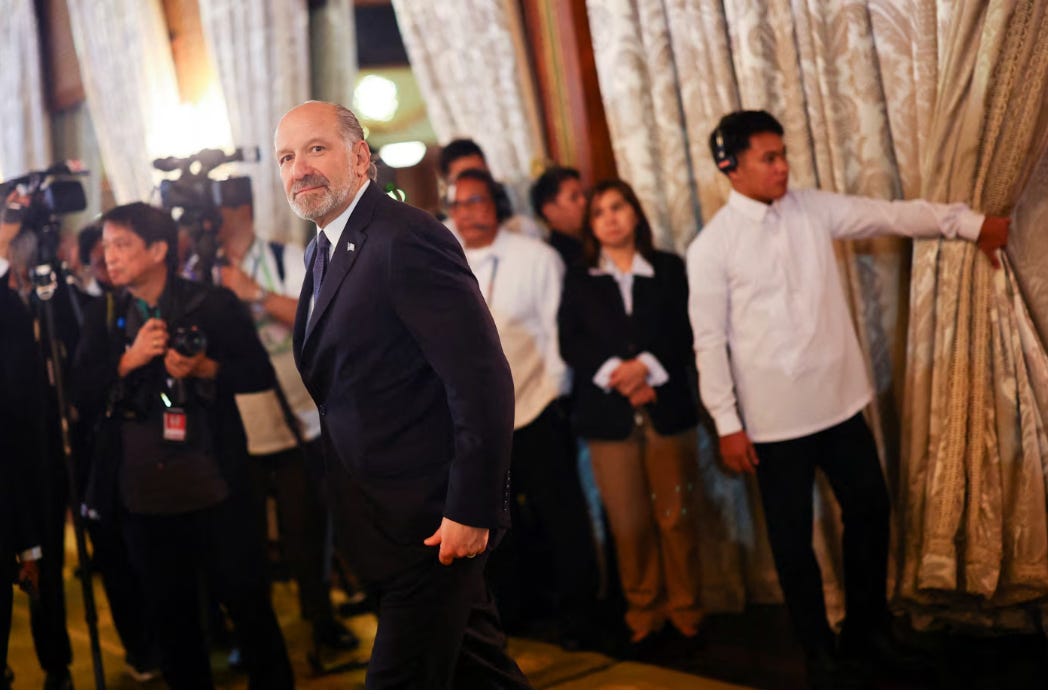
Commerce Secretary Howard Lutnick during a visit to the Philippines this past week. Photo: Carlos Barria/Reuters
Scott: Speaking of Howard Lutnick, how does he still have a job as secretary of commerce? Didn’t he lie point-blank and under oath to congressional investigators about his visits with Jeffrey Epstein, including to a certain private island? Why he did. WSJ reveals how he kept his job. When Trump began talking about firing Lutnick, he paid $25 million to Trump’s favorite slush fund, his presidential library project (which as it turns out is not really about a presidential library, but is all about giving Trump and his family discretionary control over a nice pot of cash). Then all the talk went away. This is how you solve such problems on Trump’s watch.
Trump was close to ousting Lutnick earlier this year after Lutnick acknowledged he had visited convicted sex offender Jeffrey Epstein at his private island, according to people familiar with the matter. But Lutnick, a billionaire and former chairman of Wall Street firm Cantor Fitzgerald, made a $25 million donation to Trump’s presidential library, and Trump stopped talking about replacing Lutnick, the people said. The donation was earlier reported in the book “Regime Change.”
Lutnick sometimes meets Trump at the White House for off-the-books meetings after staff have gone home for the night, according to officials familiar with the matter. Trump sometimes gives Lutnick directives at these one-on-one meetings, unbeknown to the president’s other top advisers, the officials said.
Spontaneous Republican Spine Generation
Republicans Break With Trump Over Jensen Huang
New York Times
Charles: What a difference a wave makes.
It was a rare instance of the G.O.P. pushing back on the president and threatening to use its oversight and legislative power to challenge his administration’s approach.
In its statement announcing Mr. Huang’s return, Nvidia said that its board had “received input from senior levels of the United States government,” leading it to conclude “that Mr. Huang’s reinstatement poses no national security risk.”
That assertion drew sharp criticism from Senator John Cornyn, Republican of Texas.
“No national security risk?” he posted on social media. “Based
Mr. Cornyn, who is leaving Congress in January, also questioned the handling of the intelligence that Mr. Huang had been affiliated with a Chinese asset, and previewed questions that he and others were likely to pursue in the coming weeks and months.
“Did the FBI do a defensive briefing of Huang?” Mr. Cornyn wrote. “If not, why not? If so, what did they tell him about the risk? Did he ignore it?”
North Carolina Wins Dummymandering!
Wikipedia
Charles: North Carolina redrew its congressional districts three times in the last five years to increase its Republican representation in the House of Representatives.
This result was a huge, unintentional success for democracy.
This week the final North Carolina House race was called in the 5th District with another magnificent Blue Wave result. Twenty-year Republican veteran Virginia Foxx was beaten by Chuck Hubbard by 330 votes out of 287,000 votes cast.
Two years ago Hubbard had lost to Foxx by 19 percent.
His victory made a total of seven districts flipped by Democrats in North Carolina.
Like so many other miserable Republicans consigned to the dustbin of history by this election, Foxx had always been a fountain of hatred. She voted for the constitutional amendment to ban same-sex marriage, against the Matthew Shepard hate crimes bill, and against the Respect for Marriage Act. She called the idea that homophobia caused Shepard’s murder a “hoax” and claimed it was just a robbery.
Hubbard’s journey to the House began the day after Trump was elected the first time. His daughter called him and said, “Dad, every bit of progress we ever made is gonna be taken away from us.” In a video that went viral, he promised to do “whatever, whenever, however I can to protect the LGBTQ community.”
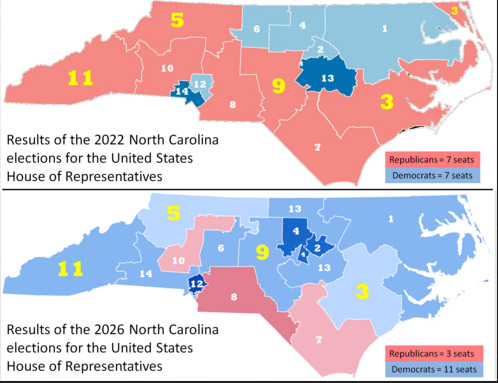
Hubbard is the first Democrat to represent the 5th District since 1995.
His win puts Democrats at 258 seats in the next House, the biggest Democratic majority since 1992.
More than 700,000 Russian troops died in the war in Ukraine by late September 2026
Meduza
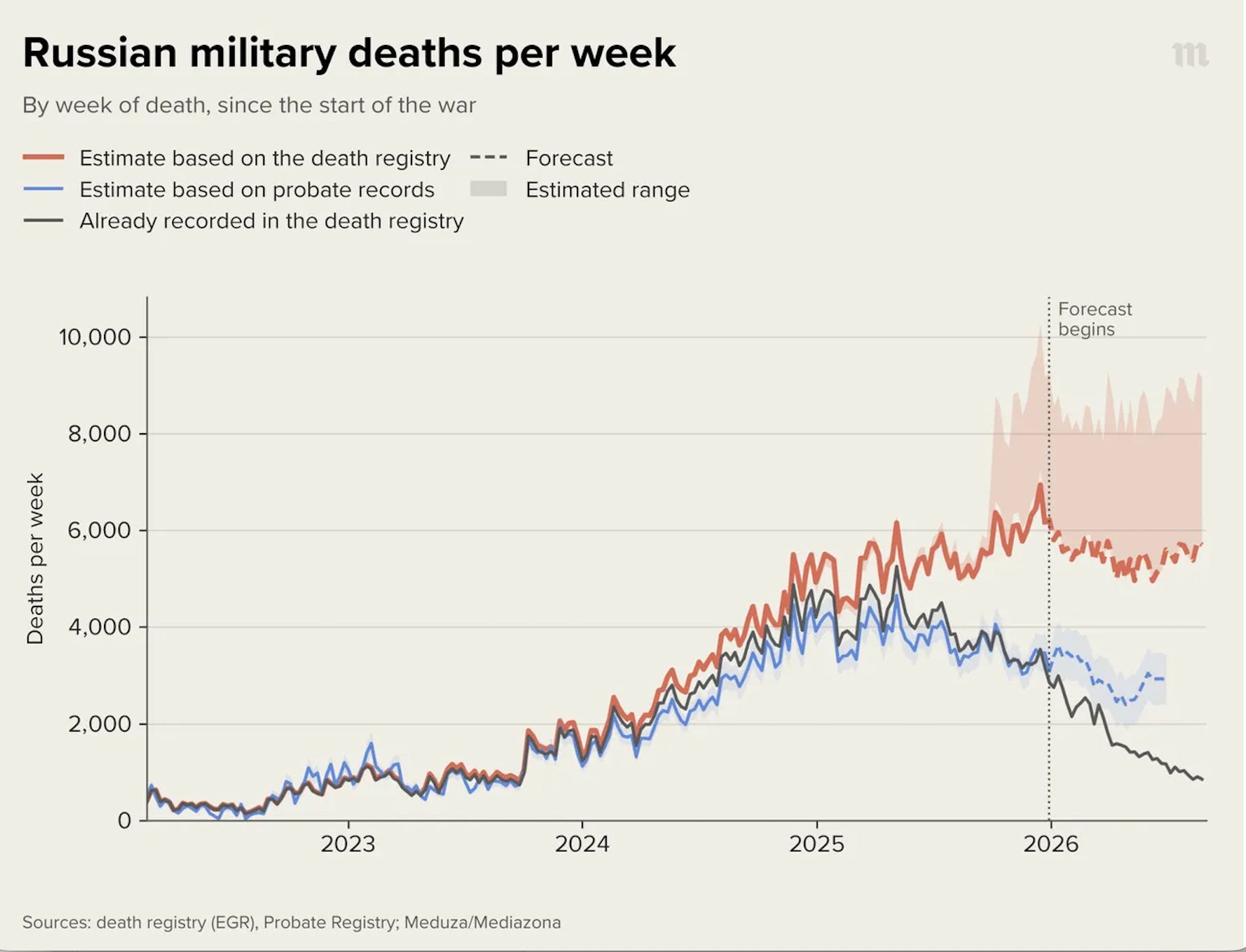
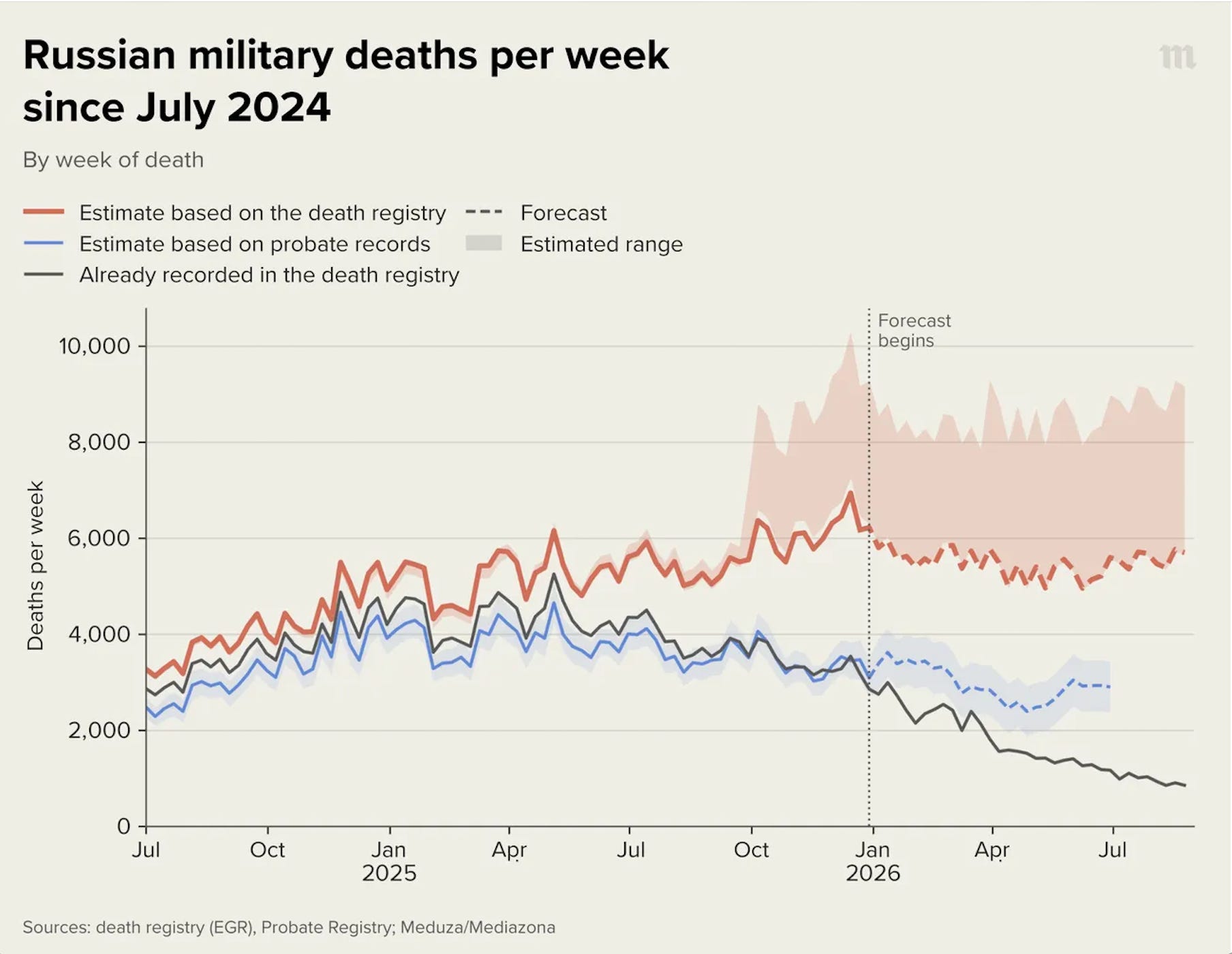
Scott: In Russian history, Putin is ensuring a special spot for himself—as the man who brought about the early death of an entire generation of Russia’s young men, all in connection with a failed military campaign to conquer Ukraine. More than 700,000 young Russian men have died in this effort so far and a much larger number have been removed from combat due to disabling wounds. We know this through a series of massive leaks from Russia’s statistical agencies, as authoritatively interpreted by Meduza and Mediazona.
On November 1, news broke that hackers from the Belarusian Cyber Partisans and Silent Crow had breached the website of Rosstat, Russia’s federal statistics agency, and obtained data on Russian military losses in the war through fall 2026. The hackers used that data to produce their own estimate of how many Russians had been killed on the front lines. They also shared the database with reporters, including those at Meduza and Mediazona, which have been tracking Russia’s military death toll together for several years. We examined the hacked database and concluded that it was very likely authentic. We then compared its records with other sources and ran a new analysis. Our earlier studies relied mainly on data from the Register of Inheritance Cases. The Rosstat database makes the new estimate more reliable. Another important change: The new estimate counts both registered deaths and missing service members, many of whom will likely be confirmed dead.
Based on registered deaths alone, we estimate that 490,000 Russian service members had been killed by fall 2026. Including missing service members brings the estimate to more than 700,000.
By the end of September 2026, at least 490,000 Russian service members had been killed in the war with Ukraine. These are people whose deaths have already been registered and appear in the leaked Rosstat documents. Meduza and Mediazona jointly checked the data obtained by the hackers and found it to be genuine. It would simply be impossible to fake this many records that match information from other sources.
The leak is valuable because it contains a large amount of previously unavailable data. It lets us recheck the estimates of Russian military losses that Meduza has calculated since 2023 based on the Register of Inheritance Cases. But the Rosstat documents alone can’t tell us how many people have died in the war. Even this database gives only a partial count of Russia’s military deaths. The database doesn’t include service members who have been killed but whose deaths haven’t yet been registered.
Both the leaked data and the inheritance register show that such registrations still happen, though rarely, even for deaths dating back to 2022 and 2023. Since 2024, the share of late registrations has grown dramatically, and it continues to rise. Today, it’s simply impossible to leave this category out of an overall estimate of the dead. But estimating how many deaths remain unregistered isn’t easy. Rosstat’s data alone isn’t enough, so additional sources are needed, and the analysis requires complex statistical methods.
Using all the information available to Meduza and Mediazona, we estimated the full death toll, including deaths that will be registered later. We did this using methods from actuarial science and epidemiology. Analysts in both fields calculate the number of events that have happened but haven’t yet shown up in the data, a problem similar to the one we face.
The final estimate is grim. We estimate that more than 700,000 Russian troops had been killed by the end of September 2026, compared with 490,000 registered deaths. Tests on older data showed that the estimate could be off by a wide margin, with nearly all the uncertainty concentrated in the most recent 12 months. The estimates for earlier years are considerably more precise and explicitly account for both recorded deaths and missing service members who have yet to appear in the death records.
Quote of the Day
“Damn, this is a tough room, and I’ve been in the Oval Office. Alone. With its new interior decorator.”
—Canadian Prime Minister Canadian Prime Minister Mark Carney, addressing the Parliamentary Press Gallery Dinner in Ottawa on Saturday night.
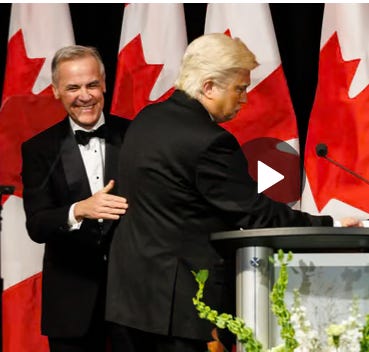
Canadian Prime Minister Mark Carney on stage with a Trump impersonator in Ottawa on Saturday Night.
Scott Explains The Deutsche Bank Leak on KPFK Los Angeles
Veteran broadcaster Ian Masters hosts Scott on Background Briefing to discuss the 15 million leaded Deutsche Bank Documents.
Listen to them here.
NATO Intelligence Services Conclude that Putin Is Preparing to Deploy Nuclear Weapons in Space
Süddeutsche Zeitung

Scott: Russia’s huge and largely obsolete nuclear arsenal occupies a special position in Vladimir Putin’s imagination. As an economic power, Russia is fading on the world stage, now occupying a position below Spain and Italy and declining another step in the rankings every few years. The Ukraine war and an improvident focus on oil and gas to the exclusion of everything else are producing an ever bleaker future. But Russia has lots and lots of nukes, and this is what makes Russia important on the world stage, or so reasons Putin. Now how to make the balance of the world believe that? Threatening to use nukes, which Putin does at the drop of a hat, is one way. But advances in military technology is another. And what could possibly be more terrifying than designing and launching nuclear weapons into space?
By the way, why is it that almost all critical reporting on nuclear proliferation breaks in the media in Germany, Sweden or the UK, and none of it—ever—in American media? It’s puzzling. Or perhaps not.
Russia is reportedly planning to deploy a nuclear weapon in space as early as this year. This assessment is shared by Western intelligence and military agencies—including the German Armed Forces (Bundeswehr) and the Federal Intelligence Service (BND)—according to research by the Süddeutsche Zeitung, NDR, and WDR. The Russians are allegedly planning to launch a satellite equipped with a nuclear explosive device into space. Reports suggesting that this could happen within the current year have recently been shared among several NATO member states. In recent weeks, experts from the German Armed Forces have reportedly briefed key politicians on these Russian plans, including Defense Minister Boris Pistorius (SPD).
When asked for comment, a spokesperson for the German Federal Ministry of Defense stated only that they are “continuously and diligently monitoring global developments in space, as well as the activities of other nations.” The Ministry further cited the need for secrecy and the confidential nature of such briefings. The Russian Embassy stated that it had no information regarding the matters described. In a press conference on Monday afternoon, Friedrich Merz (CDU)—referring to the reports—remarked: “The news that Russia is planning to introduce nuclear weaponry into space is not new, but that does not make it any less shocking. It demonstrates the level of escalation that Russia is evidently prepared to pursue.”
A satellite designated “Sputnik-S” has reportedly been stored in the Moscow area for years. In October, the U.S. Defense Intelligence Agency (DIA) issued a warning: “Russia is developing a satellite that is intended to carry a nuclear weapon.” Should Moscow proceed with these nuclear plans, it would constitute a violation of the 1967 Outer Space Treaty. The agreement prohibits placing “objects carrying nuclear weapons or any other kinds of weapons of mass destruction” into orbit around the Earth. In December 2024, the UN General Assembly voted on the continuation of the treaty – Russia voted against it.
Even back then, the U.S. warned that Moscow might station a nuclear weapon in space. U.S. intelligence agencies initially focused on the Russian satellite Kosmos-2553, which was launched into space in February 2022—shortly before the invasion of Ukraine. Western sources questioned Russia’s claim that Kosmos-2553 was conducting research on space radiation; instead, they suggested the satellite served as a “dummy” designed to test how radiation affects satellites—and at what point a satellite sustains severe damage.
This Russian plan would represent the latest escalation in the ongoing militarization of space—a trend that has been intensifying for years and was the subject of a months-long investigation by the SZ, NDR, and WDR. There have been repeated provocations in space: in November 2021, for instance, Russia conducted a military maneuver by using a missile to destroy one of its own satellites. The resulting debris posed a danger to the astronauts aboard the International Space Station (ISS). Last September, the U.S. acknowledged that it had stationed weapons in orbit capable of being used for offensive purposes. A few weeks later, a Russian satellite approached a Western satellite, coming within about a hundred meters and trailing it. Chinese satellites have also been suspected of involvement in espionage.
Studying Cancer Cells in Microgravity

This Nov. 19, 2026, image shows gastric microtumors grown within an Encapsulates biochip. The Encapsulate-1 investigation studies patient-derived tumor samples aboard the International Space Station to better understand how cancer cells move and interact in microgravity. The results could help researchers develop further testing to predict a patient’s risk of metastasis and support more personalized cancer treatments.
Orbiting more than 200 miles (320 km) above Earth, the space station is a powerhouse of cutting-edge science that is unlocking discoveries not possible on Earth.
Image credit: Encapsulate Inc.
Your Online Moment of Zen
This Land Is Your Land
Written by Woody Guthrie
Performed by Bob Dylan
November 4, 1961
January 20, 1961: John Kennedy becomes president of the United States.
January 24, 1961: Bob Dylan arrives in New York City.
January 29, 1961 Bob travels to New Jersey on a bus to meet Woody Guthrie.
October 26, 1961: John Hammond signs Dylan to Columbia Records. Bob was first known inside the building as “Hammond’s folly.”
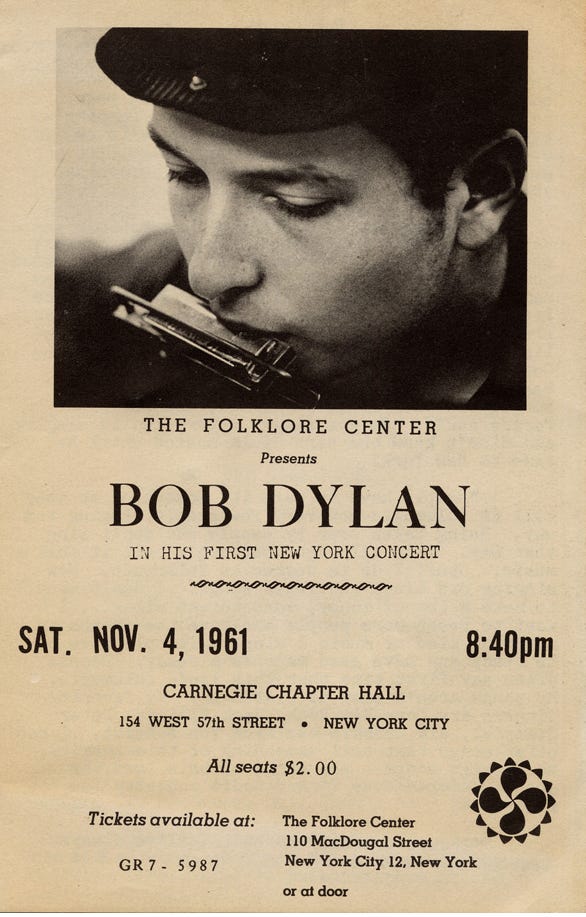
November 4, 1961: Izzy Young books the Carnegie Chapter Hall for $60. Fifty-three customers paid $2 each to be there. It was at 881 Seventh Avenue, above what is now Weill Recital Hall. This was Bob’s first formal concert in New York north of Greenwich Village.
October 26, 1963. Bob makes it to the real Carnegie Hall. This time tickets were $2 to $3.50.
He only played three more concerts at Carnegie Hall after that. The last two were on January 20, 1968.
I got to New York eight months after that final concert. Lanning Melville drove me there in his Peugeot 403.