



Bring Back Andrew Carnegie!
Why The New Oligarchs
Make Krugman Nostalgic
Paul Krugman
Charles: Elon Musk and the Tech Bros make Andrew Carnegie and John D. Rockefeller look like models of decency and generosity.
The new oligarchs are richer, more selfish and more successful at damaging democracy than their early 20th Century predecessors.
That’s the conclusion of the indispensable Paul Krugman who offered this chart to show how much worse America has become in 2026 compared to 1918.
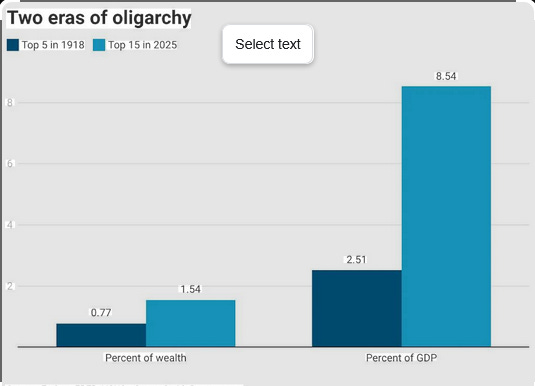
This chart illustrates a significant increase in the concentration of wealth and GDP share among the top economic elite in 2025 compared to 1918. [1, 2]
Wealth Concentration: The top 5 wealthiest individuals in 1918 held 0.77% of total US household wealth, while the top 15 in 2025 held 1.54%. [1, 2]
GDP Share: The top 5 wealthiest individuals in 1918 controlled a share equivalent to 2.51% of the nation’s GDP, rising to 8.54% for the top 15 in 2025. [1, 2]
Contextual Increase: The data shows that oligarchic wealth in the US is growing faster than the overall economy, with modern billionaires controlling significantly more resources relative to the total population than those in the early 20th century. [1, 2]
The old robber barons at least had “a sense of noblesse oblige” which inspired them to deploy some of their riches on behalf of the public good. Andrew Carnegie gave us Carnegie Hall–and 2,509 libraries in the US, the UK, Canada, and Ireland.
Krugman acknowledges that this was partly a PR exercise, but at least the old oligarchs “believed that this PR effort was necessary.”
Elon Musk is most like a cartoon villain from a James Bond movie:
“the opposite of a philanthropist. Not only doesn’t he spend any of his own money to help others, he used his power when running DOGE to cut off aid to poor countries, condemning hundreds of thousands of children to avoidable death. And he was gleeful about it.”
Some other highlights from Krugman’s post:
The chart above compares the wealth of the richest 5 Americans in 1918 with that of the richest 15 in 2025 — 15, not 5, because the total U.S. population more than tripled over that period. I scale their wealth both as a percentage of total wealth and as a share of GDP.
Either way, the concentration of wealth at the very top is much higher now than it ever was during the Gilded Age. And these are numbers from last year, before the SpaceX IPO. The robber barons were pikers compared with today’s oligarchs.
This level of wealth brings with it immense political influence. A New York Times analysis found that 300 billionaires accounted for 19 percent of political contributions in the 2024 election. And since the election the power of money has grown even stronger.
In part this reflects the way great wealth has been used to corrupt the media. Elon Musk bought Twitter, not as a financial investment, but to turn it into the right-wing fever swamp it has now become. Larry Ellison, America’s second-richest man, purchased CBS basically to destroy it as an independent news source and convert it into Fox News 2.0, a goal he is achieving — and he is now on track to do the same to CNN.
On top of this, the presidency is now more or less openly for sale. “Donald Trump,” writes Forbes, “has presided over the most lucrative presidency in history,” adding $4.2 billion to his personal wealth since regaining the White House.
There were many corruption scandals during the Gilded Age, but none on this scale.
Of course the worst part of our current state is the lack of outrage over the widest and deepest corruption in American history. Why is that? Krugman is right about that too: “it’s clear that modern America suffers from a combination of cynicism — ‘everybody does it’ — and fatalism — ‘that’s just how the world works’ — far worse than anything we experienced in the robber baron era.”
US and Iran reach framework peace deal to end war
The Guardian
Scott: A Memorandum of Understanding (MOU) between Iran and the US was reached and executed digitally on Sunday according to JD Vance. It’s certainly not unusual to maintain confidentiality surrounding negotiations until a deal is done. But keeping the world in the dark about the actual text after a deal has been signed and delivered furnishes plenty of reason to be suspicious as to what was agreed, or indeed, as to whether an agreement really exists.
Much of the attention post-execution has focused on two things: first, whether Israel, which is not a party, will abide by the commitments made on its behalf with respect to Lebanon; and second, what longer-term financial commitments have been made to Iran. It’s very clear that some very substantial commitments have been made to the Iranians. It’s unclear exactly how this money is to be paid, by whom, and what role the US would have in any of it. The Guardian examines some of the ambiguities here:
Israel has fiercely resisted Lebanon’s inclusion in the deal, where its forces have mounted a sweeping offensive and occupied a swath of land in the south. Trump called for restraint on Sunday after Israel launched fresh airstrikes on Beirut.
Israel braced for retaliatory Iranian missile strikes after its attack destroyed a building in the Lebanese capital’s southern suburbs, killing three and injuring six. Israeli military officials said the strike targeted senior Hezbollah commanders after the militant Islamist organisation, which has close ties to Tehran, launched three projectiles into northern Israel.
Reports suggested Trump made minor last-minute concessions after the Israeli strike, possibly over the timing of the lifting of the US naval blockade, to allow the deal to go ahead…
Other issues could also pose challenges, including disagreements over Iran’s demand to charge de facto tolls – potentially disguised as service fees – on shipping through the strait of Hormuz.
Iran’s Mehr state news agency reported that the memorandum of understanding called for the reopening of the strait within 30 days under “Iranian arrangements”.
Trump’s Deal with Iran Is a “Total Catastrophe”
Der Spiegel

A woman walking past a mural in Tehran. (Photo: Atta Kenare / AFP)
Scott: Most major US allies view the MoU as clear evidence that Trump lost his war with Iran, and that Iran will now emerge as a more self-assured regional power than before. And this is seen as a threat to the regional stability of the Middle East, and a very good reason to divert away from fossil fuels as quickly as possible. Spiegel’s Fritz Schaap offers a take: why this deal is a “total catastrophe.”
If the memorandum of understanding is indeed structured as reported then “this is a total catastrophe for the US in terms of surrendering,” says Iran expert Danny Citrinowicz. “The US is strengthening the regime it wanted to topple. It is strengthening the regime with respect to its own population and with respect to the Gulf states, which are obviously terrified by Tehran.”
Trump, though, had no other choice, Citrinowicz argues. Iran’s capacity to weather economic pressure had clearly outlasted that of the US and the global economy. For Israel, too, the deal is a disaster, he says, adding that the country has not achieved a single one of its war aims…
Whether a viable nuclear agreement can be reached within 60 days is an open question. The last such deal took roughly 20 months. That Trump’s negotiators Steve Witkoff and Jared Kushner will be able to pull off such a diplomatic feat in just two months strikes Citrinowicz as unlikely – the two, he said, have “zero understanding” about Iran’s nuclear program.
“We could find ourselves with no agreement, which would be bad, or a bad agreement that will be very narrow and won’t cover Iran’s entire nuclear infrastructure. And that would be equally bad,” Citrinowicz says. He considers it unlikely that Trump would resume bombing Iran once the 60 days are up. With midterm elections approaching in the fall, the president has every reason to worry about his standing with American voters. When all is said and done, Citrinowicz concludes, “the Iranians are giving almost nothing and getting a lot in return.”
Kristoff Rewards Donors With His Column
Semafor
Charles: Five years ago Nick Kristof ended his 37-year-career at The New York Times to run for governor of Oregon. Four months later, after he had raised $2.5 million for his campaign, the Oregon State Supreme Court ruled that he was ineligible to run because he had failed to meet the state’s three year residency requirement.
To the surprise of some, The Times rehired Kristof and he returned to his old perch as an op-ed columnist. The only condition of his rehiring: he was forbidden from writing about any of his campaign donors unless he identified them as such.
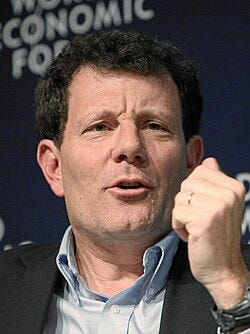
Nick Kristof
Max Tani of Semofor discovered this week that Kristof had violated that agreement by writing about at least a dozen former campaign contributors without disclosing their help to his campaign, including Bill and Melinda Gates, who had given him $100,000, and Council on Foreign Relations member Deborah Fikes, who gave him $10,000.
