



The Moors Invade Spain Again: A Note for Our Clueless Media
Zeteo
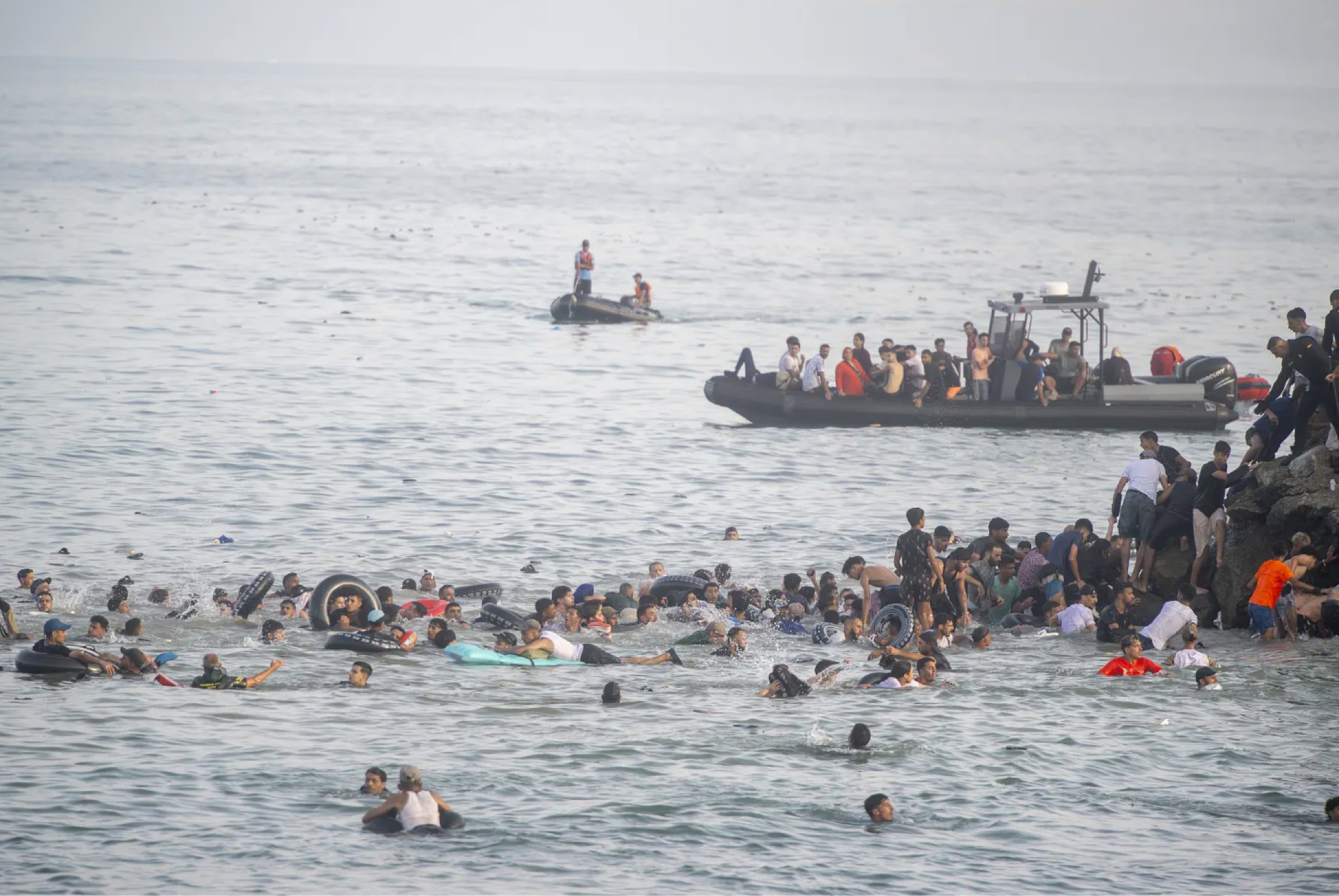
Scott: We’ve now had several days of right-wing media and fringe right politicians like Nigel Farage and Marine Le Pen talking breathlessly about a new Moorish invasion of Spain—as Rupert Murdoch puts it, northern Spain. I grew up in part not far from where all this is going on, in the quartier de l’Océan in Rabat, and I have a different take on things. (1) Ceuta is not in Spain, it is in Africa. Moreover, Ceuta is not Spain, it is a strip of Morocco that Spain holds as a colonial possession—as indeed it once held about half of Morocco. (2) Swimming across the bay or climbing the fence into Ceuta is a pretty routine pastime for Moroccans, many of whom think this will give them a foot up on getting into Spain, with better jobs, working conditions and all else. But the fact is that you still have to get across the Strait of Gibraltar, and the Spanish are pretty skilled at stopping that from happening. (3) King Mohammed VI, Benjamin Netanyahu and Donald Trump are bedfellows these days in many ways, and they share a passionate vice: hatred of Spanish PM Pedro Sánchez. (4) What better way to smack Sánchez upside the head than with videos of tens of thousands of darkskinned people climbing fences into “Spain.” (The official position of Morocco, the United States and Israel is, moreover, that Ceuta belongs to Morocco, nor Spain). This provides the motive for what happened. As for the mechanics, a lot needs to be put together. But for me the most striking thing about these events is the cluelessness of major US media, who are very happy to report on the racist rants of “populist” politicians and appear indifferent to the actual facts of what is going down.
Christmas came early for the global far right, as images showed tens of thousands of migrants from Morocco breaching the borders of the Spanish enclave Ceuta. From Donald Trump to Nigel Farage, the far right reacted exactly how you would think – by stirring up fear about a fake “invasion” and weaponizing the so-called crisis to rally their bases. Trump said the surge should be used as a “talking point” in the midterm election, while Farage used it to promote his Reform UK party.
There’s a lot of misinformation, racism, and xenophobia driving the hysterical response from the right in the U.S., UK, and European Union. So, what really happened? Here are nine things you should know about the fake “invasion” of Spain:
1. Ceuta Is Not in Europe, It Is in Africa…
2. At Least 80% of the Migrants Have Already Returned to Morocco Voluntarily
More than 48,000 people of the estimated 60,000 who breached Ceuta’s border have now returned to Morocco voluntarily, a clear contradiction of the claims of many right-wingers who called it an ‘invasion.’ At least 57 people died during the journey.
3. Trump and Israel Are Not Fans of the Spanish Government
Spain’s Prime Minister, Pedro Sánchez, is one of Europe’s most consistently critical leaders of Trump and Israel. Sánchez earned Trump’s fury earlier this year after not allowing the U.S. military to use Spanish bases for attacking Iran. While he doesn’t like Spain, Trump’s administration has enjoyed good ties with Morocco. Earlier this year, he bragged that the country named a highway after him.
It’s not just Trump. Israel is also not a fan of Sánchez. Israeli Ambassador to the UN Danny Danon falsely claimed that Spain called a state of emergency over the migrant breach. It hasn’t.
4. U.S. Lawmakers Disputed Spain’s Claim Over Ceuta in April
A report by the U.S. House Appropriations Committee in late April noted that “the Spanish-administered cities of Ceuta and Melilla are located in Moroccan territory and remain the subject of Morocco’s longstanding claim.”
Incidentally, Morocco was the first nation to recognize the United States in 1777. To say that the US and Morocco enjoy friendly relations is something of an understatement. That’s how I got to Morocco: FDR promised King Mohammed help in expelling the French and Spanish from his country, and Mohammed promised Morocco would furnish specific assistance to US military operations in exchange: the amphibious landings for the US North Africa campaign in World War II, and after the war, the US Air Force Base in Rabat Salé, which my father helped to build.
5. Morocco Used Migration as a Pressure Point Against the EU in the Past
It’s been an on-going struggle…
9. Not Your Average Monarch
Morocco’s King Mohammed VI was missing for most of 2022, according to a profile of the monarch published by The Economist in 2023, with one official estimating that he spent 200 days out of the country. The magazine noted that he had never held a press conference or given a television interview, and he spent most of his time with a former MMA champion who was convicted in Germany of assault, battery, theft, drug trafficking, and a lot more.
But wait, there’s more! Like both Trump and Netanyahu appearing on TV repeatedly, disparaging Sánchez and promising they would do something to take him down a peg. Was this that thing? Plenty of folks in Morocco think so.
It’s No Wonder Israelis Want War.
Violence Has Become a Source of Joy
Haaretz
Charles: Why have the Israeli government and so many of its citizens become addicted to war? Political theorist Ariel Handel, who has taught at three different Israeli universities, offers the most uncomfortable answers imaginable to that question.
Writing in Haaretz, Israel’s finest newspaper, Handel explained that as a child of the ‘70’s he had been taught that “that violence is a bad thing, even if it’s sometimes unavoidable. That it must be employed with restraint, in self-defense or for deterrence; that controlling oneself is a heroic act, while anyone who foments excess violence is perceived as a ‘wild weed’ to be shunned; and that taking pleasure in violence signifies a personal or social pathology.”
But in Bibi’s 21st century Israel all of that has changed.
Ariel Handel
In 2026, violence is not only a means to implement policy,
it is an effective producer of self-identity; and second, and more significant, in recent years violence has been undergoing a “revolution of joy,” to use an expression coined by popular Israeli singer Omer Adam.
Sociological studies conducted by organizations experienced in institutionalized violence, such as the army or the police, have come up with consistent findings about how implementation of violence becomes a tool of socialization. Violence serves as a means to strengthen masculine identity; soldiers often attest to pleasure derived from participating in violent situations within the context of belligerent, operational activity. However, these studies also reveal an additional, critical element: The same social actors reported not only taking pleasure in violence, but also taking pleasure in restraining it. The image of the “good self” is of someone who is able to wield violence “when needed,” but avoids doing so in nonessential situations.
In our local context, psychological studies done in the 1990s and early 2000s among Israeli soldiers in the occupied territories showed tension between a positive self-image and actions on the ground that sometimes undermine those feelings. In the research, Israel Defense Forces soldiers were depicted as not wanting to wield violence by their nature, but finding themselves in situations where they were compelled to do so.
Perpetuation of the occupation has generated psychological challenges among soldiers who have aspired to create and preserve a positive image of themselves as moral, humane and nonviolent – but who found themselves using violence, and in some cases also acting in ways that clashed with moral principles as they perceived them. Accordingly, these studies cited various mechanisms for coping with such a disparity, such as cognitive dissonance, repression, personally filtering and interpreting reality, making a distinction between the military and civilian realms, seeking ideological legitimacy and so forth.
However, these studies, which were perhaps accurate for their time, are no longer relevant. The attitude toward violence has undergone a radical change since the early 2000s. The rise of the ethno-national component of Israeli society – in which the state is viewed as the embodiment of the Jewish collective, more than as a modern state in the Western-civic sense – reduces cognitive dissonance. Even if the actions remain the same, and in practice have become harsher over the years, the social conscience no longer judges itself by universal criteria, rather according to its loyalty to the Jewish collective.
In such a situation, violence is transformed in the army from being viewed with ambivalence – as indispensable but also something to be renounced and to be ashamed of – to something that is not only a tool or a goal in military activity, but an organic aspect of a soldier’s identity. In the past, an emphasis was placed on “purity of arms” (use of weapons only when absolutely necessary), restraint, a statesmanlike orientation and morality, and not only for the sake of appearances. Today, however, violence is not only liberated from the trap of “shooting and crying,” as per a popular Israeli expression, or from acceding to the call of Naftali Bennett, in his previous incarnation as head of the right-wing, religious Jewish Home party, of “no more apologizing”: It is also becoming joyful.
Probably the clearest manifestation of the ostensible joy of violence takes the form of what’s referred to as “happy Jews.” In 2015, journalists Akiva Novick and Chaim Levinson explained in their report, “The Complete Hilltop Lexicon,” that happy Jews are those “who are not bound to the archaic conventions and rules of morality, and carry out ‘price tag’ [retaliatory operations against Palestinians] with a smile on their face.”
… Invitations to carry out pogroms are circulated on colorful, cheerful posters that look more like flyers for an open-air rave than calls to violence.
Violence is transformed in the army from being viewed with ambivalence – as indispensable, but also something to be ashamed of – to something that is not only a tool or a goal in military activity, but an organic aspect of a soldier’s identity.
