



Gaza’s Rubble Is the Grave of Our Future
The New York Times
Charles: In a guest essay for the Times, Gaza-based journalist Ghada Abdulfattah uses her words to paint a landscape of unrelenting horror: a place where a ceasefire still doesn’t mean the end of random murder by the Israelis. Israeli drones still hover all night, almost every building is destroyed, almost every Palestinian family decimated.
Rubble isn’t just a grave for people in Gaza. It’s a grave for our futures… Here, war has only changed form. It manifests in the smaller wars that repeat in our lives every day. Life in Gaza is lived in fragments: searching for water, charging a phone, cooking on a fire when fuel is available, checking the news, waiting. What exists now is not a return to normal life but a warped version of it—where the mundane persits alongside the unbearable… We are alive, but there’s no going back to once upon a time. We are learning how to live in the in-between.
Hamas’s vicious attack on Israeli civilians on October 7, 2023 was a war crime. It did not justify the vastly larger war crimes Israel continues to carry out in Gaza, in the West Bank and in Lebanon.
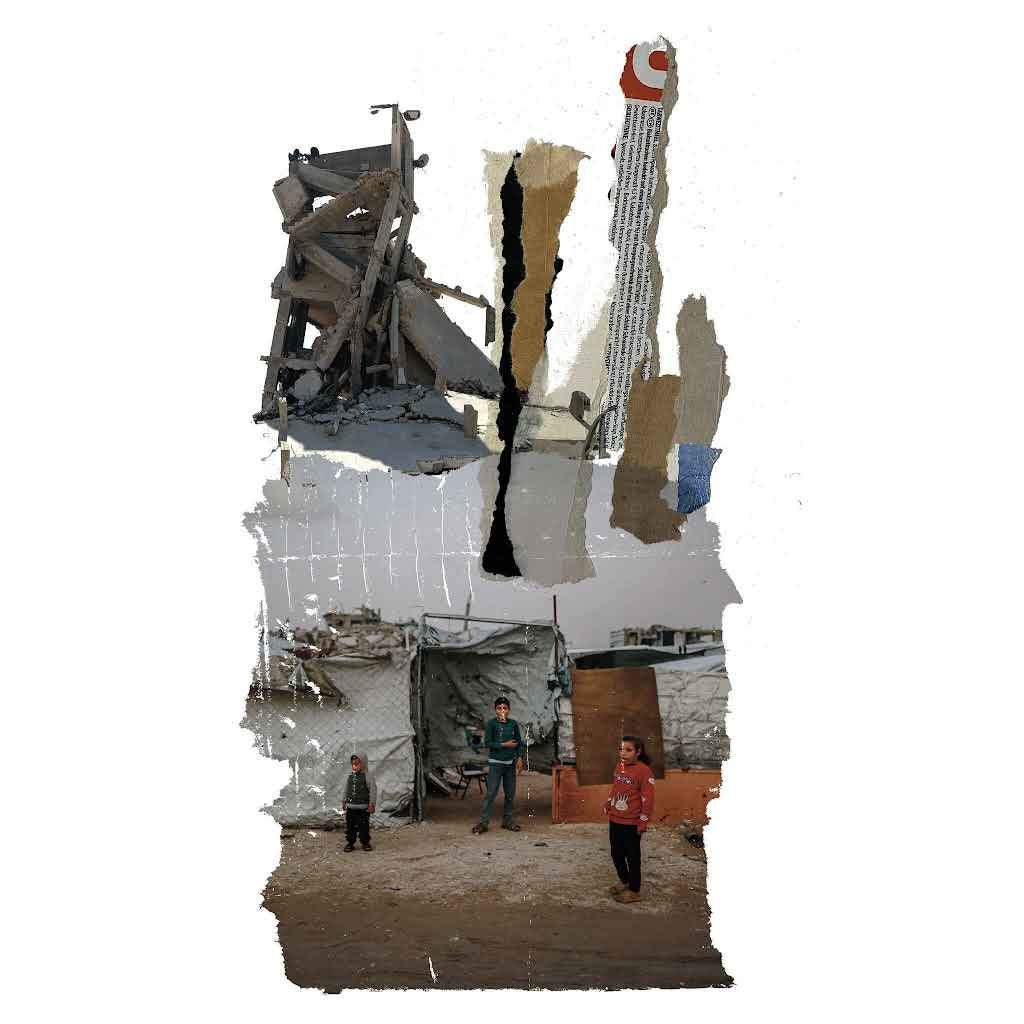
Find out how Israel is re-using the same tactics in Lebanon that it previously used in Gaza and what it’s like on-the-ground in Beirut in the first episode of The Horton-Kaiser Report podcast.
LISTEN: Israel's War on Lebanon with Abdi Latif Dahir

Yesterday, Israel marked the implementation of a ceasefire agreement, which as announced explicitly included Lebanon—it also marked heaviest day’s bombardment of the country since the war began. Israel’s attacks had a focus on the heavily populated, mixed commercial and residential, center of the city of Beirut—an area which the International Committee …
The Horton-Kaiser Report is an independent publication, and relies on support from generous readers like you.
Consider gifting a subscription with a friend.
Péter Magyar is pro-EU, but is likely to prove a tough partner
Süddeutsche Zeitung

Scott: Hungary’s centrist opposition managed to convert the spirit of the country 1956 uprising into a powerful campaign weapon that had resonance all across the country’s rural nationalist countryside that—up until this election—had supported Viktor Orbán and Fidesz. With the rise of the Tisza Party, the European Union can breathe a sigh of relief, but this doesn’t mean there will be no conflicts.
Still, at the moment it’s Donald Trump and Valdimir Putin who should be worried. In his first press conference, Péter Magyar noted that Orban’s foreign minister, who had gone missing after a series of embarrassing leaks of his private chats with Putin’s foreign minister Sergei Lavrov—in which he shared state secrets and sought instruction—had resurfaced in the foreign ministry and was seen barricaded behind closed doors shredding documents. What’s in those documents? Dealings with the Kremlin no doubt. But something else. A well-placed Hungarian diplomat tells me that a careful audit of funds moved through the Danube Foundation and other Orbán GONGOS will show that they were used to launder payments to an array of persons and entities around Trump, including the now disaffected Tucker Carlson, The Heritage Foundation and a host of social media figures, some of whom were caught earlier taking money from the Kremlin. Orbán was also busy funding “populist” groups around the world. And he was laundering money from the Kremlin. We’ll see if this pans out, because now an audit will indeed take place.
Even under Magyar, Hungary will not be among Ukraine’s staunchest supporters.
Magyar has already announced that he intends to largely continue Viktor Orbán’s migration policy. Since the rest of the EU has, in recent years, at least moved closer to Orbán’s stance, this is unlikely to cause any major friction initially.
Once Magyar takes office, the focus will primarily shift to financial matters. Magyar must first fulfill his campaign pledges—something that is only possible with the currently frozen EU funding. He will presumably insist on being treated in the same manner as Donald Tusk. Following Tusk’s election victory in late 2023, the EU released previously frozen regional development funds to the Polish Prime Minister, even though he had merely initiated—but not yet fully implemented—the judicial independence reforms demanded by the EU.
One of Magyar’s first official acts regarding European policy will involve addressing the €90 bn designated for Ukraine. Even under his leadership, the Hungarian government will not rank among Kyiv’s most ardent supporters. “No one wants a pro-Ukrainian government”—such sentiments were frequently heard during Magyar’s campaign appearances. In the European Parliament—where he currently serves as an MEP—Magyar voted against the €90 bn loan package for Kyiv. Furthermore, in confidential discussions, representatives of the Tisza Party have indicated that the release of these funds will not be a foregone conclusion. They have therefore advised their European partners to prepare contingency plans.
This is primarily due to the timeline involved. The first tranches of the EU loan were actually supposed to have been transferred already, but Orbán held up the disbursement, claiming that Ukraine was blocking the Druzhba oil pipeline from Russia—a vital link for Hungary. With this loan, the EU is assuming almost sole responsibility for financing Ukraine following the withdrawal of American support. At the EU summit in December, the heads of state and government had unanimously decided to lend money to Kyiv and to back the loan using the joint EU budget. The Czech Republic, Slovakia, and Hungary had supported this decision on the condition that they would not be held liable.
One area where Magyar and the EU will see eye-to-eye, however: aggressive pursuit of the fraud and embezzlement cases in which the EU suspects Orbán and figures close to him mismanaged EU monies.
Péter Magyar Is A Fine Role Model for the Next Democratic President of the United States
The Guardian
Charles: This is the housecleaning America will also require:
Hungary’s prime minister-elect, Péter Magyar, has pledged to pursue those who “plundered, looted, betrayed, indebted and ruined” his country, promising “a new era” after a landslide election victory over his far-right predecessor Viktor Orbán.
Magyar, whose centre-right Tisza party won at least 138 of the 199 seats in parliament, said the full election results should be confirmed by 4 May and he hoped his government could be installed the next day.
“Our country has no time to waste,” he said during a wide-ranging press conference on Monday. “We will do everything in our power to ensure this truly marks the beginning of a new era … The Hungarian people didn’t vote for a simple change of government, but for a complete change of regime.”
Although Orbán was easily the most corrupt politician in the EU, Trump as easily bested him with the billions his current term in the White House has already brought him.
Pope Leo: I have ‘No Fear’ of Trump
Financial Times
Scott: Embarking on a visit to Africa, Pope Leo offered remarks that seemed to perfectly mirror remarks of Pope John Paul II to his fellow Poles. At the height of a vicious crackdown against the Solidarity labor movement and pro-democracy demonstrations, in 1979, the first Polish pope visited students in his home town of Krakow and told them “Do not be afraid.” Pope Leo’s remarks were directed to his fellow Americans.
Speaking on Monday at the start of a trip to Africa, Pope Leo said he had “no fear . . . of the Trump administration”, adding that he would continue speaking out “loudly against war”. The declaration comes after Trump accused Pope Leo, the first American pope, of being “weak” on crime and “terrible” for foreign policy. In a Truth Social post late on Sunday, Trump said the pope should stop “catering to the Radical Left and focus on being a Great Pope, not a Politician”. “I don’t want a Pope who thinks it’s OK for Iran to have a Nuclear Weapon,” Trump posted. “I don’t want a Pope who criticises the President of the United States because I’m doing exactly what I was elected, IN A LANDSLIDE, to do.” Pope Leo has been outspoken in his criticism of the US-Israeli war against Iran, describing Trump’s threat last week to wipe out Iranian civilisation as “truly unacceptable”.
At a worldwide peace vigil at St Peter’s Basilica in Vatican City on Saturday, the Pope warned of a “delusion of omnipotence” that is “becoming increasingly unpredictable and aggressive”. Although he did not mention the war in Iran directly, his remarks were interpreted as some of his most critical of every uttered about a US president.
It should be noted that Trump misstated the Vatican position on nuclear weapons, which opposes their proliferation and seeks their control and destruction. It should also be noted that Pope Leo’s position on the war on Iran is shared by an overwhelming majority of his fellow Americans.
Today’s Dose of Trump Sacrilege Comes in Technicolor
The Washington Post
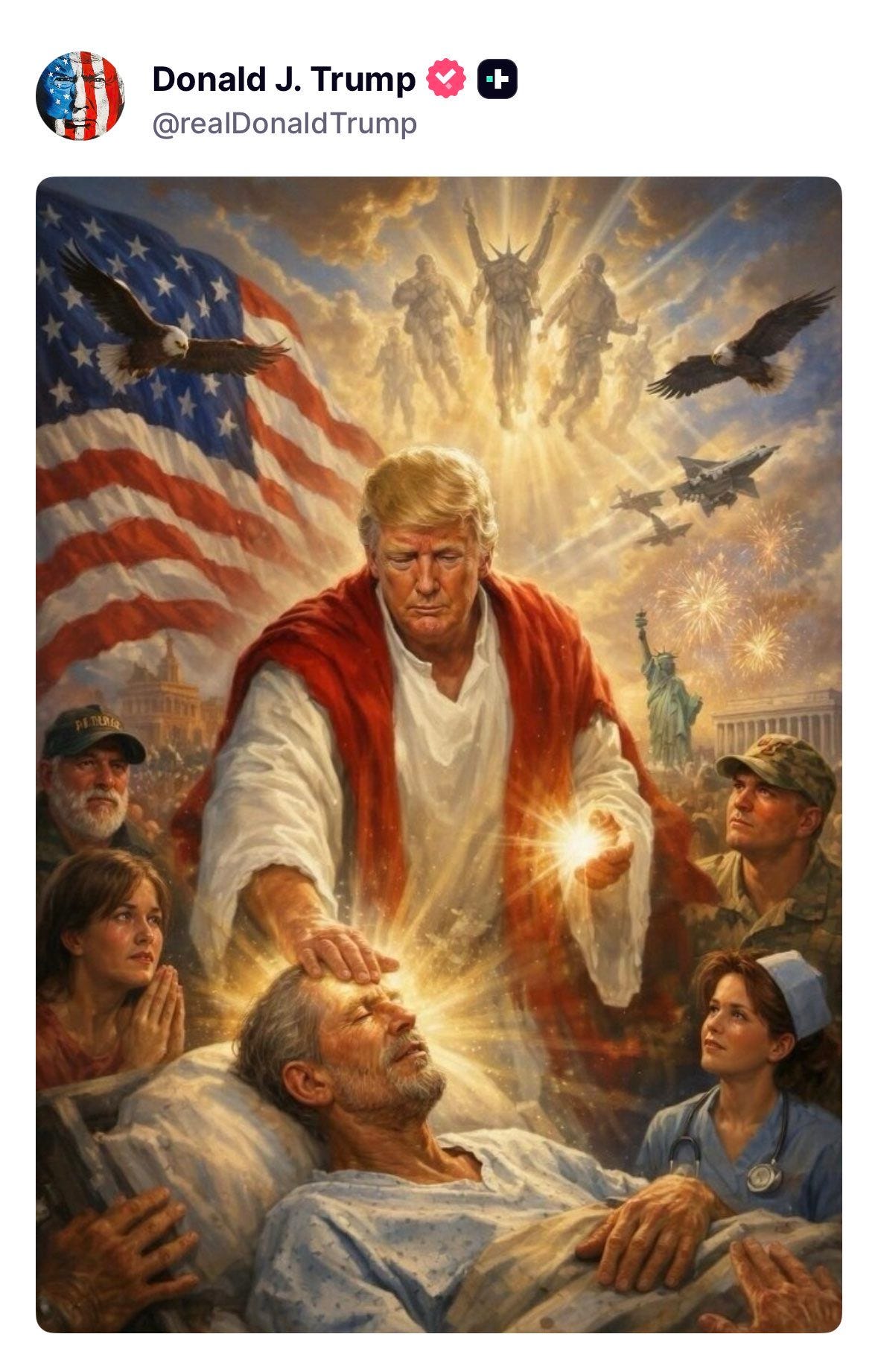
Charles: It lasted twelve hours on the sewer which is Trump’s Truth Social feed. The Washington Post reported:
“I don’t know if the President thought he was being funny or if he is under the influence of some substance or what possible explanation he could have for this OUTRAGEOUS blasphemy,” wrote Megan Basham, a prominent conservative Protestant Christian writer and commentator. “But he needs to take this down immediately and ask for forgiveness from the American people and then from God.”
Asked about the post Monday afternoon, Trump said he posted it.
“I thought it was me as a doctor, and had to do with the Red Cross, as a Red Cross worker, which we support,” Trump said. In the photo, Trump’s clothing is reminiscent of clothing worn in Jesus’ time and does not appear to be an outfit a modern doctor would wear. There is no reference in the photo to the Red Cross.
This comes after Pope Leo said in an address on Jan. 9th to the diplomatic corps that “war is back in vogue” and that unnamed powers had “completely undermined” the post-World War II order. Such a mentality, Leo said, “gravely threatens the rule of law.”
The Washington Post reported the Pentagon then summoned a top Vatican official to voice its unhappiness.
In light of the pope’s comments, the Department of War officials “attempted to justify [their] military activity” and sought to frame American force as “a legitimate path to peace,” said one person who spoke with people who attended the Pentagon meeting. That pitch, the person said, surfaced “contrasting views as to the role and purposes of war” from both sides. The person spoke on the condition of anonymity because they were not authorized to discuss the matter publicly.
Two days ago Trump renewed his attack on the Pope: “Pope Leo is WEAK on Crime, and terrible for Foreign Policy.”
“He talks about ‘fear’ of the Trump Administration, but doesn’t mention the FEAR that the Catholic Church, and all other Christian Organizations, had during COVID when they were arresting priests, ministers, and everybody else, for holding Church Services, even when going outside, and being ten and even twenty feet apart.”
The Pope shot back on Monday:
I’m not afraid of the Trump administration or of speaking out loudly about the message of the Gospel, which is what the Church works for. We are not politicians. We do not look at foreign policy from the same perspective that he may have. I will continue to speak out strongly against war, seeking to promote peace, promoting dialogue and multilateralism among states to find solutions to problems.”
Blockade Wars: The Escalation Trap at Work
Der Spiegel
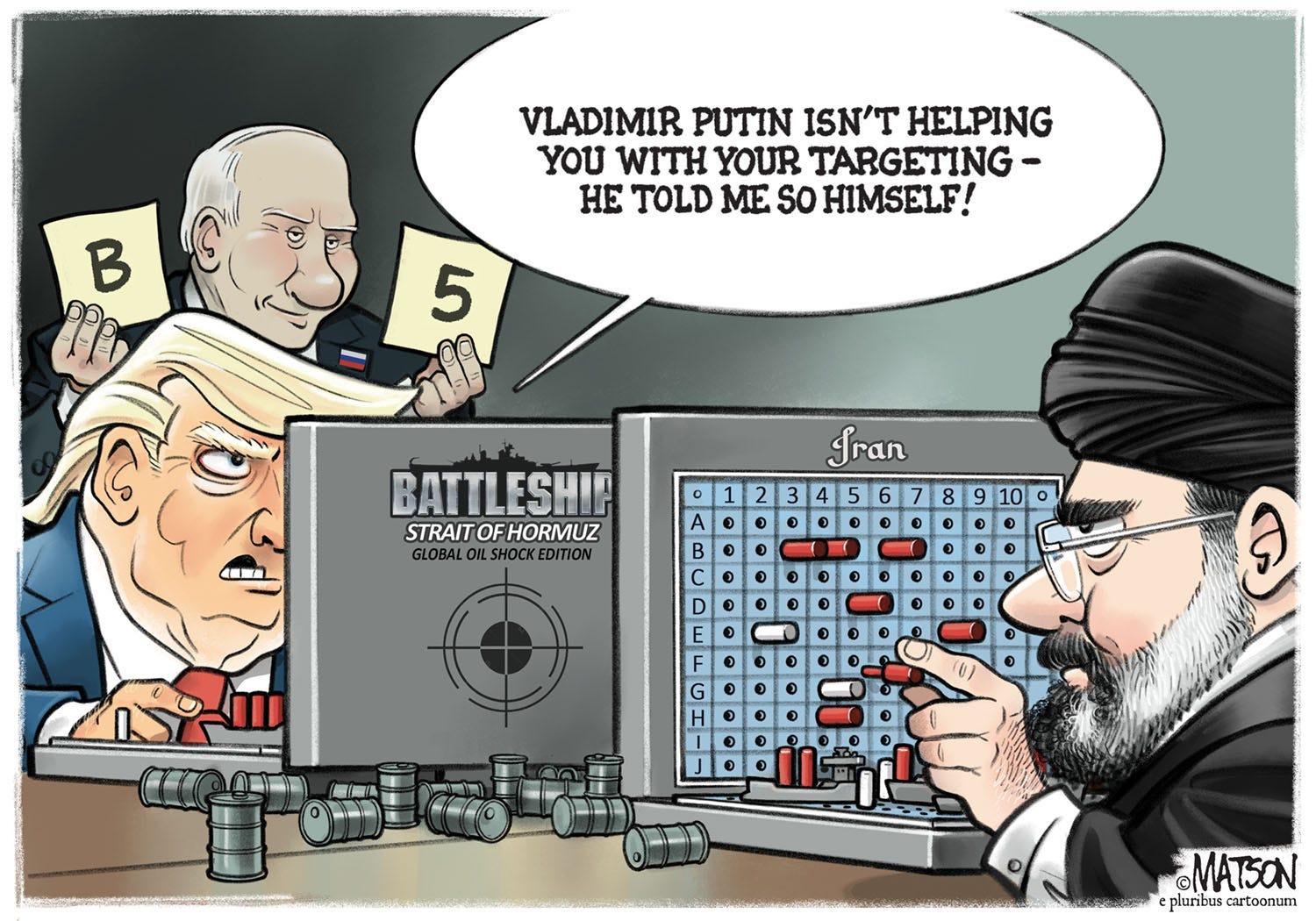
Scott: Donald Trump responded to failed talks in Islamabad with a Twitter announcement that he would now blockade the Strait of Hormuz, to match the de-facto Iranian blockade and to insure that no Iranian oil could escape the Gulf. In so doing, he reversed himself on a policy premise for the third time in the course of a single week. And he did so without consulting any allies, whose assistance he demanded just the same. Within 36 hours, a response was in, and there were no takers. “It would help if he would for once ask us to help him in a way that wasn’t blatantly illegal,” says one NATO ally, citing the maritime law which forbids such blockades in the absence of a United Nations Security Council mandate. German newspaper Der Spiegel interviews Israeli analyst Danny (Dennis) Citrinowicz about all of this.
Citrinowicz: It is unlikely that Iran will back down. It is more probable that the regime in Tehran will target American naval units. Furthermore, they could attack infrastructure designed to bypass the Strait of Hormuz—such as pipelines like the East-West Corridor in Saudi Arabia. Such a move would drive global oil prices sky-high, with immediate and far-reaching consequences for the global economy. The Yemeni Houthis, who are allied with Iran, could blockade the Bab al-Mandab strait—thereby blocking another strategically vital maritime chokepoint for global trade.
SPIEGEL: Trump told Fox News: “I predict that they will come back and give us everything we want.” How much pressure can the U.S. actually exert through this blockade?
Citrinowicz: Trump does not want to return to war. He believes that this blockade can ultimately force an agreement on American terms. But he is wrong about that.
SPIEGEL: Why?
Citrinowicz: Even after five weeks of intense fighting, the U.S. administration still seems to be missing a fundamental point: Iran is not Venezuela. Closing the Strait of Hormuz will not force Iran to capitulate. What five weeks of sustained airstrikes failed to achieve, maritime pressure alone is unlikely to accomplish. No threat will compel the current Iranian leadership to accept terms dictated by Washington. If Trump wants an agreement, he must make compromises and move closer to the Iranian position.
Trump’s Erratic Behavior and Extreme Comments Revive Mental Health Debate
New York Times
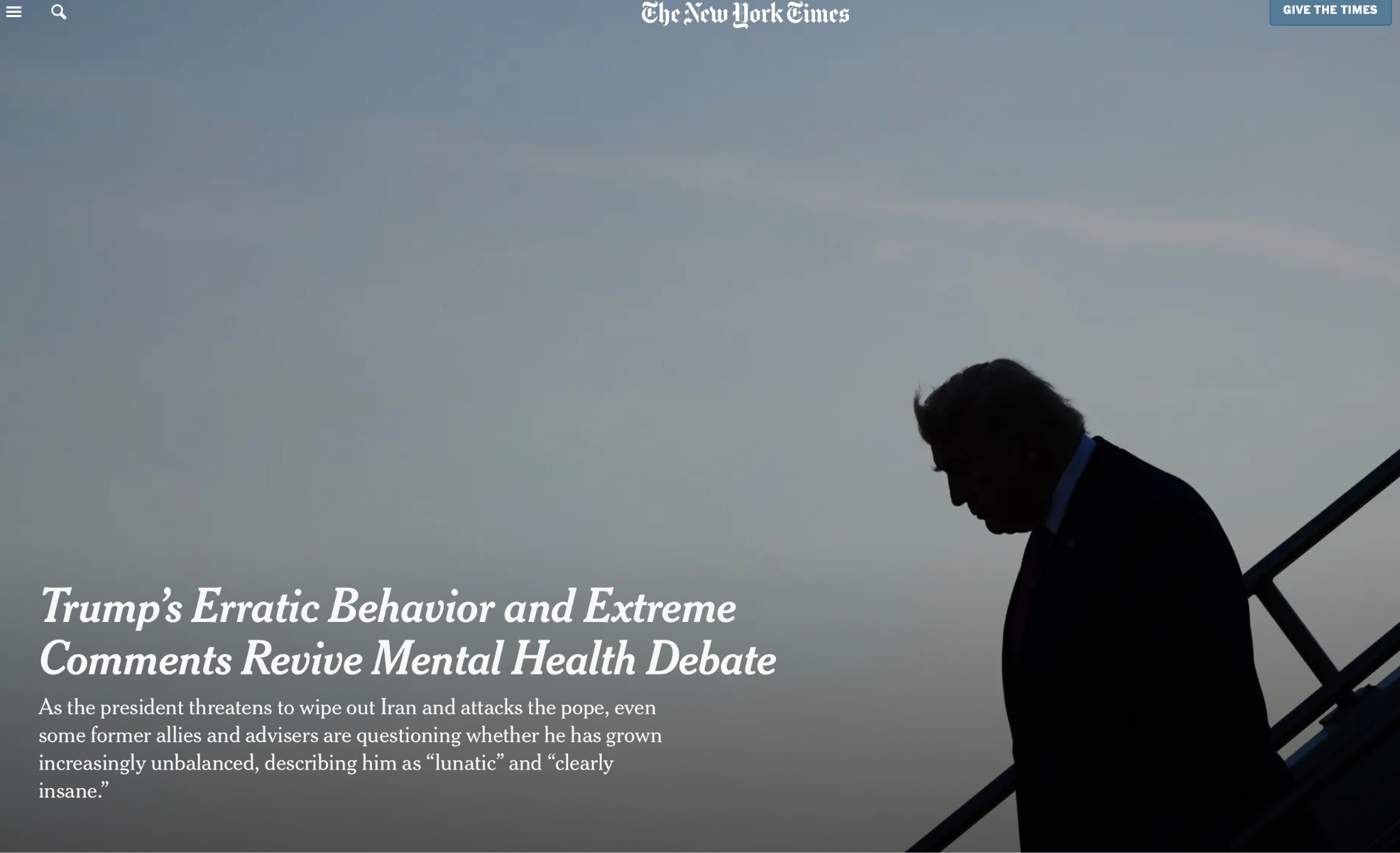
Scott: Peter Baker assesses the political banter over Trump’s mental health. He lines up all the quotes, and they’re impressive. But there’s a fundamental question about the professional journalistic standards of such a piece. Having a man who is experiencing mental health issues in charge of one of the world’s two largest nuclear arsenals could be an existential threat to humanity, that’s the situation in which America and the world presently sit. It’s also something that can’t be properly addressed by a group of political hacks on a he said-she said-they said basis. It calls for medical professionals who are capable of observing the conduct of a public figure over protracted periods and come to some conclusions, even if they can’t constitute a diagnosis because of professional restrictions like the Goldwater Rule.
President Trump’s erratic behavior and extreme comments in recent days and weeks have turbocharged the crazy-like-a-fox or just-plain-crazy debate that has followed him on the national political stage for a decade.
A series of disjointed, hard-to-follow and sometimes-profane statements capped by his “a whole civilization will die tonight” threat to wipe Iran off the map last week and his head-spinning attack on the “WEAK on Crime, and terrible for Foreign Policy” Pope on Sunday night have left many with the impression of a deranged autocrat mad with power.
The White House rejected such assessments, saying that Mr. Trump is sharp and keeping his opponents on edge. But the president’s eruptions have raised questions about America’s leadership in a time of war. While the country has had presidents whose capacity came under question before, most recently the octogenarian Joseph R. Biden Jr. as he aged demonstrably before the public’s eyes, never in modern times has the stability of a president been so publicly and forensically debated—and with such profound consequences.
Former Representative Marjorie Taylor Greene, the Georgia Republican who recently broke with Mr. Trump, advocated using the 25th Amendment, telling CNN that threatening to destroy Iran’s civilization was “not tough rhetoric, it’s insanity.” Candace Owens, the far-right podcaster, called him “a genocidal lunatic.” Alex Jones, the conspiracy theorist and founder of Infowars, said Mr. Trump “does babble and sounds like the brain’s not doing too hot.”
Europe’s far right questions merits of Trump ties after Orbán defeat
Financial Times
Scott: The complete electoral collapse of Viktor Orbán and his Fidesz party has come as a shock to the right-wing populist parties across Europe that he helped launch and finance, and for whom he was an important model.
These same parties are now taking a close look at the electoral toxicity of Donald Trump and JD Vance. True, Trump and his MAGA movement and State Department have pulled out all the stops to fund and promote them, but then Trump is someone who now seems hellbent on launching wars all over the world on no or little pretext.
The move to distance themselves is now well underway.
The far-right Alternative for Germany has traded blows over the wisdom of building ties with Donald Trump after the defeat of Viktor Orbán, with some claiming that the US president’s support for the Hungarian leader had backfired. AfD lawmaker Matthias Moosdorf, a US-sceptic with close ties to Russia, said that the “ostentatious friendship” with Trump and vice-president JD Vance had “hung like millstones around Orbán’s neck” ahead of Sunday’s election. He said that Hungary, where the opposition claimed a landslide victory and ended 16 years of Orbán’s rule, should serve as a warning for others against the risk of “grabbing falling knives”. Moosdorf’s warning, posted on the social media platform X, was reposted by one of the party’s influential ideologues, Benedikt Kaiser. Trump threw the weight of his administration behind Orbán, despite his deeply fraught relations with many of the US’s traditional allies in Europe. Last week, vice-president JD Vance flew to Budapest to support him. On Friday, Trump promised to use “the full economic might” of the US to support an Orbán-led Hungary. But some of Trump’s Maga allies in Europe now view the Hungarian election as a cautionary tale.
NGC 602 and Beyond
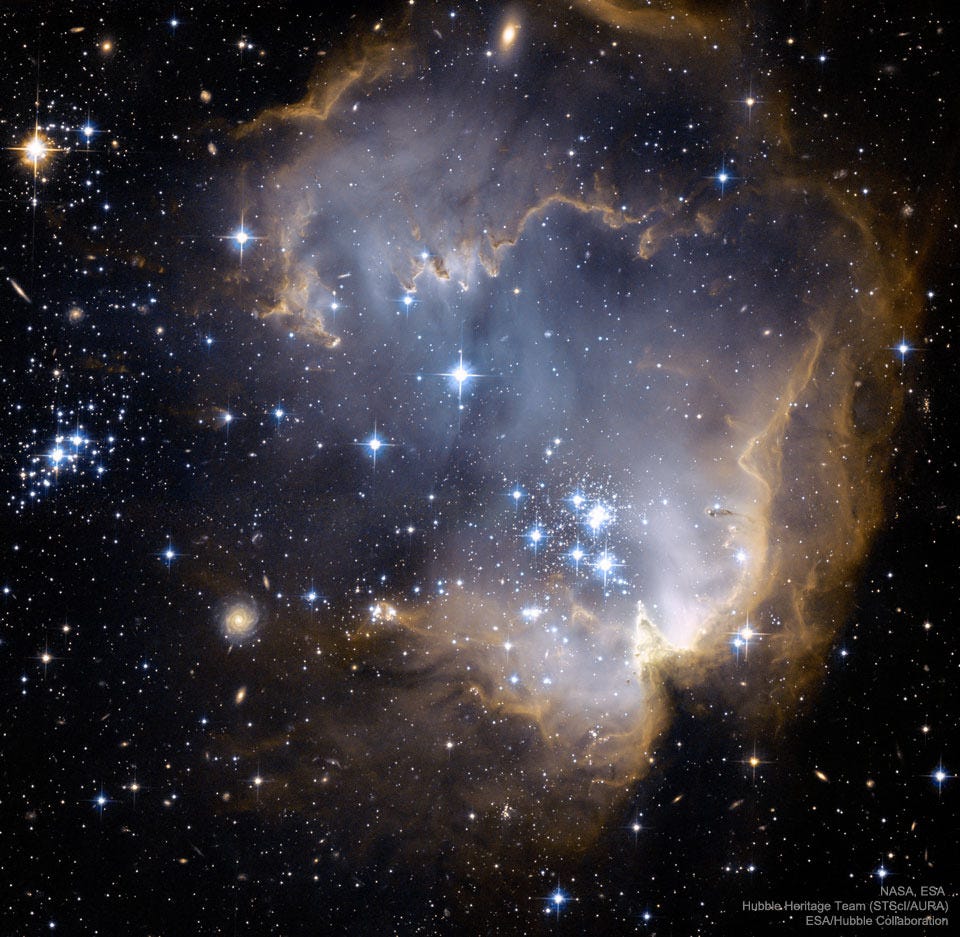
The clouds may look like an oyster, and the stars like pearls, but look beyond. Near the outskirts of the Small Magellanic Cloud, a satellite galaxy some 200 thousand light-years distant, lies 5 million year young star cluster NGC 602. Surrounded by natal gas and dust, NGC 602 is featured in this stunning Hubble image of the region. Fantastic ridges and swept back shapes strongly suggest that energetic radiation and shock waves from NGC 602‘s massive young stars have eroded the dusty material and triggered a progression of star formation moving away from the cluster’s center. At the estimated distance of the Small Magellanic Cloud, the featured picture spans about 200 light-years, but a tantalizing assortment of background galaxies are also visible in this sharp multi-colored view. The background galaxies are hundreds of millions of light-years or more beyond NGC 602.
Your Online Moment of Zen
Charles: When I first saw this painting at the Jeu de Pomme during one of my first visits to Paris, it became my favorite Toulouse-Lautrec. In 1986 it moved with most of the great French impressionists into the Musée d’Orsay, but the repurposed train station has never had the same charm for me as the Pomme did.
Its subject is Louis Bouglé, an eccentric French sportsman and renowned tournament caster who inspired the iconic Hardy Bouglé fly reel.
Portrait de Louis Bouglé

Edited by Imogen Sayers.