



Brendan Carr is a White House Puppet / Steve Rattner Brings The Receipts / Trump Stirs Doubts about US resolve in Asia / Blanche Won’t Stop Payments to Violent Felons / Marco Rubio Targets the ICC / Perseids from Perseus / Take Five, Now and Forever
How the White House Manages Brendan Carr’s Attacks on the Media
The Guardian
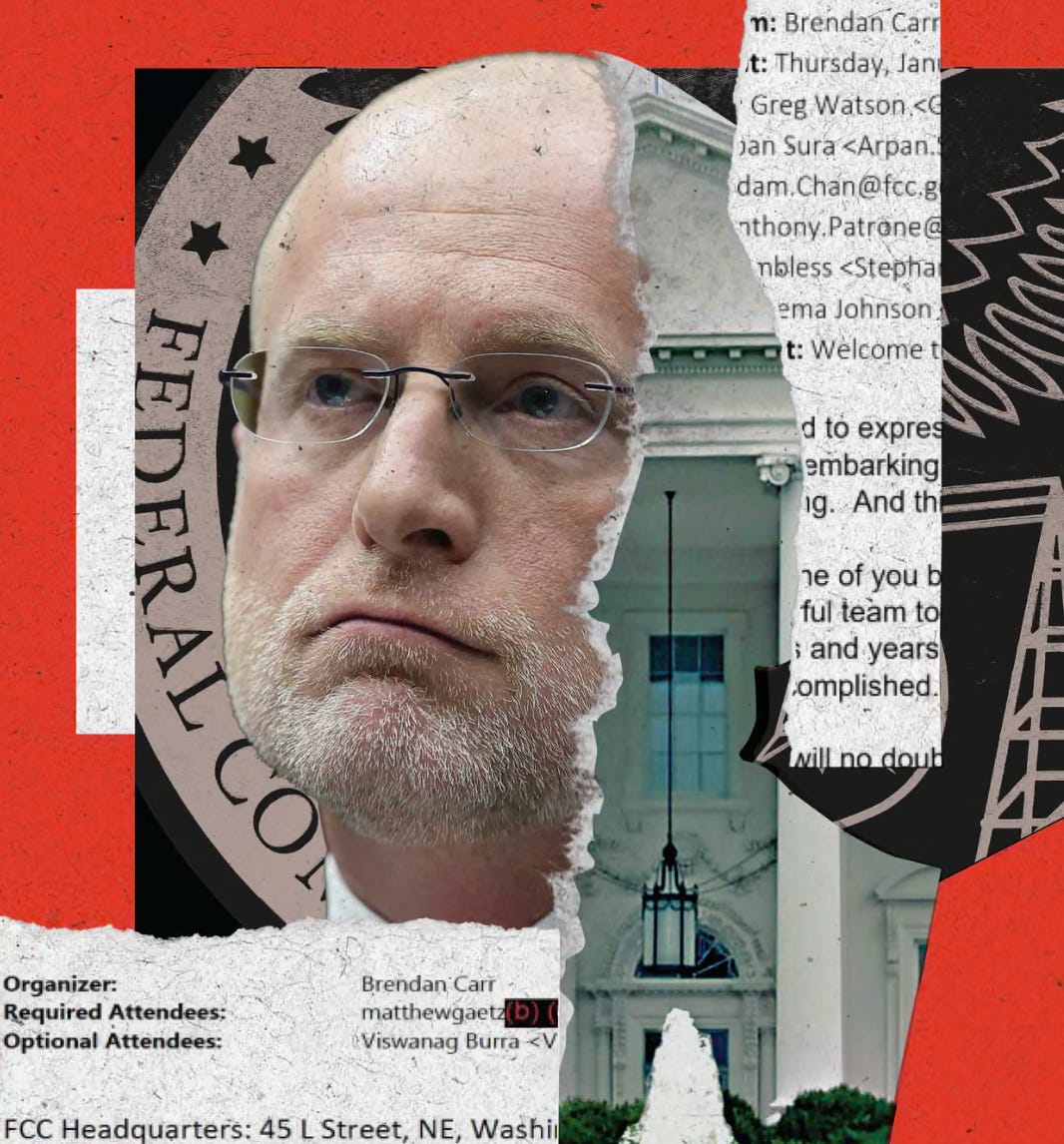
Scott: Unlike any FCC chair before him, Brendan Carr has wielded the power and authority of the FCC as a muzzle on critics of the administration he serves. And now a Guardian exposé reveals that all of this has been micromanaged from behind the scenes by the Trump White House—and how Rupert Murdoch TV is complicit in all these schemes.
Internal documents obtained by Guardian show White House meetings, scheduled calls with top Trump officials and communications with Fox News producers.
Brendan Carr was very firm.
“As a general rule, we don’t get into any discussions that happen with the White House or don’t happen with the White House,” Carr, the chair of the Federal Communications Commission (FCC), told Politico’s Dasha Burns in a recent interview. Burns had pressed Carr to explain how exactly he came to issue a highly unprecedented order forcing ABC to apply early to renew its eight local broadcast licenses just one day after the man who appointed Carr, Donald Trump, and his wife Melania called for ABC to be punished for a joke made by the late-night host Jimmy Kimmel.
“Did you get a call or talk to the president either before or after you made that announcement?” Burns had asked. Later in the interview, Carr repeated his policy: “As a general matter, I don’t speak publicly about conversations with the White House, or whether they happen or don’t happen.”
While Carr may not be keen to detail his relations with the Trump administration, a trove of FCC documents – obtained via a Freedom of Information Act request and lawsuit filed by the advocacy group Democracy Forward, and provided to the Guardian – shed light on the close working relationship between Carr, his top staffers and members of Trump’s White House team.
Between 12 March 2025 and 11 February 2026, Carr attended at least eight meetings at the White House, according to the records, and had at least three scheduled calls with administration officials, including two conversations with the chief of staff, Susie Wiles. He also spoke by phone with administration officials such as the controversial health secretary, Robert F Kennedy Jr.
In addition, the files provide insight into Carr’s media strategy, including communications with producers at Fox News, and make public previously undisclosed meetings he has held with media titans such as the Fox Corp chief executive, Lachlan Murdoch, and Sinclair Broadcast Group chair, David Smith.
“These records show a remarkable breadth of access to FCC leadership for this administration’s political allies, conservative media figures, and powerful industry interests, including companies and organizations with business before the commission,” said Dan McGrath, special counsel, oversight at Democracy Forward. “This raises serious questions about whether the FCC is operating as an independent regulator, or whether political relationships and industry influence have become too intertwined with its decision-making.”
The White House meetings, which are memorialized as Microsoft Outlook calendar items, occasionally include details about the topic of discussion. For example, on 29 August 2025, Carr was listed as the organizer of a “White House deputies” meeting focused on “FAA/Spectrum issues,” which also included the FCC’s chief of staff, Greg Watson, and Arpan Sura, a senior counsel focused on spectrum, space and artificial intelligence.
Trump’s Broken Promises, in 5 Charts
New York Times
Charles: Before he became an investment banker and a money manager, Steve Rattner was a fine reporter for The New York Times. He has never lost his reporting chops. Through his frequent appearances on Morning Joe he has become newly famous as the best chart maker of our time.

Steve Rattner
Here are five that he published in The Times this week. They should become the backbone of every Democratic campaign this fall.
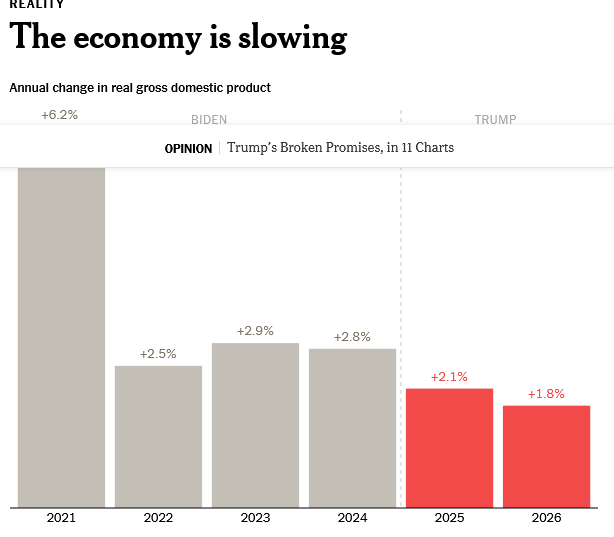
1. ‘We’re going to grow like nobody’s ever grown before.’
Economic Club of New York, Sept. 5, 2024
The economy is slowing
In this year’s second quarter, growth dropped to an annual rate of just 1.5 percent, a shift substantially caused or exacerbated by Mr. Trump’s policies. Rising energy prices and inflation. Decreased government spending. A deteriorating trade balance, thanks to his tariffs. That’s added up to materially slower growth than the healthy 2.75 percent rate that Mr. Trump was bequeathed by President Joe Biden.
2. Deficit
Trump’s Promise
‘In the near future, I want to do what has not been done in 24 years: balance the federal budget.’
Address to a joint session of Congress, March 4, 2025
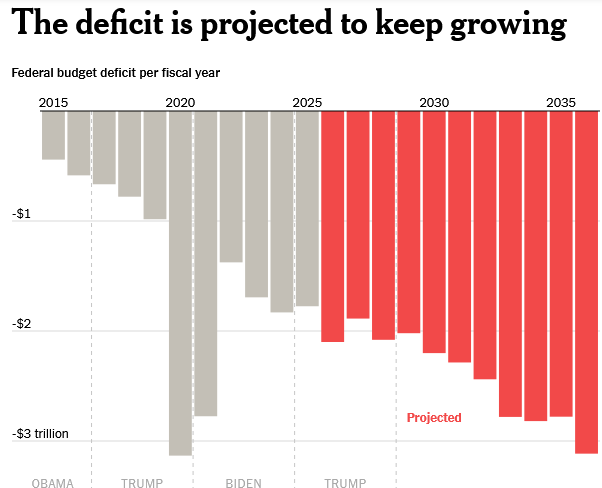
The estimate for 2026 uses the Congressional Budget Office’s August projections. Estimates for 2027-36 use the C.B.O.’s February 2026 baseline. Sources: FRED; Congressional Budget Office.
Spending was high under Mr. Biden as he worked to combat the lingering effects of Covid and invest in priorities like clean energy and infrastructure. But even as Republicans cut a number of these initiatives, the deficit rose in Mr. Trump’s first budget after his return to office, largely because of his huge tax cut. And the Congressional Budget Office projects that it will continue to climb to $3.1 trillion by 2036. That makes the notion of Mr. Trump balancing the budget just plain laughable.
3. Debt
Trump’s Promise
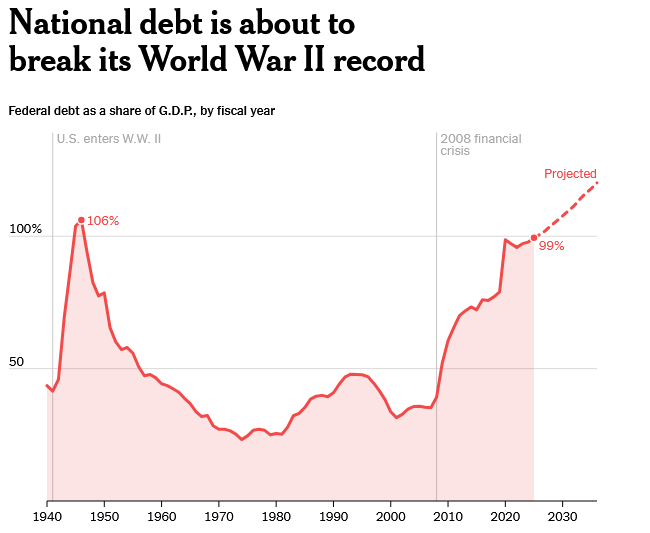
‘But now it’s our turn to prosper, and in so doing, use trillions and trillions of dollars to reduce our taxes and pay down our national debt, and it’ll all happen very quickly.’
Tariff announcement, White House Rose Garden, April 2, 2025
Federal debt as a share of G.D.P., by fiscal year
The ratio of total debt held by the public to the size of our economy is about to surpass the World War II record. By 2036, the C.B.O. projects our national debt will reach 120 percent of gross domestic product.
4. Manufacturing
Trump’s Promise
‘America will be a manufacturing nation once again, and we have something that no other manufacturing nation will ever have.’
Second inaugural address, Jan. 20, 2025
Manufacturing employment has stalled
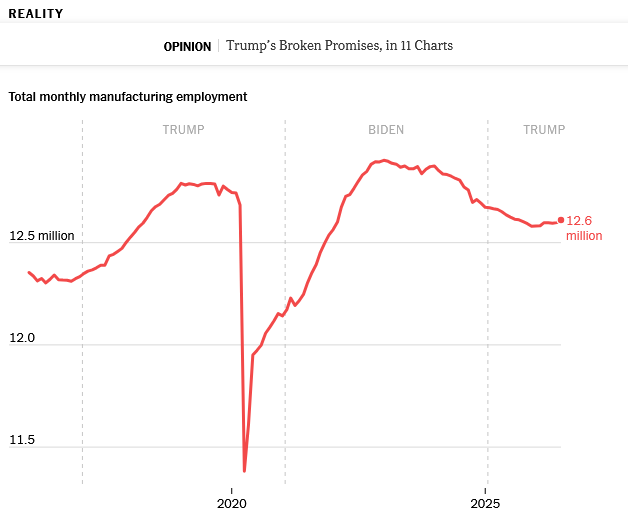
Total monthly manufacturing employment
Manufacturing employment, which grew during much of Mr. Biden’s administration because of his ambitious industrial investments, has slipped to 12.6 million, down 62,000 since Mr. Trump’s second inauguration.
5. Tariffs
Trump’s Promise
‘Without tariffs, and all of the TRILLIONS OF DOLLARS we have already taken in, our Country would be completely destroyed.’
Truth Social, Aug. 31, 2025, after the appeals court ruling against the IEEPA tariffs
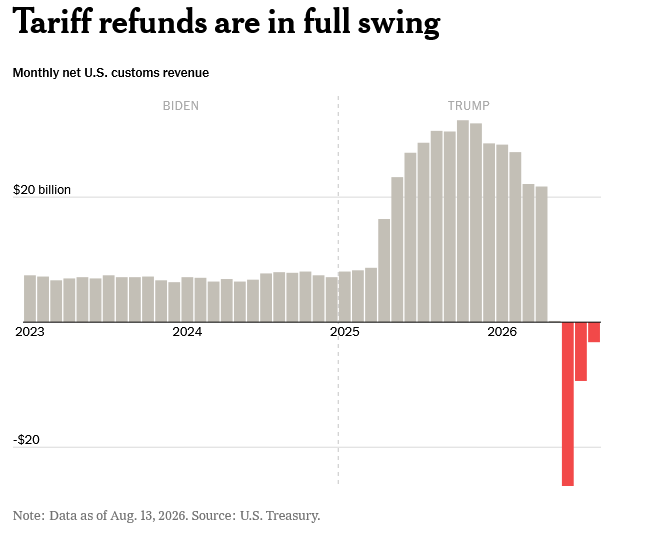
Monthly net U.S. customs revenue
The only visible changes are to tariffs themselves, given that the Supreme Court ruled that the bulk of Mr. Trump’s new tariffs were illegal and lower courts ordered those payments refunded. It should be noted that the refunds are going to the companies that paid them rather than to the consumers who probably bore much of the cost. And the array of new tariffs Mr. Trump has rolled out since have already been challenged in court. Even if they are upheld, they stand to generate only $121 billion in 2026 — far less than the $166 billion that the government must refund.
Trump’s cuts to South Korean military drills stir doubts about US resolve in Asia
Financial Times
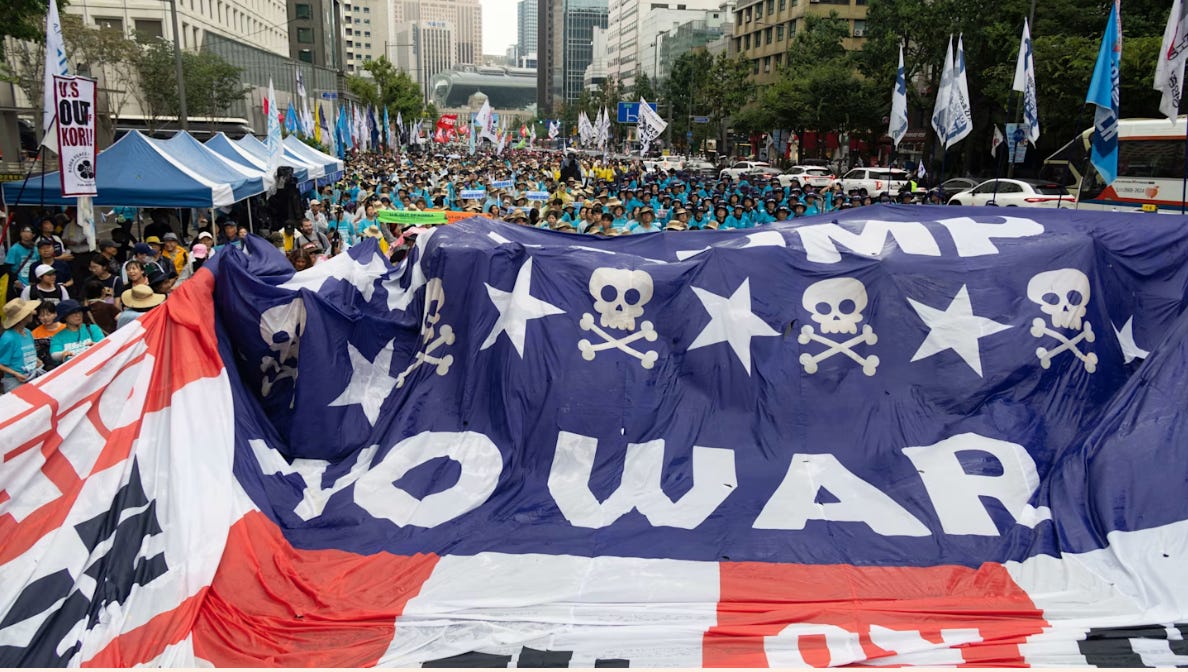
Demonstrators in Seoul protest against US President Donald Trump’s policy on South Korea © Jeon Heon-Kyun/EPA/Shutterstock
Scott: On North Korea’s Liberation Day, Pyongyang dictator Kim Jong Un received two love letters. One came from Vladimir Putin, with effusive words of praise for North Korea’s decision to sent him a fresh 50,000 troops to back up the war on Ukraine. That was expected. More surprising was the love letter from Donald Trump, which reiterated North Korean propaganda blasts against the annual joint US-Korean war games, saying they were offensive to his friend Kim and ratcheting them down. In the wake of this, two theories have been put forward by way of explanation. One is that Trump is preparing to jettison the US alliance system with the East Asian rim, just as he is seeking to demolish NATO. There is a remarkable list of evidence for this, much of which US media don’t bother to report. The second is that Trump was just venting a fit of anger over Korea’s failure to volunteer support for his failed military effort in Iran. Either way, the Trump moves furnish a shocking victory for the Eurasian alliance of Moscow, Beijing and Pyongyang, which is behind the scenes working very hard with their ally Tehran to expand the scope of Trump’s defeat in the Gulf. The lesson for US erstwhile allies is clear: being Trump’s friend and ally is a very dangerous thing.
Donald Trump’s decision to scale back joint military exercises with South Korea has deepened concerns about US reliability among Indo-Pacific allies who were already nervous about his rhetoric on Taiwan.
On Sunday, hours before US and South Korean forces were to start their annual Ulchi Freedom Shield exercises, Trump declared on Truth Social that the drills would send a “hostile” message to Pyongyang, echoing North Korea’s criticism that it was a “rehearsal for a war of aggression”.
The abrupt decision came on the heels of the USS George Washington aircraft carrier strike group setting sail from the Pacific for the Middle East, in a move that will leave the region without a US carrier as China continues to take a more aggressive stance in the region.
Michael Green, head of the United States Studies Centre in Sydney, said one US ally likened working with the Trump administration to “going into space with Sigourney Weaver” in the movie Alien.
“The latest monster to spring from the ceiling was the president’s threat to cancel US military exercises with South Korea,” said Green, who served as the top White House Asia adviser to George W Bush.
The recent developments, which come five weeks before Chinese President Xi Jinping is expected to visit Washington, have undermined US efforts to reassure allies by telling them to focus on Trump’s actions, not his rhetoric.
Elbridge Colby, the top Pentagon policy official, told an audience in Manila last week that the US would “not engage in peacocking” but would “speak softly” while carrying “the world’s biggest stick” — a paraphrase of Theodore Roosevelt’s remark in 1901 before he became president.
