



Everything You Wanted To Know About Nvidia But Were Afraid to Ask / AI News You Can Use / Eisenkot Condemns Jewish Terrorists / Jupiter Swirls / Love Minus Zero / No Limit
Trump Corruption Watch
Understanding the Essentials of the Nvidia Crash: Yes, It’s Espionage. But the Trump Administration Facilitated It
One of the most profitable illicit trades in the world: moving Nvidia chips into China. The national security interests of the US were gravely implicated. But nothing was done. Why is that? There is one compelling reason: both key oversight officers, Donald Trump and Howard Lutnick, had heavy investment positions in Nvidia and would profit massively from the sales to China. It’s pretty simple. Thus the whole Nvidia crisis and market collapse it triggered traces straight back to this dynamic duo.
Scott: On Sunday, Trump posted to his Truth Social account a screed placing the blame for the loss of $1 trillion in value on America’s equity markets on the Democrats’ election victory on Nov 3. But in fact, this shift into correction territory is already being called the “Nvidia collapse” and tied by analysts directly to the immense scandal which has surfaced surrounding the chipmaker and its former leader Jensen Huang. Why is Trump so eager to place the blame elsewhere? There’s a ready answer: because once we sift through the debris of Nvidia, we come quickly to the conclusion that the blame rests very heavily on the shoulders of Trump and his Commerce Secretary Howard Lutnick. And that they were moved not by false policy choices, but by private greed.
Three major investigative pieces published in the last week demonstrate that the WSJ, NYT and FT are able to do their jobs and get to the bottom of the scandal. Each of them points in the same direction, and their analysis and fact-finding are highly corroborative.
How Li Ming, an Alice Huang Associate, Funneled Nvidia Chips to China
Wall Street Journal

Li Ming, in a photo posted to social media in 2023, visits an AI equipment company in Shanghai
Jensen Huang’s romantic partner was the public face of a business suspected of funneling advanced computing power to China. But playing a key role behind the scenes, according to people familiar with the matter, was a man now out on bail in Singapore, living in a luxury villa down the street from the Chinese Embassy.
His name is Li Ming. The 52-year-old Chinese national was a central operator of a web of companies smuggling restricted Nvidia NVDA -14.01% decrease; down pointing triangle artificial-intelligence chips to China, the people said. This web included Megaspeed, the Singapore-based company where Huang’s paramour, Alice Huang, was a managing director. Li was deeply involved in Megaspeed’s activities and took part in major decisions, the people said, as well as playing a role in other companies trading Nvidia chips.
These previously unreported connections show that the efforts to help Chinese companies close the gap in the AI race went far beyond the Megaspeed scandal, which sparked Jensen Huang’s downfall at Nvidia.
Authorities in Singapore, the wealthy Asian city-state, charged Li and others with fraud in February 2025, in a case tied to alleged transshipment of Nvidia chips. Several companies were named in the charges, but not Megaspeed.
Alice Huang and the Secret Expressway That Funneled Nvidia Chips to China
Financial Times

Nvidia CEO Jensen Huang and Chinese executive Alice Huang embrace after he made a keynote speech at Computex 2024 in Taipei Photo: Ann Wang/Reuters
The Chinese businesswoman romantically linked to former Nvidia chief executive Jensen Huang had connections to a network for supplying AI chips that included an alleged Cambodian criminal enterprise, an FT investigation has found.
Former Megaspeed executive Alice Huang is at the centre of US investigations into whether Nvidia’s largest client in south-east Asia was involved in the underground chip trade. Some US officials suspect Alice Huang was a Chinese spy, a claim Beijing has dismissed as a “smear”.
Linked to Alice Huang was a sprawling web of companies between Nvidia and China-based users of its chips that included cloud computing partners, online gaming tycoons, Cambodian traffickers and hundreds of shell companies, the FT found.
These seemingly unconnected enterprises combined — without necessarily being aware of the full picture — to make billions of dollars from one of the most profitable illicit trades in the world: moving Nvidia chips into China.
The FT traced the connections after speaking to more than a dozen people with knowledge of the operations, revealing links that were obscured by complex structures through hundreds of corporate filings.
Nvidia’s advanced chips are crucial in developing cutting-edge AI and have become a vital commodity in the geopolitical rivalry between the US and China.
Washington’s export controls to prevent Beijing from acquiring the most powerful processors have created a multibillion-dollar black market to circumvent US curbs and satisfy China’s insatiable demand.
“Chip smuggling isn’t different from drugs or arms in terms of the structure of the supply chain. But there’s this importance attached to the semiconductor industry — it’s how the US wants to delay China in the AI race,” said Chris Clague, an associate fellow at International Institute for Strategic Studies who has focused on illicit trades in the past decade.
Chinese Intelligence Had a Major Operation Underway to Get Nvidia’s Chips
New York Times
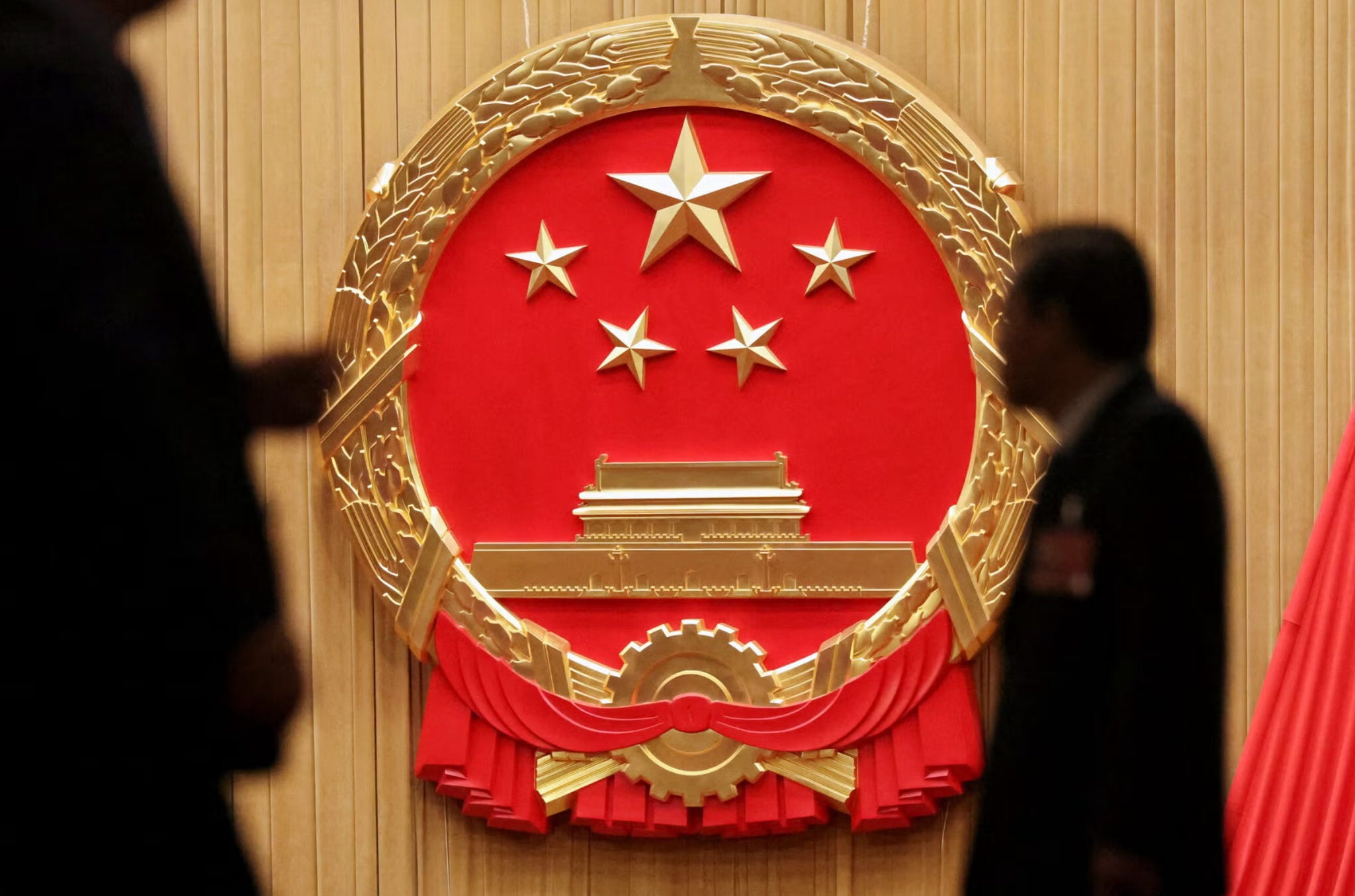
The Communist Chinese operation aimed at getting Nvidia’s chips has been running for at least two years. Photo: Florence Lo/Reuters
When China’s top espionage agency updated its priorities this year, it added a revealing goal: overcoming Western barriers to technologies that Xi Jinping sees as crucial to China’s rise.
At the heart of that quest are the advanced semiconductors needed to power artificial intelligence, including chips that the United States has barred U.S. companies like Nvidia from exporting to China.
China must “adopt extraordinary measures to intensify the drive for core technologies in priority sectors,” Mr. Xi told the Politburo, a council of senior officials, in January, according to an official text of his speech. “As swiftly as possible, solve the ‘chokehold’ problems holding back development of future industries.”
The spy agency, the Ministry of State Security, has long been dedicated to eliminating threats to Communist Party rule in China. Now, it has made it a priority to acquire advanced semiconductor chips and gather intelligence about them, according to several serving and former security and intelligence officials from governments outside China in Asia, the United States and Europe.
How China’s spy agency is seeking to obtain advanced chips and intelligence about them has become a central question in the case of Alice Huang. She is a Chinese businesswoman who U.S. officials say the Chinese agency was working with to spy on Jensen Huang, the chief executive of the American chip giant Nvidia, allegations that were first reported by The New York Times.
In a post on Twitter, Martijn Rasser has done an excellent job of synthesizing these three major pieces:
The WSJ reports that Li Ming, charged with fraud in Singapore, was deeply involved in Megaspeed, and that prosecutors allege he lied to an American supplier about who Nvidia-equipped servers were for. The WSJ didn’t name the supplier, but Singapore police have. It’s Supermicro.
I haven’t seen the two connected in the coverage so far. Police say the alleged misrepresentations came on two occasions in November 2023, the same month, per the WSJ, that Megaspeed joined Nvidia’s cloud partner program. Prosecutors allege the servers were shipped to Malaysia and on to an unnamed third location
Supermicro is not a defendant in this case, Megaspeed isn’t named in the charges, and Li’s case is ongoing. One question I have, nonetheless: Where did those servers end up? The FT reports that Megaspeed’s Malaysian subsidiary imported about $4.6B in goods from Aivres, Inspur’s part-owned US unit. Was the network drawing on more than one US-based server maker?
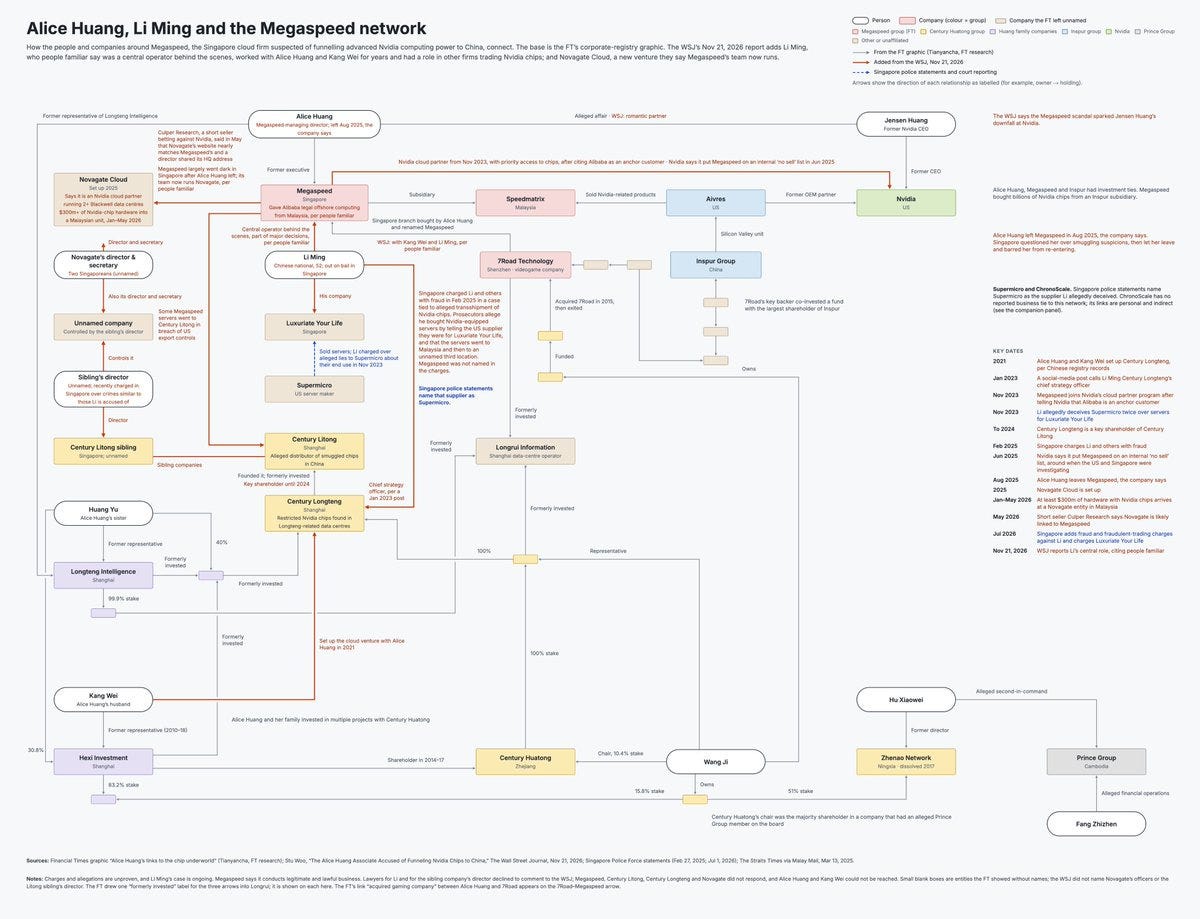
Together, the three articles published this weekend build a more comprehensive picture: the WSJ on Li’s role, the FT on Alice Huang’s links to the chip trade, and the NYT on what officials describe as a campaign by China’s Ministry of State Security to acquire advanced chips.
FT’s graphic sketch provides a ready reference, and Rasser has updated it to include the info established by WSJ and NYT.
Staying Alive In The Age of AI
New York Times
Charles: In an opinion piece in the Times, Vanderbilt Professor and cybersecurity expert Brett J. Goldstein has some powerful advice for policy makers and PC users about how to survive some of the biggest dangers AI is guaranteed to provide.
For the Policy Makers:
The flaws buried in all that code used to be needles in a haystack. But now, A.I. can find the needles, and that helps hackers exploit insecurities they would not have found otherwise. That means all code needs to be nearly perfect in order to be secure, creating huge pressure to patch existing software before it’s exploited. The process of making those updates and maintaining near-perfect software is straining the digital infrastructure we rely on.
I see us taking one of two paths in response to this moment.
On the first path, we build and invest in digital systems that are safe, sustainable and secure. Tech leaders and government officials should stop demanding new and trendy features — like chatbot tools — if they come at the expense of focusing on improving safety and security. The priority is keeping the lights on — often literally.
The second path is the one where things keep breaking. We continue to advance new technologies at an insane speed while our existing systems remain fragile and unstable. The lights will constantly flicker, if they don’t go out entirely.
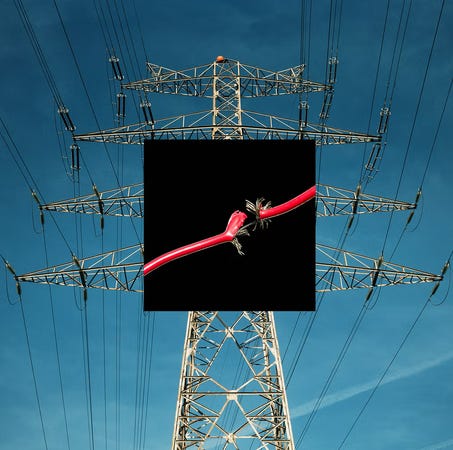
We need government leaders who will be clear with the American people how fragile our digital infrastructure is — and then act to fix it, and quickly.
Incredibly, three weeks ago we elected leaders who are actually capable of doing that. Way back in June Michigan Senate candidate Abdul El-Sayed released a remarkably thorough and sophisticated position paper explaining exactly what needs to be done to get AI under control:
Senator Bernie Sanders introduced the American AI Sovereign Wealth Fund Act to transfer 50% equity from the largest AI companies into public hands. The El-Sayed campaign proposes to take that one step further to give Americans a seat at the table to determine the future of this transformational technology, protect American jobs, and establish guardrails to keep us safe and ultimately benefit everyone, not just tech CEOs.
Abdul is the only candidate in the Michigan Senate race to support public ownership of AI, and one of the only U.S. Senate candidates to do so nationwide. Notably, he is the first to propose public control of AI.
And this is Professor Goldstein’s advice for all of us watching on our PCs at home:
Use a password manager, with a strong and different password for every website. When a site offers a passkey (digital keys enabled through facial recognition or a fingerprint scan), take it, because then there is no password to steal. Where there is no passkey available, turn on two-factor authentication and use an authenticator app, rather than text messages. Keep software patched and delete apps you don’t use. Think twice before handing an unfamiliar app your location, camera or microphone. Never click past a browser security warning. And when you are thinking of connecting everything you hold dear to the newest A.I. agent that promises to make your life magical — just don’t.
Eisenkot Condemns Jewish Terrorism
The Guardian
Charles: This story was appropriately prominent on The Guardian home page at 10:45 yesterday morning—and invisible at The New York Times.
The Times matched it a few hours later.
Arson attacks by militant Israeli settlers on Palestinian villages in the occupied West Bank have caused a political row in Israel, drawing condemnation from Gadi Eisenkot, the opposition leader, who described them as “Jewish terrorism”.
Dozens of settlers raided Palestinian communities overnight on Saturday, setting fire to about a dozen vehicles and several homes and scrawling racist graffiti. At least four communities were attacked. Israeli police said they had launched an investigation with forensic teams.

Swirls and Colors on Jupiter from Juno

Explanation: What creates the colors in Jupiter’s clouds? No one is sure. The thick atmosphere of Jupiter is mostly hydrogen and helium, elements which are colorless at the low temperatures of the Jovian cloud tops. Which trace molecules provide the colors remains a topic of research, although small amounts of ammonium hydrosulfide are one leading candidate. What is clear from the featured color-enhanced image -- and many similar images -- is that lighter clouds are typically higher up than darker ones. Pictured, light clouds swirl around reddish regions toward the lower right, while they appear to cover over some darker domains on the upper right. The featured image was taken by the robotic Juno spacecraft in 2018 during its 14th low pass over Jupiter. Juno continues in its looping elliptical orbit, swooping near the huge planet every 33 days and exploring a slightly different sector each time around.
CREDIT: NASA, Juno, SwRI, MSSS; Processing & License: Matt Brealey, Seán Doran
Your Online Moment of Zen
Love Minus Zero
\ No Limit
Written and performed by Bob Dylan
First released on March 25, 1965 on the album Bringing It All Back Home.
I saw Bob perform it at the Royal Albert Hall two months after it was released.
It was the sixth song I ever heard him play, and it contains my motto:
She knows there's no success like failure
And that failure's no success at all.
This sublime version is from The Rolling Thunder Review tour in Montreal in December, 1975.