



Hegseth Brings His “Special kind of loathsomeness” To the Beaches of Normandy
The Guardian
Charles: Almost every time the right-wing extremist who is America’s Secretary of Defense opens his mouth, the civilized world recoils with horror. On Saturday Pete Hegseth managed a new all-time low by besmirching the honor of the heroes who died on the beaches of Normandy to liberate Europe from fascism.
Speaking at the Normandy American Cemetery overlooking the sacred ground of Omaha Beach, Hegseth compared modern day immigrants to the Nazis.
“Sadly, today, different European beaches are stormed by different, dangerous ideologies. Beaches in Spain, Italy, Greece and Bulgaria, boats and men arrive. When will European capitals do something about that invasion, or is it too late? I pray not, and I believe not.
The men who fought and died here restored freedom to Europe, That freedom must be maintained by this generation of leaders and war fighters, or what they fought for was merely temporary.”
Historian Simon Schama identified Hegseth’s remarks as a
special kind of loathsomeness: a blend of historical deafness, grotesque stupidity and comically ludicrous self-importance.
As if the little people’s rage against immigration somehow is superior to the war against the Third Reich and entitles this comic book nobody to lecture the actual heroes.
From Jerusalem, the Israeli human rights lawyer Daniel Seidemann declared, “This is an obscene desecration of the memories of those who stormed the beaches of Normandy, and especially of those who fell.”
Anders Åslund, a Swedish economist and former senior fellow at the Atlantic Council, contrasted the comments with Hegseth’s later remarks on the US standing alongside its allies. “So much nonsense,” he wrote. “‘We stand by our allies!’ No you don’t. You just attacked them. Immigration policies are internal matters.”
Åslund said Hegseth’s comments were particularly “clueless” given his recent decision to skip a key NATO meeting and Donald Trump’s vows to cut the number of troops in Europe. “Doesn’t Hegseth know that the most unreliable ‘ally’ by far is the US?”
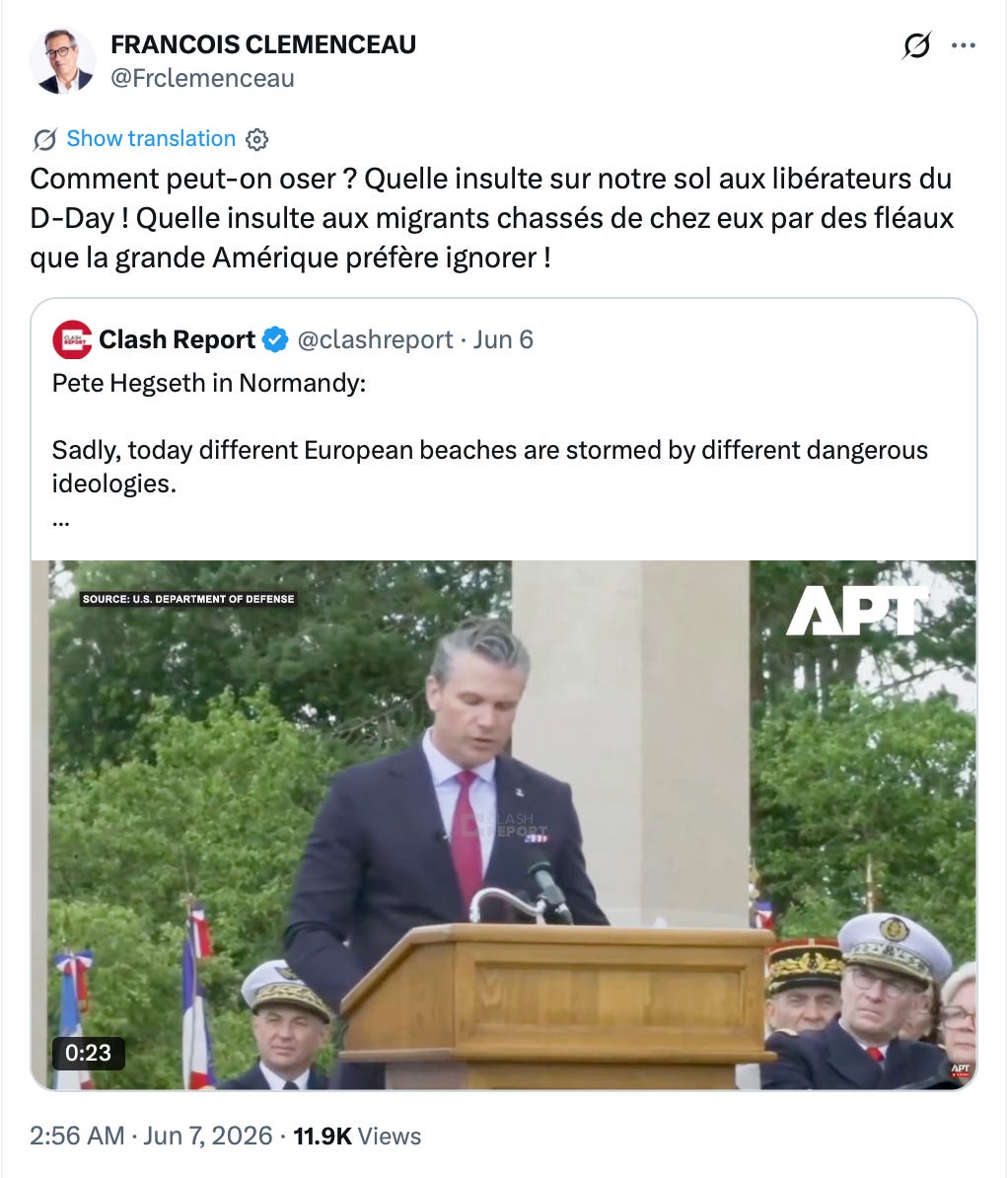
French journalist François Clemenceau, the great great nephew of World War I prime minister Georges Clemenceau, demanded:
“How could they dare? What an insult, on our own soil, to the liberators of D-Day. What an insult to the migrants driven from their homes by scourges that great America prefers to ignore.”
Never forget that Hegseth was banned from guard duty at Joe Biden’s inauguration after he was flagged as a possible “Insider Threat” by a fellow service member because of a tattoo on his bicep associated with white supremacist groups.
Hegseth accused the Pentagon of over-reacting by taking steps to address extremism, and attacked the the military’s efforts to remove people it deemed white supremacists from the ranks. Hegseth wrote that the problem is “fake” and “manufactured” and characterized it as “peddling the lie of racism in the military.” He said efforts to root extremism out had pushed “rank-and-file patriots out of their formations.”
How will change come in Russia?
The Observer
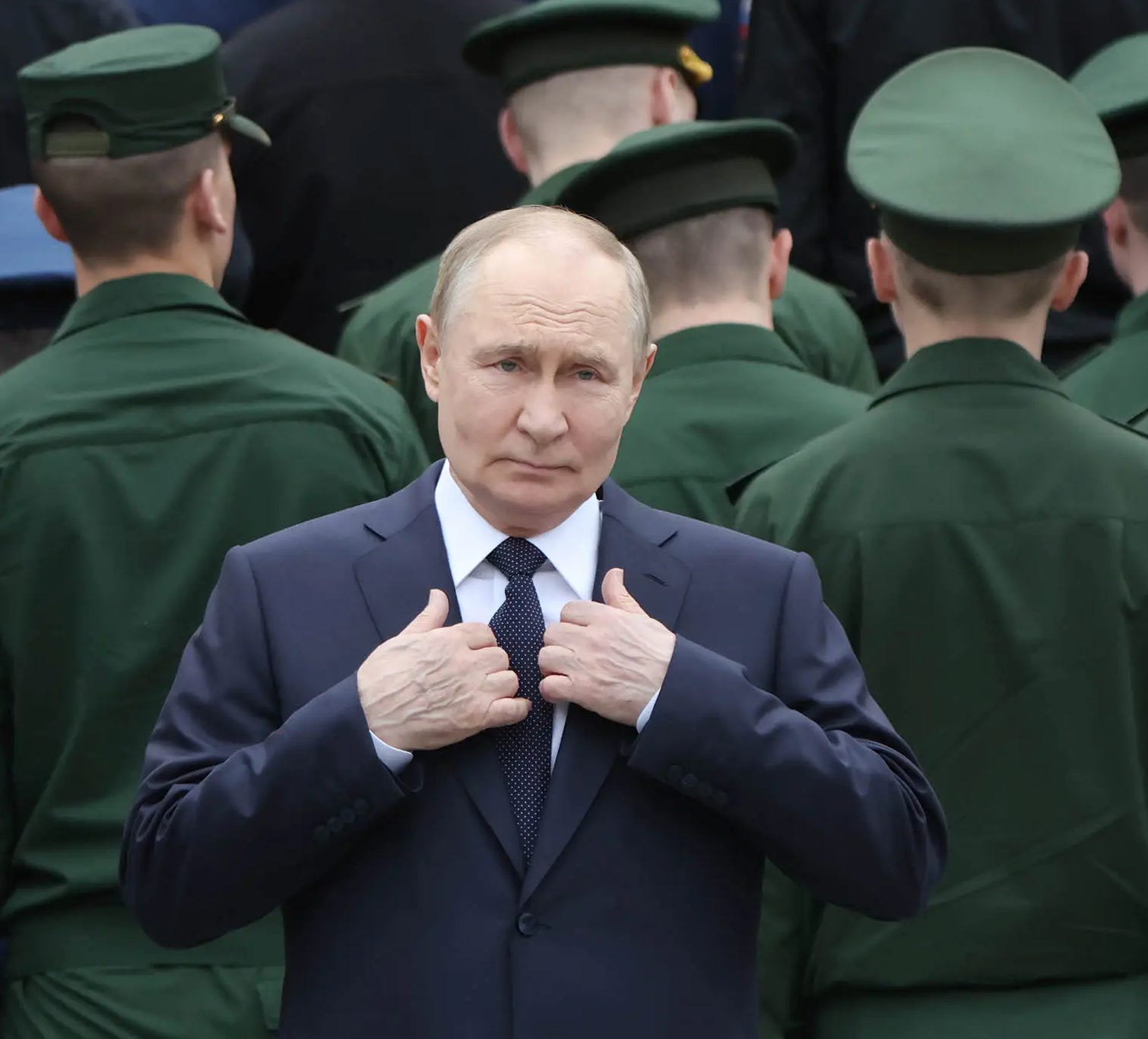
Scott: Death comes for all things, and as the Wall Street Journal told us last week, few leaders are more obsessed with their own mortality than Vladimir Putin (though his sidekick Trump gives him a run for the distinction). An embarrassing St Petersburg Economic Summit, horrific setbacks for Russia on the Ukraine front, and calamitous reports about the state of the Russian economy are now fueling a great deal of speculation about Putin’s end phase. How will be disappear from the scene and what will replace him? Andrei Soldatov, a leading student of Russia’s national security apparatus, offers some historically informed thoughts on this topic in The Observer.
Modern Russia has experienced three revolutionary crises (in 1905 and two in 1917), but the systems built in their aftermath left virtually no room for more popular revolt. The leaders of the new regimes made sure of it – from Lenin and Stalin to Yeltsin and Putin.
The sudden political upheavals of recent Russian history have been driven by elites: by the KGB and the military in 1991; by the parliament and Yeltsin’s vice-president in October 1993; and by Putin’s closest crony, Prigozhin, in 2023.
There were mass protests in Moscow in 2011–12 but they were never violent or numerous enough to threaten Putin. Since then, every segment of Russian society has been systematically pushed towards apathy and political disengagement.
That does not mean the mood in the country is unchanged. Drone attacks have had an effect, as has the growing disappointment in Donald Trump’s ability to make Putin accept a ceasefire.
But it would be naive to expect drone strikes on Russian cities to drive ordinary people into the streets or increase sympathy for Ukraine. They are irritating and frightening; they make people think that perhaps it would have been better not to start the war in the first place, and that ending it may now be the best option. But those who have such thoughts keep them to themselves. Russians have been given too many examples of what can happen to those who break their silence…
After more than four years of brutal trench warfare, it may be wiser to limit expectations to what appears realistically achievable. Drone strikes can reduce Russia’s offensive capabilities and, combined with sanctions, slow its war machine. But they are unlikely to do much more than that.
Surprises are possible. A coup d’état is always a possibility in a closed political system such as Russia’s. The problem is that Putin could just as easily be replaced by someone even more hostile to the west and Ukraine.
Scott Horton and Charles Kaiser Are Veteran Authors and Journalists.
Charles: I came to this originally as a metro reporter for the New York Times where I covered all the city beats, including real estate where I met one Donald Trump in the 1970s. Then I was a media reporter at the Wall Street Journal after which I got into the business we’re still in as the press critic at Newsweek.
Since then, I’ve written books about the 1960s, about gay life in the United States since 1940 and about a family in the French resistance who I’ve known all my life.
Enjoy two weeks of The Horton-Kaiser Report for free.
Israel Just Quintupled Its Propaganda Budget
The New York Times
Charles: Here’s why that won’t be enough to change the narrative.
At 10:39 last Saturday night (EDT) these were all stories on the home page of The New York Times:
Pentagon Sees Growing Espionage Threat From Israel
The Defense Department has increased the threat assessment to its highest level, and Israel is believed to have eavesdropped on U.S. talks with Iran.
Israeli Strike Kills 3 Lebanese Soldiers, Days After Truce Was Signed
Infant Killed as Israeli Military Fires on Car in West Bank, Palestinian Officials Say
And then there was this one:
What Visual Evidence Tells Us About Israel’s Use of White Phosphorus in Lebanon
New York Times
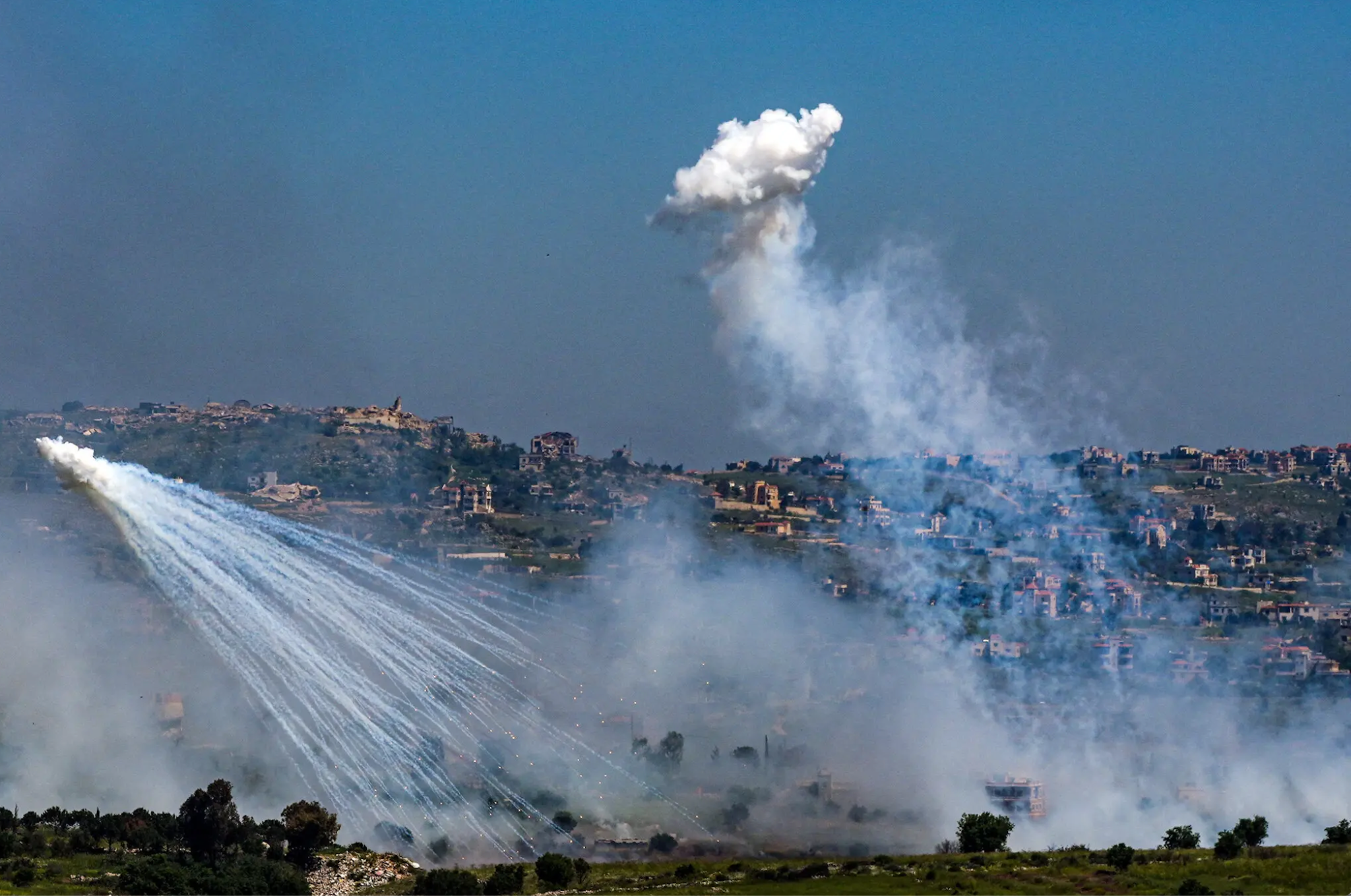
Plumes of smoke with the distinctive shape of white phosphorus are shown over the border between Israel and Lebanon in late April. Photo: Ayal Margolin/Reuters
Scott: The Trump administration’s position on the use of white phosphorus in wartime is very clear—it’s a war crime if deployed against the US or US forces, but it’s perfectly okay if the US does it. As in so many areas, this has brought the US into line with Israeli practice, which has been to use white phosphorus with gusto while generally disclaiming the fact that it’s being used. For the massive Israeli military operations in Lebanon—which aim to occupy the country’s southern third at least, to depopulate it and to level existing cities and towns—white phosphorus has been a staple, as a New York Times study makes clear. The NYT study fully validates and expands on reports by Human Rights Watch concerning Israeli use of white phosphorus against civilians in connection with Lebanon operations. This war crime is supported and funded by US taxpayers, in violation of US law.
The Israeli military has deployed white phosphorus, an incendiary substance that can be extremely harmful, over populated areas in Lebanon in its battle against Hezbollah, according to experts, aid groups and visual evidence collected by The New York Times.
Distinctive smoke trails from this type of munition were seen as recently as May 30 in Nabatieh, a city of roughly 40,000, in social media footage verified by The Times, which was filmed as Israeli forces captured Beaufort Castle, a landmark in the area.
Other verified footage showed that white phosphorus had been used in the vicinity of the coastal city of Tyre, as well as near three small towns — Qlayaa, Khiam and Yohmor — in the months since fighting between Israel and Hezbollah, the Iranian-backed militant group, began again in March. The latest fighting erupted after Hezbollah fired rockets into northern Israel, following joint US-Israeli strikes on Iran.
Once exposed to air, white phosphorus spontaneously ignites and is exceptionally difficult to extinguish…
“The harm that white phosphorus causes is horrific,” said Bonnie Docherty, a senior arms adviser at Human Rights Watch. “It inflicts burns that can penetrate to the bone.” The dense smoke it produces, she said, “causes severe respiratory damage, and organ failure. Wounds can reignite when bandages are removed and remnants of the substance are exposed to oxygen.”
