

The Birth of the Shadow Docket
New York Times
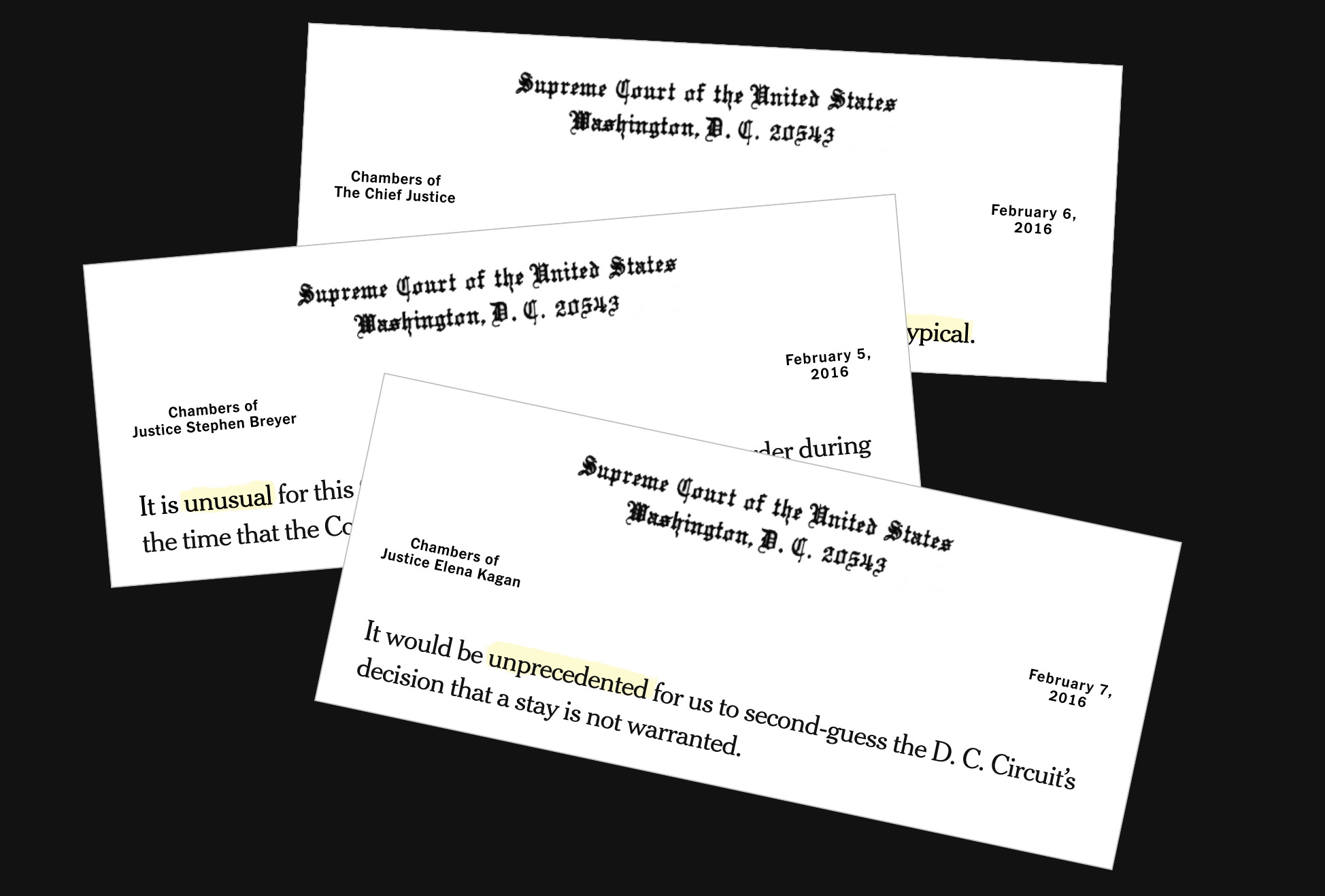
Scott: Foreign scholars studying the astonishingly rapid disintegration of constitutional protections during Trump 2.0 have consistently fingered one quick explanation for this phenomenon: the Supreme Court should be the guardian of constitutional protections and the enforcer of limitations against presidential overreach. In Trump’s second term, however, it has played the opposite of this role—smacking down lower court rulings that restrained Trump sometimes on the basis of century old legal precedents, usually without offering any clue of the legal pretext upon which it is acting.
Today, Adam Liptak and Jodi Kantor of the New York Times have offered us a rare glimpse inside the working of the Court which reveals how this procedural brush-off mechanism—now known as the shadow docket—was summoned into being by a supposed conservative traditionalist Chief Justice, John Roberts. The context was a search for a way to overturn one of Barack Obama’s signature projects, the Clean Power Plan, which was vehemently contested by fossil fuel interests that have long exercised outsized political influence within the Beltway and on the Supreme Court. The documents that the New York Times reveal demonstrate a Court very much beholden to these commercial interests and determined to loosen regulatory burdens without engaging in any meaningful legal analysis.
Since that night a decade ago, the logic behind the Supreme Court’s pivotal 2016 order has remained a mystery. Why did a majority of the justices bypass time-tested procedures and opt for a new way of doing business?
The answer would remain secret for generations, legal experts predicted. “We’ll never know (at least, until our grandkids can read the justices’ internal papers from that time period),” Stephen Vladeck, a law professor at Georgetown, wrote in a newsletter in February marking the anniversary of the order.
The New York Times has obtained those papers and is now publishing them, bringing the origins of the Supreme Court’s shadow docket into the light.
The 16 pages of memos, exchanged in a five-day dash, provide an extraordinarily rare window into the court, showing how the justices talk to one another outside of public view…
In public, Chief Justice John G. Roberts Jr. has cultivated a reputation for care and caution. The papers reveal a different side of him. At a critical moment for the country and the court, the papers show, he acted as a bulldozer in pushing to stop Mr. Obama’s plan to address the global climate crisis.
When colleagues warned the chief justice that he was proposing an unprecedented move, he was dismissive. “I recognize that the posture of this stay request is not typical,” he wrote. But he argued that the Obama plan, which aimed to regulate coal-fired plants, was “the most expensive regulation ever imposed on the power sector,” and too big, costly and consequential for the court not to act immediately.
In the Trump era, he and the other conservative justices have repeatedly empowered the president through their shadow docket rulings. By contrast, the papers reveal a court wielding those same powers to block Mr. Obama. Justice Samuel A. Alito Jr. warned that if the court failed to stop the president, its own “institutional legitimacy” would be threatened.
While energy interests could upend the Obama environmental program with votes on the Supreme Court they could not muster in Congress, years later it became very clear that the same tactical maneuver could be used to underscore dictatorial grabs of power by a president who belonged to John Roberts’ party—and to bring the judiciary to heel—without ever even offering an explanation for what was being done.
The Size of Trump’s Arch Even Alarms Its Inventor
The New York Times
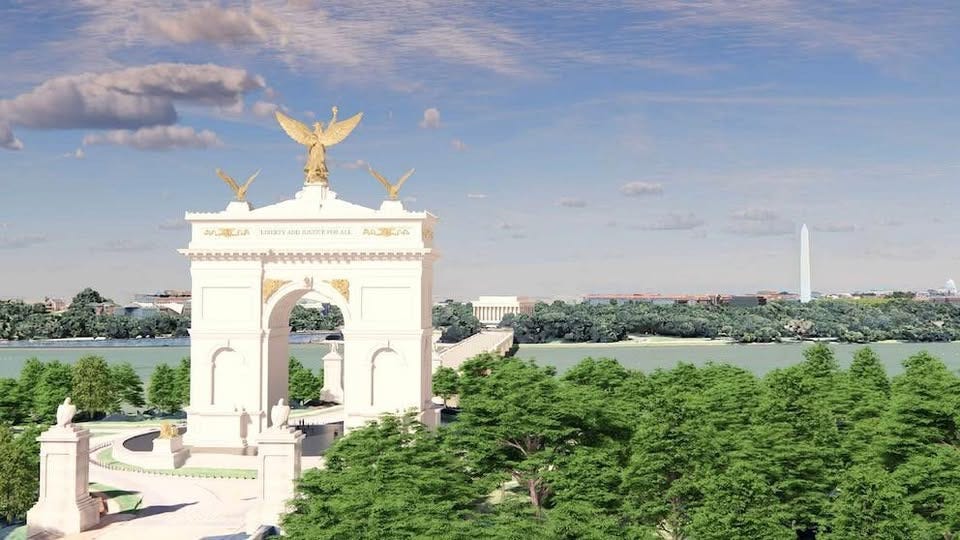
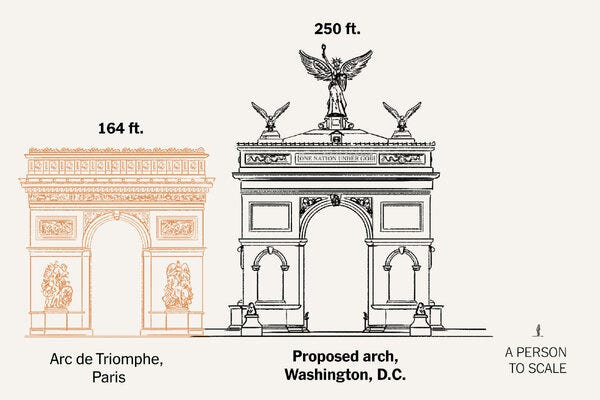
Charles: Providing the latest proof that his entire life has been a master class in overcompensation, Donald Trump’s proposed arch, that would loom over Arlington Cemetery and destroy historic sitelines to the Lincoln Memorial in Washington, D.C., is now supposed to be 250 feet high. That’s four times the size originally proposed by Catesby Leigh, an architecture critic who is now reportedly as alarmed as everyone else by Trump’s hideously super-sized idea.
Jimmy Kimmel says, “It strikes the perfect balance between Scientology and Liberace which we have come to expect from our president.”
Putin Builds a Powerful Surveillance State
The Bell & Kommersant
Scott: In George Orwell’s 1984, the protagonist Winston Smith lives in a surveillance state.
As a member of the party’s nomenklatura, he understands better than most how it works—still he barely perceives the full scope of it. Every public and private space is under surveillance through “telescreens,” which broadcast announcements, news, and propaganda. But these screens are also monitoring devices, noting every move, every word, every facial expression, of the populace of Oceania in the constant quest for thoughtcrime. “Big Brother is watching you” is the signature promise, and it is to be understood literally.
In our own times, the metric of the surveillance state is less big-screen TVs, and more social media platforms—which under the guidance of people like Elon Musk, Peter Thiel and Mark Zuckerberg are now capable of and do perform nearly identical functions in collecting information about their subjects/subscribers.
For those who want to understand better the trajectory on which Trump is embarked, four authoritarian, oppressive regimes merit closer scrutiny. They are mostly countries whose leaders Trump holds in inexplicably high esteem—Russia, China, North Korea and Iran. And they are all countries which have invested very heavily in exercising control over social media and bending it to the will of their strongmen.
Over the last weeks, Putin has been particularly busy in making major transformations, drawing heavily on technology developed by his Iranian allies. The Bell reports:
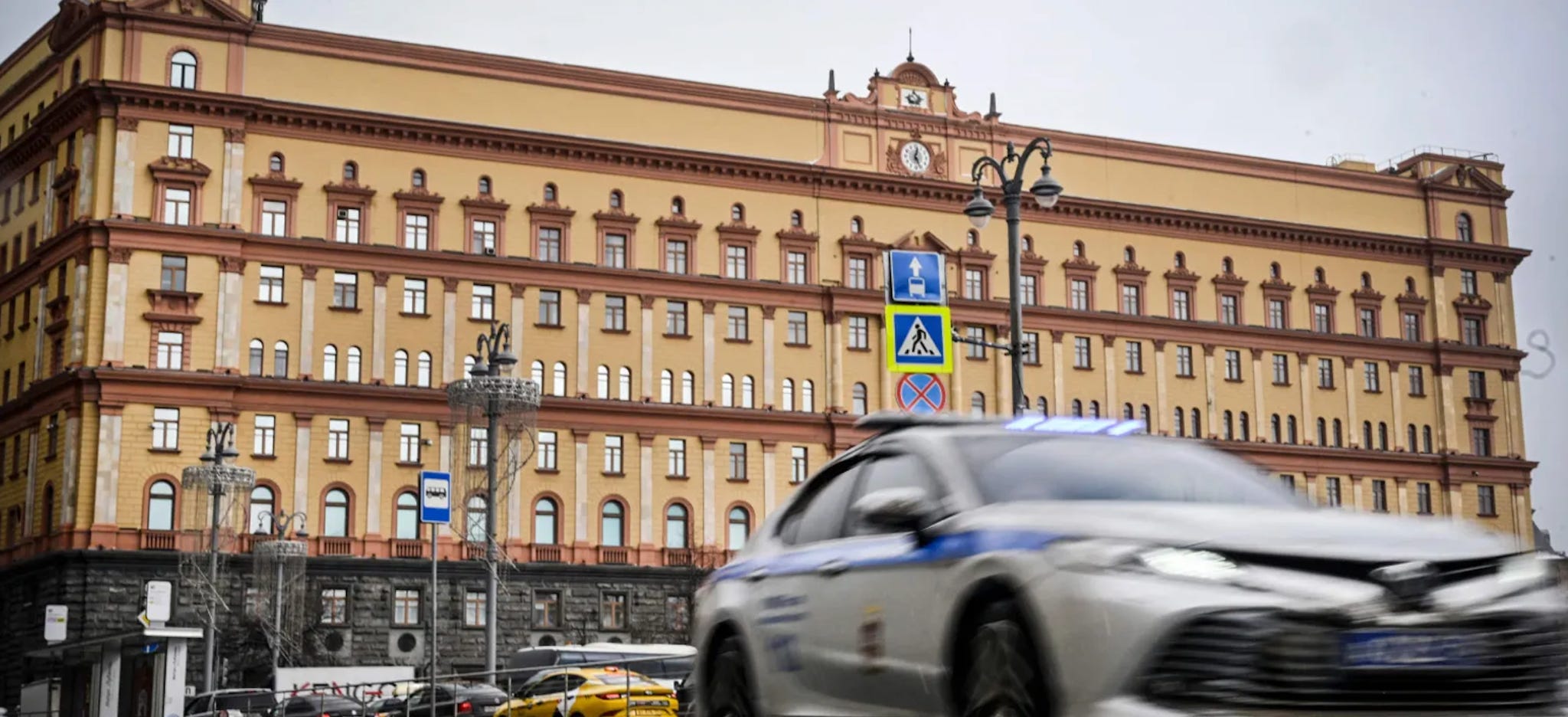
The Bell has uncovered the driving force behind the recent wave of repression targeting the Russian internet—ranging from restrictions on voice calls via WhatsApp and Telegram to the outright blocking of messaging apps and a war on VPNs. Behind these measures stands the FSB’s Second Service—the intelligence agency’s most shadowy division, tasked with safeguarding the constitutional order against the political opposition and combating terrorism. It was agents from this very unit who attempted to poison Alexei Navalny and Vladimir Kara-Murza. Since at least last summer, control over the Russian internet has been handed over to the Second Service, which is now aggressively attempting to purge it of “hostile means of communication.”
“The whole thing looked like total madness—they simply printed out sheets of paper [containing directives to combat VPNs], handed them to the executives of every company present, ordered them to sign them, and then immediately collected them. Anyone who refused to comply was promised severe retribution,” an IT industry source for The Bell recounts, describing a recent meeting at the Ministry of Digital Development. At this meeting, telecom operators and internet companies were presented with a fait accompli: they were required to take full responsibility for combating the tools Russians use to bypass internet censorship. Failure to do so, they were warned, would result in serious consequences—potentially ranging from the revocation of tax incentives to exclusion from official “whitelists.”
Executives at Russian tech companies were unaccustomed to such treatment; typically, the Ministry of Digital Development has positioned itself as a defender of the industry. However, an explanation for this shift quickly emerged. According to a The Bell interlocutor who attended the meeting, it was there—for the first time in his two decades of working in the Russian IT sector—that he encountered a representative of the FSB’s Second Service (officially known as the FSB’s Service for the Protection of the Constitutional Order and the Fight Against Terrorism). “Everything changed because the Second Service has seized the initiative [within the industry]. Now they show up everywhere; they make all the decisions,” he told The Bell. An employee at one of Russia’s telecom operators is also aware that the FSB’s Second Service has recently assumed responsibility for internet oversight in the country. Meanwhile, a source for The Bell within the payment services sector claims that, several weeks ago—at the behest of the Second Service—inspections were carried out at several major payment service providers. Officials visited these companies with inquiries regarding whether they were processing user payments directed toward VPN services. The largest operators handling such payments (including, for instance, *YuMoney*—a service owned by Sber) were ordered to immediately cease such transactions.
The Second Service’s offensive against the Russian internet began at least as early as last summer; according to one of The Bell’s industry sources, the restrictions placed on calls via WhatsApp and Telegram last August were already being spearheaded by the “Second Service.” Another source claims that, around that same time, a meeting took place between the head of the Second Service, Alexei Sedov, and Vladimir Putin. “Sedov allegedly promised Putin that he would ‘bring order’ to the internet—and was given carte blanche,” the source recounts. Putin’s press secretary, Dmitry Peskov, did not respond to The Bell’s request for comment regarding this matter.
In essence, the plan is to block Russians from using “foreign” communications platforms and require them to use a new platform which is in fact operated by the Russian intelligence services, who will monitor everything that transpires on them in real time. Essential to this effort is weaning Russians off the use of VPN services which would allow them to continue the use of the less-accessible platforms. And Kommersant has now reported how this will transpire—through criminal law legislation which will transfer control over the use of VPN system to the FSB, the Russian intelligence service formerly headed by Vladimir Putin:
Amendments drafted for the second reading of the second package of anti-fraud legislative changes (dubbed “Anti-Fraud 2.0”) prohibit hosting providers from leasing their computing resources to owners of websites and information systems that facilitate access to content blocked within the Russian Federation. Consequently, the proposed measures aim to restrict providers from granting access to VPN service operators. This information is derived from the latest draft of the bill, which Kommersant has reviewed. The document does not, however, specify any sanctions for non-compliance with these requirements.
In response to an inquiry from Kommersant, the press service of the Ministry of Digital Development stated that “at this moment, the amendments for the second reading are being coordinated with relevant government agencies and organizations,” and that a final version of the document is not yet available.
For hosting providers, this potential new regulation signifies a shift in status from that of a “technical intermediary” to that of a “controller,” explains the hosting provider RUVDS. Whereas previously a hosting provider could disregard activity occurring “inside” a server until a formal complaint was received, they are now obligated to prevent the very possibility of leasing resources to violators. “In practice, this will entail a tightening of service agreements and closer cooperation between companies and Roskomnadzor,” believes Nikita Tsaplin, the provider’s CEO.
In December 2023, Roskomnadzor—the Russian Ministry of Propaganda—began compiling a registry of hosting providers. As of February 1, 2024, hosting providers not included in this registry are prohibited from offering services within the territory of Russia. Currently, 566 organizations are registered in the registry. Authorities are now aiming to reduce the number of users utilizing VPN services. As Kommersant previously reported, digital platforms that remain accessible to users while a VPN is active may be removed from “whitelists” of approved websites, stripped of their IT accreditation, and face other penalties. Service providers will be required to verify whether a client is included on a blacklist and whether the owner of that client complies with Roskomnadzor’s directives, says Igor Bederov, Chairman of the Council on Combating Technological Violations at the NSB Coordination Council. If a client disregards the law, the provider will be obliged to deny them service: “This is not merely a matter of banning servers, but rather a specific procedural requirement for hosting providers.” Mr. Bederov adds, however, that many companies currently lack established practices and technologies to effectively identify and block such clients; furthermore, the transition to this new operational model entails significant complexities and costs, and providers’ readiness to implement it appears low at this time. “One positive outcome could be the purging of unscrupulous players from the market,” he added.
Bouquets for Europe’s Fascists from Marco’s Monsters
The New York Times
Charles: Vile like only this administration can be. Two hundred thousand American soldiers died fighting the Nazis in Europe. After that the State Department spent eighty years showing its contempt for their successors.
Now Rubio’s white supremacists are celebrating right-wing extremists wherever they can find them. In a disgusting perversion of American diplomacy, 27-year-old Christian Nationalist Sam Samson has been paying homage to every right-wing monster in Europe, from Beatrix von Storch and Joachim Paul of neo-Nazi Alternative for Germany, to Nigel Farage in Britain and Marine Le Pen in France. After Le Pen was convicted of overseeing an embezzlement scheme and barred her from running for another public office for five years, Samson lobbied a French official to allow Le Pen to run again anyway. He was then reported to the French government for foreign interference.
Intergalactic Ice Water

An observation made by NASA’s SPHEREx (Spectro-Photometer for the History of the Universe, Epoch of Reionization, and Ices Explorer) shows the chemical signatures of water ice (shown in bright blue) and polycyclic aromatic hydrocarbons (orange) in Cygnus X, one of the most active and turbulent regions of star birth in our Milky Way galaxy. The image was released on April 15, 2026, along with a study detailing the observation.
One of SPHEREx’s main goals is to map the chemical signatures of various types of interstellar ice. This ice includes molecules like water, carbon dioxide, and carbon monoxide, which are vital to the chemistry that allows life to develop. Researchers believe these ice reservoirs, attached to the surfaces of tiny dust grains, are where most of the universe’s water is formed and stored. The water in Earth’s oceans — and the ices in comets and on other planets and moons in our galaxy — originates from these regions.
SPHEREx launched March 11, 2025, and has the unique ability to see the sky in 102 colors, each representing a different wavelength of infrared light that offers distinctive information about galaxies, stars, planet-forming regions, and other cosmic features.
Using the Justice Department as His Personal Revenge Machine, Again
The New York Times
Charles: Charlie Savage and Alan Feuer report the Justice Department has now designated a former Donald Trump campaign lawyer, Joseph diGenova, to pursue one of the president’s favorite conspiracy theories, that the Russia investigation was part of a law enforcement plot to frame Trump. To make sure the legal process is as skewed as possible, diGenova will present evidence to a grand jury in Fort Pierce, Florida overseen by Justice Aileen Cannon, who previously made a series of outrageous rulings to ensure that Trump would never be prosecuted for the top secret documents he absconded with when he left the White House the first time.
In 2020, as part of the legal team for the Trump campaign, Mr. diGenova said that Christopher Krebs, a cybersecurity official who had contradicted false pro-Trump claims of election fraud, should be “shot.” (Mr. diGenova later apologized.)
Mr. diGenova’s appointment comes after Maria Medetis Long, a senior career prosecutor in Miami who had been in charge of the investigation, was abruptly removed from the case. Ms. Medetis Long, who leads national security investigations for Mr. Quiñones’s office, is said to have objected to moving forward with a portion of the inquiry focused on John O. Brennan, the former C.I.A. director.
Brennan appears to be a principal target of this witch hunt.
16 Bets tied to the Iran War Netted a cool $1bn
The Guardian
Scott: Iranian diplomats and leaders have now repeatedly called attention to the fact that Trump regularly makes a series of very dramatic posts to his social media account, just as the markets are about to close. And these tweets are usually rife with false claims designed to influence the markets.
Here the Guardian draws attention to the fact that someone with perfect knowledge of what Trump was about to tweet make a $1 bn profit at the outset of the Iran war.
Sixteen bets made $100,000 each accurately predicting the timing of the US airstrikes against Iran on 27 February. Later, a single user would make over $550,000 after betting that Ayatollah Ali Khamenei would topple, just moments before his assassination by Israeli forces. On 7 April, right before Donald Trump announced a temporary ceasefire with Iran, traders bet $950m that oil prices would come down. They did.
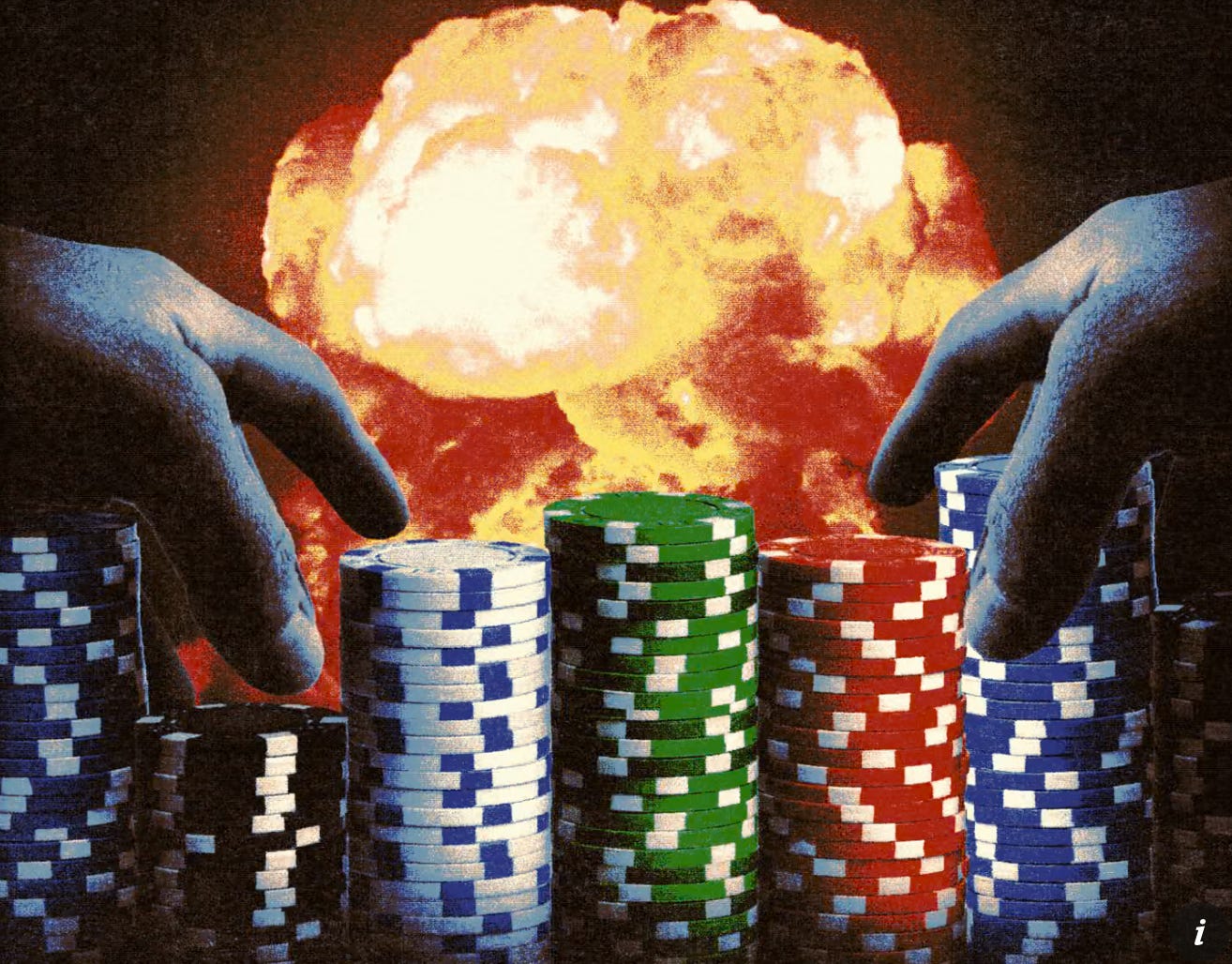
These bets and other well-timed wagers accurately predicted the precise timing of major developments in the US-Israel war with Iran, creating huge windfalls and raising concerns among lawmakers and experts over potential insider trading.
Betting – once largely siloed to sporting events – has now spread to include contracts on news events where insider information could give some traders an advantage.
Trump Goes Full Haight-Ashbury
The New York Times
Charles: This could be the first sensible policy decision the Trump Administration has ever made—thanks apparently to Joe Rogen’s advocacy.
Andrew Jacobs and Noah Daly explain:
President Trump on Saturday signed an executive order seeking to hasten research into the therapeutic benefits of LSD, Ecstasy, psilocybin and other mind-altering drugs by ordering federal agencies to ease restrictions that have long limited the ability of scientists to study them. The measure also provides $50 million for state-level research into ibogaine, a powerful psychedelic made from the root of a Central African shrub that has been drawing interest from researchers for its potential to treat opioid use disorder and other forms of substance abuse.
“I’m pleased to announce historic reforms to dramatically accelerate access to new medical research and treatments based on psychedelic drugs,” Mr. Trump said from the Oval Office, where he was joined by a number of top cabinet officials and the podcaster Joe Rogan.
Spain Seeks Termination of EU’s Association Agreement with Israel
El País
Scott: In a fiery address, Spanish prime minister Pedro Sánchez has called on the EU to take the steps necessary immediately to suspend Israel’s association agreement with the European communities, which forms the bedrock of Israeli trade and commerce. Sánchez specifically cited war crimes committed by Israel in its military operations in Gaza, its violation of its responsibilities as an occupying power in the West Bank, the manner in which it conducted military operations in Lebanon and Iran and finally its passage of legislation which would impose the death penalty only on Palestinians as the basis for his call.
The Prime Minister and Secretary-General of the PSOE, Pedro Sánchez, kicked off the pre-campaign for the Andalusian elections—scheduled for May 17—this Sunday in Gibraleón (Huelva). His objective is to shore up the Socialist Party’s electoral base, which is currently at an all-time low according to the latest polls, as well as to boost the candidacy of his nominee for the regional government, former minister María Jesús Montero—who currently registers the lowest approval ratings of all her competitors in those same surveys. Sánchez has armed himself with one of his key political assets—the “No to War” stance—and announced that Spain will formally request, during Tuesday’s meeting of the EU-27 Foreign Ministers in Luxembourg, the “termination of the Association Agreement with Israel.” “A government that violates international law or EU principles cannot be a partner,” he argued.
Sánchez took the stage at the first pre-campaign rally—before an audience of some 2,000 people (several dozen more were left outside the venue due to capacity limits)—in a province that has historically served as a Socialist stronghold. Through his presence in Andalusia—which will be a recurring feature of the campaign leading up to May 17—he seeks to boost the prospects of the second cabinet minister he has backed in a regional election during the current legislative term. The strategy employed with the previous Minister of Education, Pilar Alegría, in the region of Aragon resulted in a return of just 18 seats—the lowest level of Socialist representation ever recorded in that autonomous community.
Melania, Epstein Ungaro and Zampolli The Lego-Rap Version
The Cover Up
Charles: Inspired by this interview in The Cover Up.
Trump’s World Liberty Crypto Venture Unravels
Financial Times
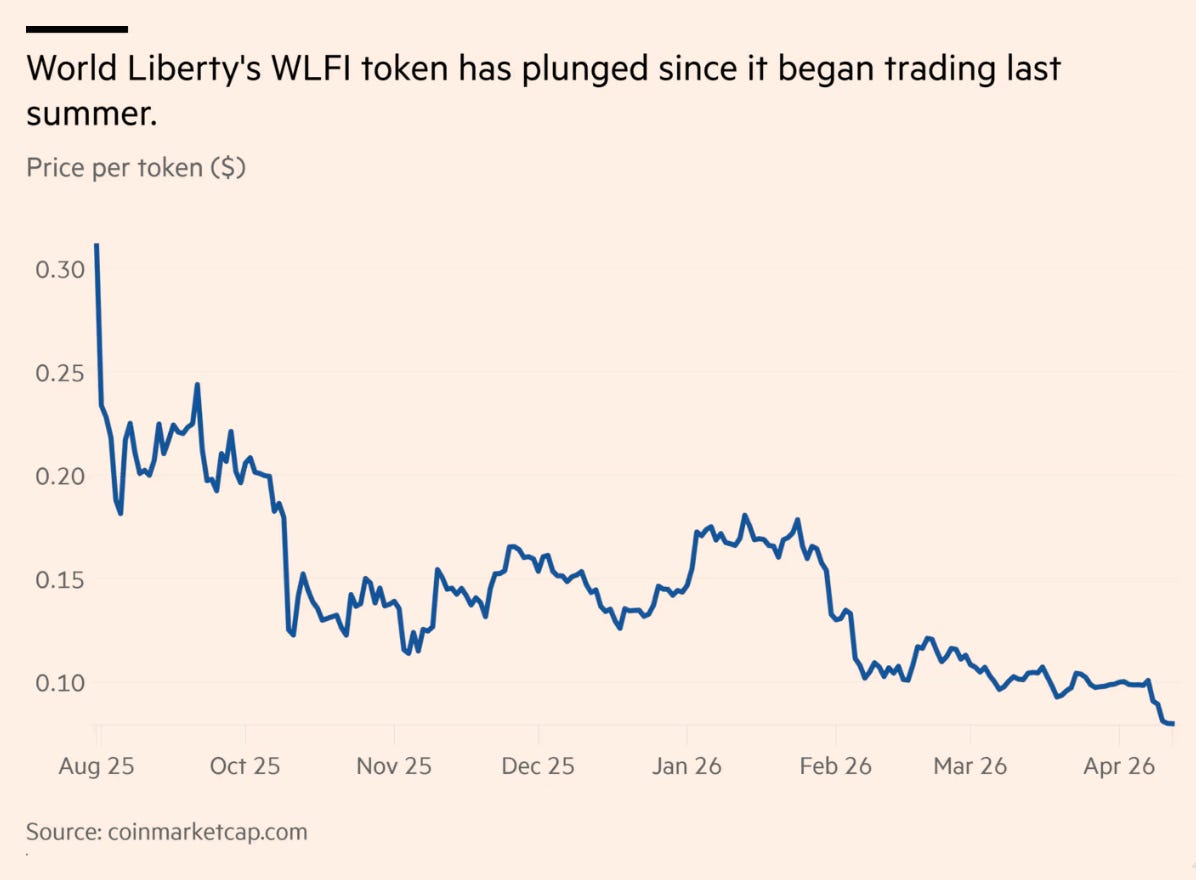
Scott: The signature investment scheme led by Don Jr. and Eric—known to Trump insiders as Uday and Qusay, after the sons of Saddam Hussein—in Term 2 is tagged as “World Liberty,” and it focuses on crypto currency speculation with an insider twist.
Critics consistently suggested that the project was merely a cover for bribe taking and rent seeking, and there is no doubt that many investors were in fact seeking something: usually to block criminal investigations or settle prosecutions. Now some of the venture’s biggest investors believe they have been fleeced, and they’re talking publicly about what they have seen on the inside. The Financial Times reports:
The difficulties facing World Liberty increased a week ago after one of its largest backers launched a social media attack on the project. Crypto billionaire Sun purchased $75mn worth of WLFI tokens following Donald Trump’s election in late 2024. US securities regulators later settled a fraud case and dropped certain charges against Sun, one of several friendly moves towards the crypto industry since Trump’s re-election. Sun has also bought at least $100mn worth of a Trump memecoin, which granted him a seat at a dinner with the president. “I have always been a staunch supporter of President Trump and his crypto-friendly policies,” Sun said on X. But he turned on World Liberty over proposals to change the token’s governance rules, calling the project “World Tyranny”. Sun accused the “WLFI team” of “treating the crypto community as a personal ATM”. World Liberty said on X that Sun’s posts contained “baseless allegations”. On Wednesday, World Liberty followed up with a proposal for further governance changes, including a path for early token holders such as Sun to sell coins that are currently locked.
World Liberty was launched in the run-up to the 2024 presidential election in 2024 as Donald Trump campaigned on his support for crypto. In total, it has raised about $715mn from token sales, according to crypto fundraising tracker ICO Drops. World Liberty still holds a cache of its tokens, some of which it pledged to take out the loan in dollar-pegged stablecoins. The transactions on digital asset lending platform Dolomite, which has close ties to World Liberty, sparked particular concern among holders since the group used about 5% of the total supply of WLFI as collateral. Dolomite chief executive Corey Caplan is also chief technology officer at World Liberty, and Dolomite’s technology serves as the architecture for World Liberty’s lending offering. World Liberty’s reasons for the borrowing are unclear, though the firm has said it is “generating yield”, or deriving income from the move.
Your Online Moment of Zen
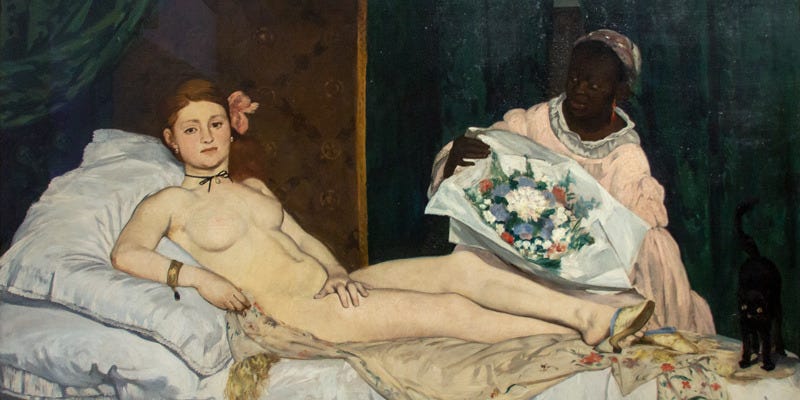
Olympia by Edouard Manet
Scorned by critics as pornography when Manet painted it in 1863, it was championed by Claude Monet who insisted it belonged in the Louvre.
The painting was finally exhibited in the Musée du Luxembourg before eventually becoming required viewing for every Lycée art appreciation class in room 14 of the Musée d’Orsay
Edited by Imogen Sayers.
Wow! That Lego-rap short is really something! Melania must be so proud. What a loser.