



Funding the Next Insurrection
One First
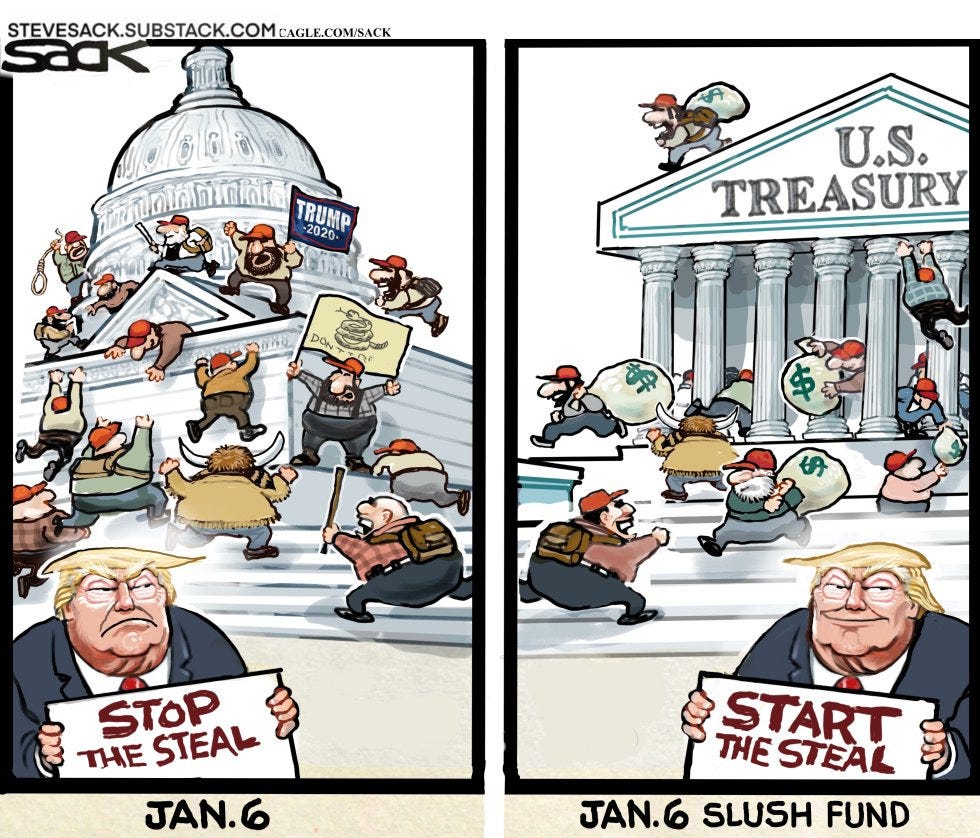
Scott: Donald Trump has a novel idea: Why not fund his next insurrection or auto golpe with money lifted straight from the US Treasury?
(Maybe it’s not so new. If you’re keen on modern German history, then you may know about the Adolf-Hitler-Spende der deutschen Wirtschaft, established by the Nazi Party on June 1, 1933, on more or less the same premise—though it was essentially a shake down of German industrialists, not as audacious as Trump’s treasury raid.)
He announced the plan as a “settlement” of his already dismissed IRS suit, and clueless media simply regurgitated the lies emanating from Trump’s Department of Justice about it for three solid news cycles.
Georgetown law professor Steve Vladeck digs into this latest act of unprecedented corruption with a focus on the major question: What is to be done about it?
Every so often a story comes along that is so brazen, so cleanly emblematic of the moment we are living through, that staying quiet about it feels like a kind of complicity unto itself. Monday’s announcement by the Department of Justice that the Acting Attorney General has unilaterally created a $1.776 billion “Anti-Weaponization Fund” to compensate so-called “victims of lawfare” is one of those stories. And the reason I want to write about it here, in a newsletter ostensibly devoted to the Supreme Court and the law and politics surrounding it, is that I’m increasingly worried that we’re asking the wrong institution to save us from one of the most offensive, alarming, and anti-constitutional things we’ve seen from any president in American history.
The Anti-Weaponization Fund is not principally a legal problem awaiting a judicial fix. It is a shockingly egregious political abuse—the President suing his own government, purporting to settle with himself, and routing nearly $2 billion from the Treasury to his own supporters as a not-so-subtle (and not-so-formal) reward, if not an incentive, for political violence. And the Constitution’s answer to political abuses of this kind and magnitude is a political remedy, not a legal one…
The real upshot of this latest headline (among so, so many other similar headlines) is that it is past time to reinvigorate impeachment—not because conviction is realistic in this Senate, or even because impeachment itself is feasible in this House, but because forcing every member of Congress to vote on the record whether this brazen, corrosive, and affirmatively dangerous corruption is impeachable is itself a point worth fighting for (and fighting with our friends over). Assuming the courts will save us absolves our political leaders of both responsibility and accountability for allowing this kind of mischief to continue, and it absolves all of us of our responsibility to refuse to tolerate those who would just as quickly shrug their shoulders and move on.
Alexander Hamilton, James Madison and other Founding Fathers labored faithfully for years to weave protections against tyrannical rule into the US Constitution and legal institutions.
The most ancient of those protections was against the King using the treasury as his private bank account. Should we now say that their project has failed? That’s what European scholars of the US constitution have, at this point, largely concluded. And I believe they are likely right.
Look out tomorrow, Saturday for our discussion of Trump’s new white grief fund with Dan Froomkin, editor of Presswatch.
Democracy at Work: Killing AI At Its Source
St. Louis Post-Dispatch
Charles: Anti-artificial intelligence activists stood and cheered and hugged after the St. Charles City Council voted 7–1 to permanently ban all large-scale data centers.
“The City Council listened to the voices of the people,” said Kara Elms, a leader of St. Charles Clean Water Advocates.
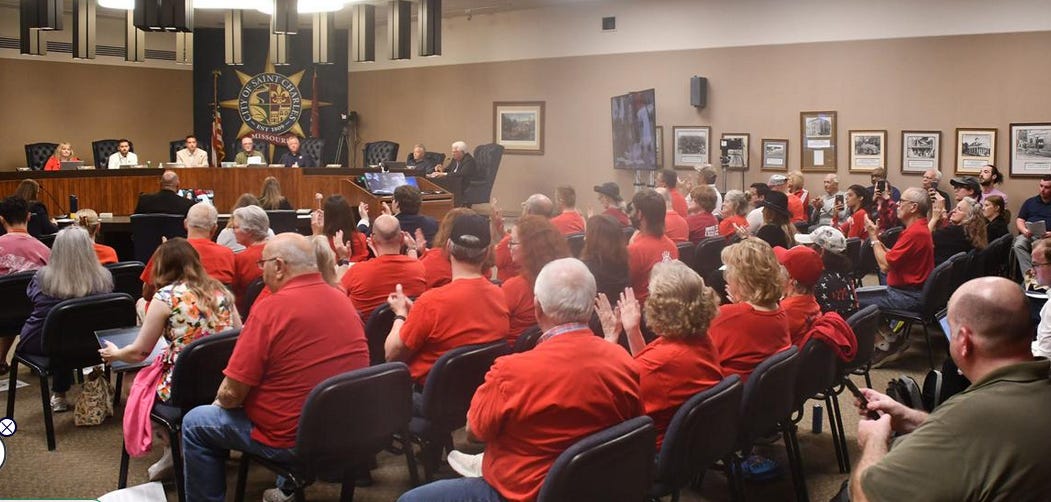
The vote came nine months after CRG—the development arm of construction giant Clayco—first pitched plans in early August of 2025 to transform a series of farm fields along Highway 370 in the suburbs of St. Louis into a 440-acre data center campus.
The plan was killed by a wonderful combination of fears over “irreversible pollution” and the dangers of huge amounts of diesel fuel, combined with the revelation that the site was largely owned by a relative of Dan Borgmeyer, mayor of St. Charles.
St. Charles, located on the Missouri River, is famous as the final jump off point for the Lewis & Clark Expedition, which departed from there on May 21, 1804.
Native American tribes like the Osage, Kickapoo Sauk and Fox, arrived in the area 11,000 years before white settlers did. The ghosts of the native people may have contributed to the margin of the vote to prevent the area’s latest desecration by white settlers.
Genuine bi-partisan opposition to insanely large data centers across America is one of the most encouraging political developments of our time.
The Horton-Kaiser Report is independent, we rely on generous support from readers like you.
Scott: I quickly came across Charles Kaiser as someone who thought about things almost exactly the same way I did. We have a kindred spirit and perspective that we share up until this day.
Get all the news you need from Charles and I, free for two weeks.
