



How We Defeated Orbán’s Right-Wing Authoritarianism
Der Spiegel
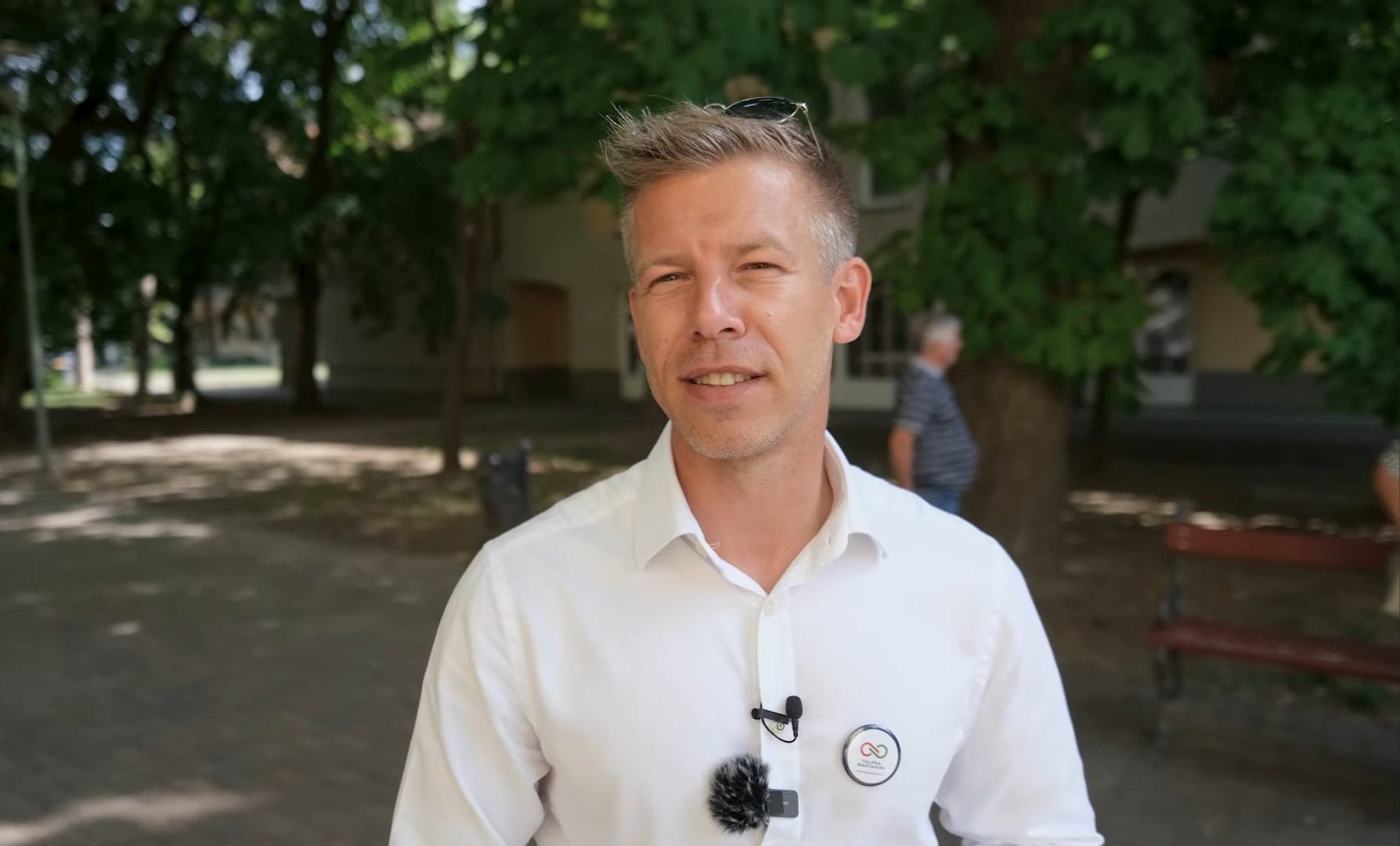
Scott: In a wide-ranging interview with the German newsmagazine Der Spiegel, Hungary’s new prime minister Péter Magyar, explains how he and his Tiszla party took on Viktor Orbán at the polls and won a decisive electoral victory… and how he is now dismantling the Orbán state and reinvigorating Hungary’s democratic institutions.
DER SPIEGEL: Viktor Orbán consistently won previous elections on the strength of extremely polarizing slogans targeting Brussels or migrants. Most recently, he invoked the alleged threat of a Ukrainian attack. Why did voters not believe those lies this time?
Magyar: People get used to constant propaganda and eventually see through it. Propaganda only works when it contains a grain of truth. We were able to show that Orbán’s claims had no basis in reality. The end of a regime comes when people are no longer afraid of it – when they even laugh at it. That is exactly what happened here. My motto from the very beginning was: “Have no fear!” Even two years ago, I said that Viktor Orbán’s power appeared far stronger than it actually was.
DER SPIEGEL: What lessons for dealing with autocrats can convinced democrats in other countries draw from your success?
Magyar: I don’t think there’s a specific recipe that applies to every country. We simply worked honestly and hard. Politics is about people. For voters to believe you, you have to go to them, look them in the eye, you have to listen to them. During the campaign, I visited more than 700 different towns and villages. I appeared five or six times in some places. I was on the road more than I was at home. The others apparently thought they only had to go on social media and television. But that’s not enough.
Knowledge Is Power
Scott: I believe passionately that one of the really poor items in media coverage in the United States is science reporting.
I am routinely pulling things out from major science journals that are significant news in themselves but haven’t really been covered as news.
Try getting the news you need from Charles and me for two weeks.
The HKR Look Back
Fifty-Eight Years Ago Today
The Mutual Broadcasting System
Charles: THE liquor flowed happily in suite 516 of the Ambassador Hotel in Los Angeles that evening. Bobby Kennedy had won the 1968 presidential primary in California, and his defeat in Oregon was just a distant memory. Jimmy Breslin was there, with George Plimpton and Teddy White, and occasionally Kennedy would retreat into the bathroom with one of them for a moment of privacy. South Dakota had also voted that day, and Bobby had won big there, too, with 50 percent of the vote, compared with 30 percent for a delegate slate allied with Humphrey and just 20 percent for McCarthy. Teddy White went on television with Walter Cronkite and called the two results “the most complete repudiation of the administration…. This is the clearest revolt yet of a new kind of politics against an old kind of politics.” CBS kept projecting wider and wider margins of victory for Kennedy—now Cronkite was saying he would beat McCarthy by fourteen points, 52 to 38.
CBS went off the air at 11:13 P.M. in Los Angeles, when it was 2:13 in the morning on the East Coast. Kennedy still hadn’t made his victory speech, but at this hour CBS figured even the most serious political junkies wouldn’t mind waiting to watch that part of the celebration the next morning. A reporter in Kennedy’s suite thought the young candidate finally seemed “liberated.” The Kennedy magic was back, and it was definitely Bobby’s magic. He was forty-two, but he still looked barely over thirty. Kennedy told Kenny O’Donnel, “I feel now for the first time that I’ve shaken off the shadow of my brother. I feel I made it on my own.”
By midnight the crowd downstairs was getting rowdy. They were singing “This Land Is Your Land” and chanting, “We want Kennedy!” Bobby told Ethel he was ready to go. Inside the ballroom he stood behind a lectern with a single KENNEDY sticker stuck on it, under the logo of the hotel. He began with baseball: “I want to express my high regard to Don Drysdale, who pitched his sixth straight shutout tonight, and I hope that we have as good fortune in our campaign.” He said California had voted “for peace and for justice and for a government dedicated to giving the people mastery over their own affairs.” He praised McCarthy for “breaking the political logjam” and making “citizen participation a new and powerful force in our political life.” And he asked McCarthy’s troops to join him—“not for myself, but for the cause and the ideas which moved you to begin this great popular movement.” Most people thought it was his best speech of the campaign. Then he thanked everyone: the blacks, the Mexicans, his siblings, his mother, “and all those other Kennedys”; even his dog, Freckles.
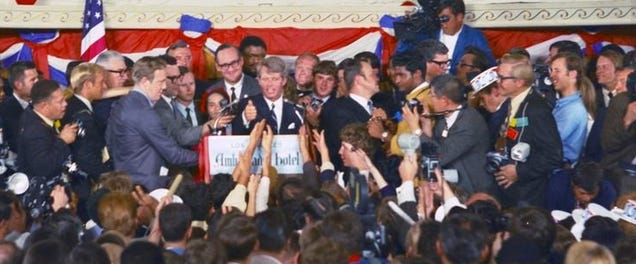
“What I think is quite clear is that we can work together. We are a great country, an unselfish country, and a compassionate country.” There were no policemen or Secret Service men inside the hotel. The crowd went wild, and in the film clip that would be repeated endlessly on television, dozens of white boaters emblazoned with Kennedy’s image bobbed happily up and down in the ballroom.
Finally he was done. “My thanks to all of you. And now it’s on to Chicago, and let’s win there!” He gave the V sign, for victory—which also meant peace in 1968—pushed his hair off his forehead in a familiar gesture, then turned to exit through the kitchen. Andrew West, a radio reporter for KRKD, trailed Kennedy as he left the podium. West had an old-fashioned radio voice: slightly theatrical. This is what his listeners heard: “How are you going to counter Mr. Humphrey as far as the delegate vote goes?” West asked. “We’re just going to start to struggle for it,” said the candidate.
It was 12:16 A.M., and Bobby paused in the kitchen to shake hands with Jesus Perez, a dishwasher. Then West started speaking again—rather hysterically: “Senator Kennedy has been shot. Is that possible? Is that possible? Is it possible ladies and gentlemen? It is possible he has—not only Senator Kennedy. Oh, my God. Senator Kennedy has been shot, and another man, a Kennedy campaign manager—and possibly shot in the head. Rafer Johnson has a hold of the man who apparently has fired the shot.”
In the ballroom next door bewilderment turned into terror. A young girl screamed, “No, God, no! It’s happened again.” A black man pounded the wall. “Why, God, why? Why again? Why another Kennedy?” Six people in the kitchen were hit by the barrage of bullets, but only one was fatally wounded. Most people believed Bobby never regained consciousness, but two witnesses insisted that he had spoken with them. When Ethel leaned down over him, she thought she heard her husband ask, “How bad is it?” And Max Behrman, an ambulance attendant, swore Kennedy spoke again when he tried to pick him up. “Please don’t,” said the stricken man. “Don’t lift me.”
Twenty-six hours later Bobby Kennedy was dead.
Adopted from 1968 In America: Music, Politics, Chaos, Counterculture and the Shaping of a Generation.
<iframe width=”560” height=”315” src=”
title=”YouTube video player” frameborder=”0” allow=”accelerometer; autoplay; clipboard-write; encrypted-media; gyroscope; picture-in-picture; web-share” referrerpolicy=”strict-origin-when-cross-origin” allowfullscreen></iframe>
Subscribe now to see all the rest: Stormer accuses Musk of trying to ‘whip up division’ in UK; The Bering Strait Tunnel: Trump gives Putin a Deal; A planetary Nebula with Cosmic Bujckyballs; Kremlin Sanctions London Schoolboy for Crypto Study; Your Online Moment of Zen.
