



Kimberley Guilfoyle Grifts With Gusto / West Coast Salmon Rejoice in the Klamath River / Switzerland Questions Its Neutrality / Terror Suspects Arrested in the UK
Trump Corruption Watch
Kimberley Guilfoyle Highlights Diplomacy Under Trump
Wall Street Journal
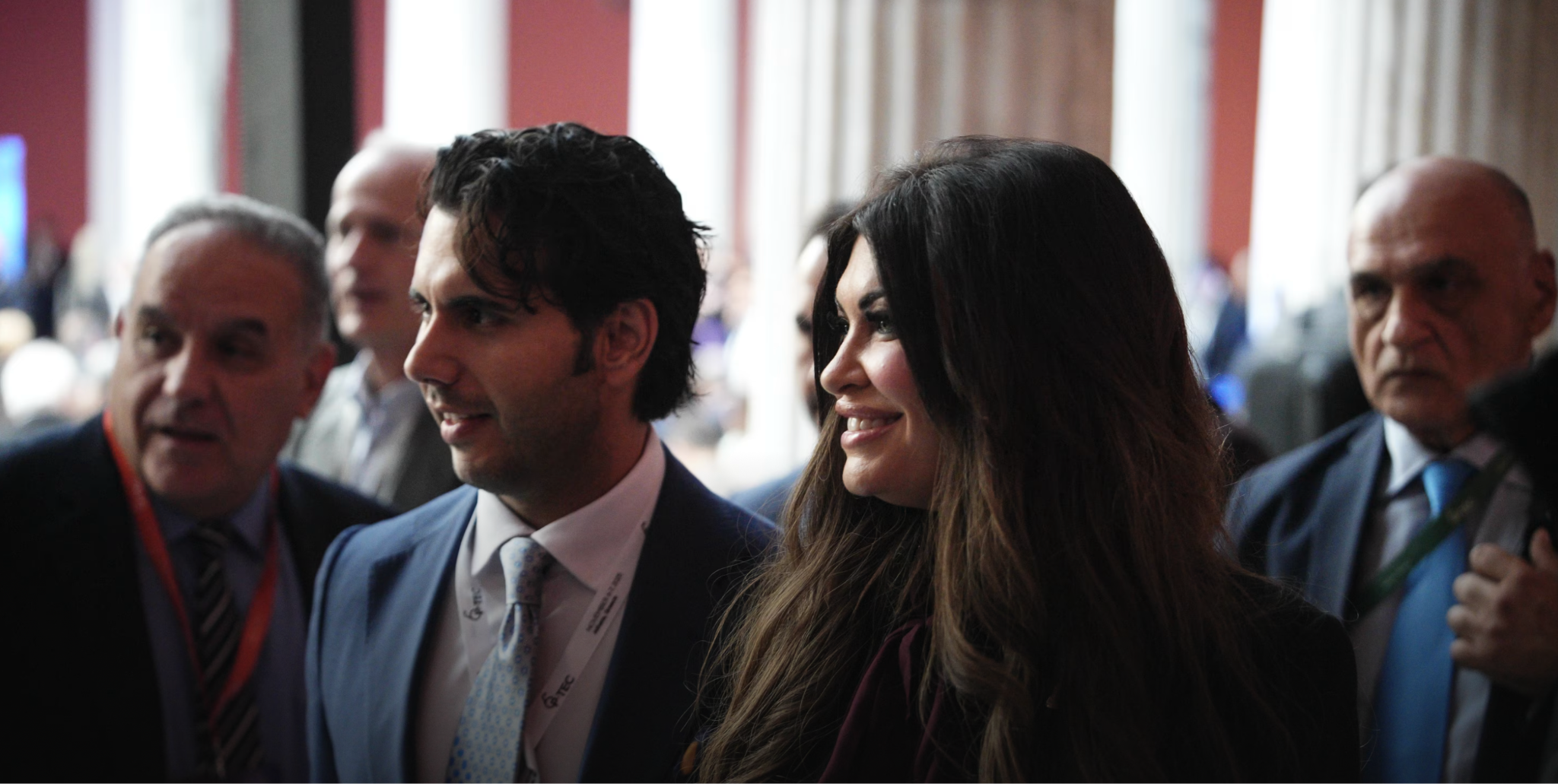
Ambassador Kimberly Guilfoyle and Christos Marafatsos attend a 2025 energy conference in Athens. Photo: Menelaos Myrillas/SOOC
Scott: Last week, Neue Zürcher Zeitung, Europe’s oldest newspaper, reflected on Trump’s appointment of a German lawyer with ties to the Trump family as his new ambassador to Egypt and observed: it shows that Trump does not trust professional diplomats, and to be clear he doesn’t trust them because of their adherence to ethical standards. For Trump, the art of diplomacy is never about advancing national interests—it is always about securing private advantage for the Trump family and its entourage. And now WSJ offers a brief study of the role of Kimberly Guilfoyle, an imperial concubine, as diplomat. Guilfoyle has no diplomatic qualifications. Rather her entire career has been driven by her rapport with politically powerful men—first Gavin Newsom, to whom she was married from 2001-06, and then Donald Trump Jr, whom she served as a love interest from 2020 until he separated from her to marry a Palm Beach socialite in 2024. As a consolation prize, Trump offered her appointment as his ambassador to Athens.
As we see, Guilfoyle has made the embassy into a grift central for a series of gambits launched by the Trump family (and her current love interest) across the Balkans, from Albania to Bosnia and Serbia. And don’t forget her new line of must-have vodka. The pinnacle of diplomacy consists of whispering to powerful Greeks that Trump took down the government of Romania, and he can do the same to you too, whenever he likes.
Kimberly Guilfoyle was a long way from Mar-a-Lago.
The U.S. ambassador to Greece—Donald Trump Jr.’s former fiancée—was shuttling back and forth to Bulgaria’s capital on a mission this spring. The Trump administration wanted allies on Europe’s eastern edge to buy billions of dollars of American natural gas.
There was just one thing.
The Bulgarian government, she told people, should deal with a Greek construction firm called Aktor Group, a newcomer to the gas business that had teamed up with a Greek state-backed energy company to bring in liquefied natural gas from the U.S. “There is no doubt that this is kind of an official position of the U.S. government,” said a person familiar with the talks.
Sitting beside the 57-year-old ambassador in an audience with the Bulgarian president was a 39-year-old named Christos Marafatsos. He has attended so many of her meetings that some foreign officials mistook him for her chief of staff. In fact, he is a top lobbyist for Aktor, whose CEO had flown Guilfoyle to the country on a private jet.
A one-time prosecutor who morphed into a MAGA icon, Guilfoyle is parlaying her ambassadorship to Greece into one of the Trump administration’s most important diplomatic roles. The former Fox News host has crisscrossed the Balkans to help Europe wean itself from Russian energy, via a “vertical gas corridor” meant to receive U.S. LNG in Greece and pipe it toward Ukraine.
But she has puzzled government officials across the region with her persistent promotion of a specific Greek company—and her extensive efforts to involve Marafatsos, a neophyte in both diplomacy and energy.
His prior experience includes co-founding a Washington, D.C.-area produce distributor and working in businesses ranging from real-estate consulting to creating “the ultimate immersive experience” of the Acropolis in IMAX 3-D.
These days, the Maryland-raised Marafatsos is frequently seen at Guilfoyle’s side, acting as her unofficial gatekeeper and joining her for meetings at her ambassadorial residence and with government officials in countries around the region—a highly unusual move for a private citizen…
As Guilfoyle prepared to move to Athens, both she and Marafatsos continued to pursue their own business ventures.
Around the time of her confirmation, she solicited investments for a vodka company she started last year called Polished Rice, pitching at least one Greek American businessman on investing $3 million, according to a person familiar with the matter.
The vodka line planned to launch at a “global VIP event” in Greece on July 2, according to a legal complaint Polished Rice later filed against its distiller. That was the day Guilfoyle held an American Independence Day celebration in Athens. The plan was scuttled when its shipment allegedly arrived with bottles broken and labels damaged.
Guilfoyle’s lawyer disputed that she had solicited a $3 million investment and said she hasn’t pursued private business ventures since entering public service.
Some Greek officials say they are happy their country, often overlooked in Washington, has the attention of an ambassador who can easily reach the U.S. president.
They are also fearful of getting on her bad side. In March, at a dinner in Athens attended by Greek and U.S. officials, Guilfoyle got into an argument with Greece’s energy minister, Stavros Papastavrou, in front of the other guests. Referring to the impending collapse of the Romanian government, Guilfoyle told the group, “We can do that to any country we want. We can do that here,” according to a person who attended the dinner and others who were told about it. The conversation became heated, with Papastavrou retorting that the U.S. couldn’t replace the government of Greece, which was elected by the people. Guilfoyle’s lawyer disputed the characterization of the exchange.
Chinook Salmon Reign Once Again In The Klamath River
New York Times
Charles: A twenty-five year battle to remove four dams from the Klamath River in California and Oregon is over, and the Salmon are rejoicing.
Two years after the last of four dams was removed—the largest dam removal project of all time–thousands of Chinook ;and Coho salmon, steelhead trout and Pacific lamprey have returned to their ancient spawning grounds. It is the first time they have had free passage up the entire river in more than a century
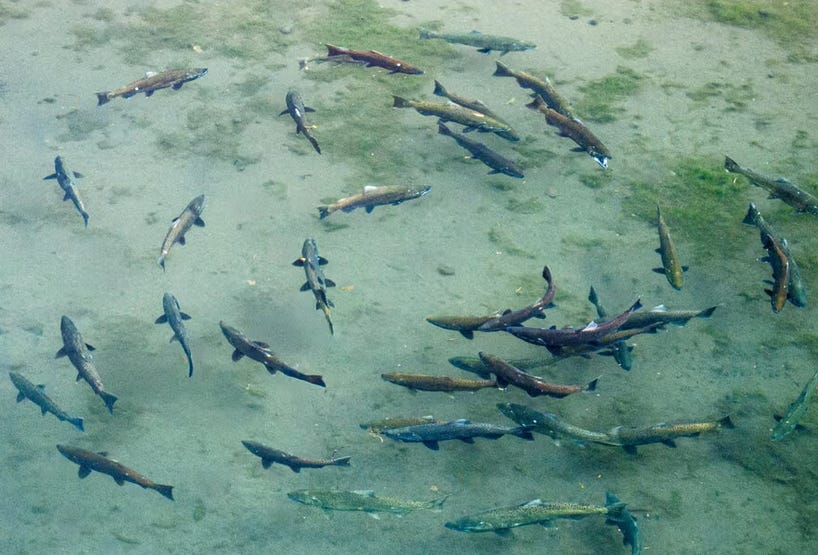
Fall-run chinook salmon in the Klamath River.
Rebecca Dzombak writes that the fish have reoccupied nearly the full extent of their known historical range.
The Yukon Tribe led the campaign to remove the dams to bring back the salmon, which have been essential to native American culture for centuries. Keith Parker, a senior fisheries biologist and a member of the Yukon Tribe, said the restoration project had already succeeded beyond “our wildest dreams.”
In 2024, after the [last] dam removal, more than 7,700 adult chinook salmon swam through. In 2025, when Chinook returned to the headwaters of the Klamath for the first time in more than a century, the number of them at the same site increased by about 72 percent, to more than 13,300. That was about a fifth of all the Chinook salmon in the Klamath basin in both years.
Researchers spotted Chinook essentially anywhere the salmon could spawn.
As we witness the most brutal destruction of the land, the air and the water ever carried out by any president in American history, this environmental miracle takes on even more importance. It’s especially significant to me, because I have always aspired to reincarnation as a salmon.
Operation Dead Hand: Putin has made his plans for life after global thermonuclear war
The Sunday Times/Danwatch
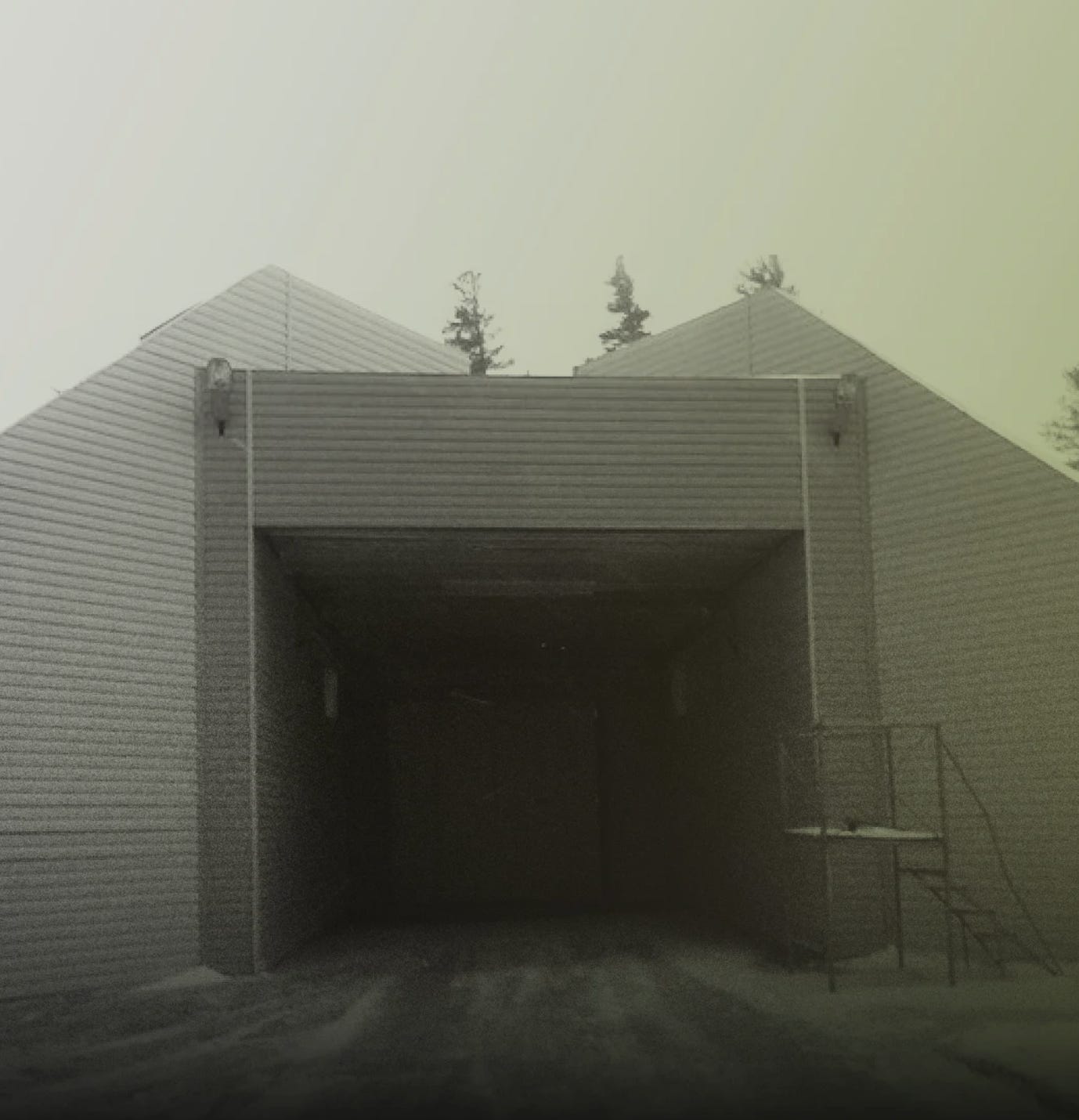
This door on the side of a mountain in a remote corner of the Urals leads directly to Putin’s secret underground city where he expects to survive following a global thermonuclear war
Scott: So much of Putin’s life seems ripped from a dystopian science fiction novel. And now we learn that Putin has been quite obsessed with survival—in particular surviving a global thermonuclear exchange. He’s busied himself with plans for a secret underground city in a remote part of the Urals where he and his progeny can chill waiting the several millenia it will take before the surface is again suitable for human habitation.
On the side of a remote mountain in the Urals is a gateway. Troops guard it around the clock from a machinegun turret.
It is the entrance to one of Russia’s most secret facilities.
From here, President Putin has revived a Cold War programme to launch retaliatory nuclear strikes on the West. The base is a giant underground command centre that can survive an attack by American bunker-busting bombs.
It is a doomsday strategy intended to guarantee mutually assured destruction if Russia suffers a nuclear strike.
Its existence can be revealed in an investigation by The Sunday Times, the Danish media group Danwatch and the Dossier Center. Using open-source journalism, we have obtained the first images of the facility and the military operation behind it, evidence of the vast construction work that has gone on there and intelligence that reveals the nuclear missile programme is fully operational.
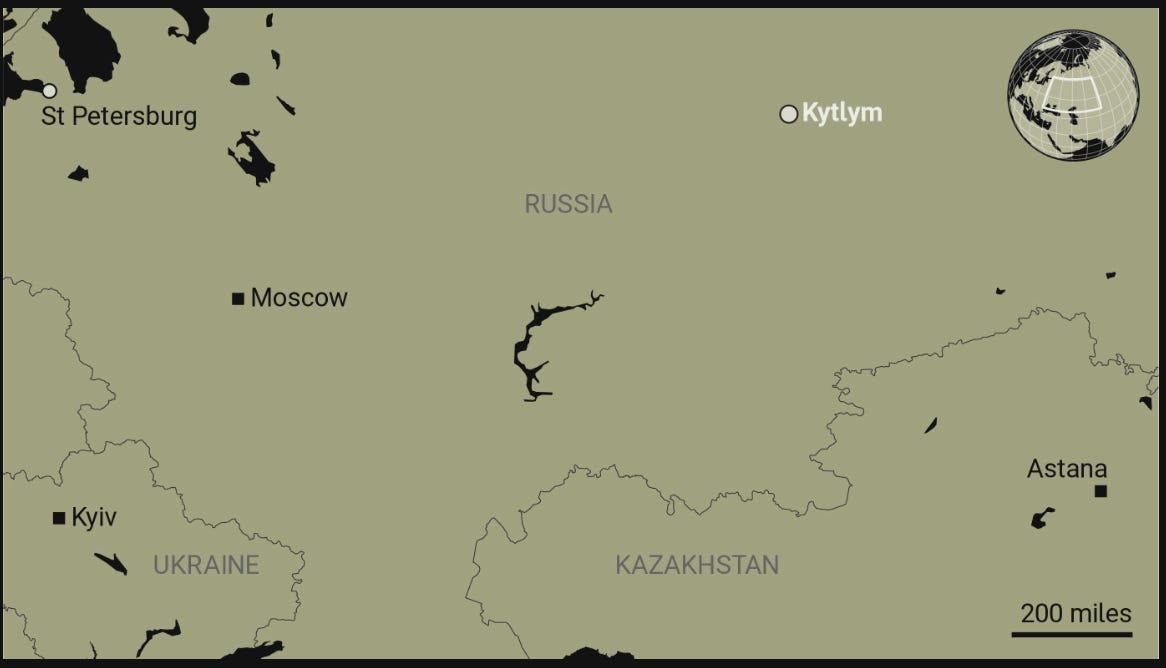
Few places are more remote than the village of Kytlym. About 1,300ft above sea level, it sits in the foothills of Kosvinsky Kamen, a granite mountain in the Urals.
One road goes in, and one road goes out. About 2,000 people live there. There are a handful of shops, a post office, a school and a monument to Russian “defenders of the fatherland”.
Coniferous forests and impassable terrain stretch for hundreds of miles in almost every direction. Visitors stand out. Until you get close, the tunnels do not.
What’s unusual about this town is the military presence guarding the tunnels. Soldiers were first stationed here in the 1980s, initially in small numbers. The Soviet Union became so paranoid about a nuclear attack that it developed a doomsday strategy called Perimeter — known in the West as Dead Hand, because it would have led to mutually assured destruction.
Bunkers able to survive an atomic blast were developed across Russia. The mountain here, Kosvinsky Kamen, was chosen for one of them and codenamed Facility 1335.
If a nuclear explosion occurred in Russia and communication with the leadership was lost, back-up control channels at Facility 1335 could be activated. These could transmit long-wave radio signals to mobile missile launchers which themselves carried communications gear. When launched, these missiles could in turn transmit an encrypted order to surviving launch silos for them to launch too.
“Perimeter is actually a communication system,” said Pavel Podvig, a UN nuclear disarmament expert and head of the Russian Nuclear Forces project. “If you are struck, you need to make sure you can transmit the order for retaliatory action.”
Analysis of about 2.5 million Russian documents and public records — gathered by Danwatch in early 2024 and spanning tenders dating back to 2011 — reveals a massive construction programme costing the equivalent of hundreds of millions of pounds to construct new underground complexes.
Procurement data shows that since 2018 Moscow has bought heavy excavation and rock-drilling equipment, mine ventilation systems, air filtration units capable of screening chemical, biological, and radioactive fallout, seismic-resistant air conditioning, and enough steel, piping, cabling, and concrete to construct an apartment building deep beneath the mountain. Orders were placed for dozens of drilling rigs, bulldozers, excavators and dumper trucks. The site used three million litres of fuel and 823,000 litres of gas.
About 20,000 tonnes of steel were bought, the weight of roughly three Eiffel Towers. The tenders make reference to at least 24 underground chambers, fitted with a compressed air system. Technical details show the straight-line distance between the main and emergency exits of the facility is about two and a half kilometres.
Putin’s paranoia
The first official clue of the revival of Dead Hand came in 2020, when the Kremlin released the transcript of a meeting between Putin and his senior military officials.
At that meeting, Putin discussed the creation of a system to ensure Russia’s nuclear command and control infrastructure would survive an attack. “We are aware that a lot depends on the survivability of these systems and their ability to continue operating in a combat environment,” said Putin.
“They have told me that the creation of an absolutely secure facility for controlling strategic nuclear forces, among others, is nearing completion, and that it will have a very high safety margin.”
Since then Putin has become increasingly paranoid about an American attack and the fact that the US has developed bunker buster bombs capable of hitting targets hidden deep underground, such as those used against Iranian nuclear facilities last year.
