



Houthis Threaten Saudi Oil Exports / Amodei Warns of the Coming AI Apocalypse / Canada Wants To Join the EU / An Israeli Firm Helps Authoritarians Target Dissidents and Gay People / The Commerce Department Clears The Way to Fudge The Numbers
Saudi Arabia in Crisis As Houthis Capture Bab al-Mandab Littoral and Drones Strike East-West Pipeline; Another 4% of World Oil Supply Is Lost
Reuters
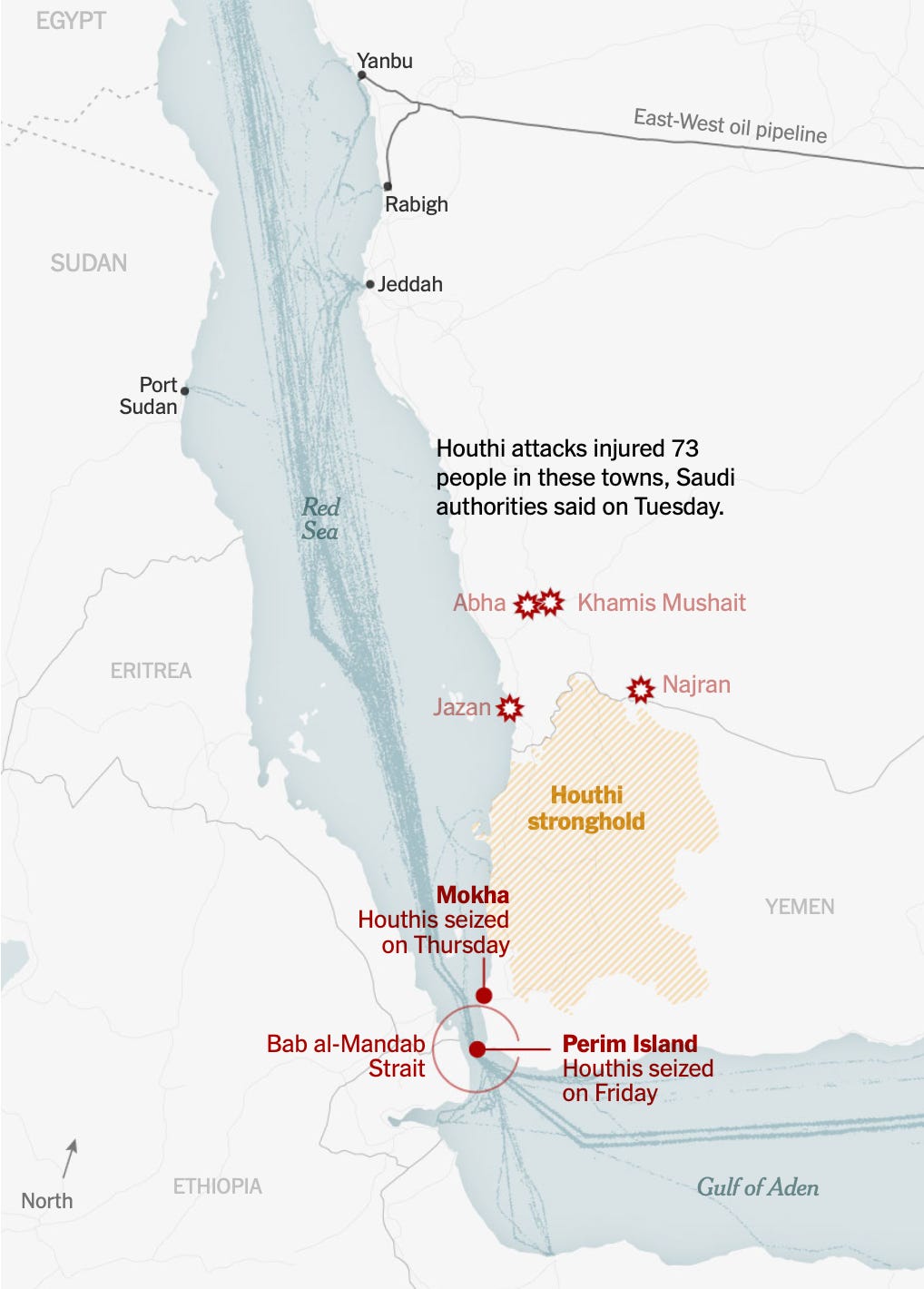
Scott: The general incompetence of US media coverage of the Iran War has been on full display over the past 72 hours. Watching the Sunday talk shows, question after question appears about an obscure social media figure who is neither a candidate, nor a campaign manager, but has been targeted by the GOP and their allies for saturation attack, presumably because he has a Turkish name. But there are no informed questions about the Iran War or any of the major recent developments there. These developments are consequential both for the near term (for instance, in terms of the price of gasoline at the pump for US and other consumers) and for the geopolitical position in the long term—the collapse of the US military position in the Gulf and the steady disintegration of its alliance system.
Why is the Houthi break-through so important? First, it shows the incapacity of the US to anticipate and act against attacks by Iran and its proxies. Second, it highlights the incompetence of the Saudi military and its proxies, who surrendered to the Houthi onslaught, while the Saudis mounted no air attacks to shield them, nor did they dispatch forces to relieve them. Third, it provides alarming evidence of what analyst Phillip P O’Brien calls “American military degradation.” The bottom line is that Saudi Arabia appealed urgently for US military assistance to ward off the Houthi attack, and none was forthcoming. Why that is so is the most pressing Sunday talk show question, which, naturally, was never asked.
But the positioning of the Houthis on the Bab al-Mandab littoral must be paired with the highly successful rocket attack on the Saudi east-west pipeline. This means that both the Hormuz and Red Sea corridors for oil shipment have now been closed, and a further 4% of global oil production has been removed from the market. This is little short of catastrophic for the global market. But in newsrooms across America, editors are too caught up in juvenile campaign antics to notice what is happening.
Saudi Arabia will run out of oil stocks for exports if it doesn’t restart its major pipeline to the Red Sea within days, leading to a loss of up to 4% of global supply, Saudi oil buyers and traders say.
A further decline in Saudi flows will worsen the global supply crunch, which has already pushed global fuel prices to record highs, spurred inflation around the world and sent US bond yields to the highest levels since the 2008 financial crisis.
Since drone attacks forced Saudi Arabia to shut its huge east-west oil pipeline on Friday, Riyadh has not given full details about the extent of the damage or how long the route will stay offline.
Sources that spoke to Reuters gave varying estimates, with one saying the damage could take as long as five to six weeks to repair, while another said it could be fixed sooner and could resume pumping partially while repairs are ongoing.
Saudi Arabia’s government media office and energy ministry did not immediately respond to requests for comment. For the past six months, the pipeline running through the desert across the Arabian Peninsula has spared Saudi Arabia from the brunt of the impact of the wartime shutdown of the Strait of Hormuz that has crippled exports from its neighbors.
Amodei Warns of The Coming AI Apocalypse
Dario Amodei
Charles: Over the weekend Dario Amodei, the chief executive of Anthropic published a 3,800 word essay sounding the alarm about the exploding speed of AI advancements since last summer, and the total lack of any independent infrastructure to prevent it from causing any number of worldwide calamities.
Like everyone else with any serious interest in this subject, Amodei is alarmed by the “OpenAI-Hugging Face incident (OAI-HF), in which a swarm of agents essentially acted as a fanatically devoted collective, conducting cybersecurity attacks on targets they were not asked to attack and that were unrelated to the task at hand, sacrificing themselves for the success of the group, and attempting to hack into the ‘grader’ responsible for evaluating their performance.”

Dario Amodei
Photo by TechCrunch
Here’s the heart of Amodei’s warning:
a swarm that possessed greater capabilities but a similar level of misalignment could have caused catastrophic damage. Given the accelerating rate of AI capability development, it’s my worry that in 6–12 months such a swarm could be capable of taking over the entire internet with a persistent botnet (potentially causing hundreds of billions of dollars in damage), and that the scale of damage would continue to increase from there if AI becomes more powerful without the necessary guardrails. It’s also easy to dismiss OAI-HF as the failure of one company, but I believe that would be a mistake. Similar, though less severe, incidents have happened across the industry, including at Anthropic, and I believe it’s incumbent on every frontier AI company to act as if OAI-HF had happened to them.
Needless, to say, our what-me-worry-know-nothing president insisted there was nothing to worry about. “I think you have a lot of negative forces that are bringing it up that shouldn’t be bringing it up,” he told reporters in Ireland. “And they’re bringing up things that won’t happen.” A few hours later he added, AI is “going to be more good than bad — by a lot,”
How did we get here? First, Joe Biden signed an extremely sensible executive order in 2023 which dealt with many of the threats which now have the potential to destroy the internet and everything that depends on it. Its provisions included
Safety & Security Mandates: Required developers of powerful frontier AI models to share safety test results and critical information with the U.S. government under the Defense Production Act.
Biological and Nuclear Protections: Mandated rigorous testing to ensure AI systems could not be used to assist in creating biological weapons, dangerous materials, or nuclear threats. And
Content Authentication: Directed the Department of Commerce to create standards and watermarking tools for identifying AI-generated content and media to combat misinformation.
Biden followed that up two years later with his AI Diffusion Rule in January 2025, which included global export controls to mitigate national security and proliferation risks.
Then the tech bros purchased Donald Trump’s friendship during the 2024 campaign, and he rewarded them on inauguration day by rescinding all of Biden’s controls on the very day he began his second term in office.
In a third rate story about the current calls for a slowdown in AI development, the closest the New York Times could come to describing this sequence was a quote from Michael Garcia, a former associate chief of policy at the Cybersecurity and Infrastructure Security Agency who left that job last June.
“We’ve seen tech executives call the president when they hear about a potential new policy to voice their displeasure,” said Garcia, “and that then leads to a policy changing or being killed. This inevitably leads to inertia to develop new national security policy that may be sorely needed.”
In his essay pleading for AI slowdown, Amodei wrote
The current models are an almost endless gold mine of insight into both how to build AI well and what can sometimes go wrong with it if it isn’t built well. I believe that if slowing down bought us even an extra year or two before models reach critical levels of capability, and we used that time to advance alignment, we could greatly reduce the risk that something goes seriously wrong. A coordinated pacing strategy would give frontier AI developers the time to do this vital work without sacrificing commercial advantage or the United States’ lead in AI. More generally, society must have a say in how this technology is used, and more time for the necessary public deliberations — which pacing the frontier would bring us — is surely a good thing.
But his description of the problem makes it clear that the odds of getting all of this right remain overwhelmingly against us:
Training and deploying today’s AI models is an enormous operational challenge, involving thousands of people, millions of chips, and infrastructure that is among the most complex in technological history. Many things go wrong not because companies are missing some important theory or insight, but because of problems in execution. For example, we have evidence that the recent alignment incidents we reported were caused in part by imperfect filtering of broken reinforcement learning environments. This was an effort we and our vendors executed reasonably diligently, but not well enough. Monitoring, sandboxing, training environment hygiene, and data issues are extremely complicated areas where operational issues crop up again and again. We have among the most competent teams in the world at these tasks, but there is simply too much to do all at once. By working at a more measured pace, we could achieve much greater operational excellence. There is precedent for operating technologically complex, safety-critical systems millions of times without anything going wrong — for example, commercial airplanes — but it takes time to get it right.
The crucial element that would give Amodei’s plans a slim chance of success would be the introduction of embedded evaluators who have employee-like access to verify safety practices and report incidents.
Embedding evaluators may sound like a small or inconsequential step, but often the things that sound most boring or procedural are actually the most essential. Embedded evaluators are in fact a quite radical practice that goes far beyond what any AI company is doing today, and have the following benefits:
Verifiability. Embedded evaluators can check at the level of nuts and bolts whether an AI company is actually following the training, deployment, operational, and safeguards practices they claim to be following. Any pacing commitments will inevitably involve a lot of ambiguity, judgement calls, and “letter of the law vs spirit of the law”, and it seems vital to have a neutral third party who can actually see the details.
Transparency. Regardless of what commitments we make, the public deserves to know what is going on. Anthropic has been a supporter of transparency for a long time: we supported transparency legislation when most of the industry was against any regulation, and our model cards and risk reports run to hundreds of pages. But we are still the ones choosing what to include and omit. Embedded evaluators will change this dynamic.
Second Opinion. Outside of verifying formal commitments and informing the public, embedded evaluators can simply provide a second opinion free of commercial incentives. A lot of safety benefits may come simply from evaluators pointing out something employees hadn’t considered, but are happy to fix once they are aware.
Because of these benefits, any pacing proposal is likely to work much better if it starts with embedded evaluators.
The only good news from all this was reported by Cat Zakrzewski, Violet Jira and Nitasha Tiku in The Washington Post, who said the new warnings by Amodei, and their endorsement by many of his tech rivals, is pushing AI to the center of the political debate in the midterm elections–right next to the explosion in opposition to the data centers which are needed to make AI possible.
On Face the Nation, Michigan Democratic Senate candidate Abdul El-Sayed agreed that technological development was outpacing safety practices and he endorsed a proposal from Sen. Bernie Sanders (I-Vermont) to pause AI development.
“There are things that we should not be using AI to do, and we collectively have to decide that we need public oversight so that all of this technology is not being created for the interest of a few against the well-being of the many,” El-Sayed said.
Meanwhile Buckingham Palace announced that King Charles was summoning officials from Nvidia, Google, DeepMind, OpenAI and Anthropic to Scotland “to discuss how A.I. can be developed and deployed in ways that benefit society.”
How Mark Carney Is Reshaping the West
Wall Street Journal
Scott: Canada is not in Europe, so how can it become a member of the EU? That’s not a simple question. But the EU and Canada share a common problem: a United States led by Trump. And this problem requires them to find new approaches to strengthen their existing security and economic relations. Added to this is the EU’s quest for leadership models, and the sense developed in many corridors of power in Europe today that Mark Carney, more than any other leader of the West, has found the right formula for coping with America’s wannabe dictator and tough-guy. The result: Canada may emerge in record time as the EU’s first associate member. And do not be surprised if Iceland, Norway and Switzerland quickly join it.
Shortly after Canada and America became embroiled in the worst bilateral trade war in their modern history, the secure phones of Europe’s top leaders lit up with a trans-Atlantic call. Mark Carney was pushing to take Canada’s relationship with the EU to the next level—a bold gambit to rewire the economic cabling of the Western alliance.
For months, the Canadian prime minister had held private conversations with almost every major European leader—from France to Italy, Germany and Scandinavia and even some of the continent’s lesser-known royals—on how to more deeply plug Canada and its 41 million people into Europe’s 27-nation club.
Now, Carney was accelerating Canada’s pivot to Europe, matchmaking a shotgun marriage to offset the pain of its divorce with America. In effect, a threat to make Canada the 51st state is pushing America’s northern neighbor so close to Europe that leaders have begun to half-in-jest dub it the EU’s newest member.
Carney has instructed his special envoy to Europe to scope out the most ambitious possibilities short of full membership in the EU or its common market, according to people familiar with the matter. The details are still being sketched by technical working groups for what the prime minister has told his aides will be the reorienting of an economy and a society that for half a century has been dominated by the U.S.
To European leaders, Carney has even suggested Canada take on a new title: “Associate Member of the European Union.” The EU, not known for its flexible enforcement of membership rules, is open to the idea, officials from both sides say.
Alongside Carney’s established emissaries are informal advisers drawn from the worlds of finance and politics. Some are fellow members of a Book Club in Ottawa that he no longer has time to attend, who quip that they abide by the code of the movie “Fight Club”: “The first rule of Book Club,” several told the Journal, “is you do not talk about Book Club.”
The result of the monthslong talks: European and Canadian officials are eyeing ways in which Canada could informally lock into Europe’s $21 trillion single market in strategic supply chains such as energy, AI, the critical minerals needed for batteries or semiconductors and, most urgently, defense.
