



How Trump Promotes Cancer / Putin Gets Part of Alaska Back / Anderson Cooper on the Assman-in-Chief / Russia’s New Favorite Congresswoman / Mt. Sinai Hospital Does The Epstein Shuffle / Trump’s Golf Courses Are A Giant Tax Scam
BULLETIN! A Brazilian Miracle!
New York Times
Charles: President Luiz Inácio Lula da Silva of Brazil surged to a remarkable re-election on Sunday, according to official preliminary results.
Bolsonaro pulls a Trump, refusing to concede.
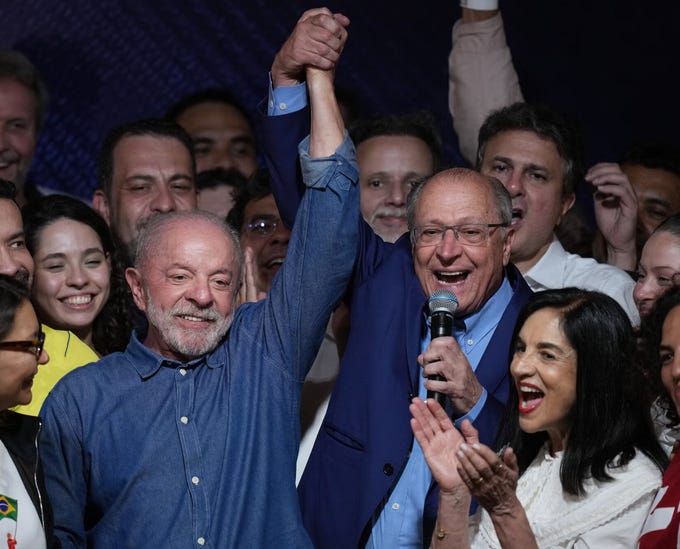
President Luiz Inácio Lula da Silva of Brazil celebrating with his running mate Geraldo Alckmin on Sunday.
Andre Penner/Associated Press
How The EPA Became the Chief Warrior for Air Pollution
New York Times
Charles: In a superb piece of investigative journalism, Eric Lipton and Maxine Joselow describe in granular detail how Donald Trump allowed the chemical industry to take over the Environmental Protection Agency and eliminate almost every new Biden-era regulation aimed at removing carcinogens in the air.
A total of 71 coal plants, 71 chemical plants, 40 sterilizers, 19 steel-related facilities and 1 copper smelter have been exempted from clean-air regulations for nonexistent “national security” reasons.
The Times spent six months pouring through 10,000 documents and interviewing more than 70 people to piece together what could be the largest and single most destructive pay for play scheme the Trump administration has carried out.
The 4,700 word piece ran exactly where it should have–as the lead story of the Sunday paper.
A complete integration of big business and the national government has always been a signature feature of fascism. This piece spells out its horrific real world consequences.

Within sight of a southeast Texas middle school stands a chemical plant that President Trump excused from new federal rules intended to curb its cancer-causing pollution.
First the President issued scores of temporary two-year waivers to allow the chemical business to spew limitless carcinogens. Then he stocked the EPA with former lobbyists and industry officials to gut the regulations altogether.
In granting the waivers to those rules, Mr. Trump cited an obscure clause in the clean air act that allows exemptions if complying with new rules would threaten national security and if the necessary technology is not widely available.
Yet the president approved the waivers even though the equipment was readily accessible and the industry’s national security claims had little detail to substantiate them, documents show.
The Biden administration pushed through the new pollution requirements after evidence emerged about the health threats posed by ethylene oxide, a colorless gas used to make products like plastic soda bottles and to sterilize medical devices like pacemakers.
E.P.A. researchers had concluded that ethylene oxide was 30 to 60 times as carcinogenic as previously thought, particularly for people who live near plants where the gas is made or used. The agency held meetings to warn community members about the elevated risks.
The Trump administration did not ask companies to present an exhaustive case for why they deserved a waiver from these new requirements. It was as easy as sending an email to the E.P.A. and invoking the obscure exemption language in the act, a provision that no president had ever used.
Mr. Trump’s decisions rewarded industries that backed his re-election campaign and continued to donate to his pet causes once he won.
AdvaMed boasted earlier this year in a letter to members that its lobbying efforts, which included political contributions to Mr. Trump’s causes, had paid off, saving the industry millions of dollars in upgrades.
“Membership has its privileges,” the group wrote.
Trump Gives Kremlin Proxy Control Over Huge Alaskan LNG Deal, US Executives Quit
Financial Times / New York Times
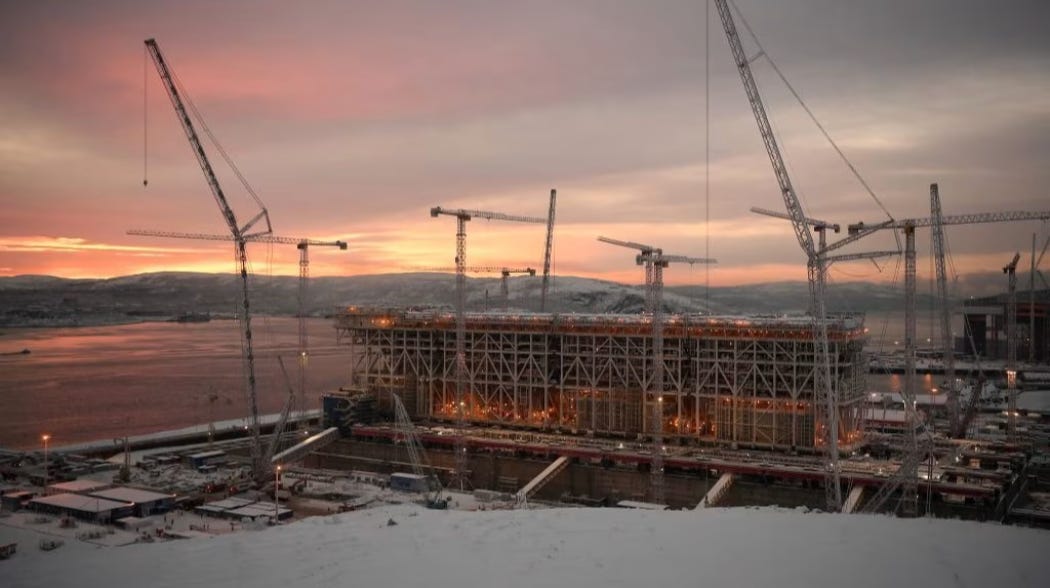
The Arctic LNG 2, a Russian gas export terminal developed by Novatek, was blacklisted by the US in 2023. Now US executives working on a massive new LNG terminal in Alaska learned to their shock that Trump was turning control of the project over to the Russians. Photo: AFP/Getty Images
Scott: In the week before the Trump-Putin Anchorage summit, Trump stated that he was traveling to “Russia” to meet Putin, spawning jokes in the Russian media that he intended to return control of Alaska—a Russian province before it was purchased for the US in 1867 by Secretary of State William H Seward—to Russia. But perhaps this isn’t a joke. On Friday, both the FT and NYT reported that a much-touted LNG terminal project in Alaska, built with US Government support and apparently controlled by investors close to Trump and his son, Don Jr, was being turned over to a sanctioned Russian firm, Novatek, close to the Kremlin. The news was so unsettling to US executives working on the project, all of them Exxon veterans, that they decided to resign en masse.
The news refocuses attention on the highly secretive dealings between Jared Kushner and Steve Witkoff, Trump’s personal representatives, and the Kremlin. These dealings are ostensibly about ending the war between Russia and Ukraine. But intercepts of conversations between Kushner and Witkoff on one hand, and their Russian interlocutors (particularly Kirill Dmitriev) on the other, show that Ukraine rarely ever featured in the conversation. Instead the focus has consistently been on a series of lucrative investment deals the Russians have dangled in front of Kushner and Witkoff, with a promise that the deals will make them massively wealthy.
Prior reporting has focused on a massive sale of LUKoil foreign assets to a consortium close to Trump and his entourage, worth tens of billions of dollars. But this is only one of dozens of deals.
What marks all the proffered transactions is an effort to entangle Trump, his family, and individual investors close to him to the now heavily sanctioned Russian oil and gas industry. This obviously serves the strategic interests of Russia by helping it to overcome crippling sanctions. And it would make private US investors, all connected to Trump (and largely presumably merely proxies for Trump) very wealthy indeed. On the other hand, there is no plausible benefit for the US in such a deal. To the contrary, it works aggressively against clearly defined US national security interests.
As NYT reports, Trump’s accounts of the Alaska deal in the past claimed that he had brought in Emirati investors to support it. However, the latest dealings expose the UAE investor as a chimera. The interests behind it are Russian. And Trump clearly knew this all along.
The former chief executive of a $25bn US gas export venture has accused Russian energy giant Novatek of secretly controlling the project, triggering the mass resignation of the company’s leadership over fears it is violating US sanctions.
The company, Polar Train LNG, is developing a gas export terminal on Alaska’s North Slope, part of a Trump administration initiative to expand US energy exports to Asia and strengthen its position in global energy markets.
The venture was launched with the involvement of Gentry Beach, an investor with ties to Donald Trump’s family. It has also featured in high-level negotiations between Washington and Moscow over potential business deals that could help secure an end to Russia’s war in Ukraine, according to people familiar with the discussions.
Polar LNG was launched in March with plans to repurpose a partially constructed Novatek gas terminal for installation in Alaska. The company sought permission from US sanctions authorities at the Treasury department to negotiate with the Russian group but had not yet received approval.
Joel Riddle, Polar LNG’s American chief executive, told the FT that he discovered Novatek was already financing the venture and directing its operations before the necessary approvals were obtained. He resigned in September, followed by almost the entire executive leadership team, including chief financial officer Dan Chandra, executive vice-president Jim Smith and executions manager Jody Trantham.
The allegations raise questions about the extent to which Russian commercial interests are already seeking a foothold in the US energy industry before any agreement has been reached. They threaten to embroil a strategically important US energy project in the fraught relationship between Washington and Moscow, despite the Trump administration’s abrupt favourable shift towards Russia.
Anderson Cooper With The Very Last Word on America's #1 Assman
Charles: Some doctors see special meaning in Donald Trump’s most recent ramblings:
Disinhibition is a trait frequently connected with severe senile dementia. Sometimes a person with dementia can lose their inhibitions and may behave in ways that others find embarrassing. . .The exclamations may reveal that a person has a long suppressed sexual orientation different from the one he manifests in public.
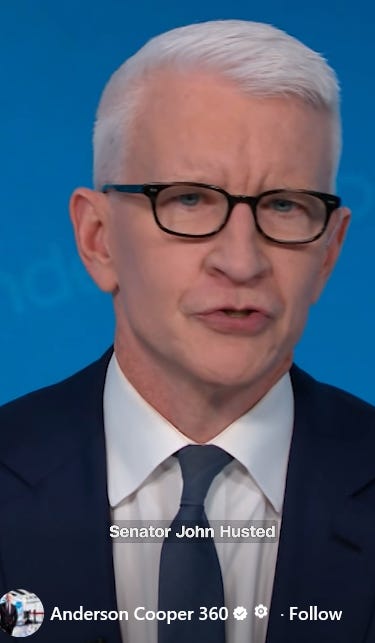
Judge for yourself! Go Here
Anna Paulina Luna’s Husband Owns 10% of Drone Startup That Got $37mn in Pentagon Deals
Mother Jones

Scott: Dana Rohrabacher (R-CA) was the Kremlin’s longtime favorite member of Congress—so favored in fact that the Kremlin is said to have funnelled a nearly $1mn payment to him in crypto. Rohrabacher was then forced to give up his seat in Congress.
But now the Kremlin has a new favorite, Anna Paulina Luna (R-FL). Her press conferences, and particularly her statements about Ukraine, read like a Radio Moscow retransmission station. And she seems available for just about anything the Kremlin wants… like hosting a visiting delegation of State Duma members from Putin’s United Russia party.
None of this seems to pose any problem to Luna’s ability to secure (through her husband) highly lucrative contracts with sensitive defense technology. Mother Jones has the scoop.
According to Luna’s 2025 financial disclosure report, her husband, Andrew Gamberzky, works for OKSI, a defense technology and artificial intelligence company. Her financial disclosure form also indicates Gamberzky has a 10 percent ownership stake in Nokturnal AI, which Luna has described as a subsidiary of OKSI. At the end of 2025, Luna reported that Gamberzky’s 10 percent interest was valued at no more than $1,000.
But just a few weeks later, Nokturnal AI got its first government contract: a $46,222 purchase order from the Air Force for a small unmanned aircraft system. (The company was, at that point, operating under the legal name of OKSI Ventures. OKSI Ventures changed its name to Nokturnal AI in June 2026.)
Her comments about opposing the personal enrichment of lawmakers seem to conflict with her family’s stake in a private drone company that has received more than $30 million in government contracts over the past year.
That January 23, 2026, award was minuscule compared to the contracts that followed. Government acquisition documents show that between February 2 and March 20, a consortium that links tech companies to the Department of Defense received more than $9.2 million for a two-phase contract. The consortium listed OKSI Ventures as the “primary” vendor. The contract did not list any other vendors. The government’s description for the first phase of this contract was “gauntlet award.”
Meanwhile, in early 2026, Nokturnal AI was participating in a competition called “the Gauntlet.” It was part of the Defense Department’s new effort to unleash “US Military Drone Dominance,” which stemmed from an executive order President Donald Trump signed in June 2025. Upon announcing plans for the program, Defense Secretary Pete Hegseth said “drone dominance is a billion-dollar program funded by President Trump’s Big Beautiful Bill.”
Luna is among the 218 House Republicans who voted for the bill in July 2025. That month, she also voted for the House version of the 2026 Department of Defense Appropriations Act, which included $400 million for the Pentagon’s Accelerate the Procurement and Fielding of Innovative Technologies program (APFIT). According to the Pentagon, APFIT is an initiative to encourage “small business[es] or non-traditional performer[s]” to compete in the defense acquisition space. The goal is that increased competition will help bridge the “valley of death” between initial development and the implementation of new autonomous technologies.
APFIT is the same program under which Nokturnal AI received its third government contract on July 9, 2026. The contract, which stated Nokturnal AI’s former name of OKSI Ventures, shows an award of $28 million in exchange for “Unruly follow on production OT.”
According to Nokturnal AI, “Unruly” is a long-range drone missile featuring an “11 ft carbon fiber wingspan and state-of-the-art autonomy.” It’s a “completely self-reliant” system that “combines far-reaching endurance with computer-vision-aided precision.” (One can learn more about the drone by visiting Nokturnal AI’s website, which replaces the standard mouse cursor with a crosshair.)
Five days after the $28 million contract was finalized, the Department of Defense publicly announced that US Special Operations Command was spending $31 million on Unruly one-way aerial systems.
The press release did not identify Nokturnal AI as the drone vendor, nor did it specify where the remaining $3 million went.
