



Trump’s Longest Enemies List / Arms Ban For Israel Gains Momentum / Kushner and Witkoff Want Russia’s Oil For Their Pals / Epstein Whistleblower’s Death Called Suicide / Immigrants Are Russia’s Newest Weapon
Palantir Offers a Major Upgrade to the Enemies List
WIRED

Scott: Between 1971–72, at the instigation of Richard Nixon, White House aides Charles Colson and George Bell began to compile a list of Nixon’s political opponents to enable the administration to “use the available federal machinery to screw our political enemies,” as Colson put it. Today, Palantir is offering Nixon disciple Donald Trump considerably greater technological specificity in the preparation of an enemies list. Palantir will take photos of all people who appear in public protests against Trump (which by current reckoning is roughly 20 million Americans), scan them in and then use its proprietary technology to identify each and every one—including individual points of vulnerability, such as social security, medical needs, tax records and court filings. It’s a fascist dictator’s delight. And it marks the true unfurling of the colors of Peter Thiel’s Palantir operation.
An explosive and newly partially unsealed court filing alleges that the US Department of Homeland Security built up dossiers on ICE observers—including their photos, license plate numbers, and other information—and stored them in a system called the Investigative Case Management database, which was built by Palantir.
Palantir did not immediately respond to requests for comment.
A spokesperson for DHS calls the case “meritless” and says that “the underlying lawsuit is based on the lie that there is a database of ‘domestic terrorists’ run by DHS.”
Plaintiffs allege in the filing, which is heavily based on documents produced by the government and depositions of DHS agents, that agents had a practice of intimidating protesters and observers. They did this, the filing says, by doing drive-bys of the observers’ homes and, in the case of at least one observer, requiring that she be referred to secondary inspection any time she tries to cross the border until at least January 2027.
“The government is treating people who exercise their First Amendment rights and seek to hold it accountable as criminal suspects, and that’s what we’re asking the court to stop,” says JoAnna Suriani, an attorney at Protect Democracy who is representing ICE observers in the case.
The filing focuses on agents’ conduct during “Operation Catch of the Day,” an immigration enforcement surge in Maine this past January. It is part of a proposed class action brought in federal court in Maine by four observers: Elinor Hilton, Colleen Fagan, Polyxenia Pantos, and Carlyn Williams. It was filed under seal in September, and a redacted version was made public Friday.
In particular, it describes how one DHS agent, referred to as “Agent J.C.” in the filing, used the Investigative Case Management (ICM) database, which the government describes as the case management system the ICE component Homeland Security Investigations (HSI) uses to document its investigations, to flag observers.
According to the filings, J.C. created ICM records on at least six observers; the government puts the number of people at eight. He labeled two people he filmed at a Home Depot parking lot with “Threat to Law Enforcement, Professional Protestor,” according to the filing, and sent photos of them and others to a US Customs and Border Protection (CBP) officer so he could run a facial recognition search on them using an app called Mobile Query.
On January 20, Pantos briefly watched and photographed an arrest in Portland, Maine, standing a few car lengths away beside their spouse’s car. Hours later, per the filing, J.C. ran the car’s plate and pulled a report on the owner—Williams—from Accurint, a LexisNexis database for law enforcement, which listed her address, phone numbers, and cohabitants. J.C. then allegedly circulated her photo to his team, asking, “Was this the protestor.” Another agent, per the filing, replied that it didn’t match the woman he had dealt with at the scene; J.C. then told colleagues he was “adding them in ICM now.”
Pelosi’s Choice Favors Full Arms Ban for Israel
Al Jazeera
Charles: If you’re still wondering how deeply Bibi Netanyahu has damaged American support for Israel, consider Connie Chan, Nancy Pelosi’s choice to succeed her as San Francisco’s newest Congresswoman.
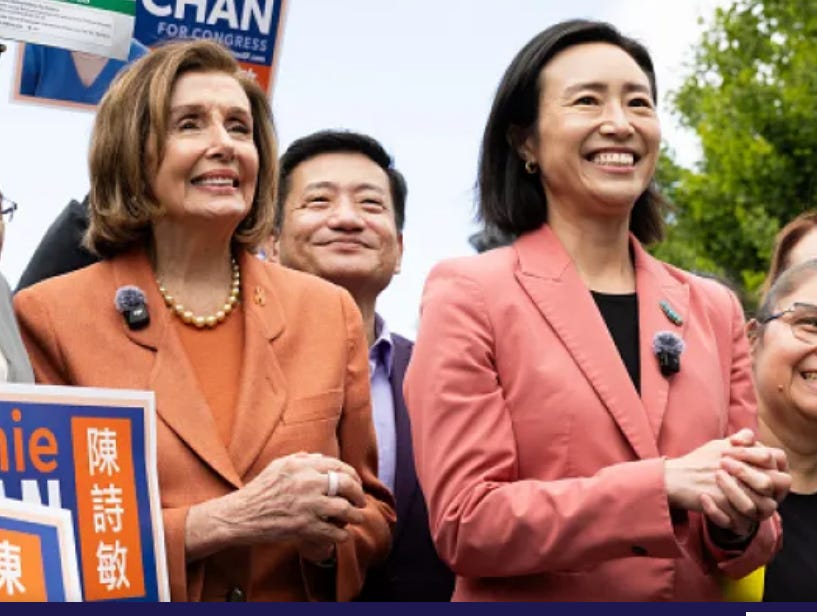
Nancy Pelosi and Connie Chan
In last week’s debate with her fellow Democrat, State Senator Scott Wiener, Chan called for a “full arms embargo on the Israeli government.” She promised on her first day in Congress she would vote to “end a genocide in Gaza and to end an apartheid state”.
While on Capitol Hill, Pelosi long supported Israel, condemning efforts to boycott or sanction the country and voting in favour of military aid.
Chan said humanitarian aid must be prioritised and told debate moderators she would not support funding for Israel’s Iron Dome missile defence system.
Wiener has also described Israel’s assault on Gaza as a genocide and said he would oppose funding for the Israeli military and the provision of bombs or offensive weapons.
“This government, and it’s not just [Israeli Prime Minister Benjamin] Netanyahu, is an absolute abomination, in my view, in terms of what it has inflicted on Gaza, in terms of Israel empowering settler violence and land grabs in the West Bank,” Wiener said.
Kushner’s and Witkoff’s LUKOil Grift, Explained
New York Times
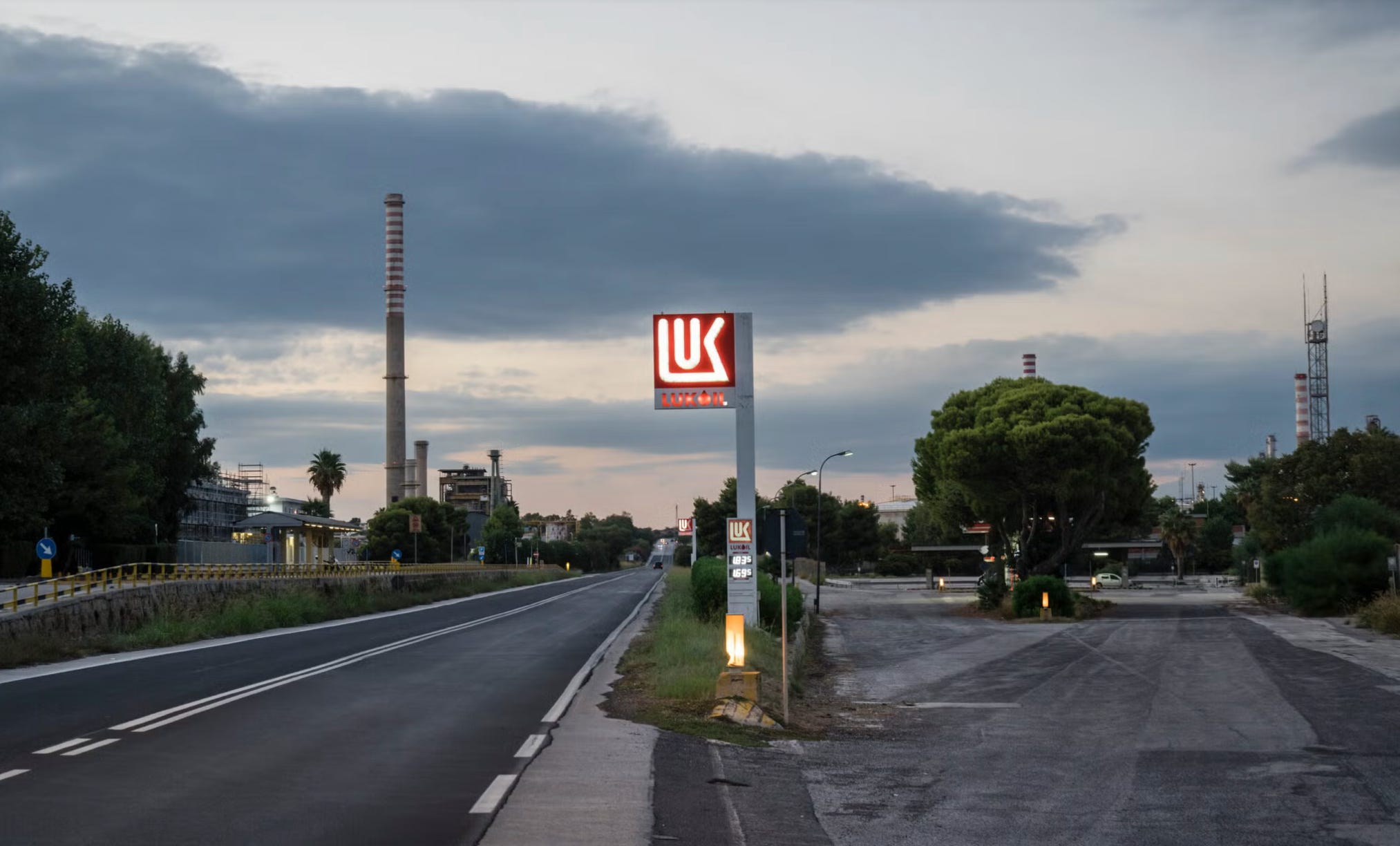
The negotiations about the Lukoil deal show that personal business interests in President Trump’s inner circle are also in play. Lukoil is Russia’s biggest private oil company. Photo: Gianni Cipriano/NYT
Scott: For several months now, transcripts of Jared Kushner’s and Steve Witkoff’s conversations with their Russian interlocutors—largely held on WhatsApp and thus very easily intercepted—have been circulating among NATO intelligence services (minus, of course, the US). It was remarkable that these conversations actually contained very little discussion of the Kushner-Witkoff mission to the Kremlin, supposedly to broker a peace agreement with Ukraine. Instead they were centered on a steady drip of intriguing business opportunities from which Kushner and Witkoff could obtain personal profit. In his blockbuster New Yorker piece, former Timesman Dexter Filkins laid all of this out in some detail. And roughly a week later, in a series of stories, the Financial Times revealed that a brokered sale of key foreign assets of the Russian state oil firm LUKOil was at the core of the discussions. The key to make the LUKOil sale work was assurance that foreign regulators—notably the US Treasury Department—would be okay with it and would lift or modify sanctions to make it work. And for a price, this was precisely what Kushner and Witkoff were prepared to step in and assure. It’s classic corruption in a breathtaking form. Yet transactions of this sort are a weekly undertaking in the Trump era… and they go largely unreported in US media.
Now NYT has picked up on the FT’s reporting and considerably expanded and elaborated on it.
The Trump administration’s talks with Russia about ending the war in Ukraine have expanded to include a multibillion-dollar oil deal that would benefit Middle Eastern business executives with ties to the two main U.S. negotiators, Steve Witkoff and Jared Kushner.
The deal, which is contingent on approval from the U.S. government and the Kremlin, is for a sprawling set of oil fields, refineries and gas stations around the world owned by Lukoil, one of Russia’s biggest energy companies.
The leading group seeking the deal includes an American investor, Todd Boehly, who has donated $2 million to President Trump’s political causes; two Middle Eastern groups that have done business with Mr. Kushner or Mr. Witkoff’s family; and an arm of the U.S. government itself.
The monthslong negotiations, which were described by eight people familiar with them, shed new light on Mr. Trump’s latest approach to settling a four-year war that has killed hundreds of thousands. The people spoke on condition of anonymity because of the sensitivity of the negotiations.
There is no indication that Mr. Kushner and Mr. Witkoff themselves stand to profit. But the pending deal represents a striking intermingling of personal business ties with geopolitics, even for an administration that has regularly dismissed concerns about potential conflicts of interest.
President Vladimir V. Putin of Russia brought up the deal when he met with Mr. Witkoff and Mr. Kushner at the Kremlin on Sept. 5, according to three people familiar with the meeting. Mr. Putin proposed it get done as a way of showing Russians that they can do business with the United States, according to one of the people.
The Americans responded that they would work on it, the person said, seeing it as a way to build good will with the Kremlin while also lowering global energy prices. But the deal is also a lucrative one for the buyers: U.S. approval for the sale would release the assets from American sanctions, instantly increasing their value.
In Moscow, the decision on the deal is widely seen as Mr. Putin’s to make, even though Lukoil is technically a private company. The upshot is that the giant transaction, involving assets as varied as oil fields in Cameroon, refineries in Europe and gas stations in New Jersey, comes down to Mr. Putin and Mr. Trump.
