




After the midterms / Donnie’s Insanity by the Numbers / The Biggest Heist / The Trump Drone Business / and more
Financial Times

Scott: In the peculiar mind of Donald Trump, all election clashes can be divided into two categories: those which he has won, and those where fraud and vote rigging conspired for the victory of an enemy. With this in mind, how is Trump likely to respond to the shellacking that the American electorate is preparing to deliver to him tomorrow? Accepting it with good grace is out of the question. Steps to overturn the election results and to undermine democratic institutions in general are to be anticipated. Ed Luce does a solid job of reviewing things here.
Trump has three stages of election interference, says Ian Bassin, head of Protect Democracy, an advocacy group, and former White House counsel to Barack Obama — “deceive, disrupt and deny”. The first, deception, involves persuading enough Republican voters that Democrats are cheating, or conversely, convincing Democrats, especially minorities, that it is too dangerous to vote. It is illegal under federal law to send armed men to polling places. That includes Trump’s much feared Immigration and Customs Enforcement agency. “Do I think Trump will deploy ICE to a handful of states, then immediately withdraw them?” says Chris Coons, a Democratic senator from Delaware. “Yes, because the airwaves will be blanketed with [images of] masked men brandishing guns and that will intimidate people.”
It would nevertheless take a big event to override what political analyst Charlie Cook has dubbed the “red undertow” — Republican voters likely to stay at home because they are disenchanted with Trump. Should deception fail to move the needle, disruption is always possible. But Trump keeps meeting obstacles. “There was a reason why the constitution’s founding framers gave the US president no role in overseeing elections,” Bassin says.
That leaves denial. Trump’s best bet would be to get Mike Johnson, the speaker of the House, to refuse to certify the new Congress on January 3. If there were more Democratic wins being contested than the party’s majority of seats, Johnson might block the swearing-in of new members. That would trigger a constitutional crisis. Johnson has made it clear that he is willing to improvise. “Some efforts [at vote rigging] are so diabolical and deeply embedded that they’re impossible to prove,” Johnson said recently. “But everyone instinctively knows something is wrong.”
Reversing a federal election, however, requires systemic connivance. Should they lose big next week, many more Republicans could discover their post-Trump self-preservation instinct by January. Thom Tillis, the outgoing Republican North Carolina senator who increasingly fell out with Trump over the past 18 months, says there is a lot of Republican anger about Trump’s architectural passions in particular. “My God, we’re trying to talk about affordability and you’re building luxury ballrooms and monuments to yourself?” says Tillis. “I was a Republican long before Trump and will be long after Trump. If the assholes on my side can’t recognise that they made a mistake and address it, maybe they deserve to lose.”
Trump lacks the support to make it easy to hijack a partial transfer of power. At between 27 and 38 per cent, depending on the pollster, he has even lower ratings than during the worst points of Covid-19. Many, thus, believe that his window to seize control is narrowing. “Trump must have missed the day in autocracy school where you are taught to consolidate power while you are still popular,” says Bassin. Many around Trump are showing their frustration. Steve Bannon, a co-architect of America First, points out that Trump’s universe of small donors — a key measure of grassroots enthusiasm — has “evaporated”. Republicans are thus relying on infusions from the tech titans. “Maga hates the White House ballroom and jets from the Gulf,” says Bannon, of the Boeing 747 Qatar gave the US last year. “If we win, we will win ugly.”
Toxicity is not in short supply. In one of the most closely watched races of the election, James Talarico, the Democratic Senate candidate in Texas, looks capable of flipping the seat after decades of attempts by his party. Fake videos have circulated alleging that a former student of Talarico was sexually abused by him. Another debunked story that Talarico had suffered a nervous breakdown this year was aired nightly on Fox and other outlets. No correction was issued. Talarico once described God as “non-binary”. This led JD Vance, the vice-president, to imply he was a pervert. “You got to wonder what the [internet] search history of a man like that looks like,” said Vance. Musk, who has pumped almost $200mn of his money into defeating Talarico, which breaks several election spending records, has called him a “creep” whose ideas are “pure evil”. “There is something deeply wrong with Talarico,” Musk posted.
Abdul El-Sayed, the Democratic Senate candidate in Michigan, has also been singled out for abuse. The word “terrorist” has regularly been bandied about. Trump called him a “jihadist” and “100 per cent Muslim Brotherhood”. El-Sayed’s opponent, Mike Rogers, called him “anti-Jew”. Even by America’s post-9/11 standards, the intensity of rhetoric against Muslims is high. Musk, in particular, has promoted the idea that western culture is on the ballot next week. He and others blame the recent French riots on Muslim immigrants and say France gives a foretaste of America’s coming nightmare under the Democrats.
By contrast, Republican warnings about the Democratic impact on the US economy have been muted. Trump has taken a public stake in 30 US companies and has promised each adult American a $5,000 “dividend” if Republicans win. Such federal largesse has made it harder to motivate libertarians and fiscal conservatives. Though there are about two dozen Democratic Socialists on the ballot, Trump’s economic meddling has blunted his ability to paint the left in statist colours. When asked to define what he meant by socialism, Vance tellingly did not mention rising deficits or public ownership. Socialism, he said, was wanting “to replace American workers with foreign workers and you want boys to play in girls’ sports”...
Whether he is angry or lame, or both, Democrats are sharply divided on the best way of handling Trump. Some want a take-no-prisoners approach. Others believe a new season of “lawfare”, which would come to naught, since they would need an unattainable 67 Senate votes to convict Trump, could single-handedly revive his popularity.
James Carville, who was Bill Clinton’s 1992 campaign manager, recently enraged the left by saying that he would prefer Republicans to retain control of the House than Democrats getting a five-seat majority. The latter would make Jeffries a “hostage” to the Democratic Socialists of America, he said. Coons put it more delicately. “The two impeachment trials in Trump’s first term made him a martyr,” he says. “I would encourage a new Democrat House majority to focus on oversight and accountability.”
Effective oversight requires discipline. That “government corruption” has recently soared to the top of US voter concerns, ahead of inflation and healthcare, is striking. Sixty per cent of Americans told the pro-Trump Fox News that they were “extremely concerned” by corruption. The question is not whether Democrats investigate Trump but with what end in mind. “The priority must be for a Democrat to take the White House in 2028,” says Harvard’s Tribe. “The next two years should be about setting that up.” That would mean taking visible steps to address public anger about the rising cost of living, Democratic insiders say. Each time Trump vetoes a bill they would link it to his self-enrichment. As the Republican Tillis puts it: “If I were a Democratic Speaker, I would say, ‘Mr President, you want to increase the debt ceiling, then why don’t we get through some of these bullshit things like saving a billion on that ballroom? Maybe you could put up an obelisk instead?’”
On the global front, there is little Congress can do to check Trump’s leeway. Trump’s hunt for peace deals, and his volatility when he fails to secure them, implies a radical gamut of scenarios. “My fear is that foreign policy will become even more of an outlet for Trump’s adventurism if he loses Congress,” says Coons, who would be chair of the foreign relations committee if Democrats regain the Senate. Trump’s foreign policy unpredictability can cut both ways.
Unreported at the time was Trump’s 2025 invitation to hold talks with his Iranian counterpart, Masoud Pezeshkian. Trump cut short his attendance at the June 2025 summit of G7 leaders in Alberta because he was expecting a response from Iran, says a former senior Trump official. Tehran’s return call never came. “People forget how much Trump invests in personal diplomacy,” says the official. “He talked to Kim Jong Un of North Korea. He really wanted to talk to the Iranians.” Trump’s first attack on Iran, Operation Midnight Hammer, took place a few days later…
Trump’s recent tilt to Putin, including his call for Zelenskyy to leave office and buying Russian diesel in a forlorn bid to reduce prices before the midterms, has triggered rare Republican pushback. There was special anger when Trump’s envoy, Steve Witkoff, thanked Putin for being a “humanitarian”. Republicans were already seething over Trump’s refusal to implement a Russia sanctions bill that was passed in the wake of the unexpected death in July of Lindsey Graham, the Republican South Carolina senator. Graham was the closest among Trump’s confidants to being a champion of Ukraine. “Graham’s Russia sanctions bill [which passed 86-11] was a good proxy for the will of Americans,” says Tillis. “We can’t get 86 senators to agree on motherhood. Then Witkoff describes Putin as a fucking humanitarian? It’s hard to pivot from that.”
Should there be, as some forecasters anticipate, a Democratic “blue wave” next Tuesday, the Trump 2028 succession race will heat up sooner than expected. The Democratic field already promises to be crowded. But a stinging rebuke for Republicans would place both Vance and Marco Rubio, Trump’s secretary of state and losing 2016 presidential candidate, in a quandary. The two men lead most prediction markets to succeed Trump. Both would be penalised by being perceived as too close to him.
Kamala Harris’s most costly moment in the 2024 election was her inability to think of anything that she would have done differently from Biden. Trump has not expressed much interest in whom he might anoint as his heir. Bannon has recently gone quiet after having said he had a plan to enable Trump to bypass the two-term limit and run for a third. But he points out that Trump is not on the hunt for his successor. No leader has ever dominated America’s attention quite like Trump. The word “loser” is the dirtiest in Trump’s vocabulary. It is near unimaginable that he would become less angry following a big loss than he is now.
Trump is Gaga: The Times Proves It By The Numbers
New York Times
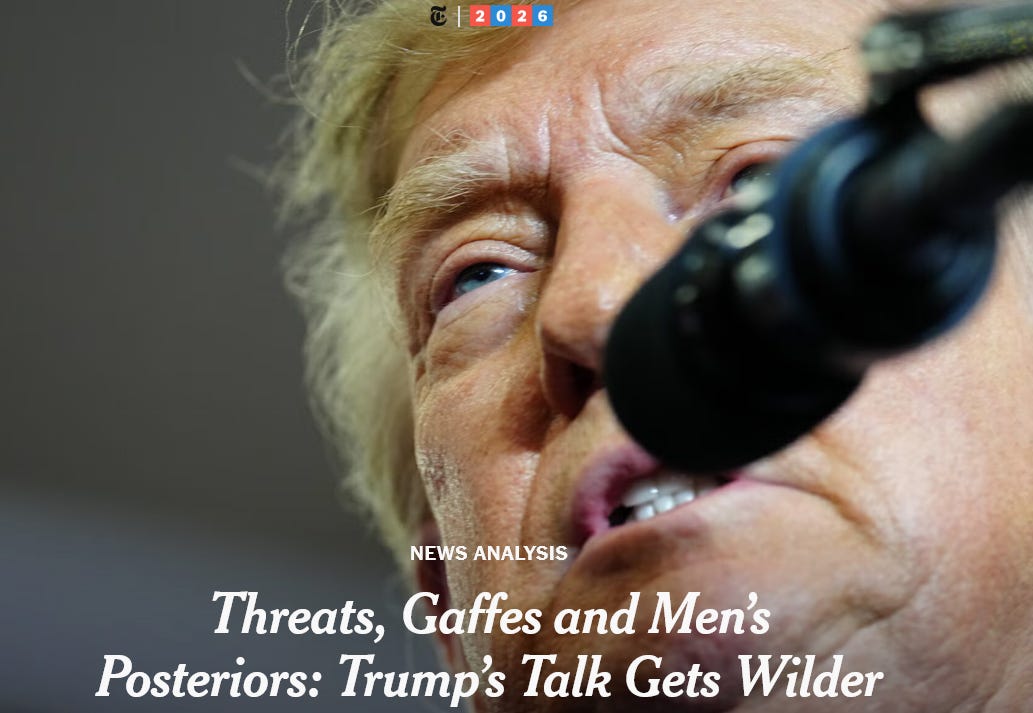
Charles: White House correspondent Peter Baker and Times A.I. projects editor Dylan Freedman crunch the numbers to prove what is clearer to everyone every day: the president is losing it.
“To identify confusing and rambling passages of text, we used the A.I. model Claude Opus 5.5 to score more than 6,500 passages of Mr. Trump’s speeches with detailed instructions,” the authors explained.
Trump told the Willie Horton story twice, thirty minutes apart, at the same rally.
He is cruder than ever, using nearly 15 swear words per 10,000 words compared with six a decade ago, a change consistent with age-related disinhibition.
He makes rambling or confusing digressions in his rallies and speeches two and a half times as often in his second term as in the 2016 campaign
He says things that are manifestly unhelpful to him. In Perry, Ga., he said that high oil prices were good because the fossil fuel industry was making hundreds of billions of dollars. Even as he said it, he acknowledged it would produce bad headlines. “I don’t give a damn,” he said. “I’m going to say it. We’re making a freaking fortune.”
The man who dispenses disparaging nicknames like “Talafreako” for James Talarico and “Annie Trannie” for Dr. Annie Andrews insisted with a straight face the other day that “I don’t go around mocking people.”
Peter Baker used the president’s own words to hang him in the story’s kicker: “When someday, there’ll be a time when I do the weave is weave, weave. Someday, there’ll be a time when I don’t get back to the original subject, and then you can say he’s had it. OK? You can say then he’s had it.”
North Korean Hackers Steal $6.3 billion from Binance in Just Thirty Minutes
Bloomberg / Financial Times
Scott: It’s the perfect crime for the age of Trump. In just a paltry thirty minutes, North Korean hackers worked their way through a series of Binance crypto wallets, lifting a solid $6.3 billion from them. The marks are grifters with close ties, via the Trump bros, to the White House. The targets are best known for the use of crypto to evade sanctions—thus rendering invaluable assistance to a diverse crowd of rogues including Russia, Iran, North Korea and assorted international criminal syndicates. And the perps are seasoned national security experts of a foreign power, which for incomprehensible reasons Trump has decided are his friends.
The largest financial theft in history took no more than 30 minutes.
Just after 8pm London time on Thursday, five cryptocurrency wallets controlled by Binance, the world’s largest exchange, were suddenly drained of roughly $300mn in crypto tokens. Over the next half-hour, the attacker repeated the trick several times, stealing an eye-watering $6.3bn in bitcoin, ethereum and other cryptocurrencies.
As Binance raced to stem the bleeding, crypto companies froze what assets they could. Still, within a few hours, the hackers controlled at least $3.33bn, according to analysis by Elliptic, a blockchain analytics company — making the hack by far the biggest robbery of all time.
“This is huge by almost any metric,” said Eswar Prasad, economics professor at Cornell University.
The size and speed of the theft has left Binance, its customers and even the most ardent crypto enthusiasts asking how such a breach could happen at the world’s biggest digital assets exchange.
Richard Teng, co-chief executive of Binance, laid bare the scale of the hack on Friday, saying the company was rebuilding and retesting its “entire infrastructure system” and “conducting a full security review across the entire company”.
Binance, the FBI and blockchain analysis companies are racing to trace the funds and try to stop them being cashed out.
The theft is the latest and largest in a wave of heists that highlight the threat hackers pose to crypto exchanges and the capabilities of North Korea’s powerful state-backed hacking industry, which is thought to have been behind the attack.
“The scale is what is challenging here,” said Phil Larratt, senior director of global services at Chainalysis, a blockchain tracing firm which is working with Binance. The hacker was “state-sponsored” and “extremely sophisticated”, he added.
The day before the heist, the hacker began practising, first by sending three small crypto payments into an online wallet via Tornado Cash, a service designed to obscure where crypto comes from. Then, about four hours before the attack, the hacker tested the malware used against Binance on two other crypto wallets, Elliptic said.
Exactly how the hacker accessed the wallets is unclear. Binance’s initial investigation suggested the attacker first compromised the laptop of one of its software engineers and then submitted “unauthorised withdrawal transactions”.
Engineers’ laptops are attractive targets for hackers because such staff often have privileged access to many parts of the IT system.
Teng later said the attacker “did not simply use one engineer’s permissions, and this was not a single ‘one-click’ action. It involved a more complex attack process”. The company said it had “uncovered additional points of breach” and was still investigating.
During the theft, speed was key. Almost all of the $6.3bn was taken in the first 30 minutes, according to Elliptic, with a second, much smaller wave of withdrawals executed about three hours later at 11pm.
The Wild Rise of a Trump-Backed Drone Company
Wall Street Journal
Scott: In Pete Hegseth’s Pentagon, billion dollar defense contracts are awarded on a non-competitive basis based largely on the contract proponent’s proximity to Trump and his family. And that proximity can arise through the most curious paths—like a social media shout-out. Conventional criteria, like the contractors record, resources and assessed ability to perform the contract, really don’t appear to matter. The drone start-up Powerus, which landed more than $100 mn in contracts in a matter of weeks, is a perfect example.
Last July, drone pitchman Brett Velicovich joined Fox News to praise the Trump administration’s plans to invest more than a billion dollars in America’s military drone industry.
Moments later, he earned a public shout-out from one prominent viewer.
Velicovich “really knows his ‘stuff,’ ” President Trump said on social media. “We are really on our way. MAGA!”
Fifteen months later, Velicovich is now a top executive at Powerus, a new drone company backed financially, in part, by Trump’s eldest sons, Donald Trump Jr. and Eric Trump. It has emerged from a crowded field to snap up multimillion-dollar contracts in the U.S. and overseas.
Assembled from $5.7 million in assets, Powerus has grown within months into a $300 million enterprise, led by an unlikely cast of characters that includes a public golf-course operator in Florida; a sushi restaurateur; a Democratic donor with a New York cleaning business; and a former child-modeling talent scout who has settled claims of defrauding parents.
To Velicovich, his new company’s early success is a testament to the business acumen of its founders. “I have never seen another drone company that in their first year in business has been able to do what we’ve done,” Velicovich said in an interview. “You will see us exceed them all.”
When it was less than a year old, Powerus secured a $90 million Air Force contract. A month later, Powerus said it beat defense-tech giant Anduril Industries for a $22 million job defending American oil infrastructure in the Middle East.
In September, Velicovich met with Pakistan’s Army chief, whom Trump has publicly called his “favorite field marshal,” as part of a deal to sell his forces drones. Powerus already had a deal with Pakistan’s archrival, India, and has been sought out by heads of state elsewhere, including Lithuania and Iraq.
Earlier this month, Powerus also became a public company as Velicovich and his partners, cheering and flanked by their families, rang the opening bell at the Nasdaq stock exchange. A fund backed by the Trump sons, American Ventures, has cashed out at least $6 million from its investment to date. The fund owns about 3.4% of Powerus, according to a securities filing, and holds warrants that can convert to tens of millions of additional shares in the future.
Dominari Holdings, the financial firm behind American Ventures, helped take Powerus public. The Trump sons each own around 6% of the investment bank, which often merges underperforming publicly traded companies with businesses in buzzy industries.
To ethics experts, Powerus is an example of the blurred lines of government and private business in the second Trump administration that are without modern comparison. “Never have we seen a president’s family benefiting from military contracts,” said Richard Painter, a White House ethics lawyer under President George W. Bush.
Hacked Emails Reveal the AfD’s Tight Ties with Ethnonationalists
Der Spiegel
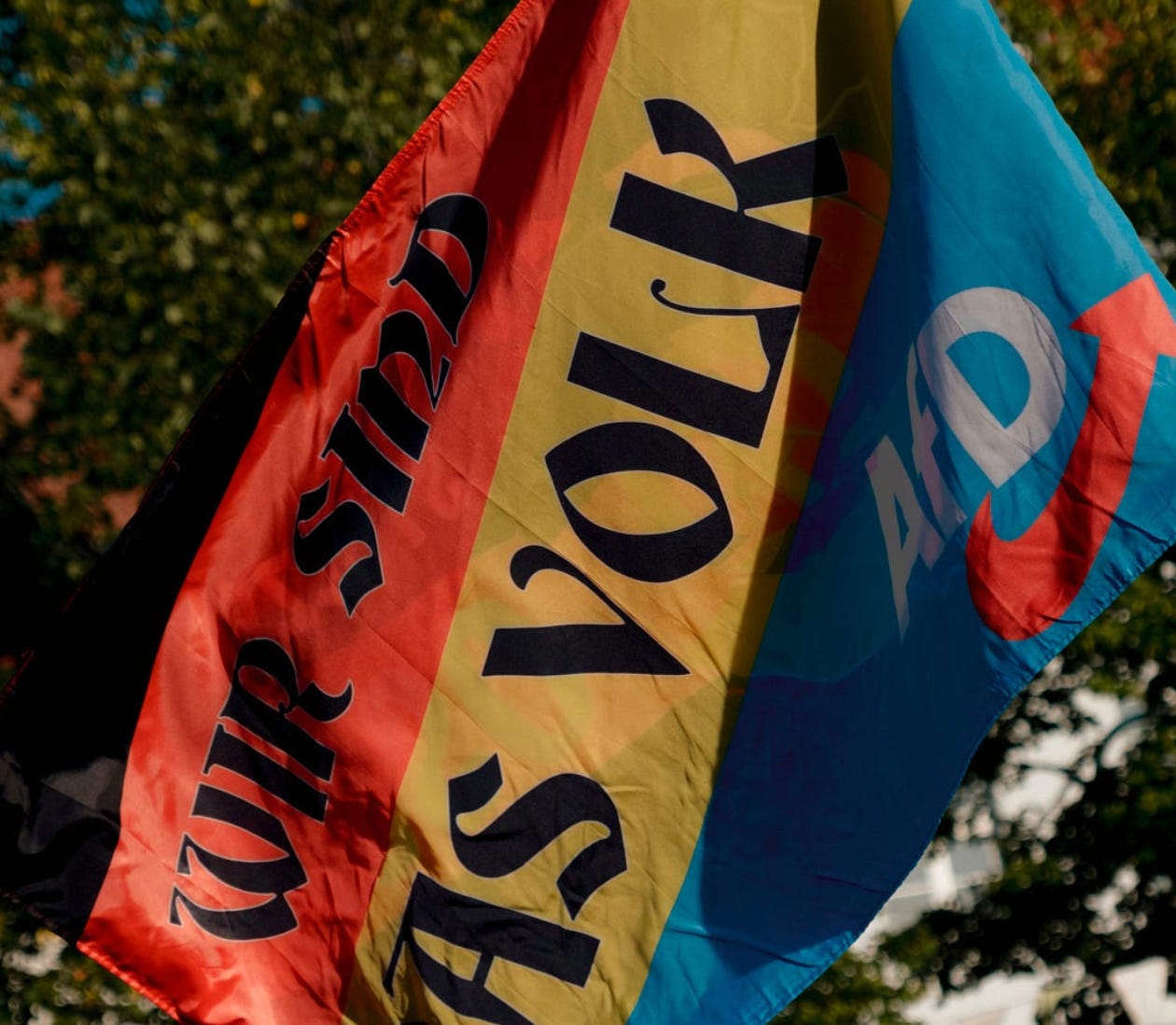
Hacked emails from the right-wing Alternative for Germany party reveal a cozy relationship with ethnonationalist extremists. Photo: Martin Pauer / Der Spiegel
Scott: A massive leak of emails and documents from Germany’s Neo Nazi Alternative für Deutschland (AfD) party have given the public a sudden look into what makes this party tick. Of primary interest are its relationships with hostile foreign powers that appear to exercise huge influence over its operations—Russia, Hungary under Orbán and Syria under Assad, for instance. These governments arrange trips abroad and focus on indoctrination, and communications often suggest that the AfD members view them less as peers and more as superiors. But a second subset of the materials details AfD’s relationship with extreme, and often violent ethnonationalists. Spiegel has a summary.
Patrick S. and two accomplices ambushed the man in front of his garage, beat and choked him. Then they bound him with zip ties and searched his apartment. They left the victim behind, “bleeding and whimpering in pain,” according to the ruling of the Federal Court of Justice. The man had to be put into an artificial coma multiple times in the hospital in order to survive. That was in 2020.
The three perpetrators were sentenced to six years in prison by the Hanover Regional Court for aggravated robbery in conjunction with dangerous assault. Recently, the Federal Court of Justice referred the case back to the regional court to clarify whether the convicted men had in fact intended to kill. That could increase the sentence.
Patrick S., however, is not in pretrial detention. He is known to the authorities as a neo-Nazi. In 2015, he was convicted for attacking a Green Party member of the Bundestag, Germany’s parliament, in the middle of the street.
As a result of the Federal Court of Justice ruling, Patrick S. will soon be back in court. In the meantime, though, he is earning money with graphic design. One of his clients? The Alternative for Germany (AfD) party.
According to email traffic, he developed graphics for social media, to name one example, and an advertisement intended to run in a newspaper close to the AfD. At least €4,180 euros were billed to the AfD in Mecklenburg-Vorpommern, payable to a company listed with his wife as the owner.
The transaction is revealed by internal AfD documents that were stolen from the party’s email inboxes and released publicly by hackers last week. The party has confirmed that significant quantities of data were leaked. In total, it involves more than 420,000 emails and over 48,000 documents; DER SPIEGEL is analyzing them and also verifying their authenticity.
The largest leak in AfD history offers insight into the far-right party, which has steadily radicalized since its founding 13 years ago. The group of euro-skeptic professors, as the AfD presented itself back then, has transformed into a völkisch (ethnonationalist) extremist party that is increasingly merging with figures from the very groups listed on its own incompatibility list.
That list includes hundreds of organizations that were deemed too radical in the early days of the party. Members of such groups were only supposed to be admitted into the AfD in special cases. But those exceptions are becoming more frequent, as the leak also shows.
As the AfD drifts ever further to the extremes, calls for a ban are growing louder. Most recently, state premiers Hendrik Wüst (of the center-right Christian Democratic Union) and Cem Özdemir (of the Greens) spoke out in favor of moving forward with proceedings to ban the party.
Alice Weidel, who currently sits unchallenged at the head of both the AfD party and its parliamentary group, evidently no longer even takes issue with the extremists being allowed to join the party. Even as she warned early on against crossing certain lines, the leaked emails now show that her criticism fell silent long ago. Instead, she herself publicly fans the flames of the radicalization, for instance by spreading historically revisionist lies about Adolf Hitler and claiming that he was a communist and left-wing extremist.
None of it has diminished the AfD’s success. On the contrary, in nationwide polls, it stands at around 28 percent, and in Saxony-Anhalt it could soon install Ulrich Siegmund as its first state premier. Even in Mecklenburg-Vorpommern, where the state party was not particularly united behind its candidate Leif-Erik Holm, the AfD won the most votes in September’s state election.
The AfD in that state is an instructive case. Its Mecklenburg-Vorpommern state branch is the only one among the eastern German state branches that has not been classified as “confirmed extremist” by the state Office for the Protection of the Constitution, Germany’s domestic intelligence agency. It has often been described as more moderate, at least by comparison.
The leak shows clearly that this assessment was wrong.
The AfD in Mecklenburg-Vorpommern, for instance, shows little reluctance to engage with people who were previously active in neo-Nazi organizations or who remain involved to this day in the völkisch Identitarian Movement. On the contrary: some of them were hired to cast the AfD in a favorable light during the election campaign. And they were paid well for it – with some of that money coming from taxpayers.
The party no longer shies away even from someone like Patrick S., with his history as a violent neo-Nazi. That is likely also because the man who brokered the business relationship with Patrick S. has known the extremist at least since 2012.
That man is Daniel Fiß, the AfD’s campaign manager in Mecklenburg-Vorpommern. All the threads ran through him – including when it came to Patrick S. He was the one who forwarded Patrick S.’s invoices to the state executive committee and made sure they were paid.
NASA’s James Webb Space Telescope Captures Eerie Cat’s Head

NASA, ESA, CSA, STScI; Image Processing: Joseph DePasquale (STScI)
Intricate structures within the Cat’s Head Nebula are illuminated in this mid-infrared view from NASA’s James Webb Space Telescope released on Oct. 29, 2026. The distinctive “cat’s head” shape of the nebula was likely sculpted over time by the intense ultraviolet radiation and winds from massive stars in the Carina Nebula. As this stellar feedback erodes the surrounding gas and dust, denser material within the feline-shaped pillar resists erosion, at least for now.
Image credit: NASA, ESA, CSA, STScI; Image Processing: Joseph DePasquale (STScI)

Your Online Moment of Zen
When I Was a Freeport And You Were The Main Drag
Written and peformed by Laura Nyro
From Nyro’s 4th album Christmas and The Beads of Sweat.
One of my four favorite song titles—and one of Laura’s very greatest songs.
Released November 1970, just in time for Thanksgiving.
This is how John Wilson described her Carnegie Hall debut a year earlier in the Times:
Laura Nyro, a 22-year-old singer and songwriter who has developed an avid underground following during the last two years, emerged from the shadows to give two concerts at Carnegie Hall on Saturday night. Her following came with her, filling the house at the first concert, greeting her with a standing ovation, recognizing the first introductory note of every song with cheers, applause and squeals, and then listening with eager, breathless attention. They called her back for three encores and finally poured adulation on her as she strode back and forth across the stage to receive prolonged applause. It was, without a doubt, a triumph for Miss Nyro. Seated at a piano, wearing a long, white gown, her brown hair streaming loosely down her back, she played and sang songs that reflected a young, contemporary, urban view of life. Both she and her songs are products of the city. "When I open my window, It doesn't smell like flowers,' she said in a pause between songs. "It smells like pizza." From her opening song, "New York Tendaberry," her response to the warmth she finds under the harsh surface of the city, through her romantic evocation of "Emmie" and the exuberant gospel drive of "Stoned Soul Picnic" to her urgent, impassioned "Save the Country," Miss Nyro steadily built the enthusiasm and excitement of her audience. Although she occasionally used a soft, sweet style of singing, most of her songs were shouted out, gospel style, as she pounded rugged support from her piano. Miss Nyro is, in the view of many of her followers, primarily a poet.
<iframe width=”560” height=”315” src=”
title=”YouTube video player” frameborder=”0” allow=”accelerometer; autoplay; clipboard-write; encrypted-media; gyroscope; picture-in-picture; web-share” referrerpolicy=”strict-origin-when-cross-origin” allowfullscreen></iframe><iframe width=”560” height=”315” src=”