



Trump Corruption Watch
We are #1
At 250 Years, America Is Transformed from a Beacon of Democracy into the World’s Premier Kleptocracy
Financial Times
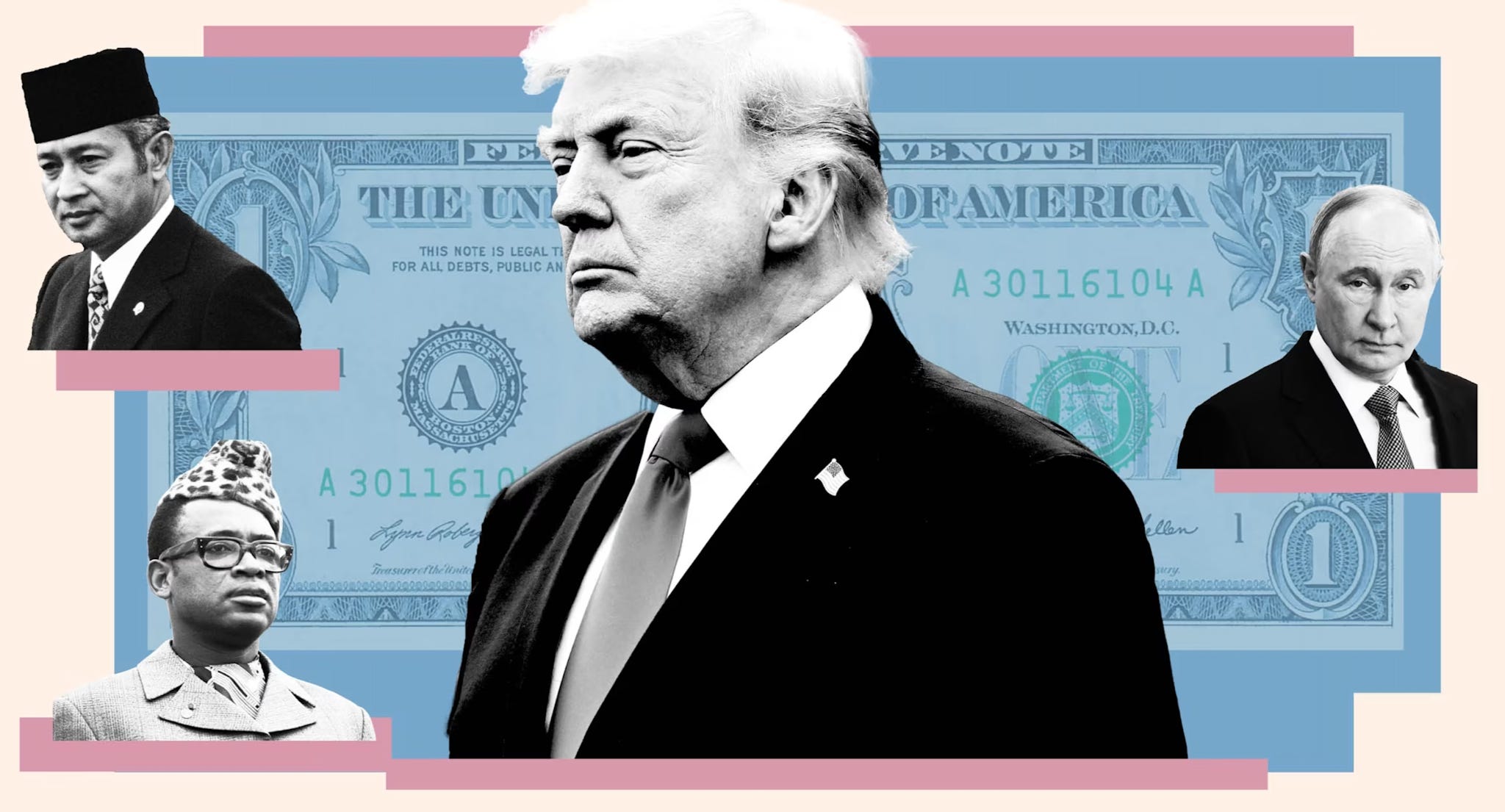
Scott: As the world’s oldest continuous democracy, the United States has long served a beacon for nations striving to obtain democracy around the world. But on its 250th birthday, the Financial Times finds that another label fits more aptly: kleptocracy. Indeed, FT lines up Trump’s voracious skill at using his office to acquire wealth for himself and members of his family up against the best known kleptocrats of our time and finds that, in less than a year, Trump has blown them all out of the water. This remarkable transformation demonstrates several other things: (1) the total failure of congressional investigation and oversight, as Congress becomes increasingly an irrelevant ornament; (2) the collapse of anti-corruption rule enforcement by the Department of Justice, Securities and Exchange Commission and a host of other regulatory and enforcement agencies; and (3) as European political scientists are particularly quick to note, the failure of the Supreme Court to play its fundamental role as gatekeeper blocking overreach by an authoritarian executive. What the US has come most to resemble is not one of its developed peer states, but an impoverished third-world dictatorship in which higher state office is viewed principally as the key to rent seeking and wealth accumulation.
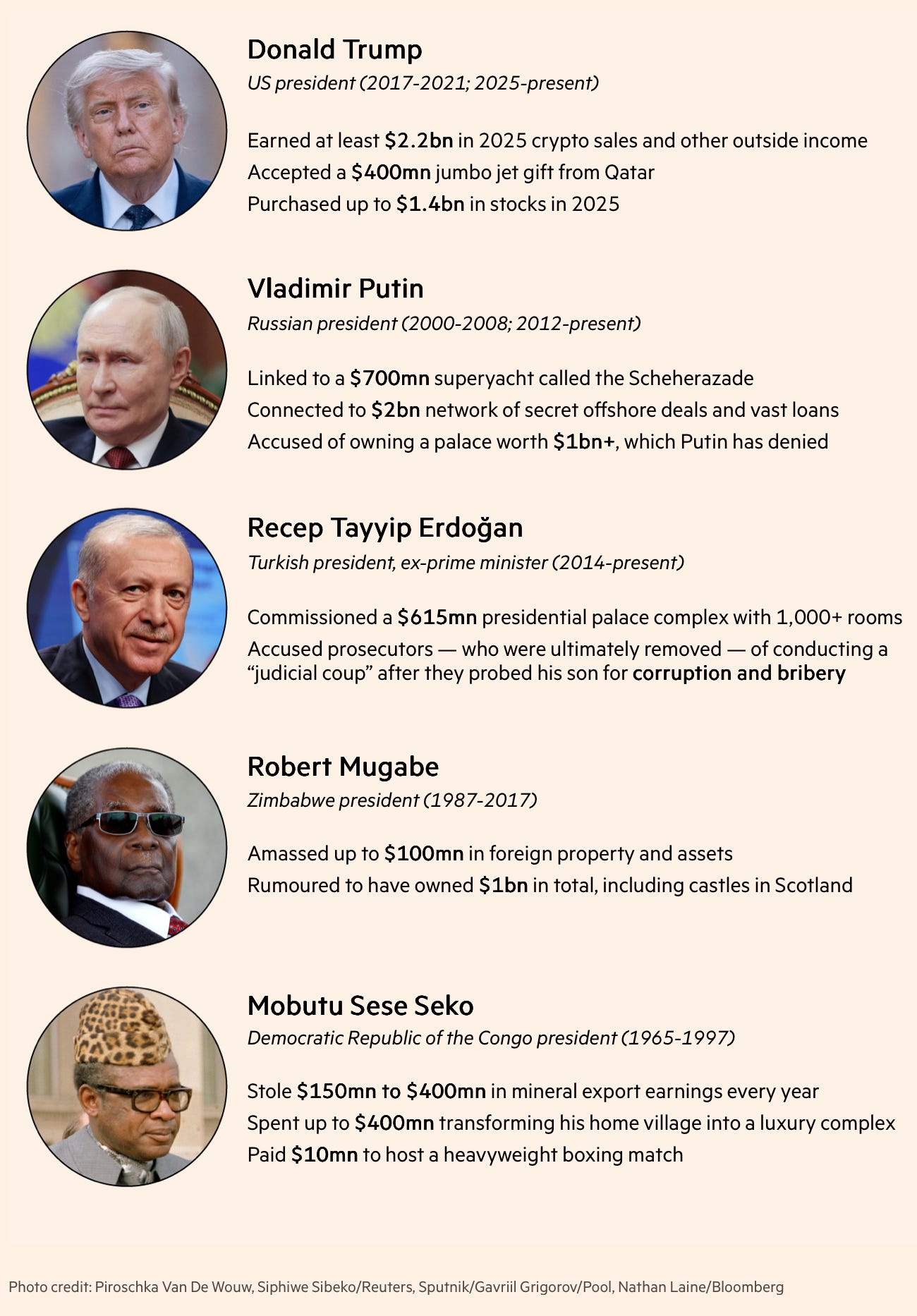
President Donald Trump flew to Medora, North Dakota, this week to dedicate the Theodore Roosevelt Presidential Library. It was notable for being his first trip aboard the new $400mn Boeing 747 gifted to him by the Emir of Qatar.
Trump flew out on the same day it was disclosed he had earned more than $2.2bn since his return to the White House, a windfall without precedent in US presidential history and one that has raised more troubling questions about conflicts of interest in his administration.
The size of the earnings — largely from crypto ventures — is inviting comparisons that might have seemed outlandish even a year ago. Some political scientists are beginning to see parallels between Trump’s behaviour and those of foreign strongmen in Africa and Asia notorious for their self-enrichment in office.
Nic Cheeseman, an Africa expert at the University of Birmingham, said Trump’s way of governing had echoes of the “patrimonial” system in parts of Africa, where the ruler treats the state as an extension of his personal household.
“It’s typically associated with blurring the line between public office and private wealth,” he said. To Cheeseman, Trump’s $1bn earnings from cryptocurrencies and the Qatari jet exemplify that.
Some also see echoes of Turkey under Recep Tayyip Erdoğan, a close ally of Trump’s who has faced persistent allegations that he, his family and his political network benefited financially from his more than two decades in office — claims that he has consistently denied.
Howard Eissenstat, a history professor at St Lawrence University in New York and an expert on Turkish politics, said that in many ways, Trump had surpassed Erdoğan.
“There’s a ‘greed is good’ vibe in the Trump administration and that is not how Erdoğan does business,” he said. In Trump’s desire to accumulate wealth, he said, “things are bigger and more brazen and more obvious in a way that’s stunning”. The Turkish president “is a lot more cautious”
Because Not Enough Crazy People Already Own Automatic Weapons in America
New York Times
Charles: Since it’s been twenty-four hours since you’ve read anything new about how Donald Trump is destroying the United States…
The Trump administration is scrapping more than three dozen firearms regulations, abandoning a crackdown on illegal sales, restoring gun rights to some people with mental illness and loosening oversight of private weapons transactions.
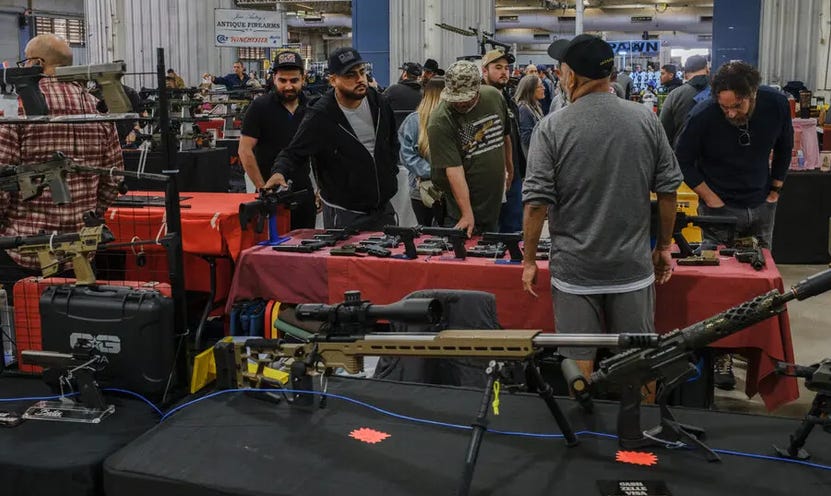
Having already decimated the Bureau of Alcohol, Tobacco, Firearms and Explosives by reassigning hundreds of its officers to immigration duties, the Trump administration has now announced drastic new measures to sharply increase the chances of more mass shootings in America. After all, only 214 people have been killed and 897 people have been wounded in 214 shootings during the first six months of 2026.
The more than three dozen rules the administration wants to eliminate would raise the legal threshold for revoking a dealer’s license; extend gun rights to buyers who had faced restrictions because of mental illness or inability to manage their own finances; and end extra scrutiny of stabilizing braces, gun accessories that have been used in mass shootings to lethal effect.
The administration is now targeting gun regulations that Democrats have passed at the state and local levels. It has challenged bans on semiautomatic rifles in Colorado, the District of Columbia and Virginia. On Wednesday, it sued California for its restrictions on the sale of Glock and Glock-style handguns, and Virginia for limits on the sale of semiautomatic rifles, hours after both laws went into effect.
A Million ‘Investors’ Lost $3.8 Billion on Trump Crypto Coin
New York Times
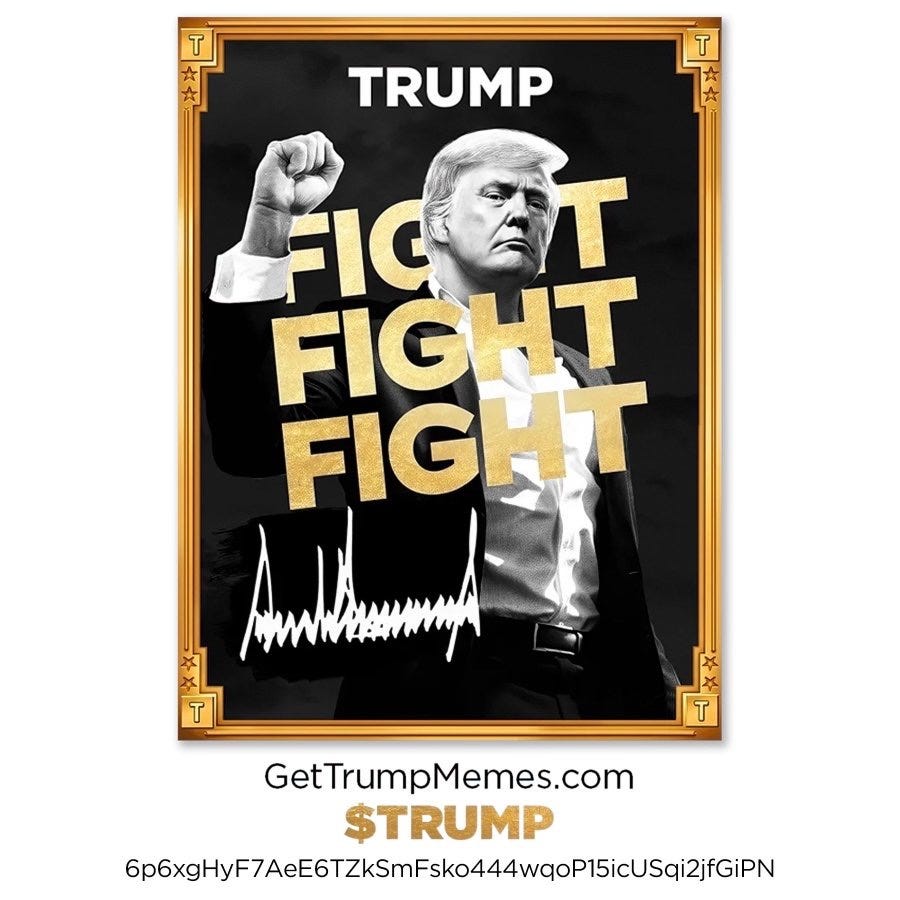
Scott: Of the $1.26 billion that Trump took in through dealings with crypto and meme coins, $636 million came from sales of the Trump memecoin. The New York Times ploughs through the financial disclosures of the issuer to find out just how “investors” in the memecoin did. Of course these investors fall into several categories. One are people who are generally not acquainted with the market or the nature of the memecoin as an investment device, nor the risks associated with it. Another group fully understand that purchasing this memecoin is little different from making a payment to Trump, for which some concession or benefit can quietly be solicited… always in a manner designed to avoid troublesome quid pro quo difficulties.
An up-to-date tally of Trump followers turned crypto investors is in. And for them, the overall results are remarkably bad.
Nearly 1 million people who bought President Trump’s memecoin have lost money through the end of June, according to a report by the cryptocurrency analytics firm Nansen. Their losses total $3.81 billion.
The analytics firm’s assessment was calculated this week after Mr. Trump signed an annual financial disclosure showing that he walked away with a $636 million payout on the same crypto bet, part of a haul of at least $2.2 billion from all of his business ventures in 2025.
The odds were always in his favor. Mr. Trump profited whether the price of his memecoin went up or down. He collected returns whenever anyone traded the tokens, as he repeatedly pushed his followers to do, using his Truth Social account to promote the coin…
The memecoin was only one of several crypto ventures that reeled in profits for Mr. Trump and his allies. Mr. Trump’s total profits from World Liberty reached $799 million last year, according to his financial disclosure, including hundreds of millions from the United Arab Emirates, which secretly moved in early 2025 to buy nearly half the company. A Trump business entity also collected a 75 percent cut of sales of $WLFI, after the deduction of certain expenses, guaranteeing that Mr. Trump would profit, even if the coin’s price ultimately crashed.
The HKR Look Back:
The White Line That Transformed America
Charles: When my uncle Jerry Kaiser was teaching me to drive sixty years ago on the roads of Westport, Connecticut he told me to focus my eyes on the white line at the right edge of the pavement to avoid the high beams of cars coming in the opposite direction.
He mentioned that the line was the clever invention of a man from Connecticut.
From that moment until today I never heard another word about that man until The Wall Street Journal identified him last week as John V. N. Dorr.
The director of the bureau of the Connecticut Bureau of highways immediately rejected Dorr’s idea.
The next time he suggested it, he wrote to the Westport Town Crier newspaper in 1953 and offered to pay for “a demonstration test of a few miles.”
That was right around the time my uncle moved his family to Westport.
This time, Dorr got a more welcoming response.
“Dr. Dorr’s suggestion,” the paper wrote in an editorial, “is a dandy.”
Before long, Connecticut was testing his dandy idea on a few miles of the Merritt Parkway between Greenwich and Stamford. The study found that Dorr’s line nudged cars away from the center line, into the middle of their lanes, and narrowed the speed gap between day and night. In other words, the study found scientific evidence that a single line could dramatically alter human behavior.
When he began his campaign, the agency overseeing the safety of America’s roads specifically warned against edge lines, fearing they would confuse drivers. This meant he was lobbying states to spend money on something that authorities said they didn’t need—and something they dismissed as too expensive. The cost was $50 per mile per line, which government officials considered a waste of $50. Dorr considered it a bargain.
“Paint,” wrote the New York Daily Mirror, “is cheaper than blood.”
In less than a decade, Dorr’s line was so popular that people wondered how they ever lived without it.
“The public is demanding it,” a Bureau of Public Roads official declared in 1958. “Everywhere drivers are saying: ‘This is the finest thing we’ve ever seen.’”
As soon as they saw it, they couldn’t unsee it. Before he died in 1962, Dorr watched his idea stretch across the country, around the world—and all the way to his front door.
One morning, he stepped outside and there it was: a Connecticut highway department truck, painting a line down the side of the road.
Nigel Farage secretly funded by convicted criminal
The Times

Scott: Nigel Farage, it turns out, lives a very comfortable life, largely on the basis of the largesse of his close friends. Problem is, we have difficulty figuring out who those friends are. One of the most reliable has been Roskomnadzor, the Russian ministry of propaganda, the owner operator of RT, which paid Farage handsomely through various guises. Another is a series of shadowy not-for-profits based in Belgium suspected of being under Russian control. Then there’s a shadowy Thai crypto billionaire who made his money in dodgy fuel contracts, who gave Nigel a cool £5 million. And a stream of bankrupt companies who have given Farage and his Reform UK lots of money that they apparently don’t have. And now Rupert Murdoch’s Times unloads another bombshell about Farage’s main pillar of support, a convicted fraudster who spent time in US federal prisons, and who has plenty of ties to Trump and his entourage as well. It has all the makings of a parliamentary inquiry.
At 6.36pm on June 16, a black-tinted Range Rover crept down an empty backstreet a short walk from Buckingham Palace. The driver parked directly opposite a Georgian townhouse, the back door positioned so the passenger could take the shortest walk possible to get inside.
The first person to leave the vehicle was a former Royal Marines commando who began working as Nigel Farage’s bodyguard after the general election.
He opened the door for the VIP in the back seat. Out stepped not Farage — the Reform UK leader was headed north for the Makerfield by-election — but a convicted criminal and crypto-gambler holding a fat wad of cash.
His name is George Swinfen Cottrell, otherwise known as “Posh George”. A babyfaced British aristocrat and former US federal inmate, he has no official role in Reform UK — but has been Farage’s closest adviser for more than a decade and travels with him in Westminster and around the country. The pair’s lives are so intertwined Cottrell uses the ex-soldier for his own protection, having quietly paid for Farage’s security for a number of years…
Secrecy follows Cottrell, 32, who has made an art of being difficult to pin down. He was once labelled “deceptive” by a judge for legally changing his name from “Cottrell” to “Cotrel”. Today he flies on private jets and makes bank transfers under the alias “George Co” and is a key player in a crypto gambling company owned via a complex offshore structure whose ownership is invisible to the public.
Yet his relationship with Farage, whom he calls “Daddy”, has been most opaque. It is so important to the Reform leader that lying in one of Cottrell’s homes is a copy of Farage’s maiden speech as an MP, the culmination of repeated attempts to enter the Commons over three decades. The Clacton MP signed it by hand as a tribute to his friend’s support, writing: “Thank you for everything! Nigel Farage”.
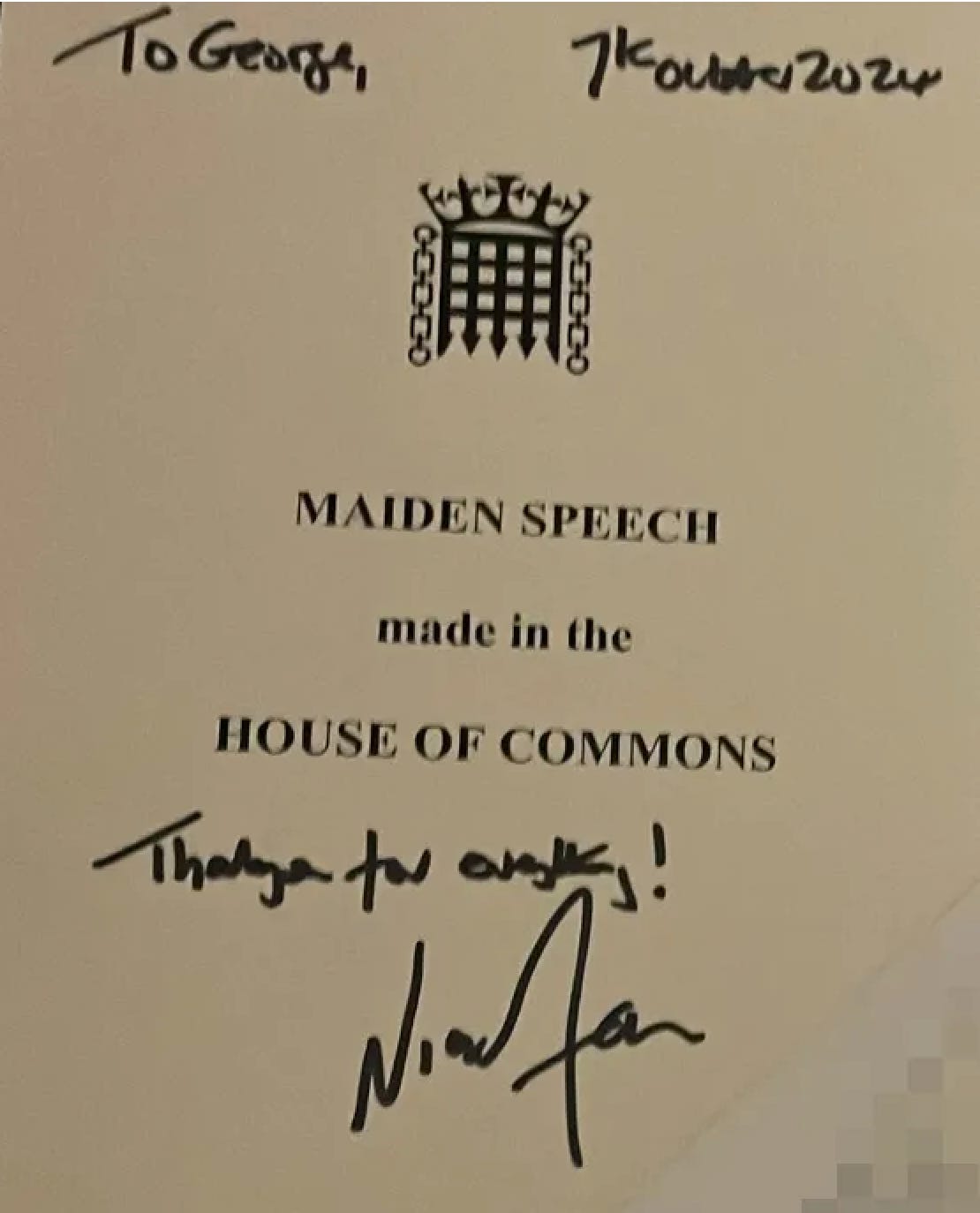
Listen to the full podcast series Posh George: The Criminal Behind Farage.
Israeli Start-Up Seeks to Block Solar Radiation in a Radical Climate Experiment
Ha’aretz

Stardust’s particles. According to the company, each particle is “a million times more effective than greenhouse gases.”
Scott: Can science offer a simple fix to global warming? One thing’s clear: the force of solar radiation beating down on earth is not increasing. It’s been measured. The forces producing the heating are largely man-made are trapped in the atmosphere. An Israeli start says it has a solution, but it has plenty of critics who are skeptical of a quick fix of this sort and who argue that the fix may only intensify the problem.
A small company based in Nes Tziona, in central Israel, believes it has another way. Its ambition is nothing less than to dial Earth’s temperature back to pre-industrial levels through advanced climate engineering. To do that, the company has developed a particle that, if dispersed in the stratosphere in quantities of millions of tons, would reflect most of the incoming solar radiation that hits them back into space – much like a tiny mirror.
The technology is groundbreaking. The promise is enormous. And so are the risks.
If artificial intelligence seems like humanity taking one step too far in its quest to play God, Stardust Solutions pushes the idea even further. On paper, its proposal sounds almost insane. Yet behind it stands a team of respected scientists. The company has already raised $75 million, making it by far the world’s most successful solar geoengineering startup. Investors include the Canadian-Israeli venture capital fund Awz Ventures, whose founders and advisers include former senior officials from Israeli intelligence, the Mossad, Shin Bet security service, and their counterparts at the CIA, FBI and MI5.
The latest Israeli attempt to reshape the world is not on a disputed stretch of land in the Middle East but in the Earth’s atmosphere itself. Depending on whom you ask, the project could help save humanity or push it closer to catastrophe. It is already attracting global attention.
About a month ago, the company published eight papers online describing the project for the first time, generating intense interest. Interview requests have poured into its offices in Nes Tziona from major newspapers and television networks across the world, from Australia and East Asia to North America. Haaretz is the first Israeli media outlet to visit the company’s laboratories for an open, if not always easy to follow, conversation with its three founders.
Saturn’s Iapetus: Painted Moon
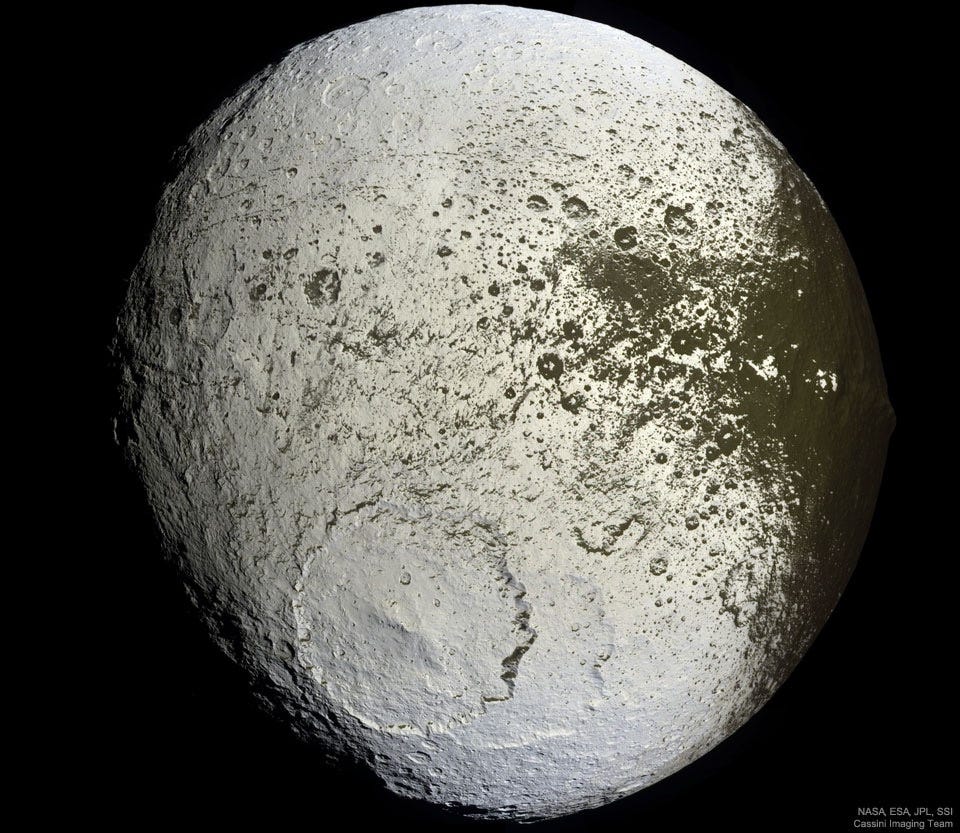
Image Credit: NASA, ESA, JPL, SSI, Cassini Imaging Team
Explanation: What has happened to Saturn’s moon Iapetus? Vast sections of this strange world are dark as coal, while others are as bright as snow. To help better understand this unusually tinted moon, in 2007 NASA directed the robotic Cassini spacecraft then orbiting Saturn to swoop within 2,000 kilometers. Pictured here, from about 75,000 kilometers out, is the hemisphere of Iapetus that is always trailing. A large impact crater seen in the south spans 500 kilometers and appears superposed on an older crater of similar size. The dark material is seen increasingly coating the easternmost part of Iapetus, darkening craters and highlands alike. A leading hypothesis is that the dark material is mostly a form of carbon-rich soil leftover from when relatively warm but dirty ice sublimates. An initial coating of this dark material may have been effectively painted on by the accretion of meteor-liberated debris from other moons.
Your Online Moment of Zen
Percy’s Song
By Bob Dylan
Written and recorded in October 1963 for Bob Dylan’s third album The T imes They Are A-Changin’, but it never made it on to that record.
According to the official Dylan website, Dylan performed the song at Carnegie Hall on October 26, 1963.
That was his first and last public performance of the song.
The first time most people heard it was in 1967 when Joan Baez performed her magical version in Don’t Look Back, while Dylan typed away at his next masterpiece.
It did not appear on an official Dylan album until Biograph came out on November 7, 1985–six days before I interviewed the great man at the old Ritz Carlton on Central Park South.
<iframe width=”560” height=”315” src=”
title=”YouTube video player” frameborder=”0” allow=”accelerometer; autoplay; clipboard-write; encrypted-media; gyroscope; picture-in-picture; web-share” referrerpolicy=”strict-origin-when-cross-origin” allowfullscreen></iframe>
It is one of my 37 all-time Dylan favorites.