



Trump Corruption Watch
What history tells us about Trump’s self-enrichment
Financial Times
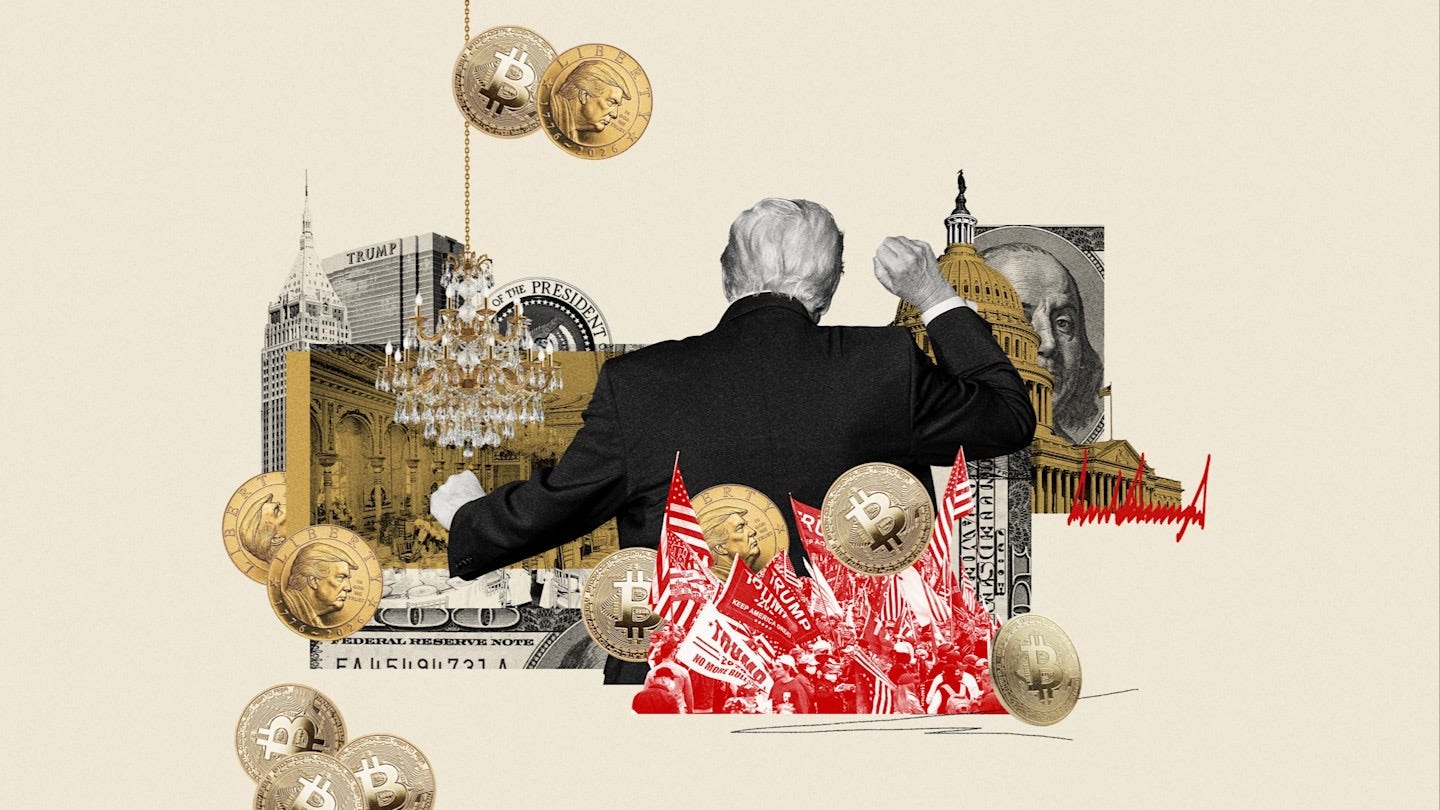
Scott: Trump’s own 2025 financial disclosures make clear beyond doubt that Trump is the premier kleptocrat of his age. His use of public office to enrich himself far surpasses his nearest rivals, like Vladimir Putin, Recep Tayyip Erdoğan or Mobutu Sese Seko. In the FT weekend essay, Princeton professors JC de Swaan and Harold James survey modern history to examine what effects such corruption can have on a previously democratic society and how a resilient democracy responds to it after its disclosure. They do not get into the familiar Roman approach, the passage of a lex damnatio memoriæ, which simply declared all the wealth acquired by the kleptocrat and his family forfeit to the state… which might make the most sense for America today.
Still the most common problem that a kleptocrat presents to a country is the obvious one: the accumulation of ever more wealth and power becomes his reason for being, and the pursuit of the nation’s interests both domestically and on the international stage take a second seat to this. And this we now see in abundance with Trump.
In American history, Trump is a singular figure in many respects. The US tradition has long held its officials to a standard of probity — the self-denying servant of the republic, from George Washington’s resignation of his military commission to Jimmy Carter’s recusal from his peanut business.
Many presidents left office worse off financially than when they entered. Washington set the tone by initially refusing a salary. Thomas Jefferson and James Madison both depleted their own capital to fund state dinners and receptions, Jefferson leaving office in debt. By the mid-20th century, Harry Truman’s near-destitute status in retirement impelled Dwight Eisenhower to create the presidential pension…
The Trump experience has an odd precursor in British history — one that profoundly shaped the thinking of the American republic. Britain had been wracked by the South Sea Bubble, which burst in 1720. The South Sea Company was a political enterprise, a Tory initiative to rival the Whig innovation of the Bank of England, built on bribing parliamentarians with stock. After the collapse its directors were prosecuted and expropriated. The historian Edward Gibbon, grandson of one of them, complained bitterly about his family’s pauperisation.
The South Sea collapse discredited Tory corruption, but what then emerged was a Whig alternative. Robert Walpole built his reputation by warning against the bubble; after the collapse he protected the monarch, George I, and developed a proposal to restructure the company and consolidate government debt. He became Britain’s first de facto prime minister and developed an extensive patronage system alongside a programme of massive self-enrichment.
His family prospered with him: his brother handled money for overseas British military and diplomats; two sons held Exchequer posts. His stately home at Houghton, Norfolk, was crammed with European masterpieces. He covered himself in satin and piled on diamond decorations. He gave spectacular banquets. Walpole defended himself by asserting that corruption was the natural state. In one of his greatest parliamentary performances, when successfully blocking a demand for more frequent elections, he simply noted that “There may be some bribery and corruption in the nation; I am afraid there will always be some.”
His critics — Jonathan Swift, Alexander Pope and John Gay — accused him of debasing public service by amplifying its capacity for personal enrichment. Pope observed that “Nothing is sacred now but villainy.” His political enemy Henry St John, 1st Viscount Bolingbroke, deployed satires depicting a man with a “purse of gold” appearing at Westminster Hall.
Still Walpole’s self-enrichment was at most $200 million in modern money, a tiny fraction of Trump’s…
Will Trump’s corruption become a decisive electoral issue? No easy linkage with living standards can be made at this stage. A questionable gift of a jet from Qatar may influence US treatment of that country, but will not measurably affect American voters’ daily lives. The full impact from freewheeling crypto regulation may not surface for years.
Yet the issue is rising as a priority concern — Navigator Research, a Democratic-aligned pollster, now tracks it as nearly tied with inflation and the cost of living as the top issue across 67 battleground districts. In midterm campaigns, Democrats are converging on a message that ties the affordability issue to alleged presidential corruption. Rahm Emanuel, a prospective 2028 presidential candidate, has described the topic as a “gem” for Democrats to mine. Several Senate candidates have made it a major theme, including Jon Ossoff in Georgia and James Talarico in Texas.
If a financial bubble collapses, then Trump would be as deflated as the stock market. But if the exuberance continues, it will drive prices higher. If inflation persists, the disparity between most Americans’ dwindling purchasing power and the extraordinary wealth being generated by the Trump family and its connected partners is bound to loom larger — a message that could well resonate by election day.
Lindsey Olin Graham 1955-2026:
He Came and He Went?
Charles: The best of Facebook on this very special occasion:
He offered us a paradigm on how sociopathic power deforms a weak personality.
The Ernst Röhm Society issues its most profound condolences at the passing of our friend and honored colleague Senator Lyndsey Graham

The Senator’s Final Visit to Disney World
From Harper’s Magazine:
21 Grahams
From descriptions of Donald Trump, stated between 2015 and 2018
By Lindsey Graham
A race-baiting, xenophobic bigot
The Islamic State’s “man of the year”
The death of the GOP’s relationship with Hispanic voters
A death blow to the GOP’s relationship with women
The world’s biggest jackass
A wrecking ball
A salesman of fear
A politician whose ideas are gibberish
A politician who is incapable of representing a mattress company
A poor representation of a Republican
A president who is unfit for office
A president who sometimes crosses the line
A Twitter user whose tweets are sometimes beneath the office of the presidency
A man who has a blind spot
A thoughtful person
A good person
A strong person
A golfer with an accurate drive and an athletic swing
A president doing a great job
The best hope in decades for peace
A potential recipient of the Nobel Peace Prize
In Venezuela, Trump hones a new form of post-Capitalist Imperialism
New York Times
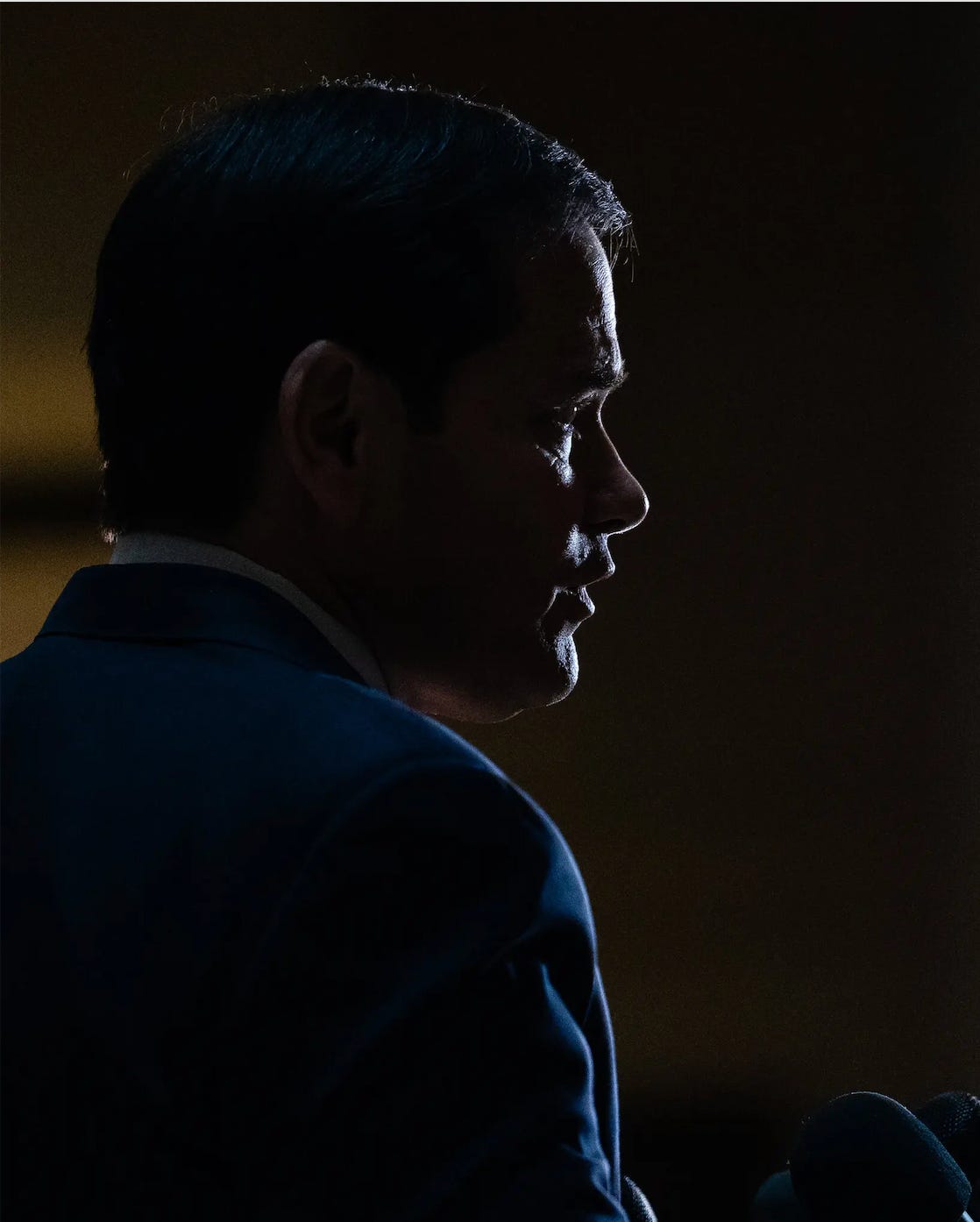
Scott: The Romans had the office of Proconsul. The Medes and the Persians had the Satrap. The Spanish and British empires had Viceroys. Kaiser Wilhelm and Hitler had the Reichsstatthalter. Trump has the Rubio. Each of these describes an arrangement for the administration of a province newly annexed to the Empire, through a personal representative of the Leader under circumstances assuming some continuing self-administration through local government. In an outstanding investigative report, NYT has taken a deep dive into the arrangements that Trump has quietly put into place in Venezuela, with no public discussion or legislative preparation or oversight.
The most alarming thing about the Rubio satrapy has to do with the movement of money. Trump has taken Venezuela’s oil wealth, funneled it through still unknown channels, and passed a pittance of it back to the Venezuelan clique that runs the country in arrangements that look identical to those made by a mob boss who has moved in on a new territory and subordinated its boss to his syndicate.
The constitutional conflict that underlies the modern history of the Anglo-Saxon world relates to the primacy of the legislature in the raising of funds, their lawful appropriation and use. The MAGA Congress under Mike Johnson and John Thune is unlike any of its historical predecessors in its total indifference to its historical rights and prerogatives and its pavlovian subservience to Trump. Here we see Trump doing an end run around the congressional power of the purse and of appropriation, as Congress looks the other way, unwilling to assert itself in any way.
Mr. Rubio could be the next leader of Venezuela, Mr. Trump suggested. And while the president’s aides say he was joking — and that he frequently teases Mr. Rubio about an overseas assignment — the fact is that Mr. Rubio does not need to move to Caracas.
He already runs Venezuela from Washington.
In the six months since U.S. forces blew open Mr. Maduro’s bedroom door and snatched him in the dead of night, Mr. Rubio has become the de facto viceroy of Venezuela, holding sway over a sovereign nation in a way that no American official has since L. Paul Bremer III arrived in Baghdad in 2003 to run U.S.-occupied Iraq.
Mr. Rubio now effectively controls Venezuela’s finances, the distribution of its natural resources and its government, according to interviews with more than a dozen officials and people close to both governments in Washington and Caracas, who provided details about his involvement in steering the country’s policies. Many spoke on condition of anonymity to describe private interactions and internal discussions.
While he has not visited Venezuela in person since the U.S. took over, the secretary of state is deeply involved in the country’s day-to-day operations, keeping in close contact with Delcy Rodríguez, who was Mr. Maduro’s vice president and now leads her country on an acting basis, with the imprimatur of the United States. The two exchange messages in Spanish on WhatsApp, trading gossip, birthday greetings and selfies.
Despite the banter, the relationship between Mr. Rubio and Ms. Rodríguez is far from a partnership. It is a manifestation of Trump-era American power, in which the winner takes all regardless of sovereignty and international law…
The U.S. Treasury receives the revenue from most of Venezuela’s exports, then disburses it to Venezuela through the country’s banking system, a relationship akin to parents handing out allowances to children. Mr. Rubio and his team set the conditions on what that money can be spent on, and by whom.
This system has allowed Mr. Rubio to stop Venezuela’s most egregious corruption schemes. And it brings some benefits to the Venezuelan government, which uses the effective protection of the U.S. Treasury to receive revenues without being hounded by the numerous creditors seeking repayment of billions in unpaid debt.
But the arrangement has also given Mr. Rubio immense leverage over Ms. Rodríguez, who depends on the money to pay workers and prop up the national currency.
He also oversees the application of U.S. sanctions on Venezuela, deciding who gets to do business in the country and how. He has worked to reshape the oil sector and boosted the access of U.S. companies. For her part, Ms. Rodríguez runs important government appointments by him, such as the minister of defense…
Washington’s grip on Venezuela’s economy extends beyond the oil revenues. Mr. Rubio’s team drafts the licenses that provide companies who want to do business in Venezuela with exemptions from sanctions. Mr. Rubio has warned Ms. Rodríguez’s government to abstain from business with U.S. adversaries. Following Mr. Maduro’s downfall, for example, Venezuela’s state oil company has quietly taken over the operations of the oil projects that it co-owns with Russia’s state-run Rosneft. Rosneft did not respond to request for comment.
The Trump administration has also successfully pressured Ms. Rodríguez to turn over Venezuelans who have crossed the Justice Department. At the behest of the United States, Ms. Rodríguez’s government in February detained Alex Saab, the billionaire friend and business partner of Mr. Maduro, and approved his extradition to the United States, after stripping him of his Venezuelan passport.
Another Under-the-Radar Unitary Executive Catastrophe
Charles: The New Yorker’s indispensable Elizabeth Kolbert describes the latest planned destruction of the Federal budget process by Russell Vought, architect of Project 2025, director of the Office of Management and Budget and one of the most vicious and effective members of the Trump administration.
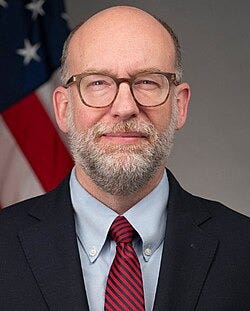
Russell Vought
Every Democrat in the Senate has signed a letter describing it as a “new cudgel” to “advance Trump’s partisan agenda and punish political rivals.” The legal website Lexology said, “The stakes could not be higher.”
Previously controlled by civil servants and peer review panels, the proposal would shift the power over all discretionary federal spending to political appointees of the president.
Senator Patty Murray of Washington said the new policy would “turn the entire federal government into this one big slush fund to reward those aligned with the Administration and punish everyone else.”
Among the proposed rules’ many provisions is one that would prohibit federal money from being used to support collaborations between researchers in the United States and their colleagues in many other countries. “By this guidance, America would not be allowed to be included in the International Space Station,” Colette Delawalla, who founded and heads the group Stand Up for Science, said in an interview. “The same goes for every type of weather monitoring and pandemic monitoring.”
Last year, the Administration terminated or froze nearly eight thousand research grants. Federal judges have ordered many of them to be reinstated; still, roughly a third, totalling some 1.4 billion dollars, have yet to be released, and may be gone for good.
The O.M.B. is aiming to finalize the new regulations by October 1st. …It’s no accident that Vought wants the proposal enacted before the midterms; this would allow the Administration to continue to terrorize grant recipients even if Democrats gain control of Congress a free nd start to exercise real oversight.
H/t Michael Finnegan
