



Spy Sheikh is the Trump Brothers Newest Backer / Big Hope from the Heartland / America Seizes Venezuela’s Oil / ICE Wants Robot Dogs with Guns / Zuckerberg Unbound (as ever)
Emirati Spy Chief Will Fund the Trump Family Bank
Wall Street Journal
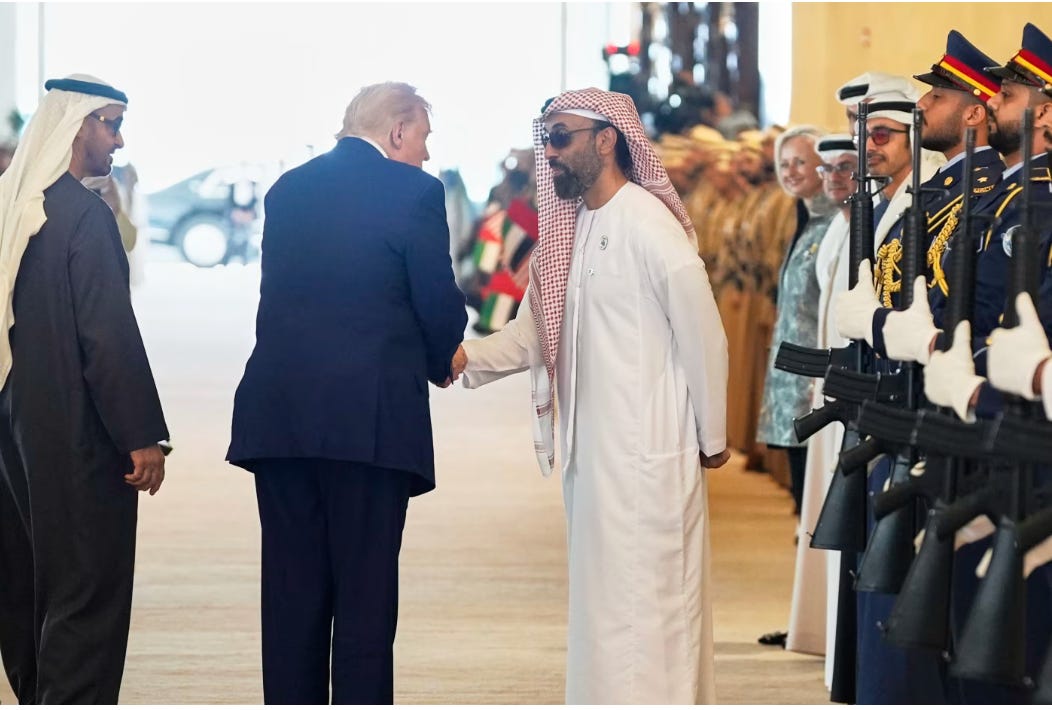
Trump was greeted by Sheikh Tahnoon bin Zayed al Nahyan, the UAE’s Spy Chief, in Abu Dhabi last year. Photo: Alex Brandon/AP
Scott: The emoluments clause of the US Constitution prohibits any person holding an “office of profit or trust under the United States,” such as the president, from accepting any present, emolument, office, or title from any “king, prince, or foreign state” without the consent of Congress. Republican judges have now repeatedly manipulated standing notions to block any attempt to enforce the emoluments clause against Trump. And this is the result: in Trump’s second term, he and his entourage are increasingly brazen and open about taking the money for foreign governments. In this case, Trump has granted his family the charter for a federal bank. And the Trump bros have turned to the notorious Emirati, Sheikh Tahnoon bin Zayed al Nahyan (known as the “spy sheikh”) to finance the venture. According to West Coast FBI agents, Sheikh Tahnoon’s name appeared repeatedly in investigations into Emirati efforts to bribe politicians (largely, but not entirely, Republicans), and it appeared he was running a significant influence operation targeting American politicians. Now this operation has stepped out of the shadows. The Wall Street Journal has the story.
The Abu Dhabi royal sometimes referred to as the “spy sheikh” is a major shareholder backing a new U.S. bank the Trump family’s cryptocurrency venture is preparing to launch, according to people familiar with the matter.
Sheikh Tahnoon bin Zayed al Nahyan and co-investors are behind an entity that owns the largest stake—49%—in the holding company that World Liberty Financial created to house its banking venture, according to people familiar with the matter. The sheikh last year backed a $500 million investment into World Liberty Financial in exchange for a 49% stake in the company, The Wall Street Journal previously reported.
The Office of the Comptroller of the Currency earlier this month granted preliminary conditional approval for World Liberty Financial to launch a federally chartered national trust bank to issue, redeem and safeguard USD1, the dollar-backed stablecoin World Liberty launched last year.
The new venture marks an expansion of the business relationship between the Trump-backed crypto company and a foreign government official. Tahnoon serves as the United Arab Emirates’ national security adviser and is brother to the country’s president. He oversees a more than $1.3 trillion empire funded by his personal fortune and state money.
Stablecoins are pegged to the value of real assets held in a reserve. USD1 now has a market value of $4 billion. World Liberty says the dollars backing USD1 are invested in U.S. Treasurys and other cash equivalents, generating an estimated $150 million a year in interest. Previously, World Liberty issued USD1 through BitGo, a separate trust bank that held the stablecoin’s reserves and kept a portion of the interest.
The more USD1 in circulation, the more revenue World Liberty can generate from its reserves.
World Liberty says it plans for the trust bank to drive “mainstream adoption” of USD1 and to offer new services to clients, such as holding their cryptocurrency for a fee.
After the OCC approval, Chief Executive Zach Witkoff, son of U.S. Middle East envoy Steve Witkoff, said World Liberty’s ambition was “to build the most trusted and widely used digital dollar in the world.”
Hope From The Hinterland
The Guardian
Charles The very best news of the week came in this headline in The Guardian: The datacenter backlash is bringing the entire political spectrum together – against big tech billionaires
For everyone who has been waiting for something that would finally drive the citizenry into the streets because of the blindness, greed, corruption and stupidity of the Tech Bros behind AI, the prairie fire engulfing mega datacenters is the answer to our prayers.
Aaron Regunber is a former Rhode Island state legislator and the current director of the Climate Accountability Project at Public Citizen.
In The Guardian he writes “the movement against datacenters is uniting Americans because they perfectly illustrate how a few individuals hold all the power to control decisions that affect our lives.”
They also prove that oligarchs have terrible judgement.

Bryce Gustafson is the lead organizer with Citizens Action Coalition (CAC), a consumer and environmental organization. Knocking on doors all over Indiana for the last ten years, he’s used to hearing a lot of different reactions to whatever he’s pitching to voters.
Not this time.
He talked to 50 people at a festival in Monrovia, Indiana about a proposed 550-acre Google project proposed for the town of 1,600. None of them wanted it there. “And at least a half a dozen people came up to me to say, ‘Hey, I voted for Trump. What the heck’s he doing, supporting these things?’”
If there’s one thing Gustafson sees uniting Hoosiers of all stripes – from rural areas such as Morgan county to suburbs such as Franklin Township to the historically African American neighborhood of Martindale-Brightwood in Indianapolis – it’s fury over these water-guzzling, air-polluting behemoths and the tech oligarchs imposing them.

The enemy within.
Over the last year, intensifying waves of local opposition to big tech’s datacenter buildout have surged into a nationwide tsunami of resistance…
Today, three-quarters of Americans oppose local datacenter development, a swing of more than 30 points in just a year. More than 500 counties and municipalities have passed datacenter bans or moratoria, while dozens of proposed projects have been killed outright. And the issue has come to define some of the highest-profile political races in the country. In the battle for US Senate in Ohio, populist Democrat Sherrod Brown has made Republican senator Jon Husted’s support of datacenters the centerpiece of his campaign, prompting warnings from the National Republican senatorial committee that “datacenters are the anchor hanging around Husted’s neck”.
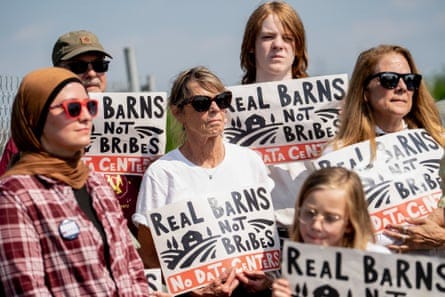
People protest during a news conference near the construction site of ‘The Barn’ datacenter, developed by Related Digital for Oracle and OpenAI, in Saline Township, Michigan, on 30 July 2026. Photograph: Bloomberg/Getty Images
The movement could constitute the best opportunity we’ve had in generations to truly shake up American politics, by redirecting the partisan anger that oligarchic forces have long used to divide regular Americans and channeling that energy instead against the billionaires that are actually the cause of so many of our shared problems.
People are realizing that the left-to-right divide isn’t as important as the divide between the working class and big corporate interests
The datacenters have finally given voters a concrete reason to rise up against authoritarianism.
The political science term for this strategy, coined by Jennifer McCoy and Murat Somer, is “transformative repolarization”. McCoy and Somer argue that opponents of authoritarianism need to redraw the lines of contestation that define their politics – to shift the “us versus them” struggle from, for example, a left-to-right polarization, to a different axis of conflict that can bring a large majority of the public together against real structural threats.
“On many issues, people come in with a baked-in partisan lens that influences their thinking,” said Ben Inskeep, program director at CAC. “On datacenters, we don’t have those firm camps formed. And so we’re seeing broad concern from Republicans, Democrats and everyone else on the political spectrum. We’re seeing folks saying, ‘Hey, I might be a Maga Republican and you might be a liberal yahoo from the big city, but if you’re coming to our community to help us fight this datacenter, you’re my best friend.’”
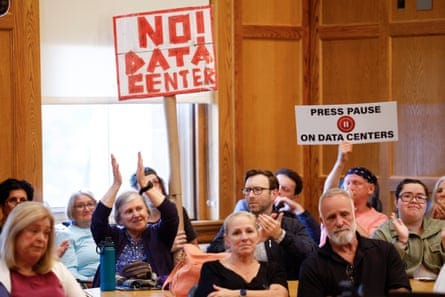
Westfield, Massachusetts, residents applaud as their city council votes in favor of a temporary moratorium on the construction of a datacenter within the city on 6 July 2026. Photograph: Boston Globe/Getty Images
This is an issue powerful enough to give Democrats the Senate.
An organizer I spoke with who’s been opposing datacenter construction in Texas noted a similar dynamic playing out in his state. “I’ve never seen anything that mobilizes this many rural Texans before,” he told me. “Folks are starting to get politicized through this work. They’re realizing when they reach out to their state reps, their state senators, that these people are not batting for them. They’re batting for the tech oligarchs. The electoral implications of this process should be obvious. But for anyone too thick to draw their own conclusions, voters themselves are starting to get quite explicit. When MS Now asked a woman in Hood county, Texas, which is 80% Republican, “you’re willing to forgo every conservative issue and let the Senate fall into the hands of Democrats if that’s what it takes to kill datacenters?”, her response was immediate: “Yep. My entire community’s going to break rank.”
What remains to be seen is whether Democrats will seize this opportunity – or let Republicans regain the initiative.

And all of this is for what? Though the development of datacenters creates temporary construction work, once developed, the facilities do not provide communities with significant long-term jobs. The only thing these sites produce (other than many shades of pollution) is added compute for a technology that we’ve all been told will soon put billions of people out of work. In the meantime, as we wait to see whether that dystopian future materializes or it was all an economy-wrecking bubble, AI is largely being experienced as the thing making the internet more annoying, our jobs more stressful, surveillance more terrifying, and big tech billionaires – already widely despised – more powerful than ever. It’s not hard to understand why this doesn’t constitute a very compelling case for datacenters.
What it does provide is a perfect canvas on which to illustrate the broader problems with our political and economic system: how a few individuals have all the money and power to control the decisions that impact our lives. “Datacenters are the physical manifestation of the greed and the hubris and the power of the AI oligarchs,” Gustafson said. “That gets people thinking about why we are allowing these tech billionaires to just run roughshod over our state.
With Deal in Venezuela, US Government Suddenly Plans to Become a Fossil Fuels Major
Financial Times
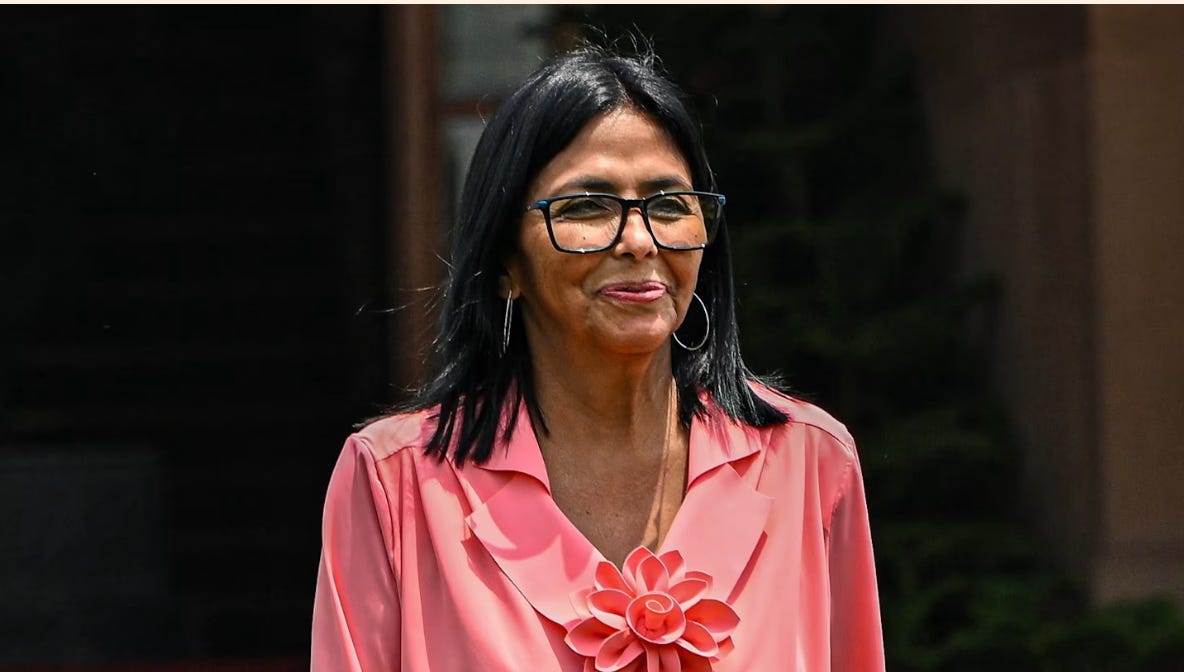
Delcy Rodríguez, Venezuela’s acting president, signed the deal with US secretary of state Marco Rubio and defence secretary Pete Hegseth © Bloomberg
Scott: So what was Trump’s Venezuela gambit all about? At this point it is clear there was no clear plan or design at the outset—it was a spontaneous act done because Trump thought it would play well to the MAGA base. But “taking their oil” was a Trump object from the outset, however vague. Now that goal is taking clear form for the first time, as Trump signs a deal with the Caracas regime for some 63 billion barrels of oil (in reserves), what Trump proudly proclaimed as “THE BIGGEST OIL DEAL IN WORLD HISTORY” on his Truth Social account.
Major US media thus far have been faithful stenographers to the White House, not seriously examining two facets of this deal that demand attention.
First, what does this mean for the US relationship with Venezuela? It reveals that this relationship is very much like that of a major-league crime overlord, the capo di tutti capi, to a subsidiary gang leader. The ultimate capo always gets his cut, and the underboss is obliged to pay it out—unless he can manage a gang war that would take the capo out. This is Trump’s cut from the kleptocrats in Caracas, for the moment at least. Will it withstand scrutiny in legal or diplomatic terms? Of course not. But the Trump/Rubio attitude is simple: who cares.
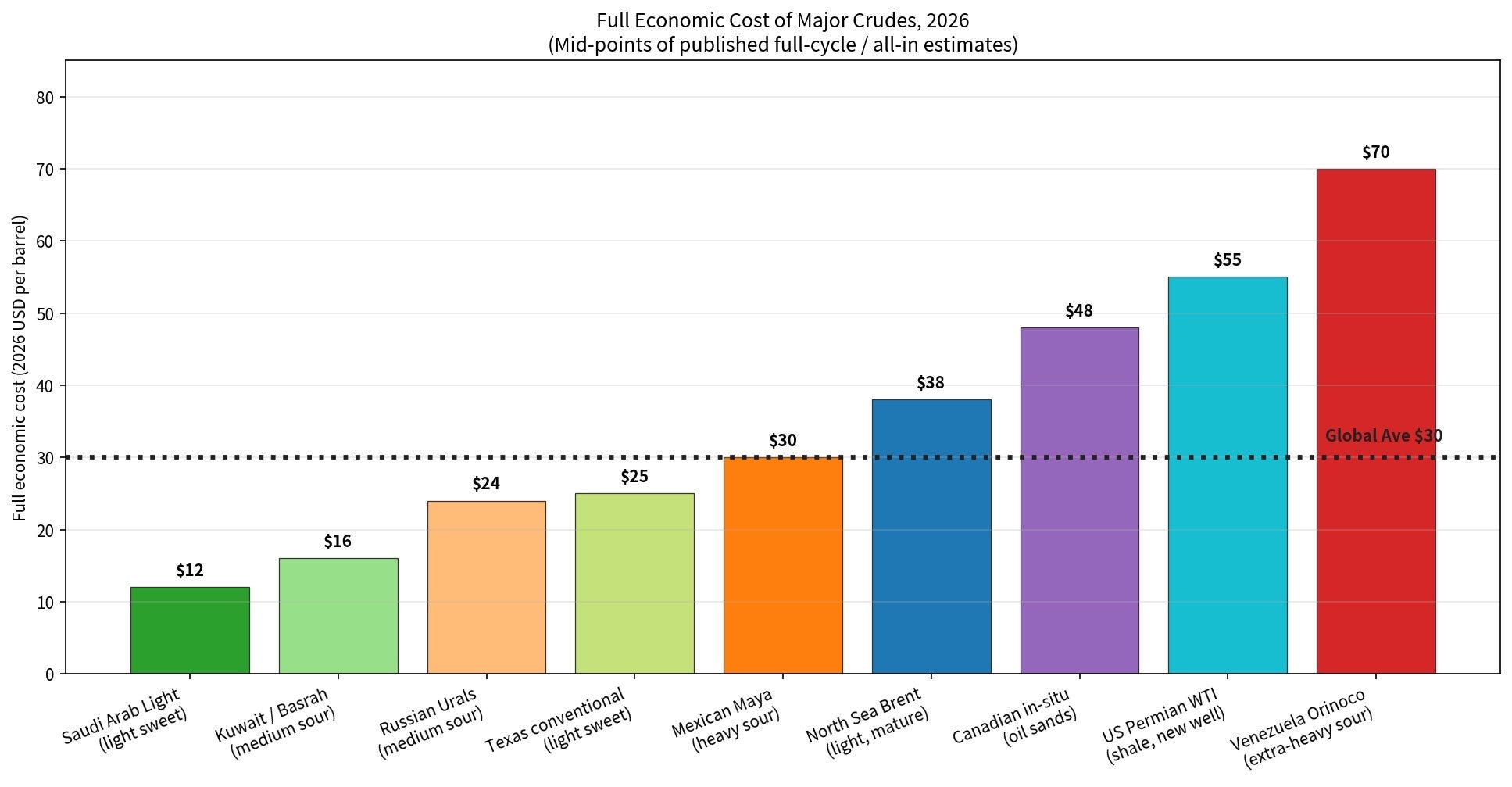
Second, what is the significance of this deal in purely commercial terms? As oil industry mavens know, there is a reason why these oil fields are undeveloped—and that is that they are uniquely undesirable on the global stage. The cost of extraction and refining is huge (see chart below). This is why major fossil fuels industry CEOs said flatly “no” when Trump offered them this deal in the beginning. For Trump, this is all about bravado, not about serious business.
In the back of Trump’s mind, no doubt, is Iran. This is the solution he would want from Iran: take some of their oil reserves. It’s not going to happen, but it does help demonstrate that late 19th century imperialist motives are very much the essence of Trump’s foreign policy.
Donald Trump has said the US has struck a deal to gain majority control of more than 65bn barrels of oil in Venezuela.
The US president described the agreement between US secretary of state Marco Rubio, defence secretary Pete Hegseth and Venezuelan interim president Delcy Rodríguez as “THE BIGGEST OIL DEAL IN WORLD HISTORY!” on Truth Social on Friday night.
“This Historic Transaction MORE THAN DOUBLES American Oil Reserves, greatly increases our Oil Supply, and will substantially lower Gas Prices for all Americans, long into the future, while helping to continue to set Venezuela on a course toward Tremendous Success and Great Prosperity,” Trump said on his social media platform.
“This Transaction will greatly strengthen the already growing relationship between Venezuela and the United States!”
A White House official claimed the US had gained 55 per cent of the “effective output of a new private joint venture that will be the second-largest private oil company by reserves in the world” after Saudi Aramco.
The official said the joint project of the US government and an “experienced private operator in Venezuela” would have 100-year concessions for oilfields totalling 65bn barrels of proven reserves.
Rubio said the deal would bring “nearly $100bn in private investment” to Venezuela and “drive the reconstruction” of its economy.
The announcement of the oil deal comes as the Trump administration faces growing public frustration over rising petrol and diesel prices ahead of November’s midterm elections to decide control of Congress.
The Venezuelan government did not respond to a request for comment.
One source close to the Venezuelan government said “a major agreement has been reached establishing the operational management framework for 17-21 oilfields, which involves a significant investment in drilling rigs to boost oil production”.
In January, the US captured former Venezuelan president Nicolás Maduro and his wife during a night-time military raid in Caracas. They are set to go on trial next year in Manhattan federal court on drug trafficking charges. Former vice-president Rodríguez became interim president after Maduro’s removal.
“This initiative is the result of strengthening relations between Venezuela and the United States, and it will facilitate a significant flow of investment aimed at recovering and reconstructing strategic infrastructure for the development of our hydrocarbons industry,” Rodríguez said.
Since Maduro’s arrest, Washington has lifted sanctions enabling US companies to invest in Venezuela’s oil sector. Venezuelan authorities in January also passed a hydrocarbons law that drastically weakens state oil firm PDVSA and allows private companies to operate wells directly.
The Trump administration has repeatedly said that stabilising Venezuela’s economy is the first part of a three-phase plan for a political transition in the South American country, which has been under revolutionary socialist rule since Hugo Chávez was elected president in 1998.
Oil majors Repsol, Eni and Shell have made agreements with Venezuela’s government this year, while Chevron, which has operated in Venezuela for a century, increased its stakes in its joint ventures with PDVSA in April.
Analysts said many questions remained unanswered about the details of the agreement and warned that any significant boost in production would require billions of dollars of investment and years of development.
