



Trump’s War of the Week On Canada / Data Centers Galvanize The Midterms / Jeffries’ Insane Meeting with Kushner / Trump’s Plans For a Fake Emergency / Mariam Abu Dagga is the 274th Journalist Murdered in Israel
Trump’s War With Canada
Financial Times
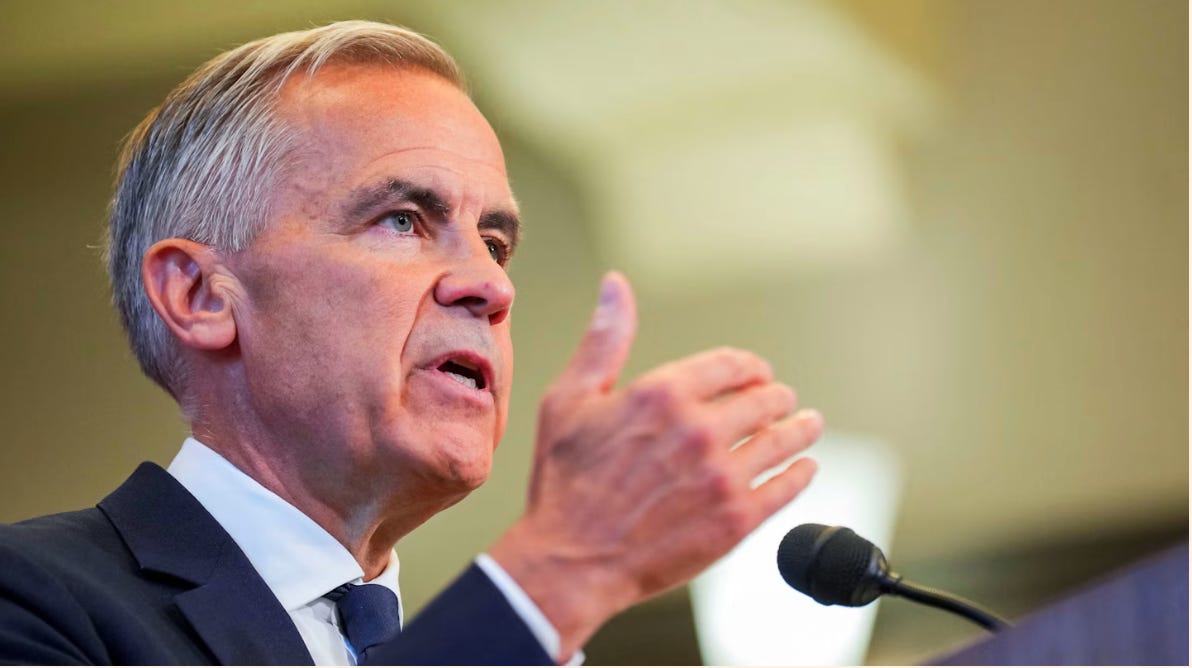
Canadian Prime Minister Mark Carney speaks after withdrawing negotiators from trade talks with US © Reuters
Scott: America invaded Canada twice with the objective of conquest and absorption: the first time was in 1775, the second during the War of 1812. Both invasions ended in abject failure for the American forces, which is why they are carefully excised from high school history texts in the United States. Most Americans react with a blank expression when told of them.
The third US effort to subjugate Canada is underway now, and the US media is remarkably reticent to report on it, seeking to mischaracterize everything that is going on as some sort of petty disagreement about tariffs.
Not so in Canada, nor indeed the balance of the planet. “We cannot accept what they’ve offered and we will not give what they’ve asked” says Prime Minister Mark Carney in remarkably lucid and compelling remarks delivered to his fellow countrymen. “We are at war,” he concluded.
A detached review of the course of the talks with Trump’s representatives underscores Carney’s take. After months of professional back-and-forth on conventional trade issues, an agreement seemed at hand. Then Trump introduced an entirely new set of points to the negotiations which had the cumulative effect of gutting Canada’s sovereignty as a nation and reducing it to the status of a de facto dependency of the United States. No Canadian leader could ever accept such dictated terms, and Carney did not. He appears to have a historically united Canada at his back, a country that fully recognizes the gravity of the threat that Trump and his regime present.
Canada was “at war” over trade with the US after President Donald Trump “miscalculated” by escalating his tariff attack, Prime Minister Mark Carney said.
Carney delivered a defiant address to the nation on Saturday after suspending trade talks with the US overnight, saying the Trump administration had demanded a “bad deal”.
The collapse of talks ushers in a new wave of tariffs on $20bn-worth of Canadian exports on top of existing levies on steel, aluminium, lumber and vehicles.
“You’re at war when you’re attacked, and we got attacked,” Carney told reporters in Ottawa.
Trump underestimated Canada’s resolve to stomach economic hardship in a “miscalculation” that escalated the trade war, he said.
“We cannot accept what they’ve offered and we will not give what they’ve asked,” he added.
Carney said last-minute changes proposed by the US were unacceptable. Ottawa had made no new demands and was “continually disappointed” by US answers to the issues Canadian officials raised as a midnight deadline loomed, he added.
Trump posted on his social network, Truth Social, overnight: “Canada wants the benefits of being a State, without being one!!! They have also charged our great farmers, for many years, massive amounts of Tariffs. No more!!!”...
Carney said Ottawa was willing to lift retaliatory tariffs on strategic sectors, particularly steel and aluminium, if the US “substantially lowered” theirs on Canadian companies. “In exchange for a fair deal, we would encourage our provinces to return US alcohol to the shelves,” he said.
But despite “progress made towards a possible agreement” this week, the US suddenly changed its position, he said. “They asked too much and they offered too little,” he said. “It’s a power play.”
Carney listed numerous concessions Canada made to satisfy the evolving list of US complaints, from issues concerning the fentanyl drug trade to anti-tariff advertisements that had attracted the US president’s ire.
Canada had acted “in good faith to try to find compromise and secure a comprehensive deal in the best interests of both Canadians and Americans”, he said.
Carney said there was “no rationale” for new US demands on the auto industry, adding that they “would make production more uneconomic over time”.
At the eleventh hour, the US also introduced measures to restrict Canada’s ability to seal trade deals with other nations, he said. The US was seeking “exclusive access” to Canada’s critical minerals, which was a new red line, Carney said.
The US had also raised new concerns over perceived trade barriers due to language provisions in French-speaking Quebec, he said.
Carney suggested that tensions among US negotiators fuelled the talks’ breakdown. While Greer led Washington’s side of negotiations, car, aluminium and steel levies also brought the talks under commerce secretary Howard Lutnick’s purview.
Data Centers Are The Hot Issue For The Midterms
New York Times
Charles: The bipartisan uproar against data centers across the country is one of the most encouraging developments of 2026, with 71 percent of Americans telling the Gallup poll they are opposed to their local construction. While Wall Street tycoons debate AI’s future at East Hampton confabs without ever mentioning its environmental impact, ordinary citizens are fiercely aware of what its rollout is already doing to the water supply and electricity grids.
As the Financial Times reported earlier this year, researchers at the Lawrence Berkeley Laboratory forecast that so-called hyperscaler data centres will consume anywhere between 60bn and 124bn litres (16bn and 33bn gallons) of water on-site each year in 2028. This figure excludes the indirect water use tied to electricity generation, which the lab previously forecast could be as much as 12 times higher than direct consumption.
Last year American electric rates went up by 6 percent, and in states that are already heavy with data centers like Pennsylvania and Virginia, bills rose by 19 and 10 percent.
Of the roughly 100GW of additional electricity capacity that the US is projected to need at peak times by 2030, roughly half will be used by data centres, according to the Department of Energy.
The Lincoln Institute of Land Policy says the newer, AI-focused “hyperscale” data center can use as much power as 100,000 homes or more. Meta’s Hyperion data center in Louisiana, will use more than twice the power of the entire city of New Orleans.
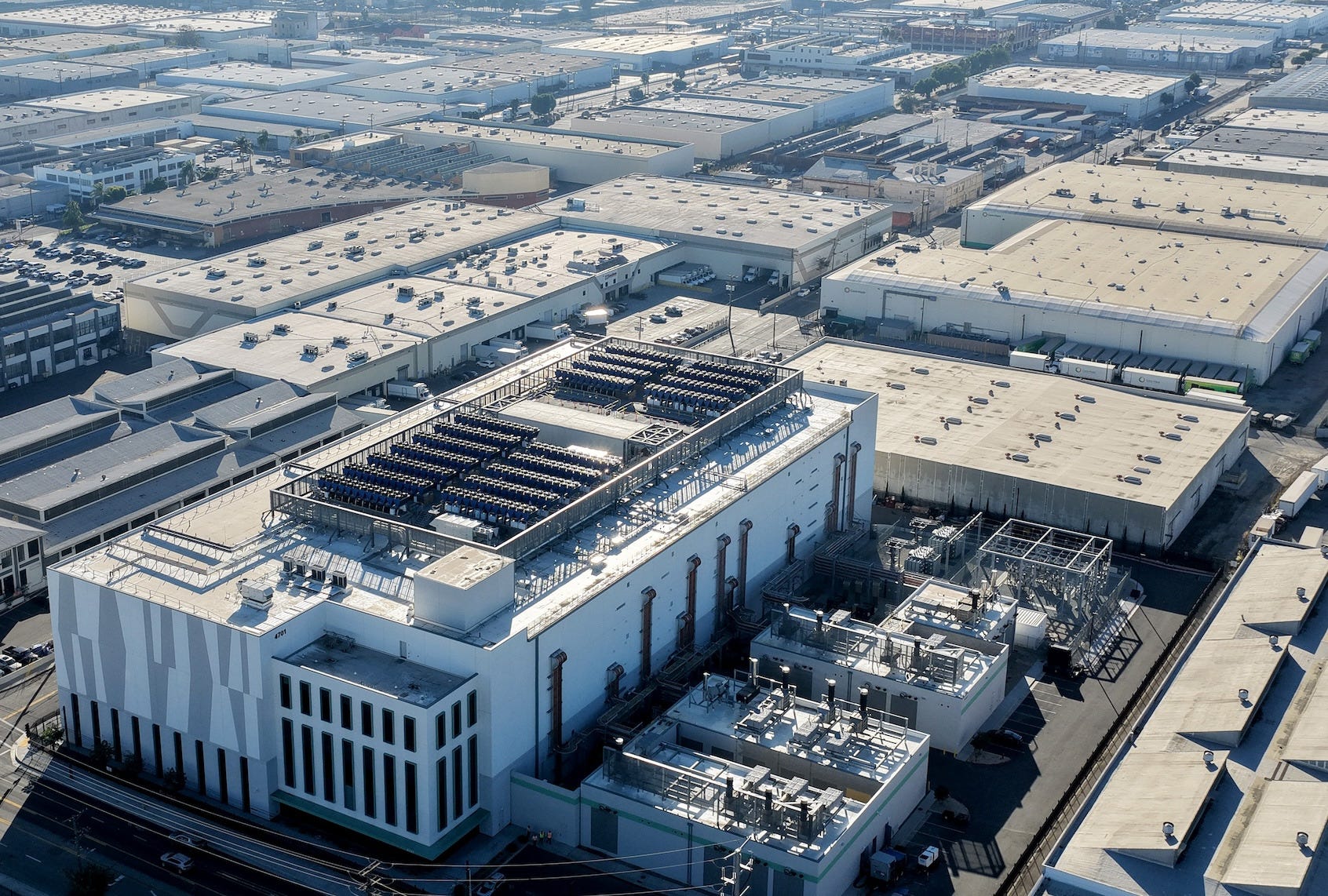
In The New York Times, political reporter Shane Goldmacher hinted at the potential impact of these statistics without ever mentioning any of them. He writes the “fight over data centers is suddenly at the epicenter of the midterm elections” and experts call it “an unusually fast-moving force that is already reshaping races for the House, the Senate and governor’s mansions.”
Goldmacher says “Democrats have chiefly been the ones racing to harness voter anger about data centers,” and then spends most of the rest of the article contradicting that, by citing Republicans who have jumped on the anit-data center bandwagon:
Some Republicans are now using “data center” as an epithet, and casting themselves as the real opponents of corporate tax breaks and unfettered construction. Last week, Mike Rogers, the Republican running for Senate in the key swing state of Michigan, said that he supports a one-year moratorium on data center construction.
On Wednesday, a remarkable memo from the National Republican Senatorial Committee warned that data center politics was endangering Senator Jon Husted of Ohio, a Republican. His challenger, Sherrod Brown, the state’s former Democratic senator, has aired millions of dollars of ads, calling Mr. Husted “the face of data centers in Ohio.”
“More than any other thing in this race, data centers are the anchor hanging around Husted’s neck.
Zac McCrary, a Democratic pollster, said that opposing data centers offered Democrats a rare chance to make inroads in rural areas and small towns that are resisting the developments.
“It absolutely shakes up the snow globe on the partisan coalitions in a part of the world where Republicans have been dominant,” he said. “It’s one of the few issues today that does not immediately code as red or blue, left or right.”
In Florida, Representative Byron Donalds, the Republican nominee for governor, spent more than $2 million on one ad in his primary, vowing to “protect” the state from data centers that “jack up utility rates.”
In Michigan, William Lawrence, a progressive activist, rode an anti-data center message to win the Democratic nomination in a key Michigan House seat this month and then immediately made a general election ad targeting Representative Tom Barrett, the Republican incumbent, on the issue.
The next day Mr. Barrett began airing a new data center ad of his own, in which he claimed that “I stood up to my own party and voted against giving your tax dollars to data centers.”
In an interview, Mr. Lawrence, who supports a moratorium, called the ad “outrageous” and said voters would not be satisfied with half measures. Data center opposition, he said, was “number one in terms of intensity” in the district.
Even Texas Governor Greg Abbott has been dampening his own enthusiasm for data centers, after bragging that Google’s $40 billion investment in his state made Texas “the epicenter of A.I. development,” bringing both construction jobs and tax revenues.
But this summer he announced new standards for data centers on water use and electricity and called to end some tax incentives. Earlier this month he directed the state’s utility commission to audit all data centers seeking permits before they could move forward.
With his usual perspicacity, Goldmacher finally uses a quote from Michigan Democratic Congressional candidate William Lawrence, which actually describes the breadth and depth of the opposition to these centers–in the final graph of his story:
“It’s bringing together three-time Trump voters, anti-vaxxers, environmentalists, independents, nonvoters, people who are in our cities, people who are in the rural areas. And it’s bringing together all these people because none of us trust big tech to do right by our communities.”
Inside the Jeffries-Kushner Summit
New York Times
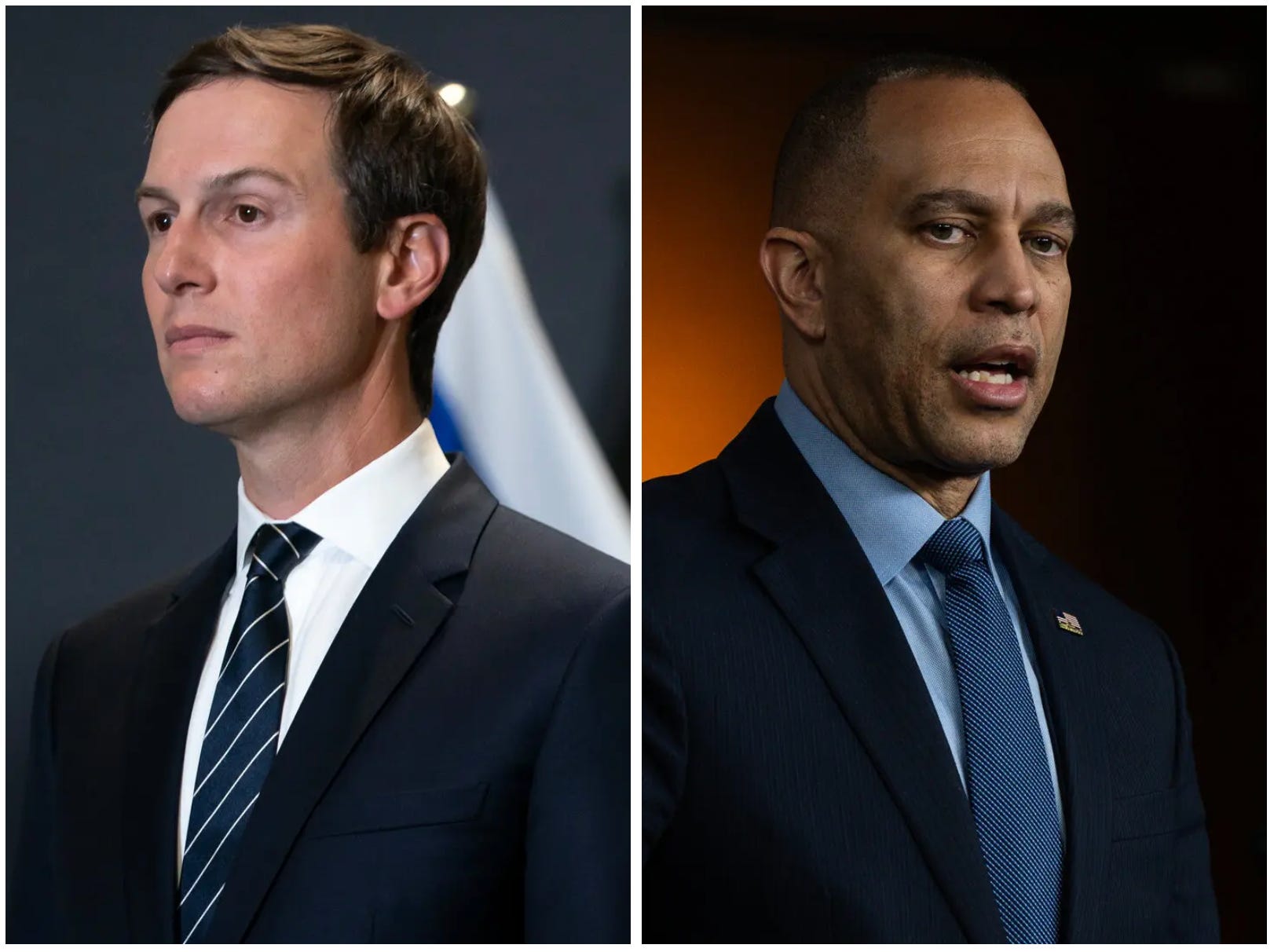
Scott: By holding a secret summit with Jared Kushner in a “quest for common ground,” Democratic House leader Hakeem Jeffries has provided the most dramatic demonstration yet of his poor judgment. Democrats will now need to scramble to find a new leader in the House.
Representative Hakeem Jeffries, Democrat of New York and the minority leader, met privately in recent weeks with Jared Kushner, President Trump’s son-in-law and top outside adviser, and discussed potential areas of common ground, according to five people with knowledge of the meeting.
The rare engagement was held in a private space in New York City, offered up by a mutual friend of the two men, according to two people with knowledge of the meeting and a third who was briefed on it. They and others were granted anonymity to discuss a meeting about which they were not authorized to speak publicly.
Through aides, neither man would comment on the session, which was described by one person with knowledge of it as a broad conversation on a range of topics. Still, its timing underscored that those around Mr. Trump were well aware of the likelihood of a Democratic-led House, and trying to foster as much of a working relationship as possible before any change. Mr. Jeffries is in line to be the speaker, were Democrats to win the majority.
Assuming, as the political world now does, a Democratic House of Representatives following the November midterms, the first order of business for the new Congress is likely to be investigative work focusing on unprecedented corruption in the Trump administration—which the Financial Times has labelled the most extreme kleptocracy in modern human history. Exhibit A for this corruption is Jared Kushner, the president’s son in law, who has taken some $2.2 billion in Saudi money and serves as their advisor while ostensibly representing Trump in sensitive negotiations across the Middle East. He has wielded his ostensible authority on behalf of Trump to raise billions more in funds for his investment services and his real estate empire. The act of “reaching out” to him for friendly discussions was an amateurish demonstration of Jeffries’ complete lack of seriousness as a political leader. It would be unforgivable for a political novice. It’s disqualifying for a supposed party leader.
