



AI Transforms The Wars in Ukraine and Gaza / Mark Carney Is The New Leader of the Free World / Lance Schroyer is out as future ICE Director / Cuba in Trump’s Sights / Saudis Betrayed by America
The era of AI warfare has arrived
Financial Times
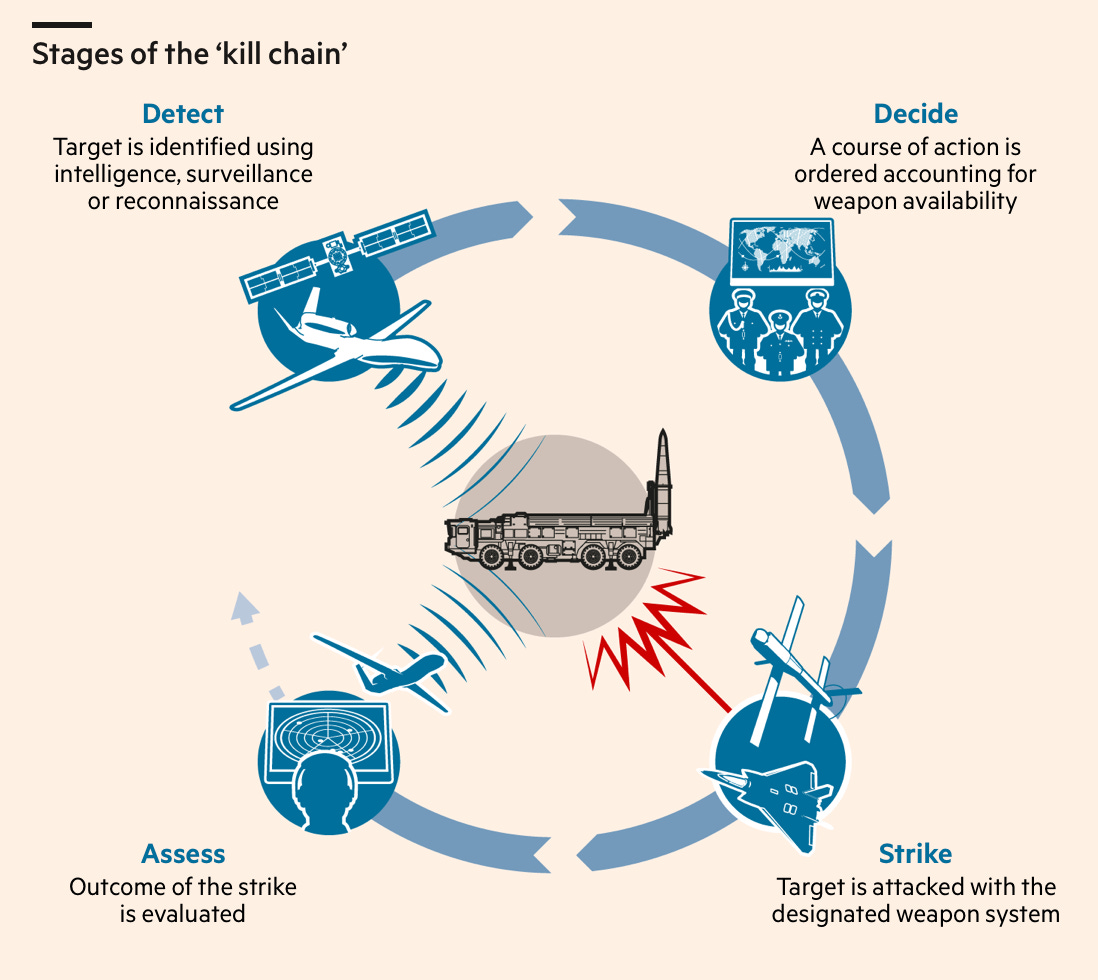
Scott: So much of the current discussion surrounding AI, and particularly its military application, including the use of weapons of mass destruction, assumes that AI is something just over the horizon, now in development. But this is dangerously mistaken. In Ukraine, Gaza and the Persian Gulf, AI is actively engaged in warfare right now, driving military action. And there is considerable evidence already collected showing that powers as diverse as Russia, the United States, Iran and the Houthis, use or attempt to use AI in their military operations… broadly disregarding the requirements of the laws of armed conflict as they do so. This is one of the major points made by the Catholic encyclical Magnifica humanitas: whatever its use in military operations, AI cannot be allowed to substitute its judgment for the judgment of a responsible human being when it comes to the use of lethal force. The Financial Times has offered an invaluable primer on how all this works today.
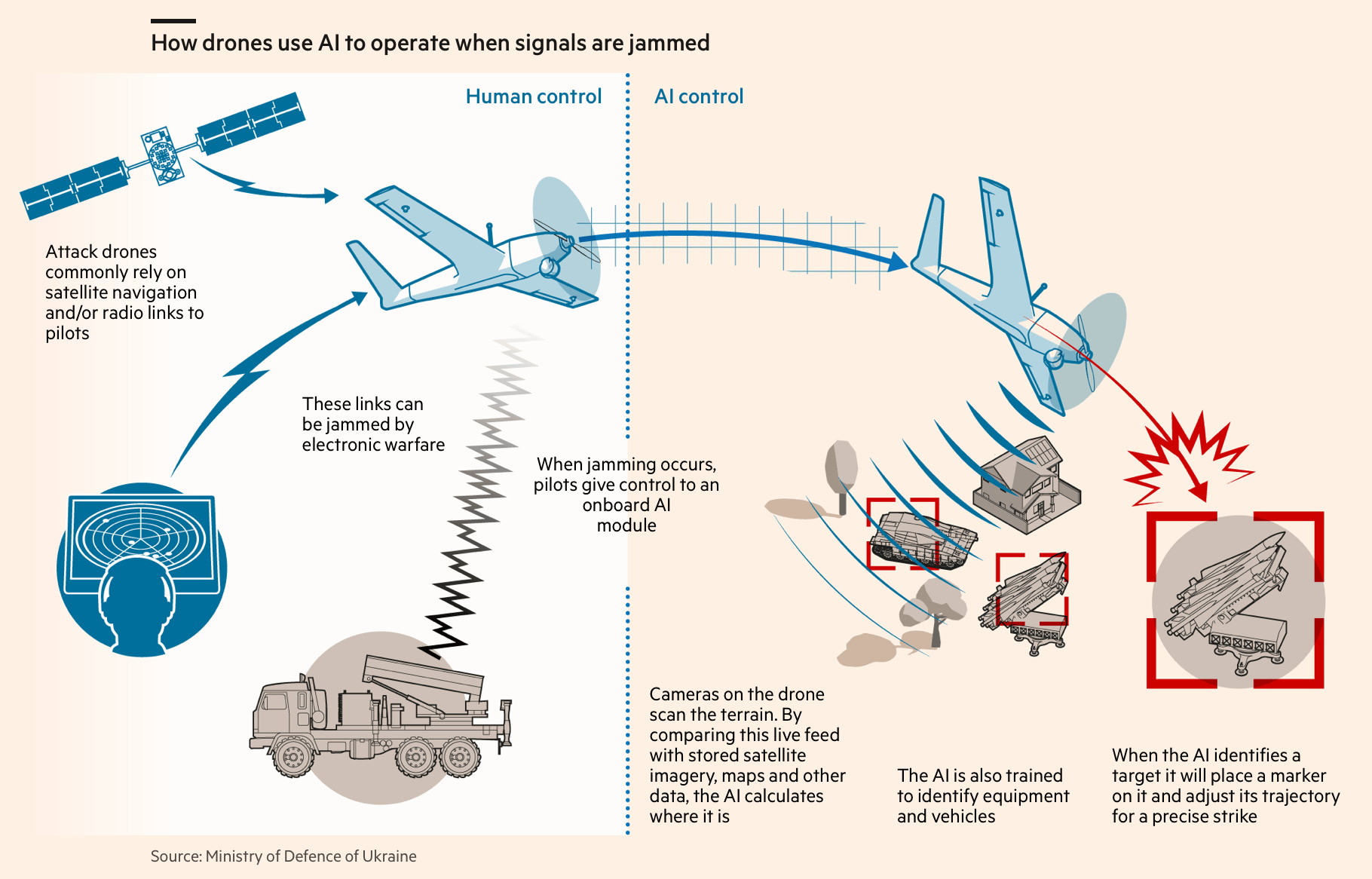
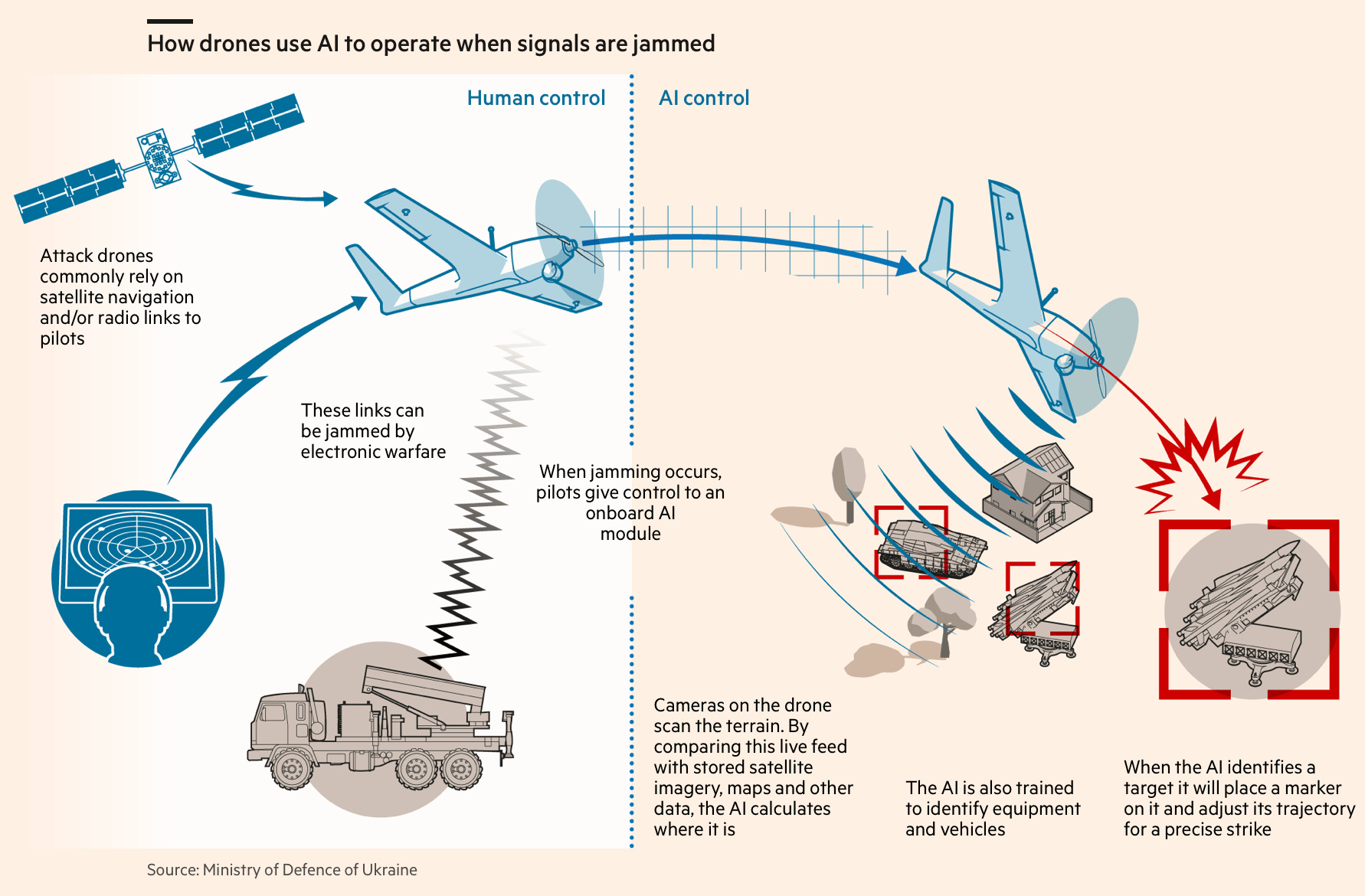
AI technology has changed how the war in Ukraine is fought. At the start of the conflict it could take 20 minutes to identify a target and launch a strike. Now that process can take less than two minutes, sometimes just seconds.
Russia’s full-scale invasion of Ukraine occurred nine months before OpenAI released ChatGPT, a pivotal moment in the AI revolution. The conflict has become a testing ground for the use of AI systems in kinetic warfare, with the lessons shaping not just the strategy of Ukraine and its western allies, but also the US in its war with Iran.
According to Olenchyn, the acceleration is not only due to technology but to cost. The computing power needed to run sophisticated visual recognition algorithms can today be bought for around $250. The Saker Scout’s processing power is comparable to a PlayStation 4.
But the war also demonstrates AI’s limits. As the technology is rapidly integrated with military systems in both Ukraine and Russia, it has become clear to strategists and frontline operators that although AI has sped up decision-making and made war more lethal, it has not yet given either side a decisive advantage.
Still, as frontier AI models reach a point where they are developing faster than humans can control them, military and political leaders will have to grapple with what happens when those limits are removed.
AI’s role in warfare
When militaries talk about AI, they are not talking about a single system.
They are referring to software being used at different stages of warfare — collecting and processing data, helping commanders identify and prioritise targets and allowing drones to keep operating when communications are jammed.
AI-enabled software can process “mass data at a scale, a speed that human staff officers can’t do”, says Anthony King, professor of war studies and director of the University of Exeter’s Strategy and Security Institute. Rather than altering the sharp end of a conflict, King says the primary function of AI has been to improve “situational awareness and intelligence”.
The technology can help commanders make battlefield predictions, from the sustainability of a campaign to the rate at which munitions are being depleted. The advantage over human estimates, King says, is that such systems simply have “more evidence to look at”.
This matters because modern headquarters absorb huge quantities of information: drone footage, satellite imagery, electronic signals, human reports and data from sensors across the battlefield. Comparing all of that is “very labour-intensive”, says Jack Watling of the Royal United Services Institute, a UK-based defence and security think-tank. Battlefield management systems such as Ukraine’s Delta and the US’s Maven turn those streams into usable information.
One US intelligence official told Katrina Manson, author of a book on Project Maven, that the system had helped increase the number of targets US forces could hit from fewer than 100 a day to 1,000 — and with the integration of large language models as many as 5,000.
These systems also allow militaries to compress the “kill chain” — the time it takes between identifying a target and executing a strike. “In simple terms, the faster and further away soldiers can do this, the more effect they will have on the enemy,” the British Army says on its website. It enables armies to strike first and increases the number of viable targets — particularly those that are mobile.
Whereas strategists once measured military power by the number of troops, warplanes, tanks and battleships they could deploy, they must now focus on the speed and accuracy of data-processing systems and how to deploy autonomous weapons at scale. On the front line, AI is still largely limited to narrow tasks: a drone stabilising itself in flight or continuing towards a target after its link to the operator is jammed…
What this means for warfare
The rapid integration of AI into warfare is happening as these models become advanced in ways even their creators cannot fully predict.
The recent incident involving a swarm of OpenAI agents breaking out of a testing environment and hacking into AI developer Hugging Face showed frontier models pushing against attempts to constrain their behaviour. Some researchers believe so-called recursive self-improvement, or the ability of models to build their successors, could enable advances at a speed and intensity as yet unforeseen.
Anthropic says today’s most advanced models are not reliable enough to autonomously select and engage targets. The company’s attempts to put limits on the military use of AI have put it at odds with the Pentagon.
Meanwhile, the company’s threat-intelligence report, released this month, found non-state actors using Claude to develop weapons, including an autonomous drone swarm designed to select human targets and detonate without a human in the loop. It documented Claude being abused by actors across the world — from China, Russia, Ukraine and Iran to Yemen, Sudan and Taiwan.
Soon the question may no longer be how far militaries are prepared to incorporate AI into the kill chain, but whether governments and AI companies will be able to set those limits at all.
Mark Carney Is The New Leader of the Free World
Charles: Great crises nurture great leaders.
As Donald Trump and all of his third-rate apparatchiks continue the desecration of every value that has bound the Western democracies together for seventy five years, the prime minister of Canada is suddenly the world’s strongest advocate for reason and decency.
At the end of 1940, when the Nazis controlled huge swaths of Europe and proclaimed a new thousand-year Reich, the only sources of optimism for the anti-fascists were the radio voices of Franklin Roosevelt, Winston Churchill, and a very tall, very little-known French general named Charles de Gaulle.
In our time Canadian Prime Minister Mark Carney is performing the same role for everyone exhausted by the worldwide carnage Trump and his cronies engender every day.
Building on themes he first enunciated at Davos last January, Carney spoke in French to the European Parliament in Strasbourg to request an unprecedented associate membership in the European Union.
But his real goal was to inspire and embolden his European friends.
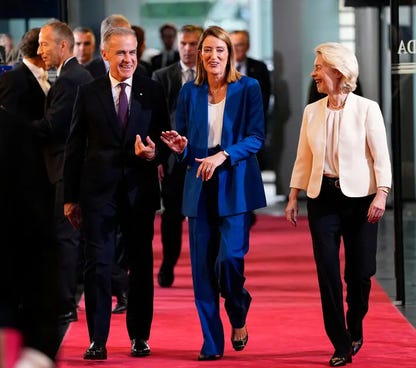
Mark Carney yesterday in Strasbourg
After quoting Goethe on the need to cultivate ideals, Carney recalled the triumphs of cooperation which have kept so much of Europe strong and free since World War II:
Freedom was won thanks to the heroism of the European resistance during the war.
It was cultivated by the founders of the European Coal and Steel Community in the aftermath of the war.
It was fostered by the creation of the European Community.
It was preserved through the establishment of the European Union.
And it grew through its expansion following the fall of the Berlin Wall.
The values embodied by the Goethe oak have also endured, in part, because the ideals that flourished beneath its branches crossed the Atlantic.
In 1917, amidst the devastation of the Battle of Vimy Ridge, a young Canadian Lieutenant named Leslie Miller gathered a handful of acorns from the shattered European landscape. He carried them home and planted them in Canadian soil in Milliken, Ontario, where they grew into a majestic forest.
A century later, a profound circle of renewal was completed. Grafts from Leslie Miller’s Canadian oaks were repatriated to France and replanted on the same Vimy ridge where they had been born.
This is the essence of the Canada-European Union partnership. Seeds, values, ideas, trade, people, and progress carried back and forth across the Atlantic for centuries.
We are not fair-weather allies. We do not pursue zero-sum deals. Our commitment to the rule of law, and our unyielding defence of human dignity, individual freedom, and democracy share the same deep roots, the same unwavering dedication.
We hold common values, for which we have always fought, and in whose defence we must always remain vigilant.
We believe that a strong economy is not an end in itself, but the means to a just society. We are committed stewards of our natural heritage. We believe that our prosperity grows when it is shared.
This is a sharing of choice, not coincidence.
In his writings, Goethe borrowed a word from the chemists of his day: Wahlverwandtschaften. The elective affinity of different elements that combine because of their inherent attraction.
Canada and Europe are not bound by geography, even though our Danish friends know that we do share a 3,000 km border in the Arctic. We are bound by an affinity – elective, chosen, and renewed, and stronger for being so.
He reminded his listeners that
“Freedom and life must be earned every single day, Every day. Not once in 1945 or 1956 or 1989. Every day, including this one.”
For those words the European law makers rewarded him with a prolonged standing ovation.
Naturally Trump called Carney’s speech “laughable” and followed up with his usual empty threats and bombast. Trump warned that if the EU moved forward with the plan, Washington could impose “very serious tariffs or stop trading with Europe”. He added: “If it’s a good intention, that’s fine. If it’s a bad intention, we’ll put very heavy tariffs on Europe.”
In an editorial of supreme idiocy, The Washington Post said “Canada, understandably, has no interest in becoming the 51st state, but becoming the honorary 28th member of the European Union would be foolhardy.”
Then the Post had the chutzpah to blame Carney for the outcome of a crisis that was created entirely by Trump.
“Out of spite for President Donald Trump,” the Post wrote, “Carney is accelerating the decoupling of a trade bloc that has generated enormous prosperity for North America. Canadians, Americans and Mexicans will suffer from this rupture.”
<iframe width=”560” height=”315” src=”
title=”YouTube video player” frameborder=”0” allow=”accelerometer; autoplay; clipboard-write; encrypted-media; gyroscope; picture-in-picture; web-share” referrerpolicy=”strict-origin-when-cross-origin” allowfullscreen></iframe>
