



Are There Enough Sensible Israelis To Collaborate with the Sensible Arabs? / El-Sayed Gets AI / For Hegseth It’s Also All About The Grift / Trump Rescues Bolsonaro / Judy Barnett Knows the Road To Your Heart
Can the Israeli Opposition Form an Alliance with the Arab Block?
Ha’aretz
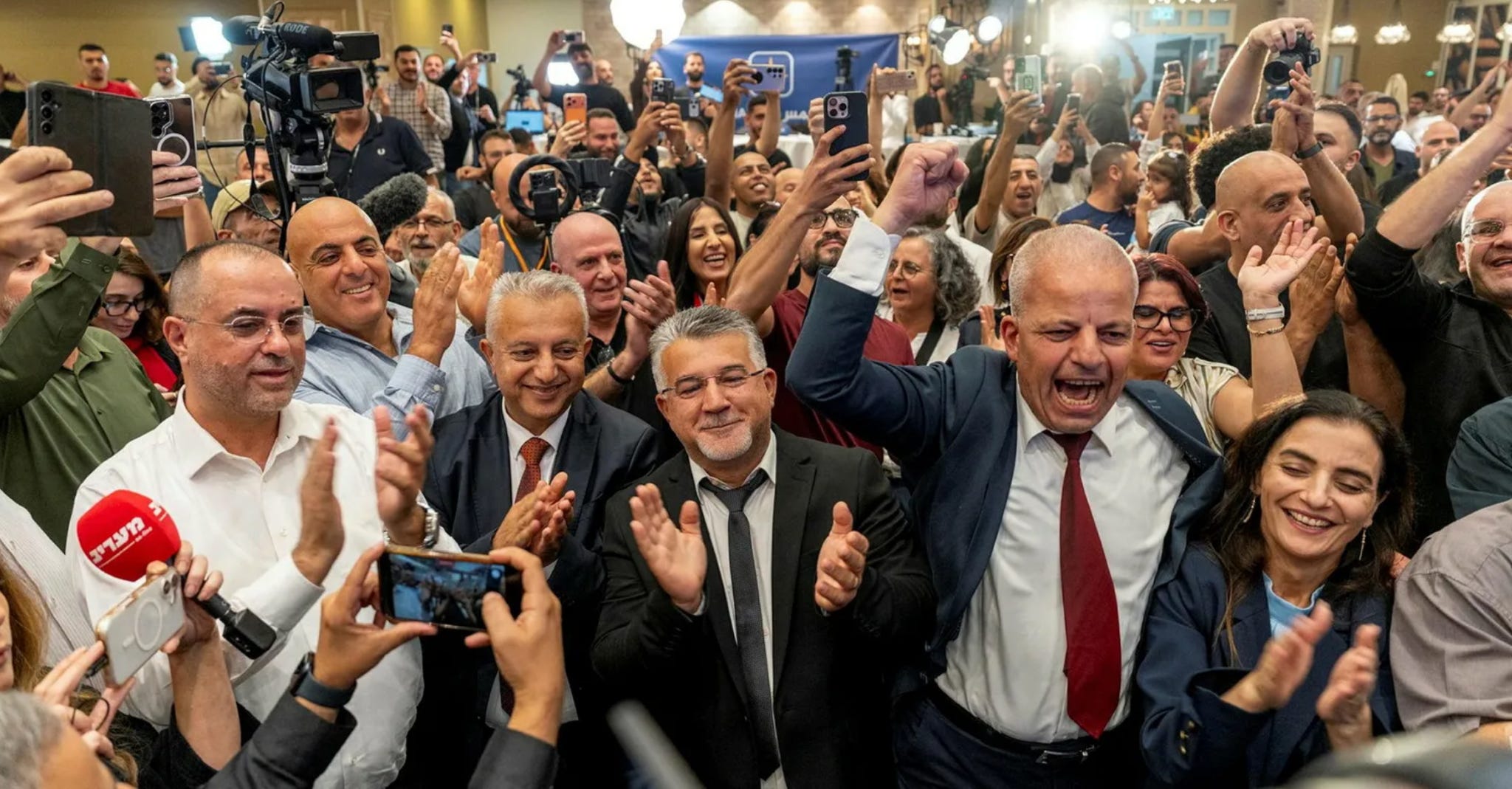
The clear winners in the Israeli elections were the Arab-majority Joint List. Here they react to the exit polls at the party headquarters in Nazareth, northern Israel, on Tuesday. Credit: Daniel Rolider
Scott: The Israeli elections failed to bury Benjamin Netanyahu, and indeed, the conventional wisdom is he will continue on as a caretaker while the process of forming a new government stretches into months. However, Ha’aretz notes there is one way of avoiding this terrible, war-prone interregnum, and that is for Eisenkot’s group to form a compact to govern with the real winners of the election—the majority Arab Joint List, whose voting ranks were swelled by Israeli Jews sick of Netanyahu’s racist bigotry. Whether this can be achieved or not is essentially a test of how deeply the poison of racism has seeped into Israel’s body politick.
After counting most of the ballots, excluding absentee votes, it appears the opposition stands at about 67 Knesset seats in total, of which about 19 are for the Arab parties and about 48 for the Eisenkot bloc.
The coalition, however, currently has about 53 Knesset seats. So while Likud is the largest party with about 26 Knesset seats, the majority of the Israeli public clearly voted against the current government led by Prime Minister Benjamin Netanyahu. This government has lost substantial support since the last round of elections.
The figures clearly point to an unprecedented achievement by the Arab community, which voted en masse for political partnership with Jews. Despite the challenges and reservations about voting, and amidst a particularly racist incitement campaign, a record 19 Knesset seats loudly and clearly declare: We are an inseparable part of this country.
It wasn’t just the Arab voters who made an unprecedented effort. Their political leaders ran a calculated and disciplined campaign and were unafraid to explicitly state that they saw themselves as part of the fight, whether by joining a government or by backing it with an obstructing voting bloc or safety net.
The response to this rising political agency was seen in Likud’s reaction on Election Day, when it falsely claimed that “the elections in the State of Israel were stolen by Arab parties.” Likud demanded the police and the Shin Bet security service investigate the matter.
In a normal situation, 67 versus 53 should be simple math. A democratic-liberal bloc should read these numbers and rejoice. Both for practical reasons, because they expand the range of possibilities for ousting Netanyahu, and for fundamental reasons, because a sustainable democratic camp should want a political partnership with the Arab community that’s lending a helping hand.
But in a country where Netanyahu makes the racist rules of the game even for the opposition, there is a reasonable cause for concern that the leaders of the “bloc of change” will discard 19 Knesset seats simply because they belong to Arab voters. This would be a slap in the face to the citizens who went to the polls in droves to vote for integration. The political and moral duty of the bloc’s leaders is to begin negotiations immediately with Arab party leaders, just like Netanyahu does when it suits him. Cowardice and racism must not be allowed to win the election.
Now more than ever, when the delegitimization of the Arab community threatens to nullify its great feat, remember the quote from the Declaration of Independence, which the “bloc of change” adopted as one of its slogans: “We appeal, in the very midst of the onslaught launched against us now for months, to the Arab inhabitants of the State of Israel to preserve peace and participate in the upbuilding of the State on the basis of full and equal citizenship and due representation in all its provisional and permanent institutions.”
El-Sayed’s Plan for AI: Ideas of a Visionary
The Guardian
Charles: Of all the many reasons to elect a brilliant progressive like Abdul El-Sayed as the next Senator from Michigan, none is more compelling than his plan to rein in Artificial Intelligence.
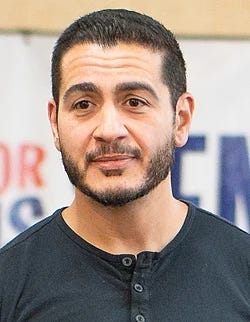
Abdul El-Sayed
As Jerel Ezell explained in the Guardian, El-Sayed’s mantra is rooted in his background in medicine: First, do no harm. The Senate candidate’s “AI Under Control” plan is full of ideas about how to accomplish that:
Force Google, Microsoft, Meta and Amazon to divest themselves of their shares in AI ventures like OpenAI and Anthropic
Slow down the development of data centers, freeze residential utility costs and focus on quality of life issues likethe noise and the pollution data centers always produce. He has been especially vocal about the colossal OpenAI-Oracle datacenter being erected just outside Ann Arbor, Michigan.
Pause AI’s most potent releases
Ban artificial superintelligence
Require an AI kill switch
And most important of all: Require 50% plus 1 board seats on every AI Company to be publicly appointed or democratically elected. This would give the public the power to veto datacenter developments and biological weapons–things Jerel Ezell describes with great understatement as those that “could undermine the public interest.”
Impossibly socialistic for America? Maybe not if you know how people really feel about these things in the heartland. The most recent Quinnipiac poll found that 73% of Americans are concerned about AI posing a threat to human existence.
And according to a June report, roughly 69% of American adults support AI companies transferring 50% of their stock to public sovereign wealth fund, a pot of money used to support public interests.
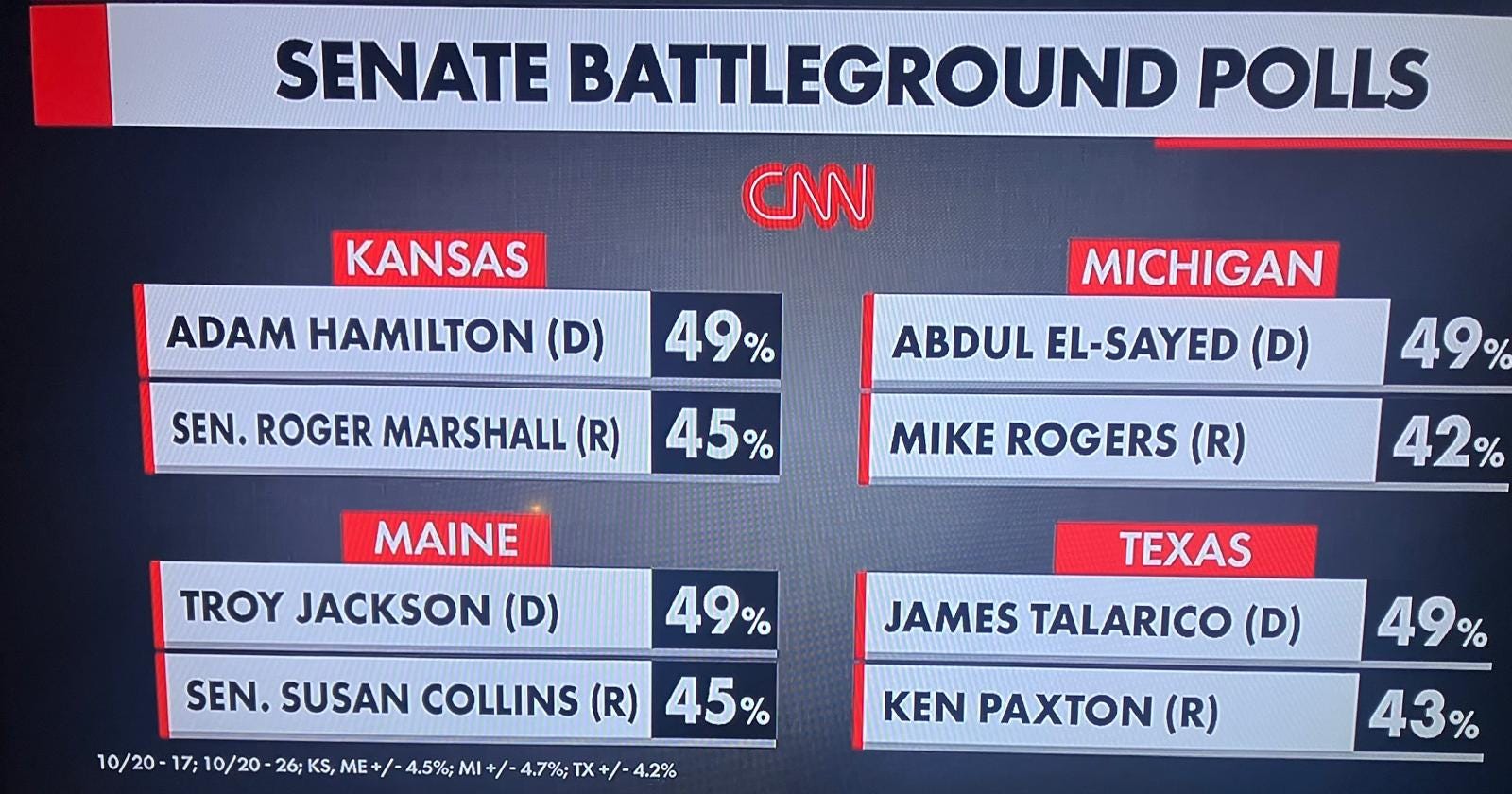
Hope for Tuesday
Trump Corruption Watch
Uday’s and Qusay’s Global Grifting Adventure: A Catalogue
Financial Times
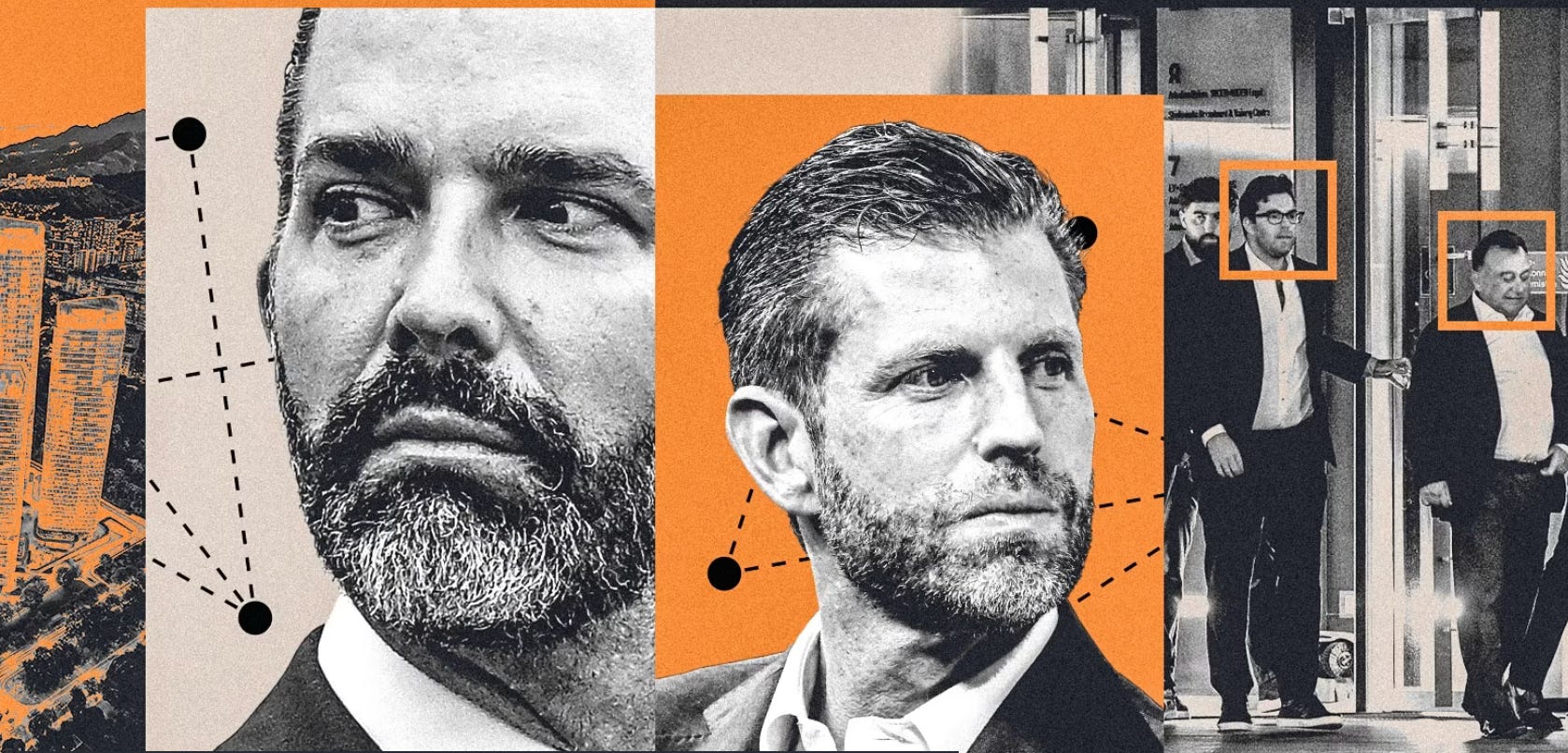
Scott: When it comes to exploiting being a son of the president for fun and profit, Hunter Biden is a piker compared with the likes of Donald and Erik Trump. Indeed, they have honed the game in a manner that reflects criminal brilliance, building their meagre inheritance into fantastic wealth. The question right now is simple: how much of this ill-gotten gain will they be permitted to retain when the hour of accountability strikes?
Something of which all Americans should be conscious: in nations around the world in which democracy has failed and a dictatorship has taken its place, fact patterns like this abound. It is the fear of accountability and loss of wealth and power that pressure the duly-elected wannabe autocrat to dispense with all the trappings of a rule-of-law state.
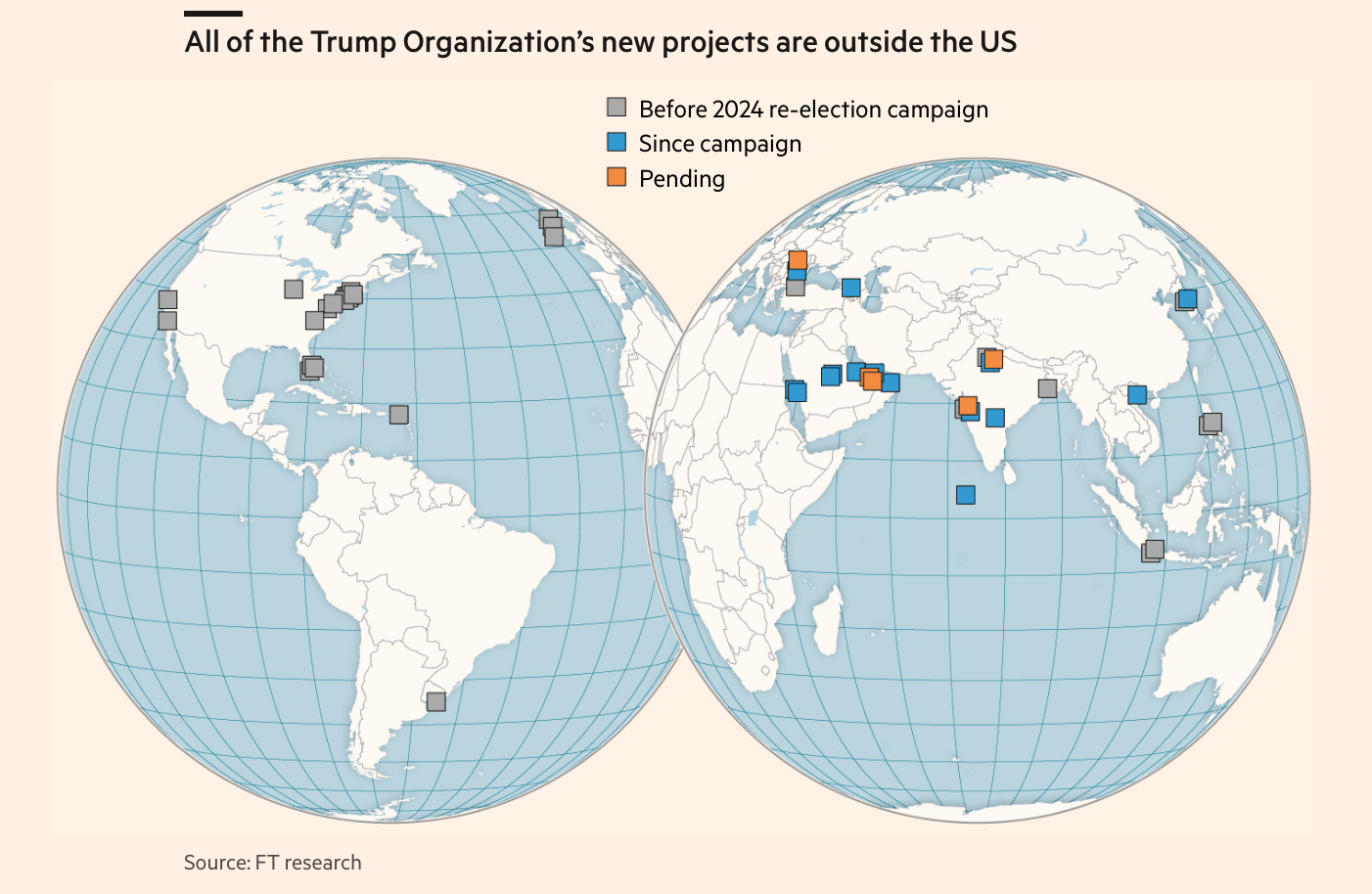
Trump Jr and his brother Eric have made a habit of meeting foreign officials and politicians: the FT has documented at least 18 such encounters since their father began his second term in January 2025.
These include conversations with at least six current and former prime ministers or heads of state, nine senior ministers or officials, and two groups of politicians from places as diverse as Vietnam, Serbia and Somaliland.
As sons of the sitting US president, Trump Jr and Eric often seem to be greeted as emissaries of the Trump administration — despite the fact that neither man holds a formal government role.
Richard Painter, a former White House ethics lawyer in the Bush administration and Trump critic, says it would be “highly improper” for Trump’s sons to meet with foreign leaders in any diplomatic capacity, as they are not official emissaries nor subject to conflict-of-interest laws. “We have no way of knowing what was said in these conversations,” he says.
Trump Jr’s spokesperson said he always clarifies with any government official he meets that he is not an emissary nor involved in his father’s administration. “Don is a private citizen and has the same First Amendment rights that any other law-abiding American has,” the spokesperson said.
However it might appear, the Trumps have seized the moment to maximise the profits of their businesses, building a tangled web of financial connections with the potential for conflicts of interest.
A huge chunk of President Trump’s personal income last year, which topped $2bn, came from his sons’ ventures. He reaped over $500mn from sales of tokens from World Liberty Financial, the crypto business co-founded by the brothers, as well as hundreds of millions from the family’s traditional real estate company.
The Trump Organization has earned tens of millions from at least 20 new projects launched overseas since Trump’s 2024 campaign, according to the company’s announcements and the president’s ethics disclosure.
Because Trump Jr and Eric are not government employees, their business relationships and finances are more opaque. The brothers have investments and advisory roles in companies across industries — including some being transformed by US policy such as crypto, defence and critical minerals…
After Trump Jr’s visit to Estonia, he flew to Poland for a 12-hour stop and a series of meetings also shrouded in secrecy.
Travelling with the group was Adrian Thiess, a Romanian political consultant who has helped host events with Trump’s two eldest sons in Hungary, Romania, Serbia and Bulgaria in the past.
Thiess declined to comment on the meetings in Warsaw. Trump Jr’s spokesperson said he was in Europe for speaking opportunities organised by Salem Media, a conservative group.
Breaking ground
Trump Jr’s younger brother Eric, who has become the face of the family real estate empire, has meanwhile embarked on his own global dealmaking tour to partner with foreign developers on Trump-branded projects.
In most cases, the group doesn’t own buildings itself: instead, it offers the Trump brand to project developers and consults on the construction process in exchange for licensing and development fees.
And in Donald Trump’s second term, the family brand is more valuable than ever. Its finances, included in Trump’s annual ethics disclosures, show an ever-expanding global empire with a range of partners building commercial, residential and hotel projects that each earn the family millions per year.
The Trump Organization has announced 15 new projects overseas since Trump’s 2024 re-election campaign, according to FT analysis, including in Bucharest, Dubai and Vietnam.
Trump’s ethics disclosures list five more projects that are yet to be officially announced: one in Romania, two in India and two in Abu Dhabi. The disclosures show that these foreign licensing, development and management revenues increased 40 per cent to $63mn between 2024 and 2025.
During Trump’s first term, the Trump Organization announced it would pause international deals. This time, the family business released guidance that allows foreign deals so long as they are not with government counterparties. Last year, the FT asked Eric Trump why the family decided to undo its earlier pledge.
“It’s very simple,” Eric responded. “We didn’t have to do it in 2017. We did it. We got absolutely no credit for doing it, and we’ve done everything right.”
But these private deals have brought Eric and Trump Jr — both of whom are executive vice-presidents of the Trump Organization — into proximity with government officials and politicians in the course of their family business. In many cases, these officials hope the Trump brand will help them build a better relationship with the White House.
In Georgia last month, hundreds of the country’s elite gathered to celebrate the announcement of Trump Tower Tbilisi — set to be the country’s largest skyscraper — with traditional dances, a drone light show and a speech by Prime Minister Irakli Kobakhidze.
Eric Trump, appearing live via video, praised Kobakhidze and highlighted Georgia’s high GDP growth. “The Georgian people love the United States, and the United States loves the Georgian people,” he added.
The remarks were at odds with the US’s official stance on Georgia, as relations have become frosty over the ruling party’s posture towards Russia. Kobakhidze is a close ally of his predecessor Bidzina Ivanishvili, a billionaire who was placed under sanctions by the Biden administration in 2024 for “undermining the democratic and Euro-Atlantic future of Georgia for the benefit of the Russian Federation.”
One week after he spoke at the Trump Tower launch event, Kobakhidze had brief conversations with President Trump and Rubio at a reception on the sidelines of the UN General Assembly meetings in New York.
“Thankfully, these attacks have been stopped and relations are substantially healthier,” Kobakhidze said at a press appearance this month. “We remain optimistic that the strategic partnership will be restored, but the rest depends entirely on the US administration.”
Sometimes, governments have explicitly tied Trump projects to diplomatic efforts. In Vietnam, the government has seized on a new Trump resort in the country’s north. The then prime minister called it “significant to strengthening Vietnam-US relations” at its groundbreaking in May 2025, just seven weeks after Trump’s “liberation day” tariffs hit the country’s export industries. Since then, the government has provoked local controversy, asking thousands to move and planning to relocate bodies from a cemetery to make room for a golf course.
A spokesperson for the Trump Organization denied it had any ties to US foreign policy. “The company operates completely separately from the presidency and is in full compliance with all ethics and conflict-of-interest laws.”
In some places the Trump brand has lost its lustre. Altus Property Group dropped the Trump name from a tower it is developing on Australia’s Gold Coast following protests and a petition with 120,000 signatures.
“When the war [in Iran] started, the pressure here built up to a frenzy,” CEO David Young tells the FT, adding that not paying — and thereby scuttling the deal — was an unfortunate necessity. “Despite my best efforts to explain it to Eric and the Trump Organization, they really didn’t want to hear about it.”
“Mr Young’s attempt to blame certain world events for our termination of the agreement is merely a ploy to distract from his own defaults and failures,” said the Trump Organization spokesperson.
Walker Davis, deputy research director at the Citizens for Responsibility and Ethics in Washington (Crew) watchdog, who has studied Trump’s empire, says agreements that are not explicitly political still present an ethical hazard for the president.
“How could it not be a factor for Trump, that his business — which he still owns and profits from, which is run by his family members — is expanding into these countries,” Davis says, even while Trump sets US policy towards them.
“It at least raises questions about influence on the presidency, and whether the millions of dollars that those deals are generating from foreign sources may factor into official decisions,” he adds.
Familial interests
Back home, the brothers have built a diverse portfolio of crypto businesses, investment funds and advisory roles — often in industries that are being transformed by their father’s decisions in the White House.
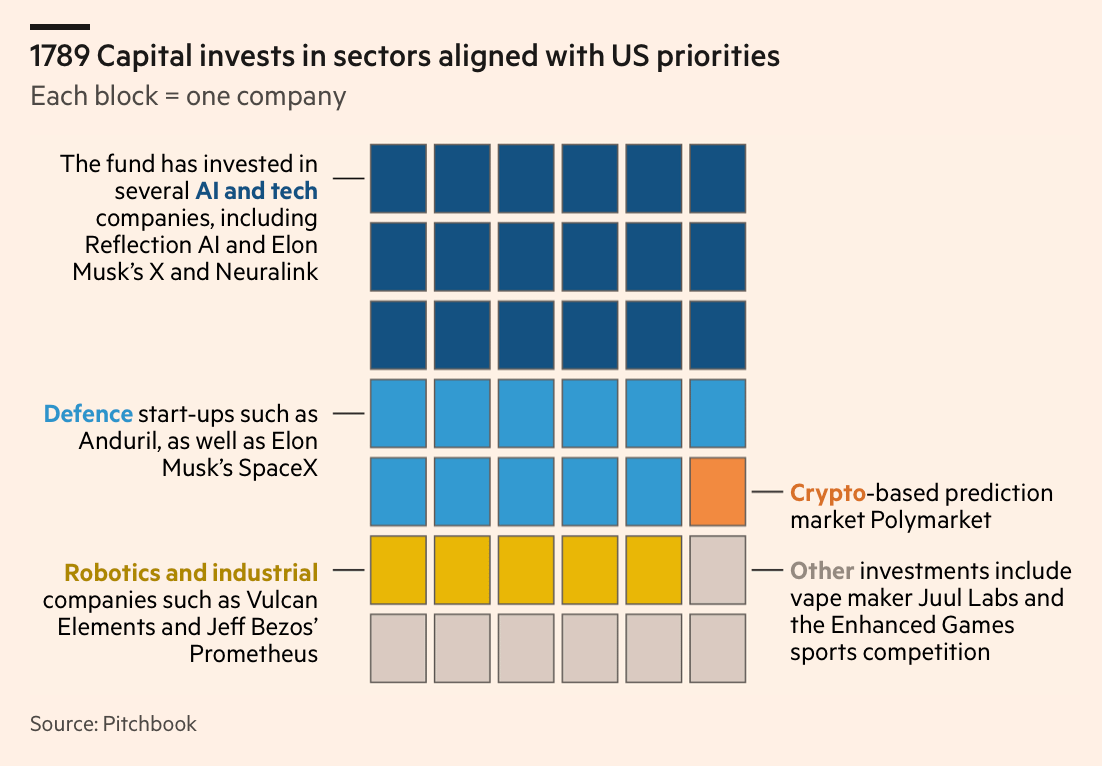
Trump Jr has pursued investments through his role as a partner in 1789 Capital, co-founded by investors and Republican donors Omeed Malik, Christopher Buskirk and Rebekah Mercer. The venture fund has said its assets under management have jumped from $200mn to over $3bn since it was founded in 2023, after going on a dealmaking spree with many of the leading privately held AI companies.
1789 Capital has gained access to investment rounds in popular companies that are regularly oversubscribed and unavailable to most investors.
The brothers also have investments in a number of prediction market and crypto ventures, some of which have benefited from the Trump administration’s actions to deregulate the industry.
Donald Trump Jr was handed about $300,000 worth of equity in prediction market Kalshi after joining the company as a strategic adviser in early 2025. He also serves as an adviser to Kalshi’s competitor, Polymarket, in which 1789 Capital has a stake.
Both companies have benefited from a more permissive approach from the Trump administration’s regulator, the Commodity Futures Trading Commission, allowing the prediction markets to offer sports bets that have fuelled their skyrocketing growth.
“Don is a big believer in the power of prediction markets,” his spokesperson says. “He never interfaces with the federal government as part of his role with any company that he advises or invests in.”
The Trump sons’ crypto venture World Liberty Financial has made most of its money issuing a stablecoin called USD1. The company earns interest on assets it holds to back the token, which has $4.1bn in circulation. Among its investors are Sheikh Tahnoon bin Zayed al-Nahyan, the United Arab Emirates’ national security adviser.
World Liberty Financial’s application for a US banking licence was approved this summer by the Office of the Comptroller of the Currency. Bank licensing has historically been a tightly regulated process, made easier by the Trump administration’s aim to promote crypto banks.
A spokesperson for World Liberty said that while the brothers are co-founders, they are not involved in day-to-day operations, and that the company “neither sought nor received special treatment”.
Additionally, the brothers have interests in a number of defence and critical mineral companies — strategic priorities for the US which often rely on government financing and contracts.
Last year, the FT reported that Trump Jr’s 1789 Capital invested in rare earths start-up Vulcan Elements, shortly before it received a $620mn loan from the Pentagon. Another company, Trump Jr-backed drone group Unusual Machines, also received a military contract. And this year, US start-up Reflection AI, a 1789 Capital portfolio company, struck an agreement to deploy its technology in classified Pentagon networks.
A spokesperson for 1789 said: “Don Jr does not have a role on the investment committee at 1789; therefore, he does not decide who gets money from 1789,” noting that defence companies in its portfolio have received contracts under both Trump and Biden administrations. “1789 takes minority stakes in companies, which has nothing to do with government contracts.”
The brothers are also invested in American Ventures, a series of special-purpose vehicles that manage about $1bn investing in “US-based leaders in new technologies”. Together, they own about 12 per cent of American Ventures’ management company, Dominari Holdings, which is headquartered in Trump Tower.
Through American Ventures, the brothers have a stake in a construction company that is set to merge with a mining developer that earlier secured access to critical minerals in Kazakhstan with the Trump administration’s direct support.
The brothers’ spokespersons said Eric and Trump Jr are passive investors with no involvement in the day-to-day operations or activities of American Ventures. Dominari Holdings’ chief executive Anthony Hayes said that they have a “relatively small ownership percentage” in its vehicles.
Other Trump Jr projects are more varied, including a hunting magazine, a podcast, and a Washington DC members’ club called Executive Branch. According to a 2025 version of the club’s bylaws seen by the FT, annual membership can be as high as $15,000, on top of initiation fees reportedly in the six figures.
Painter says these ventures could look like profiteering on the presidency. “When you name your company 1789 Capital — after the founding of the Constitution — or you have a social club called Executive Branch, that they’ve started up to sell memberships . . . it’s not subtle.”
Before leaving Ulaanbaatar last month, Trump Jr had breakfast with Unenburen Ulziiburen, a Mongolian entrepreneur with a series of crypto ventures.
Like Trump Jr, Ulziiburen is a political scion: his mother is former environment minister and member of parliament in Mongolia’s opposition Democratic Party.
Trump Jr’s spokesperson said he has no plans for any business in Mongolia.
Trump Jr’s travels still leave open many questions: precisely who he met with, what they discussed, and what, if any, business ventures may emerge from it. While President Trump’s ethics disclosures offer some insight into Eric’s work on the real estate empire, much of the sons’ dealings remain opaque.
What is public already raises concerns about conflicts of interest in presidential decision-making, says Crew’s Davis — not to mention what is unknown. “We shouldn’t have to wonder whether those decisions are what’s best for Americans, or what’s best for Trump’s bottom line.”
Since Hegseth Became SecDef He’s Been Receiving Mass Amounts of Cash and Bitcoin and Squirreling Them Away in a Madmoney Account
CNBC
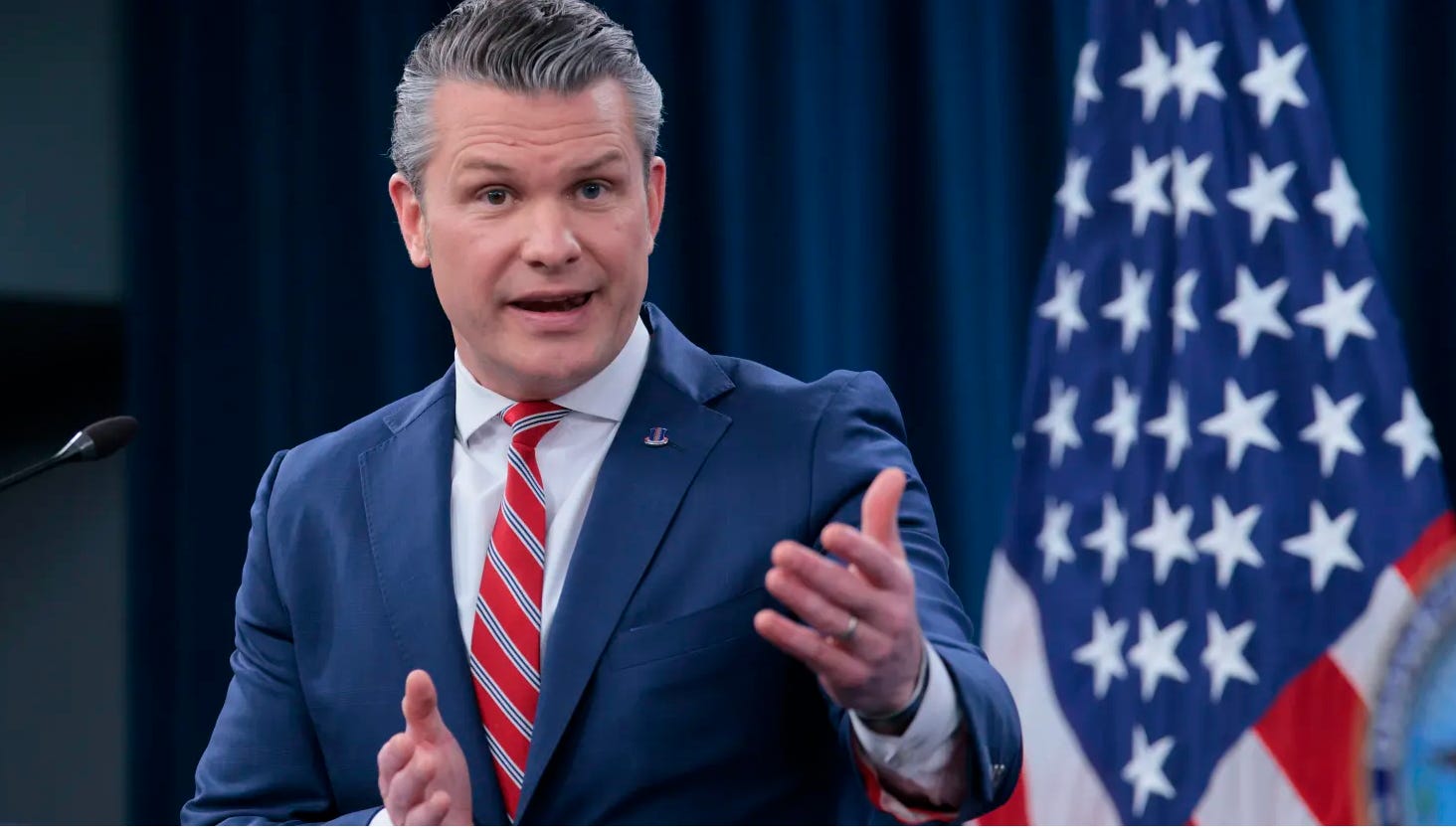
U.S. Secretary of Defense Pete Hegseth speaks during a press briefing at the Pentagon on May 5, 2026 in Arlington, Virginia. Photo: Chip Somodevilla | Getty Images
Scott: Pete Hegseth took a career as a cashiered Army major with a grievance and parlayed it into wealth and influence, entirely thanks to the benefice of his patron, Rupert Murdoch. In his final two years at Fox he earned some $4.6 million, plus benefits. And that continues, today, to account for the bulk of his wealth (with an ongoing infusion into the family account from his wife, another Murdoch executive).
But since Hegseth became secretary of defense, something strange has happened. His coffers continue to fill with infusions in cash and Bitcoin, the source of which is unexplained. And this is happening as he is photographed continuously in social settings with an array of Bitcoin and other crypto figures.
Congress has some questions to ask.
Defense Secretary Pete Hegseth reported at least $3.1 million in cash, retirement investments and bitcoin in his newly released 2025 annual financial disclosure, including more than $1 million in cash held in a single bank account.
The Office of Government Ethics filing provides the latest look at the finances of the former firebrand Fox News host, who was confirmed as Defense secretary in January 2025. Hegseth is facing calls to be impeached from members of his own party related to his handling of the war with Iran.
The disclosure lists five retirement accounts containing investments worth roughly $2.05 million to $4.35 million. Hegseth’s three accounts accounted for about $500,000 to $1.25 million of that total, while his wife, Jennifer Hegseth, reported roughly $1.55 million to $3.1 million in two rollover individual retirement accounts.
The household also reported three cash accounts, including one worth more than $1 million, and bitcoin valued at between roughly $16,000 and $65,000.
Bolsonaro’s Flight to Avoid Prosecution in Brazil Reveals Trump’s Helping Hand at Every Stage
Frankfurter Allgemeine Zeitung
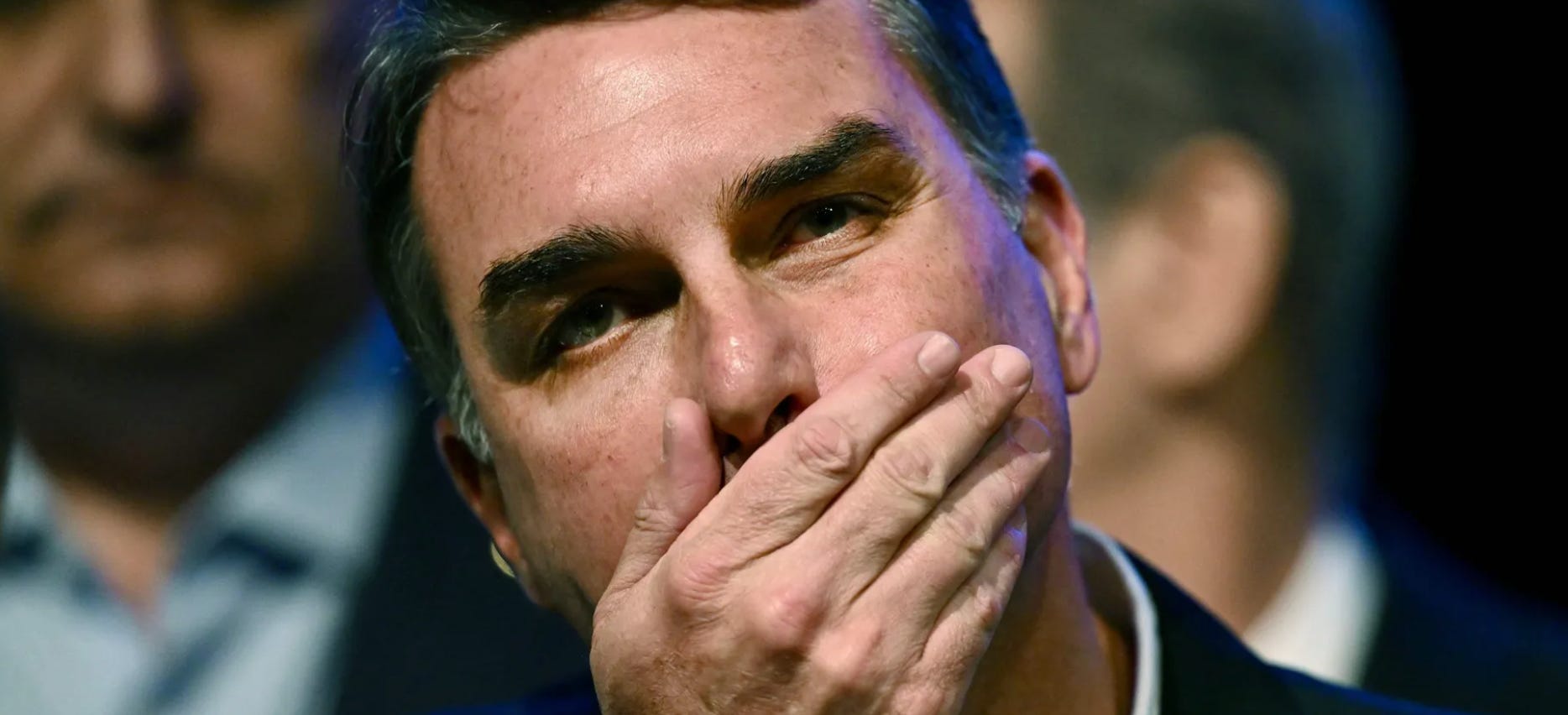
Flávio Bolsonaro fled to the United States to avoid prosecution on money laundering and corruption charges. Just as in the election, in his flight he was assisted by the hand of Donald Trump.
Scott: American media reporting is remarkably scant. Absent is any reporting about the leading role played by Trump adjutants in his election campaign; the details of the long-standing criminal probes against him; and any meaningful parsing of how, exactly, he came to be transported after issuance of a Supreme Court decision in Brazil banning his travel outside of the country, to safety and shelter in close proximity to Mar-a-Lago. Outside the US, however, there is little difficulty learning all these facts.
Two days after his defeat in the Brazilian presidential election, Flávio Bolsonaro left Brazil for Argentina. As the Argentine migration authority confirmed on Wednesday night, the politician crossed the border at Foz do Iguaçu with his wife and two daughters shortly before 11 p.m. local time on Tuesday evening. Shortly afterwards, the family boarded a private plane in Puerto Iguazú bound for Guayaquil, Ecuador. The plane took off shortly after midnight. From there he continued on to Florida…
The new information contradicts Tuesday’s reports. In the afternoon, Bolsonaro’s confidants had already claimed to Brazilian and American media that the senator was on his way to the USA. Later it was even said that he had already landed in Florida and met his brother Eduardo. In fact, Bolsonaro was apparently still in Brazil at the time. It is unclear whether the contradictory information was deliberately spread in order to distract from the escape preparations.
US President Donald Trump personally approved Bolsonaro’s entry, CNN reported, citing an adviser to the president. The US State Department confirmed that Bolsonaro and his family were granted visas and allowed to enter the country. There was no mention of political asylum in the official statement.
Investigations into possible financial crimes
On Monday, Flávio Bolsonaro assured that he was not thinking of leaving Brazil. He wants to organize the opposition against the re-elected President Luiz Inácio Lula da Silva. Previously, Judge Alexandre de Moraes of the Supreme Court had banned him from leaving the country and ordered him to surrender his passports within 24 hours. Moraes had previously been warned by the federal police about the risk of absconding. Bolsonaro missed the deadline on Tuesday. The federal police then canceled his Brazilian passport and a diplomatic passport. According to the newspaper “Folha de S. Paulo”, Bolsonaro’s Italian passport remained valid.
The 45-year-old senator is being investigated in two cases for possible financial crimes. On the one hand, the federal police are investigating whether Bolsonaro is involved in money laundering transactions carried out by his lawyer friend Willer Tomaz. Tomaz is suspected of using online betting to launder money. According to the Ministry of Finance, he moved around five billion reals on betting platforms within a year (equivalent to 840 million euros). Investigators found evidence that Bolsonaro had access to the account of one of the lawyer’s companies.
The second case concerns payments made by banker Daniel Vorcaro, who was arrested for fraud, to finance a film about Bolsonaro’s father. Flávio denies criminal conduct. According to people close to him, Bolsonaro feared he would be arrested soon. His Senate mandate also expires at the end of January, meaning he will lose his parliamentary rights. As president, he would have been protected from prosecution. The prospect of pardoning his father Jair Bolsonaro, who was convicted of an attempted coup, is also gone with the election defeat.
Who helped escape? American Fingerprints Are Everywhere
Argentine authorities said Bolsonaro presented valid travel documents upon entry. It is unclear which passport he used to cross the border. On Tuesday morning, Javier Milei’s government declared that Bolsonaro had not entered the country. In fact, he didn’t cross the border until late in the evening. Those close to Bolsonaro say that a small circle of confidants prepared the escape. Two “Folha de S. Paulo” informants, including one with ties to the Trump administration, attribute an active role to US Secretary of State Marco Rubio. There is no official confirmation. However, according to research by CNN, the Trump administration is said to have known about the impending passport surrender on Monday and signaled to Bolsonaro that he would be allowed to enter the country.
President Luiz Inácio Lula da Silva sharply criticized the departure on Tuesday, saying it was “shameful”. Anyone who is innocent can face the investigation, the president said on his 81st birthday. There are fears within the government that the travel ban will further strengthen Bolsonaro’s portrayal of political persecution. Moraes is the same judge who presided over the trial against Jair Bolsonaro
NASA’s Hubble Marks Way for Roman Space Telescope

A sinuous spiral galaxy (center) appears in the same field of view as a vivid gravitational lens (right corner) in this Hubble image.
NASA, ESA, and X. Huang (University of San Francisco); Processing: Gladys Kober (NASA/Catholic University of America)
A sweeping barred galaxy takes center stage in this Oct. 22, 2026, image, but the gravitational lensing at bottom right is the real target. This observation is one of many gravitational lensing images taken by NASA’s Hubble Space Telescope in preparation for science with the new Nancy Grace Roman Space Telescope.
Astronomers will use these images to analyze gravitational distortions to learn more about dark matter in the foreground galaxies and to lay the groundwork for future Roman observations. Images like this offer a glimpse of how Hubble and Roman will work together to build an even more comprehensive picture of the cosmos.
Image credit: NASA, ESA, and X. Huang (University of San Francisco); Processing: Gladys Kober (NASA/Catholic University of America)
Your Online Moment of Zen
The Road To My Heart
Written and Performed by Judy Barnett
From the album The Road to My Heart
2004
Judy Barnett is one of the great singer-songwriters of our generation.
Listen to her on Apple or Spotify or wherever Toscanini-level musicians are found. Judy and Arturo both lived at the Ansonia—a couple of decades apart.
Judy has known the Road to My Heart since 1964.
<iframe width=”560” height=”315” src=”
title=”YouTube video player” frameborder=”0” allow=”accelerometer; autoplay; clipboard-write; encrypted-media; gyroscope; picture-in-picture; web-share” referrerpolicy=”strict-origin-when-cross-origin” allowfullscreen></iframe>