Jared’s Secret Billions / France Under Siege / Ukraine Decimating Russia’s Oil Business / The Crime Family Running Venezuela (Guess Which One) / 120,000 Cameras To Find Your Estranged Wife / Marina Madness
Trump Corruption Watch
How Jared Kushner Scored Billions from Saudi and Emirati Princes To Do Their Bidding
Vanity Fair
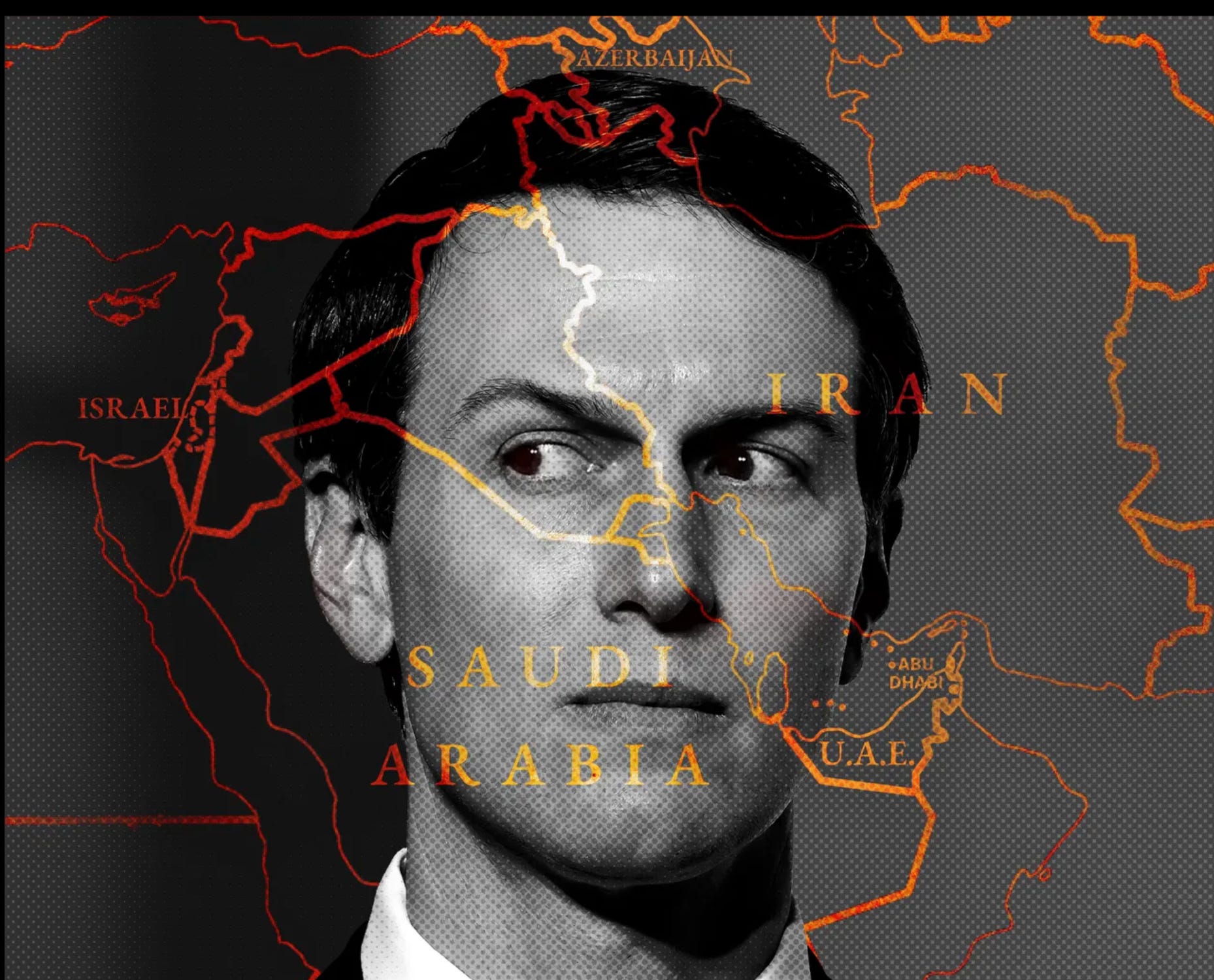
Scott: Only a few weeks ago, Dexter Filkins used phone intercepts of Kushner’s WhatsApp calls to Russians to present us with a detailed introduction to what Kushner’s supposed negotiations with Russia about Ukraine were all about. The intercepts were furnished by Polish intelligence, but it appears that at least four other European intelligence services had the same materials. What we learned was that peacemaking was almost entirely absent from their dealings, which instead focused on the Russians dangling a long string of very lucrative private deals before the extremely naïve and very greedy personal envoys of Trump. Today, the first excerpt of Matthew Cole’s blockbuster new book, Princes and Thieves, has been published in Vanity Fair. And what we learn—this time courtesy of intercepts by Dutch intelligence—focuses much more on Kushner’s dealings with his Saudi and Emirati patrons and is still more hair-raising. Billions of dollars are dangled in front of Kushner, and he is given control of accounts holding these funds. The princes want a long slew of policy adjustments (including making war on Iran) from Washington to meet their needs, and they appear to have gotten everything they wanted. It’s pretty clear none of these things were in the national interest of the United States as historically interpreted. The brazenness and audacity of this corruption are breath-taking and far exceed anything Americans have seen in their history to date. And the facts present straightforward crimes of corruption by Kushner and others around him. The piece is an essential read, a primer on what the words “foreign policy” really mean under Trump.
In The Hague, the MIVD hacking team tried to reverse engineer the Russian penetration of Kushner’s iPhone. Kushner owned what was then the latest model, the iPhone X. Released in November 2017, it featured Face ID, a state-of-the-art security feature that Apple had promoted at its launch. The Dutch team had been trying to pick the phone’s door lock, so to speak, when it occurred to them that the Russians may have found an unlocked window to gain entry instead. Their hypothesis was correct. By early 2018, the MIVD had found a vulnerability in the iPhone that gave them access. The security exploit wasn’t perfect, however. Some malware allows a hacker to turn a victim’s phone into a microphone and video camera, turn the phone on or off, and pull and add files. The Dutch solution did not provide that level of access. Instead, when Kushner used the phone, they could see his screen. Almost as soon as they got inside, the intelligence service began capturing every image of Kushner’s screen as he used it, filing their own cache of surveillance on their internal computer servers.
As they monitored Kushner’s phone, they discovered he used it to log in to a UAE bank account. By the time the Dutch spies had visibility into the phone, the account had received hundreds of millions of dollars from a bank in Azerbaijan. Their initial assessment was that the bank account was affiliated with the government there.
“Jared was looking for shortcuts in his diplomacy,” a source who knew of the UAE’s deal with Kushner said.
For the MIVD hackers, the bank account became an intelligence mystery to unravel. Nearly everything they worked on had a tinge of Russian conspiracy. A little over a year into Trump’s first presidency, the MIVD, like FBI agents and federal prosecutors in Washington working on the Robert Mueller investigation, had only part of the story.
Kushner, UAE ruler Mohamed bin Zayed (MBZ) and Mohammed bin Salman (MBS) of Saudi Arabia, converged at an auspicious moment. MBS wanted to be crown prince. MBZ wanted to blow up Obama’s Iran nuclear deal, and Kushner wanted both to help him force the Palestinians into a deal that Israel would accept. Despite the perception of his wealth, Kushner was not entirely financially independent of his parents, and the family business, Kushner Companies, faced a billion-dollar loan coming due on their trophy property, the Manhattan office building at 666 Fifth Avenue.
Early in the first Trump administration, MBZ and MBS offered to pay for a slush fund dedicated to helping the new administration with foreign policy goals. The idea was to help pay for Trump’s promised wall between Mexico and the US, for example, in an effort to secure a second term in the White House. The two Arab royals initially discussed with Kushner putting more than $10 billion into the effort. Within months, though, as MBZ pushed the Trump administration to help back MBS’s effort to become his country’s crown prince—and future king—the broader foreign policy slush fund idea fizzled. Instead, MBZ and MBS initially, and then MBZ alone, put at least $2 billion into at least two bank accounts for Kushner. It is unclear how the royals organized their $2 billion in combined payments, but they effectively split the cost. For the purposes of explanation, it is best to understand where and how each bank account was controlled.
Bank account Alpha was held at First Abu Dhabi Bank, the largest in the UAE, and was overseen by MBZ’s brother, Tahnoon bin Zayed, who served as the bank’s chairman. Beginning in 2017, the Saudis and Emiratis transferred roughly $750 million into the Alpha account. Alpha would be used as a foreign policy fund. This money would be overseen and partially managed by Kushner and MBZ, who, in their effort to strike a grand bargain to end the Israeli-Palestinian conflict, believed the region’s map needed to be redrawn.
“Jared was looking for shortcuts in his diplomacy,” a source who knew of the UAE’s deal with Kushner said. This person held discussions with both senior UAE and Israeli officials about the secret financial arrangement between Kushner, the UAE, and, at least initially, Saudi Arabia. “Jared promised MBZ that he’d push their agenda with Trump if they participated in a fund. He wanted normalization with Israel so that business could take off.” A slush fund—a shared pool of money for off-the-books diplomatic objectives—was a common form of Gulf Arab government corruption, this person explained. “The Emiratis and the Saudis do this once a year. A billion or two is nothing for them, and if it gets them what they want, it’s money well spent.”
The Alpha account looked like the funding source of a UAE government program, by which MBZ paid his bureaucrats their salaries or funded government-run schools. But how and through whom the money flowed into the Alpha account revealed that it was intended to remain secret, more akin to a covert and illicit scheme, given that it was managed in part by a senior advisor to the president of the United States…
Regardless of whether he was a signatory or the owner, Jared was required by federal government regulations and the Internal Revenue Service to disclose his access to the account. Unless disclosed to and approved by the US government and reported on his tax returns, Kushner’s access to the Alpha account may have violated US law… In addition to the Alpha bank account, MBZ put money into at least one other account intended for Kushner. By the spring of 2018, the crown prince had moved roughly $1 billion to Israel via Azerbaijan for Kushner. We will refer to this account as the Beta bank account. It is unclear how Israeli Prime Minister Benjamin Netanyahu first learned of MBZ’s money for Kushner, but a person briefed on the Beta account told me that the prime minister encouraged Kushner to have the money deposited in the Israeli Central Bank, in what would appear to be a government account. It is also unclear how Kushner used the money the UAE deposited into the Beta account for him, but according to the person with knowledge of the money, its allocation was for Kushner’s personal benefit. But as with the Alpha account, there were clues in the way the Beta account was managed.
Israel’s Central Bank does not operate personal accounts. The bank holds and transfers only government funds. The government accounts use a dual-key system, which requires two authorized individuals to make any transfers from the account as an oversight mechanism. Netanyahu required Kushner to inform him before making any transactions from the Beta account.
To do so, Kushner passed his messages through Ambassador David M. Friedman, who frequently met with Netanyahu. With the money in the Central Bank, it would be difficult, if not impossible, to connect MBZ’s payment to Jared. It is unclear if spies in the Netherlands had any indication of the Beta account…
Apparently, Kushner faced the challenge of moving money from the Beta account in Israel to other accounts where he could have untraceable access to the funds. One person who worked with Kushner to move the money out of Israel said that much of it went to bank accounts in Cyprus before being moved elsewhere…
Although Kushner’s position as senior advisor to the president was unpaid, he was an official government employee. Not only did his position require financial disclosures for ethics regulations, but each year he worked in the White House, he had to file both a public and confidential financial form, known as the Executive Branch Personnel Public Financial Disclosure Report, also known as a 278e disclosure. Because he had access to classified government secrets, Kushner was required to disclose any bank account to which he had signatory—or beneficiary—access.
Kushner’s apparent betrayal of the public trust, however, went further than his failure to disclose the secret Alpha account in the UAE or the Beta account in Israel. By giving him access to roughly $2 billion, regardless of how the money was used, MBZ and MBS were paying for his influence within the US government. Any efforts he made to shape US policy that came from a foreign government that had provided him with money would make him an agent of a foreign power. US law requires citizens who lobby on behalf of a foreign power to declare themselves and the country they are working on behalf of to the Justice Department.
One former prosecutor who worked on the Mueller investigation said that if Kushner promised anything to MBZ and MBS in return for the money they offered him—even if it was just speaking to his father-in-law—he may have violated federal bribery laws, as well as the foreign agent statute.
France Under Siege
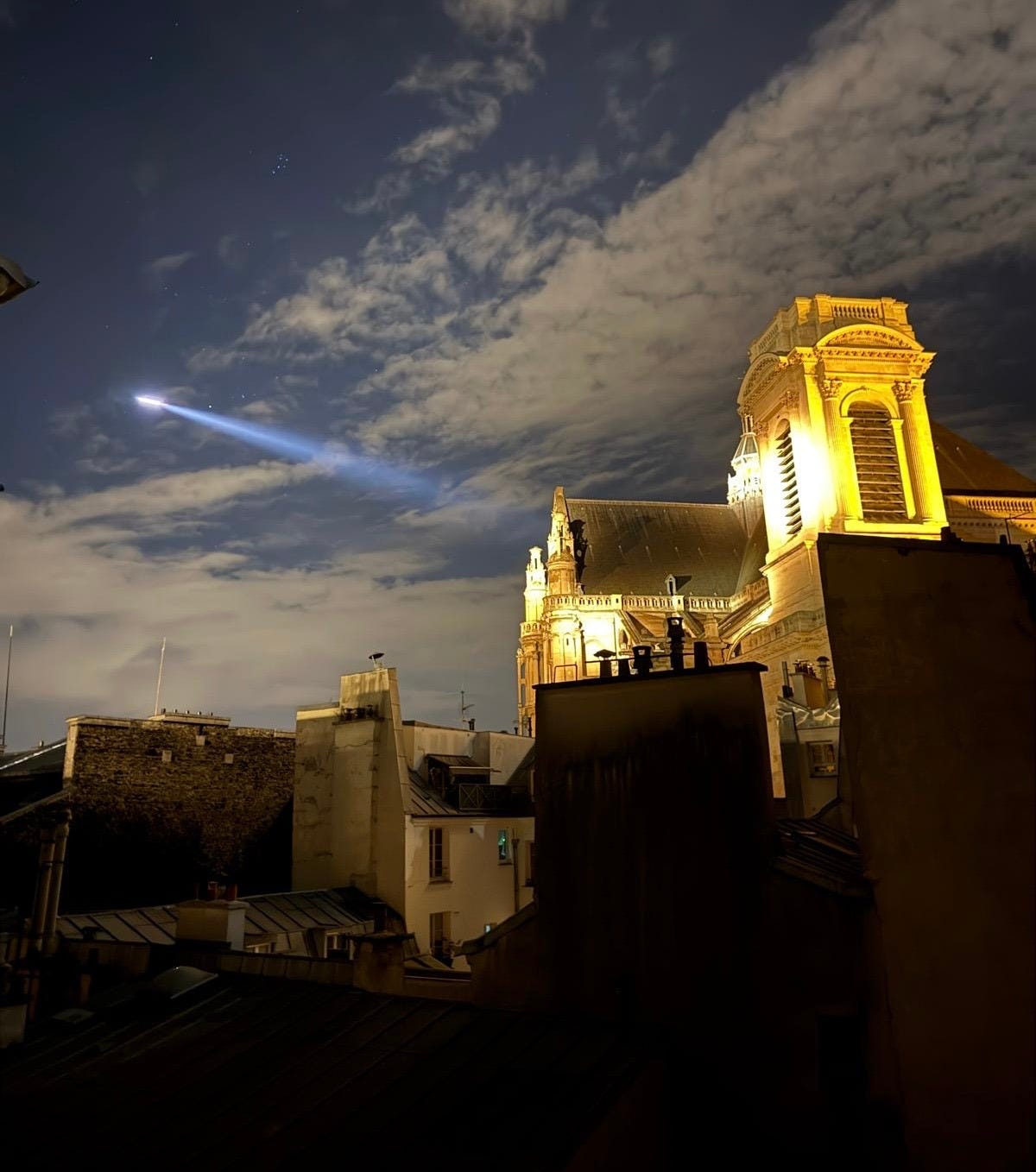
A helicopter hovering over Les Halles in Paris Thursday night to enforce a curfew
Photo by Michael Finnegan
Putin’s War On Ukraine Puts Oil Giant Rosneft Under Mounting Pressure
Bloomberg
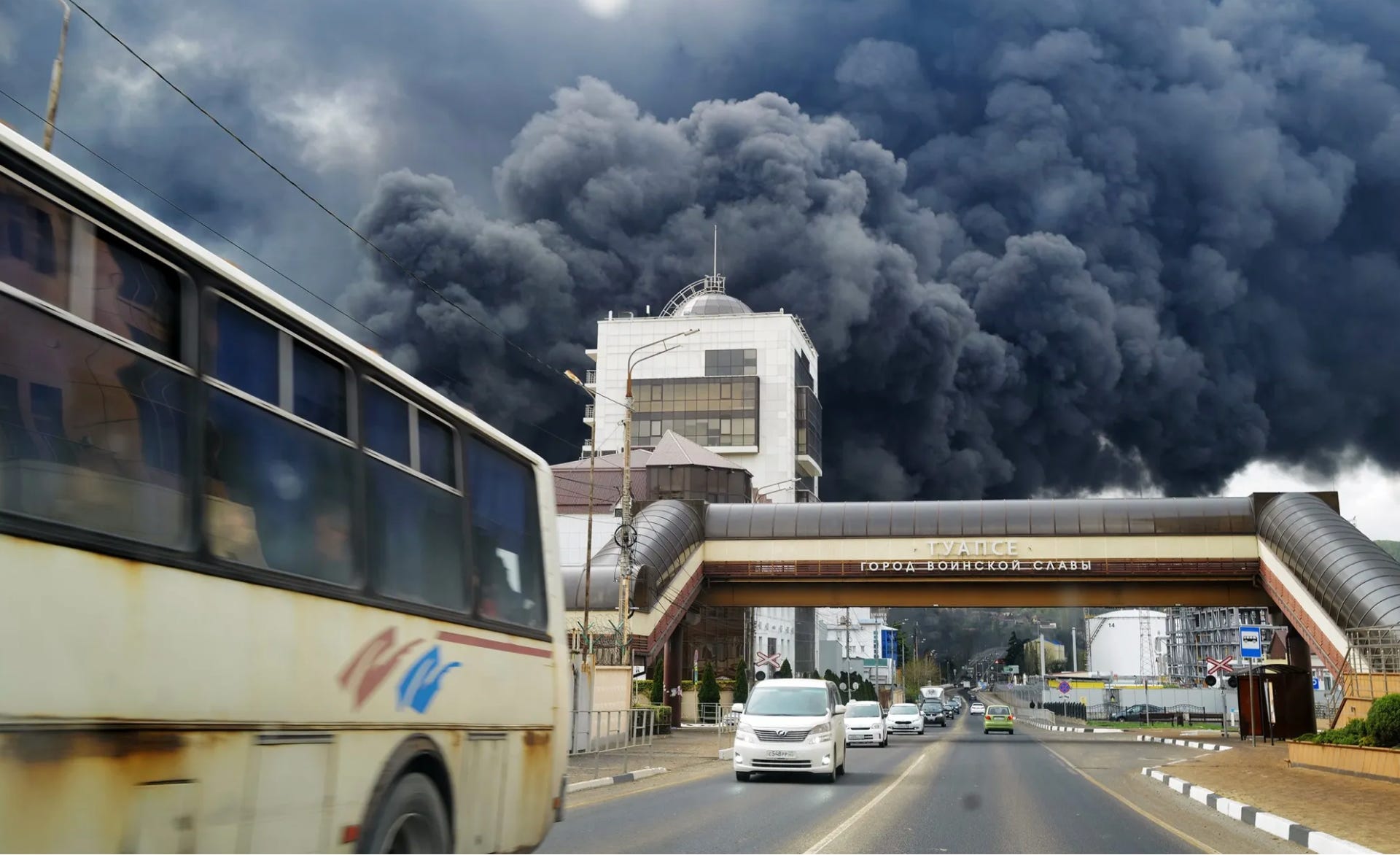
Smoke rises from a fire at Rosneft’s Tuapse Oil Terminal, in a photo distributed by Russian state media. According to Russian officials, a massive drone attack on the night of April 20 targeted the city of Tuapse.Photo: Boris Morozov/Sputnik/AP Photo
Scott: The suggestion that Ukraine’s strategic attack on Russia’s oil refining and transportation system was driving up the price of gasoline at the pump in the US is, as every industry analyst knows, utterly risible. Nevertheless, this campaign has been devastating to the Russian oil industry and was on the cusp of presenting an existential threat to Vladimir Putin and his on-going rule. Hence, he pushed the panic button and summoned Trump to reveal his true relationship by taking extreme measures to protect Putin and enable Russian ballistic missile attacks on Kyiv and other Ukrainian cities. While European commentators largely understand exactly what is going on, very few commentators in the US understand it or are willing or able to describe it. Bloomberg’s deep dive into how the Ukrainian strategy has been devastatingly effective and how it was putting Putin in a desperate position is thus invaluable.
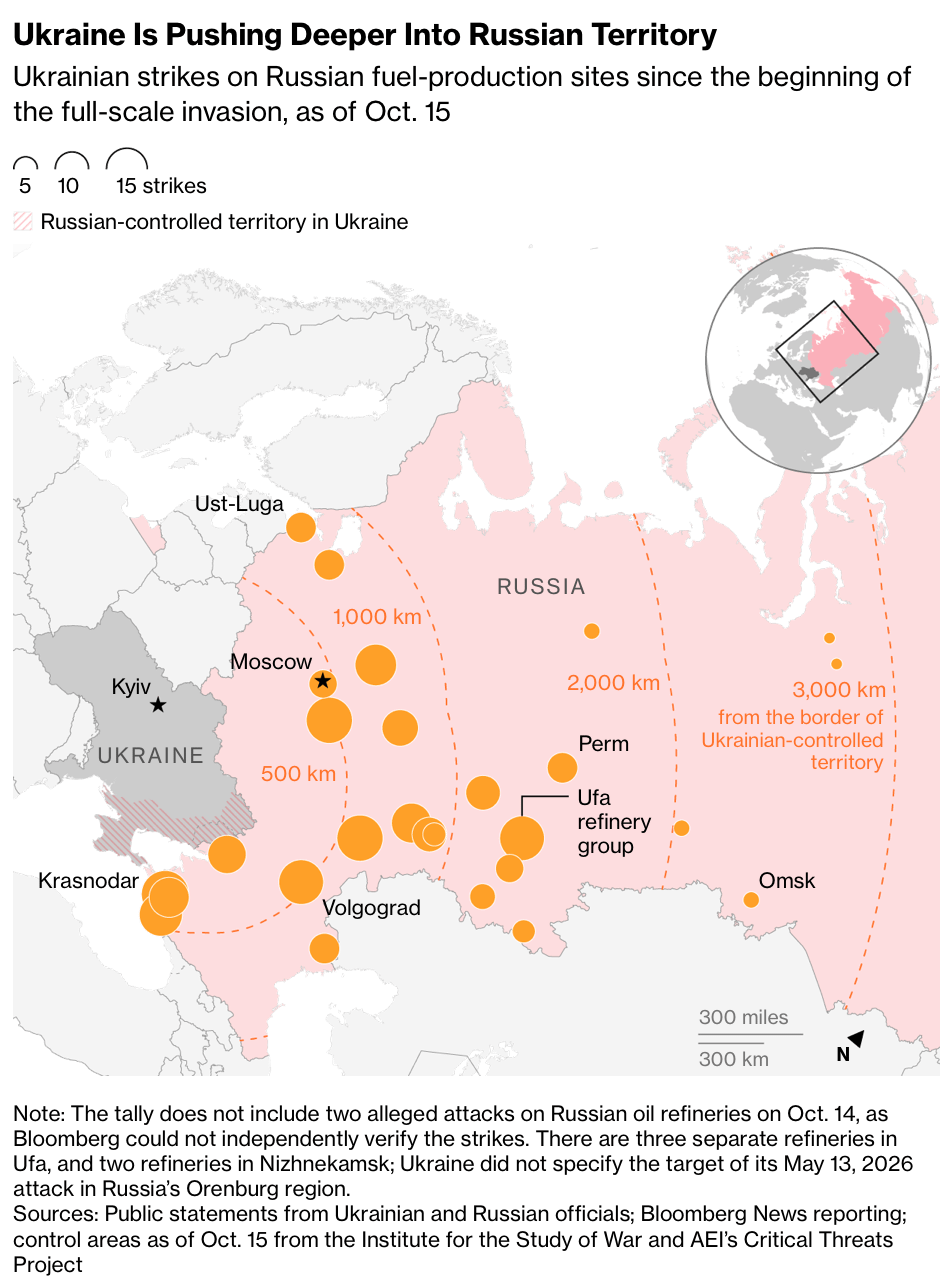
Officials at Russia’s largest oil producer are concerned that even a few more months of the war with Ukraine could leave lasting damage across the business.
One of Rosneft’s biggest refineries, Ryazan, has been shut for more than half the time since it was first hit by Ukraine in May and has run well below full capacity when operating, according to damage assessments seen by Bloomberg.
Another, Syzran, has spent much of the past six months either completely shut or operating at less than a third of capacity, according to data reviewed by Bloomberg. The Tuapse refinery has been offline since April.
Ukraine is conducting repeat strikes on the refineries as soon as repairs are completed or nearing completion. The need to repeatedly repair damaged equipment is straining operations and causing costs to pile up to levels that Rosneft officials have privately warned cannot be sustained long-term.
Some plants have deliberately slowed repairs as a result, stretching work that should take days into weeks, according to people familiar with the matter.
Efforts to protect the facilities with shipping containers, nets and steel cables have proved ineffective against swarms of drones, company plans show.
The damage is particularly difficult to repair when strikes hit complex secondary units, whose parts would previously have been sourced from the West. It means relying on Russian-made copies and Chinese imports that can take months to obtain and are not always compatible with existing machinery.
It’s put Rosneft into financial trouble. Even before the ramping up of Ukraine’s drone campaign, the company saw a “perfect storm” for its finances. Since then, its profits are down and debt is rising despite what should have been a big windfall from the Iran war.
Moscow Credit Bank, which is linked to Rosneft, is showing signs of distress with $8 billion of problem loans. It highlights how both Russia’s energy and banking sectors are coming under strain at the same time, a dynamic causing concern to Russian finance officials.
This also helps us understand the strategy pursued by the Kremlin in dealing with Trump and his private envoys: it is to entangle them as deeply as possible in the Russian oil and gas industry and thus furnish every incentive for them to support Russian efforts to seize and incorporate Ukraine. Thus the process starts with a massive deal worth tens of billions to sell LUKoil foreign assets to cronies tied to the Trumps, who would likely hold the assets under a US Treasury license as proxies for Trump and his entourage.
What Russia is doing was all described in Putin’s remarkable dissertation as a kandidat nauk at the St Petersburg School of Mines, in which he argued that Russia’s oil and gas resources could and should be manipulated to accomplish the country’s national security objectives—by enticing and corrupting foreign interests, among other things.
It’s truly remarkable that no major US corporate media appear to be capable of stringing simple facts together into a credible analysis of what’s going on right under their noses. But then, it seems they don’t want to do this.
Trump Corruption Watch (2)
Venezuela After the Apocalypse
The Atlantic
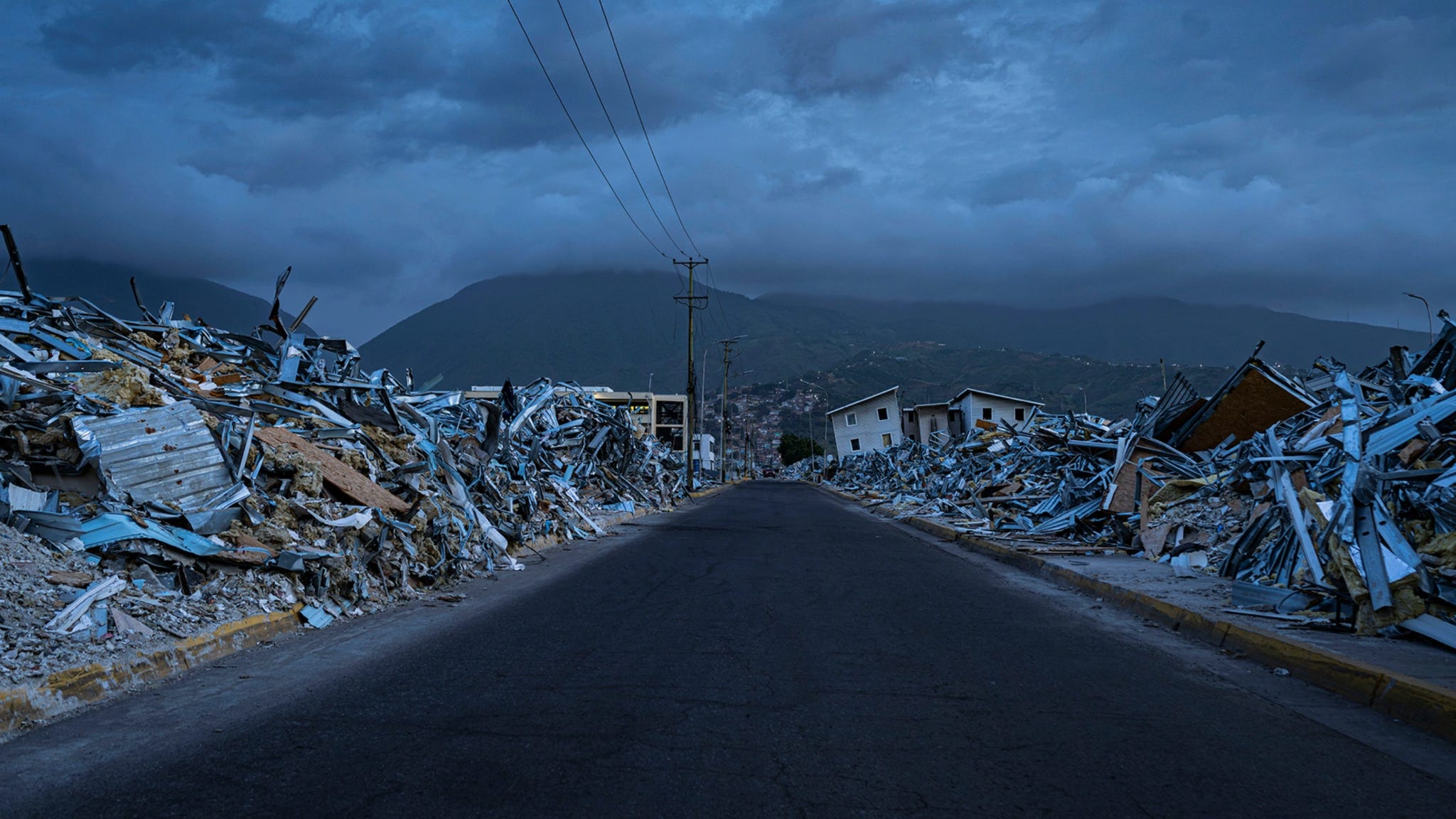
The remnants of a public-housing complex in La Guaira, Venezuela, in September, more than two months after two earthquakes devastated the city and neighboring Caracas. Photos: Lynsey Addario
Scott: What is happening in Venezuela today furnishes an excellent demonstration of what Trump “foreign policy” is all about. It is not a foreign policy in a conventional sense, in which the national interests of a country are elaborated and pursued through diplomatic, political, economic and military means. Rather for Trump, foreign policy means using the power, prestige and influence of the United States to accumulate private resources and influence for the Trump family and its entourage. The means used are not so much like the imperialism pursued by the European great powers in the late nineteenth and early twentieth centuries. Rather they are more akin to the conduct of an organized crime family moving in on a neighboring territory. The capo of the neighboring family may be executed, but the rest of the family may be left in place as long as it supplies a suitable cut to the capo de tutti capi. Anne Applebaum reports:
After the boom came the bust, at first slowly and then very fast. Hugo Chávez, who ruled the country as a leftist authoritarian from 1999 to 2013, and then Nicolás Maduro, the autocrat who succeeded Chávez and ran the country until he was removed by an American military operation early this year, undermined the industry, chasing away engineers and impoverishing workers. Even as they said they were building “Bolivarian socialism,” they removed benefits, lowered salaries, and created a capricious, repressive regime. Millions of people left the country.
Most American and European companies left too. The Russian and Chinese companies that arrived to replace them invested very little. Lake Maracaibo, the largest body of water in South America, also became one of the largest environmental disasters in South America. Two decades of neglect produced leaks, spills, poisoned water, and the ghostly drilling platforms I saw from the fishing boat. Fishermen sometimes rinse their crabs and shrimp with gasoline to remove the crude oil. All of their nets turn brown.
Billions of dollars of investment will be needed to remediate the site and recover more oil. In the meantime, people who live around the lake, like millions of other Venezuelans, work hard and earn very little. Their fish have to be sold immediately, because electricity is unpredictable and freezers are thus unreliable. Rapid inflation—20 percent in July, an annualized rate of 783 percent—has made everything unaffordable. In a Caracas market, I found prices and exchange rates written on whiteboards, because they change every day.
Fishermen and their families live along the polluted shores of the lake, the largest body of water in South America—and one of the continent’s largest environmental disasters.
The state is absent, or indifferent. Carlos pointed to a scar on his leg that he said was an old gunshot wound, the souvenir of an assault by one of the pirates who control the lake: “If you don’t pay them, they kill you and take your boat.” The coast guard is supposed to patrol the lake, he said, but it is rarely there.
The oil industry offers few well-paying jobs. At a lakeside town, its beaches blackened by oil, Francisco, a former boat mechanic at the state oil company—Petróleos de Venezuela, or PDVSA—told me he had quit because he got tired of not having the right tools and spare parts. One of Francisco’s neighbors, Iliana, told me her husband had quit PDVSA too, after his salary plummeted from $50 a day to just a few cents a day. He now works for a Russian company that pays about $35 a day, but he has to spend most nights sleeping on the drilling platform.
From a great distance—Washington, say, or Mar-a-Lago —Venezuela is sometimes described as a bonanza for America, a trove of riches. On January 3, the day that the U.S. military captured Maduro, Donald Trump promised that it would be. “We’ll run it properly; we’ll run it professionally,” he said at a press conference that day. “We’ll have the greatest oil companies in the world going and invest billions and billions of dollars, and take out money, use that money in Venezuela, and the biggest beneficiary are gonna be the people of Venezuela.” But at that same press conference, he also announced that he would be working with a new president: Delcy Rodríguez, Maduro’s deputy and a leading member of the regime that had caused the destruction in the first place. He dismissed the country’s opposition leader, María Corina Machado—who was the true winner of Venezuela’s 2024 presidential election—as a “nice woman” who “doesn’t have the respect within the country.”
In Venezuela, this language sounded jarring. Since then, it has become even more confusing, because it is so at odds with reality. When I asked people living right next to some of Venezuela’s largest oil fields whether Rodríguez had made any difference to the industry or the country, they laughed or sneered. Iliana told me, “People thought that things would change, but in reality nothing changed.” José, another fisherman who used to work for PDVSA, had a darker view: “The gringos came to rob everything—the oil, the minerals. We are rich in everything, but here, we don’t have anything.” Later, a local oil engineer told me that none of the American agreements matters anyway, because the Venezuelan government is illegitimate and so “nothing is legal.”
Cops left the force. They kept tracking people with a powerful camera network.
Washington Post
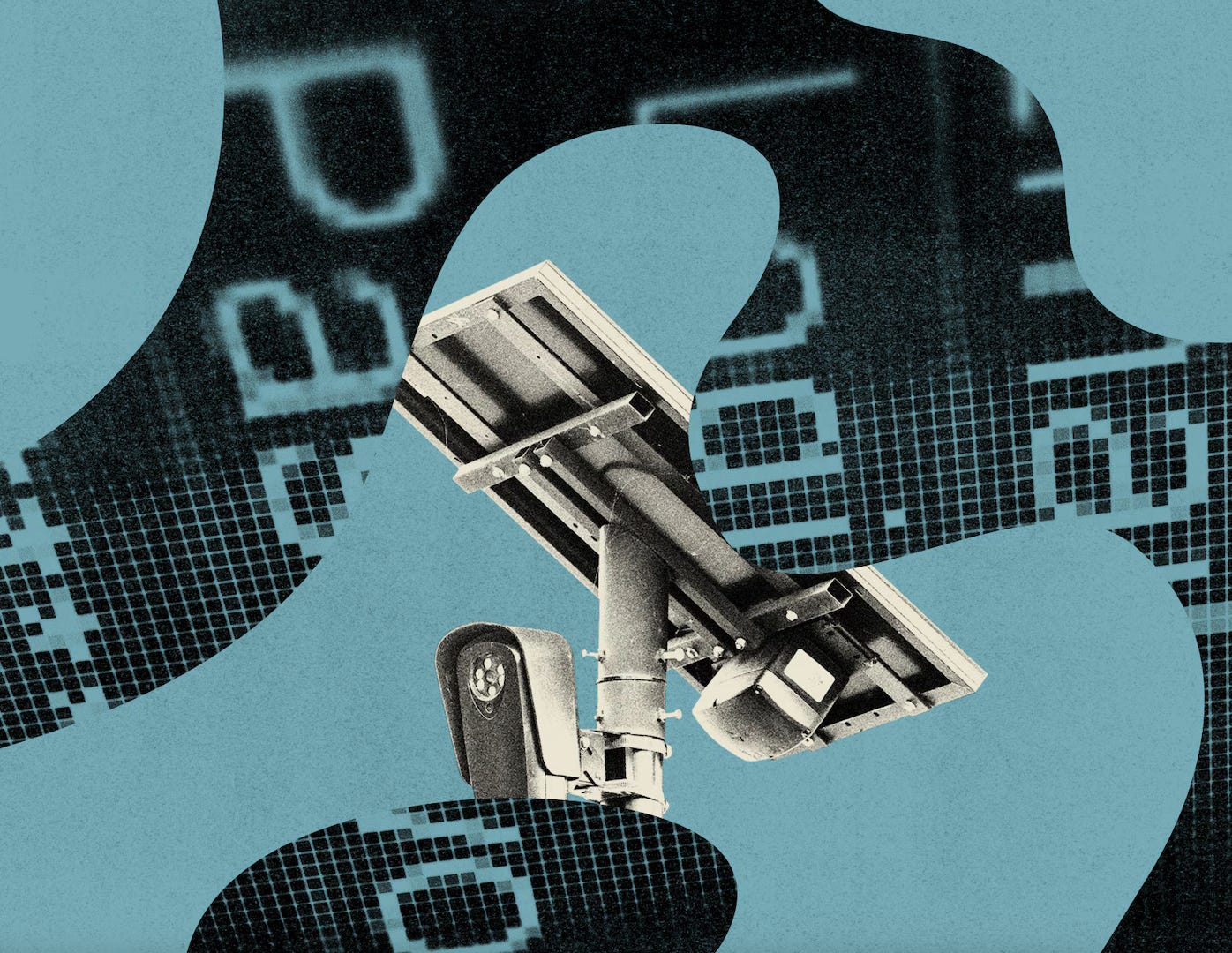
Scott: Surveillance cameras are the centerpiece of any surveillance state worth its salt. Which is why Flock and its project of spreading surveillance across the US is so important. And it seems however low the assumptions surrounding this system, the reality always turns out to be still worse.
Though Flock has pitched itself as a security-first business that closely controls access to its trove of license-plate data, company leaders have resisted calls from their own staff to implement stricter guardrails, according to three former employees who spoke on the condition of anonymity to avoid professional repercussions.
Flock managers told staff repeatedly that they didn’t want to create barriers to securing camera contracts with law enforcement agencies that were resistant to more restrictive security controls, two of the employees said.
To provide the most detailed accounting to date of unauthorized access, including two incidents that have not been previously reported, The Post interviewed police or city officials in eight states and three former Flock employees who worked on technical issues. The Post also analyzed Flock software logs released in response to public records requests, court documents, police records and officials’ statements.
The 11 incidents of unauthorized access tallied by The Post reveal how easily users could gain or retain access to Flock’s data. In four of the cases, officers were able to keep using their log-ins to Flock after leaving the force or while serving a suspension, because their accounts were not shut off. In six of the cases, police shared log-ins or passwords with active law enforcement officers from other agencies, in what officials later deemed violations of state laws, department policies or Flock contracts.
In Indianapolis, a police recruit who was not authorized to access Flock was able to use the tool for more than two years after a more senior officer opened it on the more junior officer’s laptop and didn’t log out. The junior officer, Matthew Binford, used his colleague’s credentials to search his estranged wife’s license plate more than 1,000 times over a 12-month period, according to a court affidavit. Prosecutors criminally charged Binford and four other Indianapolis officers last month, after an August inquiry from The Post prompted an agencywide audit by the city’s police department.
Binford declined to comment when reached by phone.
Flock Safety, an Atlanta-based company valued by investors at $7.5 billion last year, has rapidly built a nationwide surveillance network, blanketing roadsides with at least 120,000 cameras that photograph passing cars and enable police to track suspects’ vehicles over time. The network’s growth has also expanded the potential for abuse: The Post has reported that at least 100 employees of law enforcement agencies have been charged with or accused of misusing license-plate readers for unauthorized purposes.
Flock has been slow to adopt basic safeguards that are standard practice among commercial and government software vendors — measures that could have prevented many of the intrusions, according to security experts interviewed by The Post.
Many police departments don’t require employees to register Flock accounts to a government-issued email address, which could be deactivated at the end of their employment, interviews and officials’ statements show. Though Flock contractually requires the use of official emails, the company acknowledges it hasn’t widely enforced that policy until recently.
While movie-streaming companies like Netflix have built tools to crack down on password sharing, Flock does not appear to closely monitor for log-ins occurring from unusual locations and devices, said Jon Gaines, an independent security researcher.
Marina mania: super-rich compete for superyacht slots
Financial Times
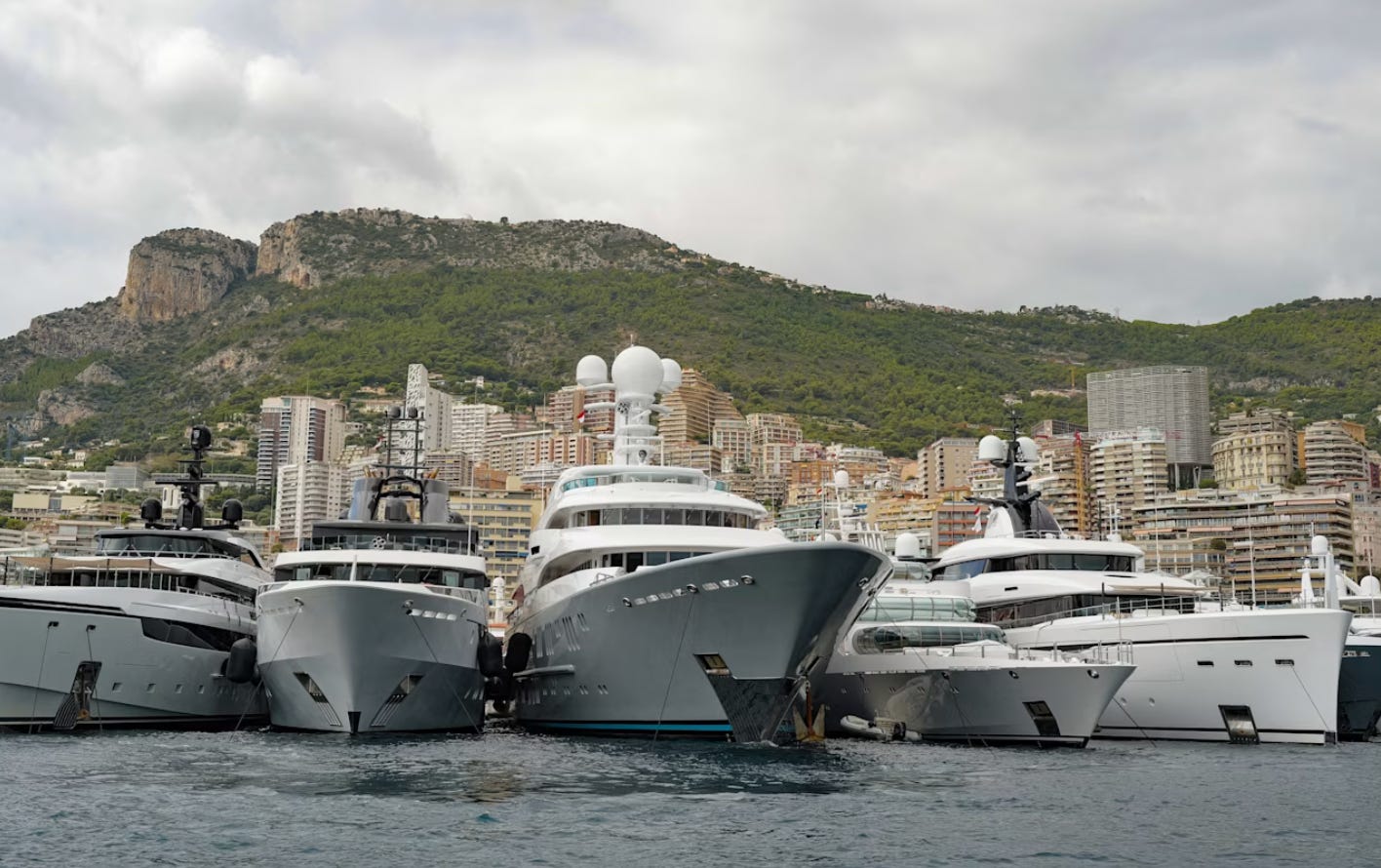
Port Hercule, venue for the annual Monaco Yacht Show
Scott: In the world that Trump, Putin and their tech bro fellow travelers are building, there won’t be money for hospitals and healthcare, but there will be plenty of money for data centers, the development of new AI-guided weapons systems, and for various military entertainments for the empire-builders. On the other hand, the plutocrat class will have a whole new category of trials and tribulations, like finding suitable berths for their superyachts—an obsession shared by the tech bros and the Russian oligarchs.
A group of white yachts — sails down, masts tall — float off the Greek island of Corfu, waiting to dock at the Gouvia marina in the late afternoon sun. It is the first Friday in September and the weather is perfect for sailing — hot, with an occasional breeze.
The Gouvia marina occupies the site of a former Venetian shipyard, built during an Ottoman invasion in 1716. It now encompasses circa 200,000 sq m of green-blue waters, protected from the choppier Mediterranean Sea. Across its pontoons, it can dock 1,300 craft, from small motorboats to multistorey yachts, and today there seem to be almost that number in residence, hardly a spare berth in sight.
“You see each year more and more boats in the Mediterranean Sea, and it is super-tough to build new marinas,” says Oliver Dörschuck, chief executive of D-Marin, which owns the port at Gouvia and more than 20 others in the region. “We normally have three to four boats inquiring for one berth.”
The marina at Gouvia is one of about 400 premium marinas located in the Mediterranean, the global capital of the yachting industry, with around a thousand in total in the region. It is in the same league as the likes of Port Hercule, host of September’s Monaco Yacht Show, and Porto Montenegro.
Yet while the number of yachts is flourishing, the number of marinas is not. Thanks to regulatory barriers, environmental restrictions and a limited supply of suitable locations, it remains difficult to build a port.
This mismatch is turning an overlooked sector into big business. Earlier this year D-Marin was sold by its private equity owners, CVC, to the French investment group InfraVia for more than €1bn. The sale auction drew interest from numerous companies, the latest deal to underscore the attraction of the business model. Industry executives expect further acquisitions.
Marina mania is more than a business play, although it is certainly that. The market is fragmented, with few large-scale players, and demand has grown from clients around the world. But what gives the phenomenon its real spice is that it forces the super-wealthy into competition with each other for a defiantly limited, slowly expanding stock of berths. They may have all the money in the world, but that does not mean they can dock where they please.
Josephine De Luca, who runs an independent consultancy representing boat owners, says that she never had trouble finding a berth at Port Vauban in Antibes for her clients before the pandemic ignited the yacht boom.
“It’s actually about scarcity now, for me that’s really key,” De Luca says. “Berthing — it’s not just more expensive but because the yachts are bigger and there’s a finite amount of berths, the bigger change is being able to get the berth you want.”
The First Green Star, WD J1330+6435

Explanation: Star light, star bright: is there a green star out tonight? Other than the Sun, all stars are so far from Earth that they appear as points in the sky. They are mostly white, but sometimes noticeably red or blue. This color typically relates to the temperature: blue stars are hotter than red stars. What about other colors? The featured image is an illustration showing WD J1330+6435, a white dwarf star, surrounded by an accretion disk with gas and rocks orbiting the star. White dwarfs are small, faint stars that are left over when a star like the Sun exhausts its nuclear fuel. Astronomers recently found that some white dwarf stars, despite their name, would appear yellow, green, cyan, pink, or purple. In these cases, trace elements that were accreted to these stars interact with the stellar atmosphere and shift its normally white color. But, alas! I wish I may, I wish I might, but they are too faint to see tonight…

Illustration: Mark A. Garlick/University of Warwick
Your Online Moment of Zen
City Blocks
Joe Stouter
Oil on canvas
2022