A Sewer of Lies
Since he first entered the White House, Donald Trump has given American journalists a challenge unlike any other: a President who has told many more lies than all of of his 44 predecessors put together.
This is not hyperbole.
On the last day before the 2020 election, which occupied so much of last night’s speech, The Washington Post counted “503 false or misleading claims as he barnstormed across the country in a desperate effort to win reelection.”
For all of his first term, the grand total certified by the Post was 30,573–averaging about 21 a day.
His performance has been numbing. But last night his devotion to the Big Lie was on display like never before, as he heaped one absurd and uncheckable allegation on top of another.
It will take many days to unravel his sewer feed of lies.
As The Guardian wisely pointed out, “Readers should be aware that no one has yet had time to independently examine these documents, making real-time fact-checking of the president’s claims impossible – which might be the point of presenting this avalanche of information all at once, as the president makes hyperbolic claims that it proves all of his lies about the 2020 election.
Except for their Sinclair owned affiliates ABC, NBC, and even CNN–soon to be engulfed by the Ellison megalopolis–all refused to broadcast the president’s speech live.
CBS confirmed its status as a Trump propaganda outlet by running it. But even at CBS Tony Dokoupil preceded the address by telling viewers, “Honestly, much of what the president has said on this topic is false.”
There was exactly one checkable allegation that was tyhpical of the whole speech: “a Department of Homeland Security review of state voter rolls identified 278,000 non-citizens registered to vote in federal elections.”
The Heritage Foundation–the author of the venal Project 2025–begs to differ.
It found 99 cases of suspected noncitizen voting, going back to the year 2000.
RIP, US State Department
Financial Times
Scott: Since the end of World War II, the US Department of State has maintained its position as the globe’s premier organ of diplomatic practice, for better (and on occasion for worse) the standard setter in international relations. Under Trump 1.0 its role was puzzling principally because its ability to speak with the force and authority of the president was unclear. Under Trump 2.0, it has been dramatically hollowed out as a political leader sits at its helm who is uncertain of his role within the regime overall, but focused, like all the Trump entourage, on retaining the personal favor of Trump in hopes perhaps of succeeding him. Most career diplomatic posts remain unfilled, and ambassadorial appointees are uniformly either political hacks or people who purchased their positions for ready cash. Most understand that their mission is to draw the favor of the White House by threatening US annexation of the country to which they are sent or picking fights with local politicians who say something critical of Trump.
A DOS Middle East diplomat I knew in the field described to me a series of visits that Jared Kushner paid to Saudi Arabia. Kushner was emphatic that he wanted no support from the embassy, no note-taker in the form of a junior foreign service officer, no translator. He wanted to meet with senior Saudi officials including the Crown Prince on his own. “It was as if something was going on that would embarrass him if exposed.” And subsequently, of course, it became evident that the urgent matters on which he was consulting with the Saudi Crown Prince prominently included a $2 billion investment in Affinity Partners, Kushner’s investment fund and principal source of income (which, it turns out, has not made any actual investments). America under Trump is the world’s premier kleptocracy, and all levers of government, including diplomacy, are used for rent-seeking by Trump and his inner circle. Understanding this, it is evident why a professional diplomatic service is undesirable, indeed something to be viewed in an adversarial way. Which is why the venerable US Department of State is no more.
As the official face and sometimes swaggering enforcer of America’s position in the world, the state department is accustomed to extraordinary respect abroad. Since the end of the cold war, US ambassadors and envoys have often dominated their hosts with the authority of imperial satraps.
But 18 months into Trump’s second term the department is not just sidelined; it appears under siege.
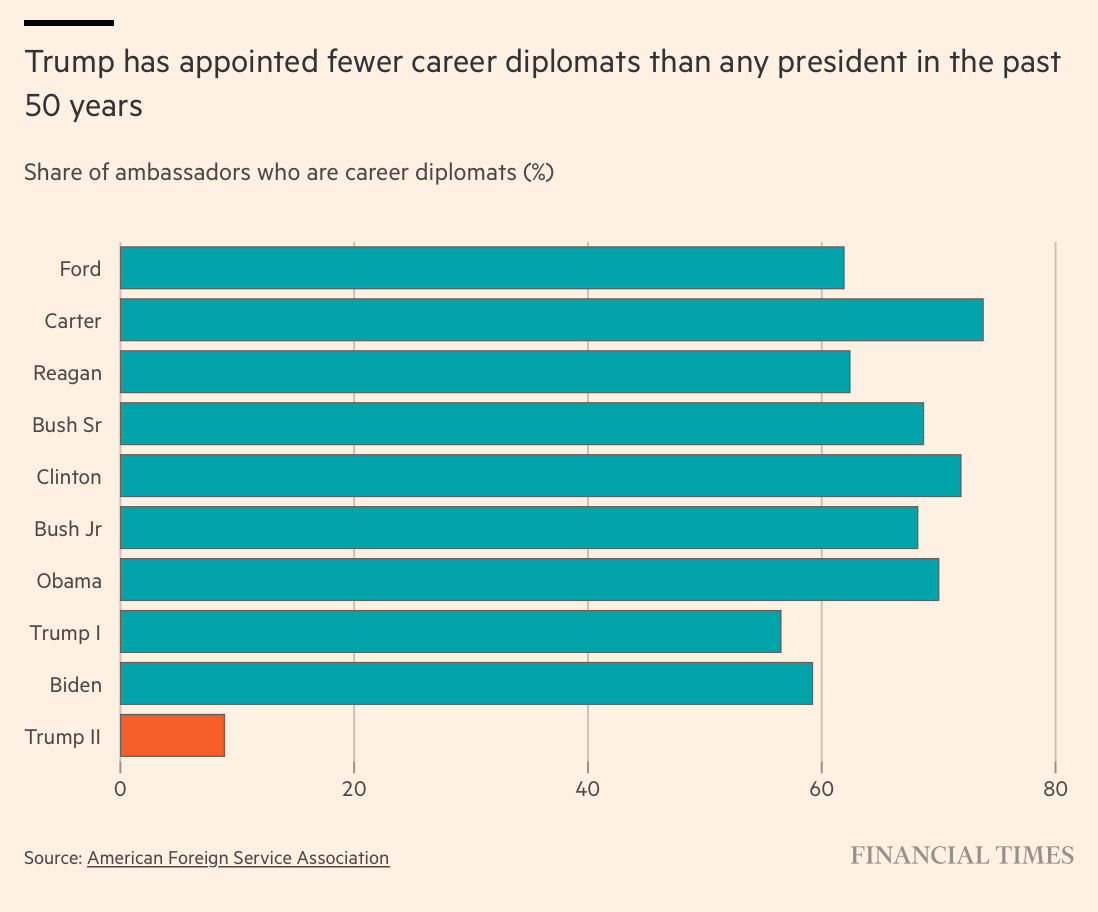
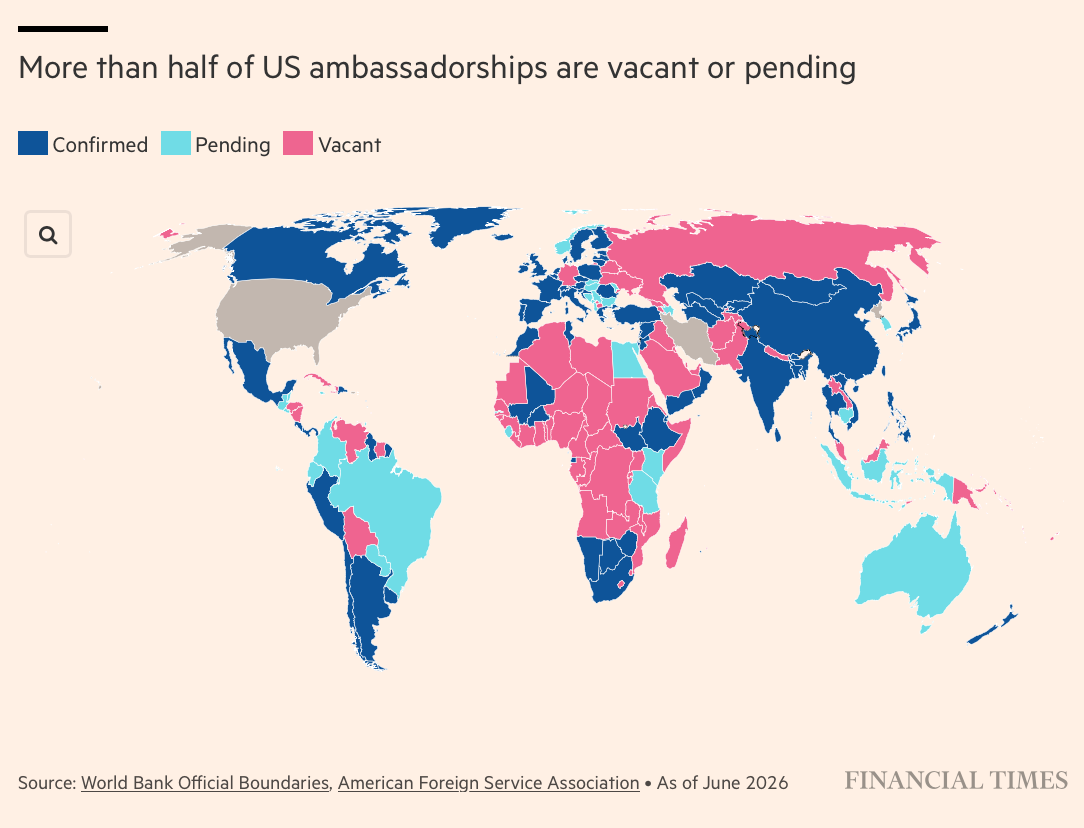
Abandoning the precedent of the past 60 years, Trump has brushed aside the foreign service officers who have typically run at least two-thirds of embassies. Of the 101 nominations for ambassadorships in his second term, just nine were career diplomats.
All this is against the backdrop of swingeing cuts to the department, whose workforce has shrunk by more than 3,000, over 20 per cent, since Trump resumed office.
Administration officials present the shake-up as an overdue reform of a bureaucratic and out-of-touch arm of government. State has, they say, become obstructive, losing sight of its purpose to help achieve America’s national security objectives.
Diplomats warn of a crude politicisation and a purge of experts in an “America First” culture that scorns regional expertise.
All the while, traditional US allies bemoan the loss of the steadying voice of the state department from day-to-day global diplomacy — even as deals crafted by relative ingenues fail to take root.
“We are looking at the most damaging crisis in the 102-year history of the foreign service,” says Nick Burns, who served 31 years in the US foreign service, most recently as ambassador to China until Trump resumed office last year.
Weakening American power?
State department veterans are aghast. Their alarm is not just over the loss of jobs and standing, but over what they see as a weakening of America’s authority through the loss of institutional knowledge and a pivot from diplomacy.
“Things are quite bad,” says Bill Burns, who served in the US foreign service for 32 years including as ambassador to Russia and deputy secretary of state before heading the CIA under President Joe Biden.
“You need that kind of apolitical career expertise to be able to compete with, in this case, Iranian negotiators, who I know from personal experience are deeply versed in the issues,” adds Burns, who was involved in several Iran negotiations himself. “The same is true if we ever get to a point of serious negotiation on Russia and Ukraine.”
Yael Lempert, a 27-year veteran of the department, who was fired as ambassador to Jordan on the first day of Trump’s second term, is blunter. “We were outplayed,” she says. “The Iranians are experienced negotiators and they brought teams of experts with them who knew these issues inside and out. The US did not, and so unilaterally put our side at a disadvantage.”