



A Criminal Probe of Fifa’s Infantino / Bill Gates is Very Afraid / Qatari’s Learn Trump Is Too Expensive to Buy / States Challenge Prediction Markets / Europe Should Follow Canada’s Lead
Uefa prepares criminal complaint against Fifa’s Infantino
Financial Times
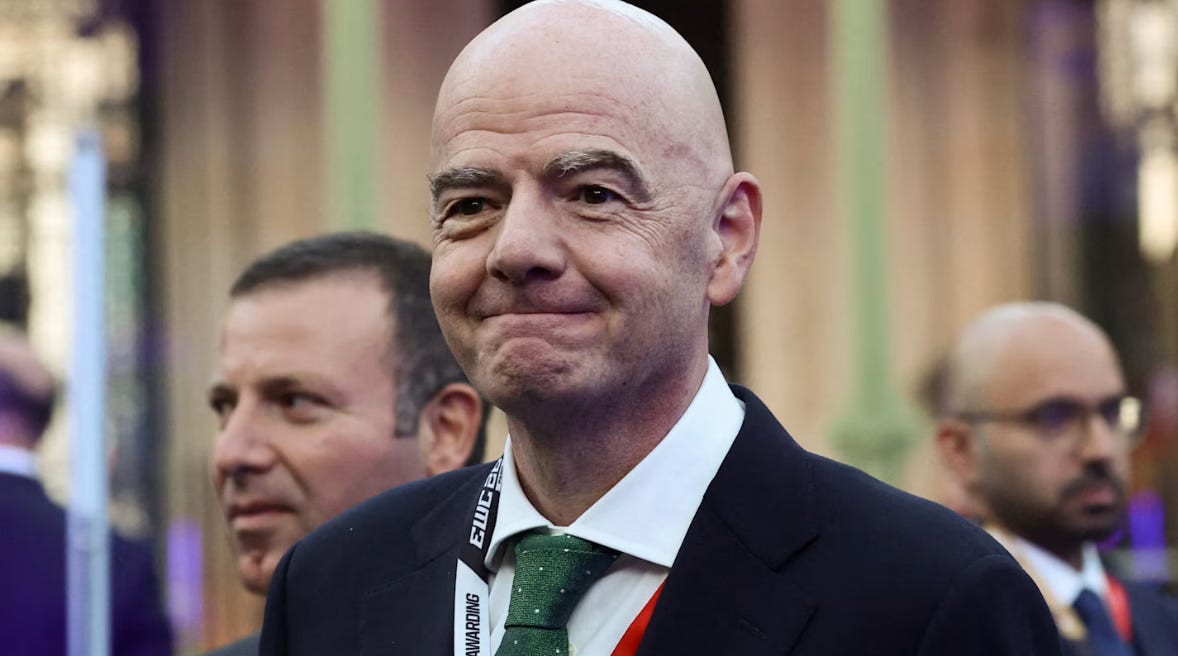
Infantino is facing pressure to resign over the affair. Photo: Reuters
Scott: Let us not lose sight of the fact that all of the criminal conduct enumerated here relates to Infantino’s dealing with Trump, in which the crimes were, in each case, actually initiated by Trump (indeed, the Uefa investigators appear to believe that the award of the “Fifa Peace Prize” to Trump is just a part of the total corrupt bargain). Nevertheless, no investigation into any of this has been undertaken or even suggested by any US federal or state law enforcement agency, nor has any oversight inquiry been held in Congress or by any agency with oversight authority. All of which points to the current environment in the United States, in which corruption of the most outrageous sort is not merely indulged, but actively encouraged. America was once a democracy. It is now a kleptocracy.
European football’s governing body Uefa said it is preparing a criminal complaint against Gianni Infantino over the Fifa president’s failed plan to sell a stake in the World Cup to private investors.
In US court filings, Uefa said it was seeking to recover documents from Joshua Kushner, his investment firm Thrive Capital and Fifa’s Americas arm, as it presses ahead with efforts to oust Infantino from his role at world football’s governing body.
Thrive Eternal, an associated investment vehicle, had been lined up as the lead investor in a new commercial entity called Fifa Forward Enterprise (FFE). Joshua Kushner, founder of both Thrive firms, is the brother of Donald Trump’s son-in-law Jared Kushner.
Infantino’s plan sought to raise $4bn by selling a 20 per cent stake in Fifa’s commercial rights, but the implied $20bn valuation of the proposed entity was “absurdly low”, Uefa said in the documents seen by the FT.
Uefa was “preparing to bring criminal claims in Switzerland against Infantino and possibly other Fifa officials and advisers for criminal mismanagement”, the documents said. Thrive and Fifa did not immediately respond to requests for comment.
The legal move comes as Uefa seeks to keep up the pressure on Infantino over the proposal, which would have split Fifa’s commercial activities from its role as the game’s governing body and rulemaker.
Be Afraid, Very Afraid
New York Times
Charles: Bill Gates joins the AI minority warning that the mad gazillion dollar dash to AI supremacy could easily be the road to perdition.
In an interview with The New York Times, Gates said people “who understand how good this stuff is” are “very worried.” But they won’t say anything in public about the dangers of unregulated AI because it would be bad for business: “Hey, man, don’t say that. It’s bad for us — the next trillion dollars we’re trying to raise.”
Gates said the industry is ignoring what used to be bright red lines for caution, including AI escaping the control of its creators or making recipes for bioweapons.
Even Google DeepMind’s chief executive, Demis Hassabis has called for the U.S. to create an AI watchdog to mitigate potential risks. “Nobody in the world knows for sure what is going to happen from here, and even the experts disagree,” Hassabis wrote in an online post. “When there is a large degree of uncertainty and the stakes are this high, proceeding with cautious optimism is the sensible and correct strategy.”
But the tech brothers effectively purchased Donald Trump before he was inaugurated, and he has obliterated all the AI regulations in an Joe Biden’s extremely sensible Executive Order 14110.
The words of Peter Thiel’s former collaborator Eliezer Yudkowsky are still the ones to remember on this subject:
Many researchers steeped in these issues, including myself, expect that the most likely result of building a superhumanly smart AI, under anything remotely like the current circumstances, is that literally everyone on Earth will die. Not as in “maybe possibly some remote chance,” but as in “that is the obvious thing that would happen.”

Eliezer Yudkowsky
The Qataris Gave Trump a Luxurious Jet. In Exchange He Crippled Their Country.
The Atlantic
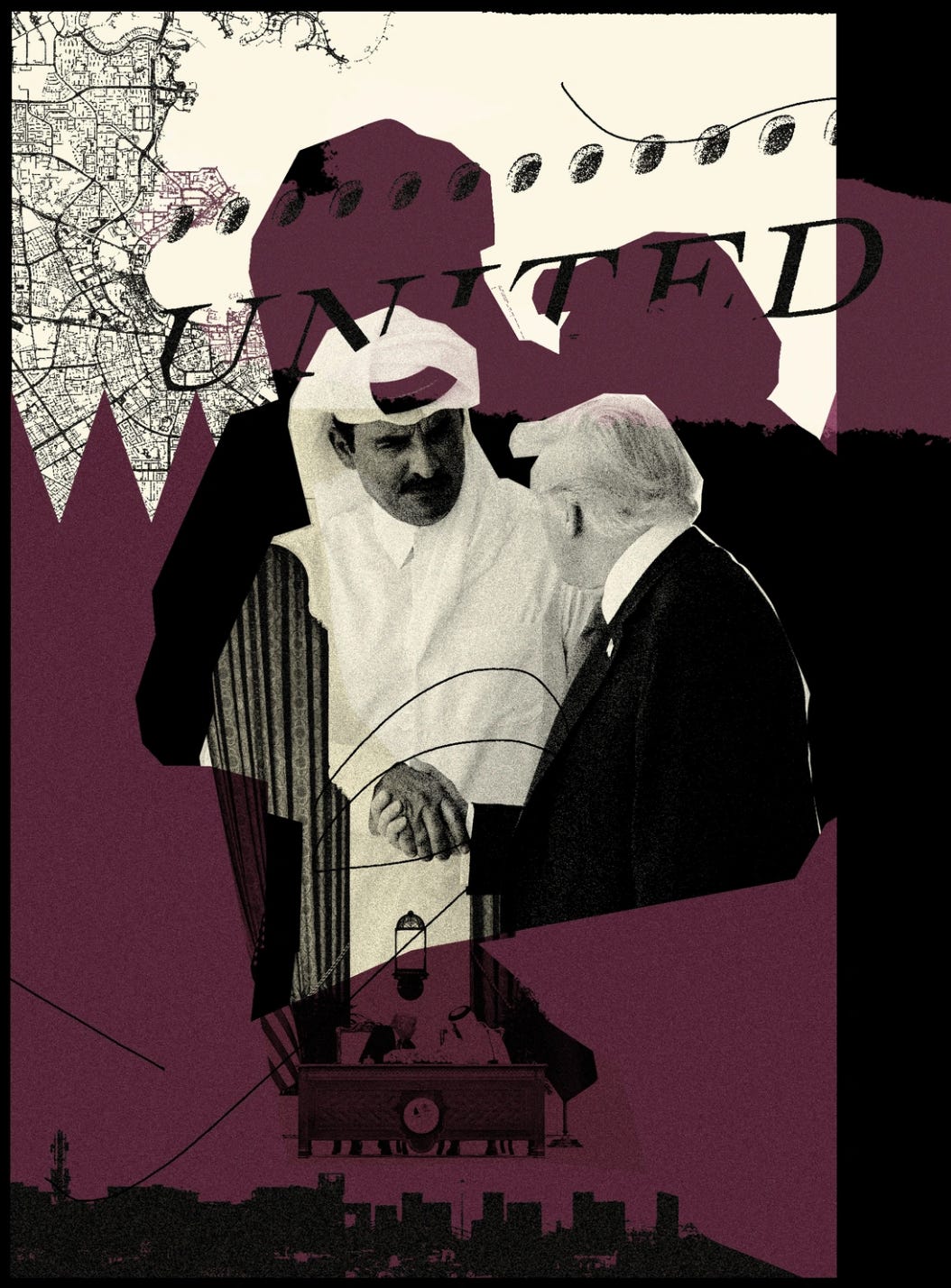
Scott: Across the Gulf area, the US forged over a period of several decades an impressive alliance system that includes 18 US military installations of some significance. All of this can now be counted as a casualty of Trump’s war on Iran. The Gulf Arabs lavished fabulous gifts on Trump and his major surrogates, particularly Jared Kushner (whose take appears to approach some $3 billion) and Donald Trump Jr and his brother Eric. They assumed this would buy them not simply access, but substantive input on issues of importance to them, including the war with their neighbor, Iran. But that’s not how it has worked out. Israel is Trump’s full (and often direction-giving) partner in this war, but the Gulf Arabs are not really viewed as partners at all. They get no meaningful notice of Trump’s often rash and ill-considered actions, and the US devotes no serious resources to their defense against Iranian sabotage, missiles and drones—making them into Iran’s favored whipping boys. And that’s particularly the case for nations like Bahrain, Kuwait, Qatar and Saudi Arabia which are home to large-scale US military installations.
US media have largely ignored the Gulf Arab’s plight in this conflict, because it doesn’t figure on the White House-supplied list of talking points that provides the outline for their coverage. But in this masterful essay in The Atlantic, Shane Harris offers a superb survey of Trump’s dealings with Qatar, and what they got in exchange for their lavish gifts. It all starts with the tale of Trump’s new AF1:
The Qataris knew Trump would want the plane. They understood the man, and his taste. It sat in the same aesthetic register as the comparatively puny “Trump Force One,” the gold-heavy Boeing 757 that he had flown as a private citizen. They also knew that Trump didn’t like the aging, baby-blue 747s that had been carrying presidents since 1990. He’d ordered two new planes from Boeing in 2018, but they were years behind schedule. Trump wanted the 11-bathroom Qatari plane, repainted in a red-white-and-blue color scheme. And he wanted it in time for a flyover on America’s 250th birthday.
This was an absurd demand. Air Force One is meant to serve as an airborne military command post. The Qatari jet would have to be stripped to the studs and retrofitted with encrypted-communications equipment, as well as special material to shield it against the radiological blast of a nuclear weapon, and a variety of countermeasures to foil missiles and rockets. It had taken a Parisian design firm four years to complete the plane’s interiors. It could take American engineers at least that long to convert the jet into a flying fortress.
But these were details to be worked out later. Or not. The Qataris drew up the paperwork for a government-to-government sale. But they should have seen Trump’s next move coming.
People close to Trump—it’s still not clear who—suggested to the Qataris that instead of selling the plane, they could donate it to the United States. A gift. A freebie from “friends” who had already put hundreds of millions of dollars into Trump’s son-in-law’s private-equity firm and bought a debt-laden Manhattan hotel belonging to Steve Witkoff, his Middle East special envoy, for $623 million. That’s to say nothing of the $8 billion they’d spent to build the Americans an air base—the biggest U.S. military base in the Middle East—or their plans to spend $10 billion more to enhance and maintain it. What was another $400 million, for a plane that the president so dearly loved?
Even some Qatari leaders were surprised by the president’s gall. But they did what they’ve always done when an American official has asked them for something dubious—politically, ethically, or even legally. They said yes.
It’s not easy to buy good press, though the Qataris have tried. But it also takes real effort to generate the kind of bad press the plane brought to a country whose name many Americans probably can’t pronounce correctly (it’s kah-tar). The bipartisan outrage in Washington was incandescent. The plane was a flying emolument, an obvious constitutional violation. “Only a FOOL would not accept this gift on behalf of our Country,” Trump wrote on Truth Social. But what Trump couldn’t, or wouldn’t, see is that only a fool would view the plane as anything other than a massive bribe, especially given that Trump said publicly that he planned to have it transferred to his presidential library once he leaves office…
The Qataris play every side, and many of their partners resent them for it. Nonetheless, for decades their experience seemed to show that they really could just buy their national security, along with global influence and even a cosmopolitan culture. Trump must initially have seemed to them to be an ideal partner. And indeed, just four months after the delivery of his airplane, in September 2025, the president signed an executive order that ostensibly guaranteed American protection.
But recently, Qatar’s leaders haven’t gotten what they paid for. In February, the United States attacked Iran with practically no warning to the Qataris, despite the fact that they host a major U.S. military base. Then Iran attacked Qatar, badly damaging the country’s natural-gas facilities, the main source of its wealth. Iran closed the Strait of Hormuz, the only route available to Qatar to export its natural gas, which must be liquefied for transport and is complex to deliver. The country’s neighbors can move oil over land and are planning to build new pipelines now that Iran controls the waterway. But Qatar is stuck, uniquely afflicted by the misadventures of the guy who took their airplane.
In Trump, the Qataris had met a man who could not be bought. He could be paid, and expected to be. But the security the Qataris hoped for turned out to be a protection racket. A man who doesn’t remember yesterday never asks Are we friends? He only wants to know, What have you done for me lately?
