




The Horton-Kaiser Report is independent, we rely on generous support from readers like you.
Charles: In this period of news overload, we can perform a particularly important service by giving you the news you need, which you may not have seen or not had the proper analysis of. You can’t truly understand what’s going on if you’re only a consumer of American media today.
Subscribe The Horton-Kaiser Report for a review of the day’s latest news from US and foreign media, free for two weeks.
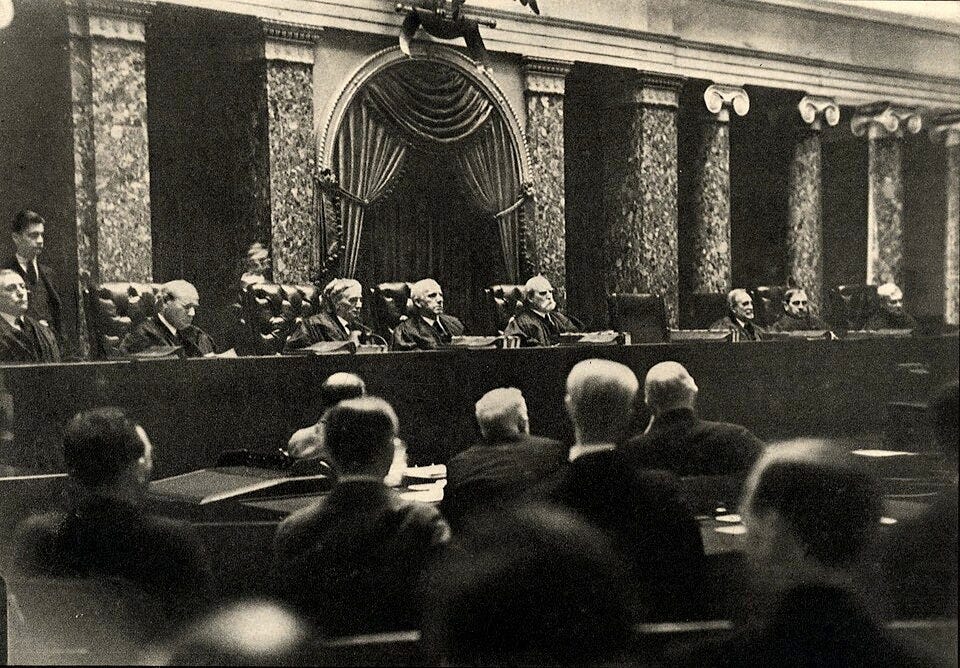
On April 29, a major Voting Rights Act case that came out of Louisiana. The Supreme Court and the decision that was authored by Samuel Alito essentially administered a death knell to what had survived from the Voting Rights Act.
The decision invited states—particularly the 11 states of the old Confederacy, which had engaged in extreme acts of disenfranchisement of Black citizens ever since the end of Reconstruction—to do as they like as long as they cited partisan politics rather than racial animus as their grounds.

“Much of the major-media coverage is casting this in purely political terms,” says Dan Froomkin, editor of Presswatch in an op-ed entitled It’s Black disenfranchisement, not ‘partisan warfare.’ “Just another part of the partisan battle for the House in November.”
Publications like The New York Times are obscuring the issue, says Froomkin:
A May 13 New York Times article started off like this:
Gov. Brian Kemp of Georgia on Wednesday called lawmakers back to the capital next month to redraw the state’s legislative districts for the 2028 election cycle, and to work on changes to the state’s voting system.
The call for a special session, which will begin on June 17, comes as Southern lawmakers have been rushing to reconfigure congressional maps to be more favorable to Republicans for this year’s midterms in response to the recent Supreme Court decision that weakened the Voting Rights Act of 1965.
But in the South, the significance of redistricting goes far beyond any partisan issue.
So let me rewrite that for you:
In a stunning display of racism, white Republican leaders throughout the South are stripping Black people of their franchise in order to retain political power.
The catalyst was a 6-3 Supreme Court decision on April 29 that gutted the Voting Rights Act of 1965, landmark legislation that gave Black people the opportunity to elect candidates of their choice.
Six right-wing justices insisted that intentional voting discrimination is a thing of the past. Southern legislators immediately responded by redrawing election boundaries to dilute the Black vote, in many cases making it virtually impossible for Black people to be elected to Congress.
What has happened in a matter of days amounts to a wrenching reversal of 60 years of racial progress—a revival of the Jim Crow era when Black people had no political power, no matter their number.
On a personal level, Black voters in the South are struggling with the repercussions of having one of their essential rights being brutally ripped away from them.
In states like Georgia, Louisiana, and Mississippi, where they make up more than 30 percent of the population, Black Americans will have little to no say in who is elected to Congress. And as the effects of the court decision trickle down to the local level, they may get shut out of some of those elections as well.
Meanwhile, the leaders of the white nationalist movement known as MAGA are celebrating. In some cases, their racism is expressed openly. “For too long, Tennessee politics has been dominated by cosmopolitan communists and race hustlers imposing their corrupt will on a deeply rural and conservative state,” Representative Andy Ogles of Tennessee posted on social media.
For the authoritarian leaders of MAGA, the dilution and nullification of Black votes is a crucial step in their quest to remain in power—even as most voters have turned against them.
MAGA’s future depends on suppressing the votes of groups that don’t support its white-male dominated Christian nationalist ideology. Reducing minority representation, to them, is essential to destroying majority rule. Destroying Majority rule is how they win.
Gerrymandering that leads to Southern states being almost entirely represented by white, right-wing elected officials dramatically improves MAGA’s political calculus. In the short run, it improves the odds of retaining Congress in November. MAGA’ strategy to keep the White House in 2028 includes yet more Black disenfranchisement, through voter intimidation, deception and disruption.
So far, MAGA’s plan is working, raising the prospect that Trump and his successors may remain in power for the foreseeable future.
But another way to characterize the current drive to disenfranchise Black voters is that it is the desperate—and maybe final—act of a white nationalist party that is being rejected by increasing number of voters.
Final Coup de Grâce to the Voting Rights Act
Scott: On April 29, the Supreme Court, speaking through the voice of its single most corrupt justice—Justice Samuel Alito—delivered its final coup de grâce to the Voting Rights Act of 1965, the crown jewel of the nation’s civil rights legislation.
Its ruling is an invitation to the Republican-ruled states of the Old Confederacy to reintroduce the regime they followed before the Civil Rights Era of gerrymandering congressional districts so as to eliminate any district that could be won by a Black candidate, including in states like Mississippi and Louisiana where Black people account for more than a third of the population as a whole.
The only requirement is that the Republican-controlled legislatures must say they are motivated by partisan politics rather than racism. To reach this conclusion, the Court set aside its own precedents stretching back over a period of sixty years, making a mockery of the rule of stare decisis.
This ruling’s rationale is brazenly partisan, its motivation to give the GOP another dozen seats in Congress and to hinder what appears to be an approaching blue wave in the midterm elections.
Editors’ note: This episode of The Horton-Kaiser Report was recorded on May 19, 2026.
Credits
Host
Scott Horton and Charles Kaiser
Guest
Dan Froomkin
Producer
Imogen Sayers, Scott Horton and Charles Kaiser
Music
Kinan Azmeh
Clips
What the Supreme Court Voting Rights Act ruling is really all about
Selma native Rep. Terri Sewell on GOP’s new voting rights assault: ‘We have to mobilize & organize’
Blame John Roberts For Destroying the Voting Rights Act - YouTube
Trump, DOJ settle $10 billion lawsuit against IRS and Treasury Department over leaked tax returns
Justice Department sets up ‘anti-weaponization fund’ after Trump drops IRS lawsuit
Lawmakers react to Trump’s IRS settlement
‘Crisis for the rule of law’: Why Trump’s IRS settlements is be called a ‘defacto pardon’
‘WE NEED TO WATCH OUT’: Maddow sounds alarm on ICE surveillance as Trump wields new weapon
AI Chatbots: Last Week Tonight with John Oliver (HBO)


