

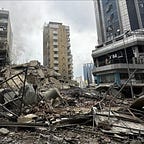


Yesterday, Israel marked the implementation of a ceasefire agreement, which as announced explicitly included Lebanon—it also marked heaviest day’s bombardment of the country since the war began. Israel’s attacks had a focus on the heavily populated, mixed commercial and residential, center of the city of Beirut—an area which the International Committee of the Red Cross noted contained no obvious military targets. The current conflict is now widely dubbed the “Iran War,” yet Lebanon, though not itself a combatant, has become a separate focus of the war, which is a pretty one-sided affair: Israel dropping bombs on its targets.
Israel styles this a war against Hezbollah—a Shia group that has considerable political clout inside Lebanon and wields de facto control over much of its territory, and which is closely aligned with the clerical-Islamic Revolutionary Guard Corps regime in Tehran.
Following a practice that was honed in the Gaza War, the Israeli military invariably justifies attacks on what are plainly civilian targets, like apartment blocks, by saying that they had a legitimate military target. Perhaps a Hezbollah commander lived in the apartment block, for instance. But the destruction in many parts of Lebanon, particularly the area around and south of the Litani River and the heavily Shia southern part of Beirut, is so extensive that this sort of justification raises obvious objection among independent observers about Israel’s actual intentions.
The official word in Israel is that the intention is to secure ‘peace for Galilee,’ to stop the periodic shelling of the settlements in Israel’s far north. For the United States, even less effort has been made to justify the bombings than is the case for Iran. But it seems increasingly clear that the Israeli effort entails a Gaza-style approach both to the adjustment of boundaries and a conscious decision to displace a large population (the International Organization for Migration put the number of internally displaced persons in Lebanon at over 1 million when the war began, and that number has certainly grown). These objectives are being achieved largely by demands for evacuation coupled with bombing strikes that have destroyed entire towns and villages. In the end, it is clear, Israeli planners would be satisfied with an outcome in which Lebanon is reduced to a pile of smoldering rubbish, consumed by chaos and civil war.

With this in mind, we settled on the best war correspondent now reporting out of Lebanon, Abdi Latif Dahir of the New York Times, for our first podcast interview, and made the war in Lebanon the subject.
“The Israeli defense minister came out last week, essentially talking about how this operation is going to continue and that they’re going to occupy much of southern Lebanon. Initially, when this war started, they talked a lot about deterring Hezbollah.
But I think those comments from last week were the clearest indication that they intend to control the region even after this invasion is over. It’s going to, as you said, basically control this stretch of territory that is At its farthest point in Lebanon, like it’s about 20 miles, I think, from Israel.”…
“More than a million people, in a country that just has less than six million people have been displaced. And so pretty much everywhere you go, there are people are sleeping inside cars. The shelters are really packed.”
Editors’ note—This episode of The Horton-Kaiser Report was recorded on April 5th, 2026, before Trump’s genocidal Truth posts and the so-called ceasefire which Israel has ignored when it comes to incessantly bombing Lebanon.
Please power through the audio quality, we promise the content is good and important.
Credits
Host
Scott Horton and Charles Kaiser
Producer
Imogen Sayers, Scott Horton and Charles Kaiser
Field recording
Abdi Latif Dahir
Music
Kinan Azmeh
Read the transcript
[00:00:00] Imogen Sayers: You are listening to the Horton Kaiser report.
[00:00:10] Charles Kaiser: Welcome to the Horton Kaiser report. Scott Horton and I first bonded 20 years ago when we were each blogging about the horrendous torture being carried out by the second Bush administration during the War on Terror. We both thought it was a terrible thing. We’ve kept in touch ever since. I have noticed that whenever I’ve read Scott on Blue Sky, I was the best educated person in the room that day.
This is because he’s not only a great lawyer and a fine journalist, he’s also the most assiduous consumer of media who I’ve ever met. This means that when you read our. Newsletter, you’ll get the benefit of his reading of newspapers in Italy, France, Germany, Russia, and many, many other places.
[00:00:58] Scott Horton: I quickly came across Charles Kaiser as someone who thought about things almost exactly the same way I did and prioritized the same thing.
So I think we had a kindred spirit. And the perspective, I’m trying to think. We may have had disagreements at some point along the line about something. I can’t recall exactly what something about Trump, I think.
[00:01:18] Charles Kaiser: We had a slight disagreement about that, but as you say, 99% of the time we are on the same page about everything that’s going on in the world.
[00:01:28] Scott Horton: Exactly. It’s rare.
[00:01:29] Charles Kaiser: I came to this originally as a metro reporter for the New York Times. I covered all the city beats, including real estate, where I met one Donald Trump in the 1970s, and I ended up at City Hall and then I was a media reporter at the Wall Street Journal, and then I got into the business that we’re still in.
As the press critic at Newsweek, which was really my best staff job. And after that I’ve written books about the 1960s, about gay life in America since 1940, and about one family in the French resistance who I’ve known all my life.
[00:02:02] Scott Horton: I’d say I have a passion for looking at war reporting and the problems that people who do war reporting face.
In fact, my legal career, I spent a good deal of time. Working for CBS news for NBC News. For the Associated Press and for other publications helping their war reporters when they got into legal troubles and doing war zone reporting. And I handled trials and gave tactical advice and other things and spent quite a bit of time in war theaters, particularly in Iraq and Afghanistan during those wars.
So, you know, I think one thing we’ll be doing regularly here is inviting in war reporters and getting their fresh perspective on what’s going on.
[00:02:50] Charles Kaiser: We’re launching the first podcast today with Abdi Latif Dahir, the new Beirut correspondent of the New York Times. Before he got to Beirut last November, he had been covering East Africa for four years and he did a groundbreaking series with Justin Scheck and Vivian Nereim, which is the winner of this year’s Poke award.
It chronicled the way. Nairobi women were being trafficked to Saudi Arabia by a company controlled by the family of the Kenyan president and sent to members of the Royal family in Saudi Arabia.
[00:03:33] Scott Horton: Abdi, it’s really great to have you with us, and particularly given the circumstances that prevail today in Beirut, it’s looks to be chaotic and difficult and I think one of the most important things we look to war reporters to do is to measure the rhetoric of governments against what they’re actually doing on the ground.
So with that in mind, I’d like to ask you to give us a sketch of how. The, um, government of Israel has described its operations in Lebanon to date and contrast that with what you’re actually observing on the ground.
[00:04:12] Abdi Latif Dahir: Thank you Scott, and thank you Charles. And congratulations again on, on this incredible Substack, uh, which has been incredible and informative in parsing the Israeli government and the way the government of Prime Minister Bibi Netanyahu has been talking about this.
The government basically frames its operations. In Lebanon as precise, targeted, defensive. They talk a lot about like neutralizing Hezbollah’s military capabilities, preventing attacks on Israeli civilians, particularly those civilians who live in Northern Israel and. While a lot of these strikes have been able to target like, you know, specific Hezbollah infrastructure, I think what’s interesting and what’s been harrowing to observe has been the broader effects of these strikes.
Like a lot of them actually have damaged civilian areas. Civilian infrastructure like bridges, they’ve targeted hospitals and clinics. They have disrupted businesses. They’ve created massive humanitarian challenges. A large part of that, besides Southern Lebanon, the strikes have been happening in Beirut, particularly in the southern suburb.
Called where Hezbollah holds a lot of sway and tens of thousands of people who live in this area have now completely been uprooted. They’ve been forced out of their homes because of repeated evacuation warnings from the Israeli government. It’s a quite a dense, both residential but also very commercial area.
So a lot of those people have now been displaced. They’ve left their homes. So while the Israeli government essentially says that it’s targeting Hezbollah and it’s targeting this militant group that is also aligned with Iran. At the same time, like, you know, what we’ve been able to observe is essentially this catastrophic damage that it’s brought into civilians.
[00:06:01] Charles Kaiser: Let’s talk a little bit about how life has changed in Beirut. You arrived as the Beirut correspondent from the New York Times in November, and the war is now in its what, fourth week? Contrast your initial experience of being a new Beirut resident before and after this war began?
[00:06:19] Abdi Latif Dahir: Yeah, so I arrived in November, 2025, full-time, I should say, because I had been here on various stints, but.
I arrived in a country, in a city that it was slowly coming back to life. So many people that I spoke to in those first few weeks, particularly as the Pope came here on his first international, uh, trip, they were very hopeful. Many people were thinking that after a. Grueling war in 2024 that finally the country was taking slow steps to its stability.
Many places, for instance, like with the nightlife that had closed, had started reopening. A lot of businesses were getting renovated. And of course, like you have to remember the complex history of this country of just even in the last five years, gone through like a major financial crisis, that there was the Beirut Port explosion, then there was the 2024 war.
So there was a sense of things were looking up. And February, pretty much like for me, encapsulated that, like I went to a lot of gallery openings. I had met new friends, I was invited to people’s homes, and Christmas was pretty much the same too. And then the war started so quickly that it, over the last four or five weeks, it’s been incredibly difficult to even parse through this.
Difficult moment and how fast it’s moving. Like, you know, we just woke up one night at 2:50 AM I remember very vividly, uh, in this apartment and there was like a huge sort of like explosion or like, they shook the house and I was like, what’s happening? I was kind of like thinking that I was dreaming. Uh, and then the next thing you know, the second strike was happening and the third strike was happening and I went online and everybody was awake and it’s just been nonstop for the last five weeks.
A lot of people were telling me about the war and how things can quickly escalate, but it’s been interesting to live that and just be able to report on the harrowing realities and the difficult circumstances that the people are going through right now.
[00:08:08] Charles Kaiser: Are the streets spilled with refugees all over the place? What are the streets like?
[00:08:12] Abdi Latif Dahir: Yes.
About more than a million people in a country that just has less than 6 million people have been displaced. And so pretty much like everywhere you go there are. People are sleeping inside cars. The shelters are really packed. So many public schools are closed in the evening.
Like if you take a walk, it’s usually people, you’ll find people always sleeping in the cars or just like have bonfires under roundabouts. It’s really quite difficult and it’s very visible, whatever, whichever neighborhood you go to. Some neighborhoods less than others. But it’s a pretty much yes displaced people or somebody who knows somebody who’s displaced or somebody who’s going out to like support other displaced people. It’s almost like a conversation that’s happening among everybody.
[00:08:56] Scott Horton: How are international relief organizations dealing with the internally displaced persons? What organizations are there? What are they doing? How are they able to address the situation?
[00:09:07] Abdi Latif Dahir: Yeah, there are a lot of like international organizations working like Doctors Without Borders, international Rescue Committee, international Organization for Migration. Other UN agencies are all working, particularly in Beirut, where a lot of people have come, or like closer to Beirut, like Townsends, where a lot of people who fled the South have also. Come. But the one thing that pretty much a lot of people that I have spoken to in the aid industry have talked about is that.
It’s a really difficult time to provide aid and humanitarian services, largely because so many of them lost their funding. Like the United States was like such a massive funder of aid in humanitarian services, not just to the Middle East, but like even Africa, Asia, so many other places. And I think with Trump, with the Trump administration, that has been lost.
So pretty much everywhere you go and like talk to eight groups, relief agencies, aid workers, everybody’s telling you like. Yes, in 2024 when all of this was happening, we had like 20 staff members, we had this many Lebanese staff members. We were able to like bring in people from abroad, like, you know, who had expertise on migration and whatnot.
None of that exists now. Right? And so I think you definitely are feeling the impact of the, the Trump eight cuts. You know, as usual, the Lebanese are quite resilient and they’re quite resourceful. So many people have come together to basically donate food. They make thousands of meals a day. A lot of cafes and restaurants basically have all these donation boxes or like they say that, that we are donating this many meals every single day.
There is a sense of camaraderie that you’re feeling, particularly around Beirut, but like immediately you hit the road out of Beirut.
There’s a sense of a lot of aid organizations just being like, we don’t have much, we’re not able to provide this. Or last time for it, like on Friday, I was. We were inside the, in the south, and somebody was telling us that in 2024 they had like about 10 mental health therapists who were coming in quite regularly to work with like all these displaced people, but like now that they have only two and they, it’s just impossible to be able to take care of people in that shelter that we were at, which has about 400 people.
[00:11:13] Charles Kaiser: Has the war affected any of the basic services in Beirut? Electricity, water, telephone, internet, anything like that.
[00:11:22] Abdi Latif Dahir: I will be honest and say that we live in an incredible bubble when it comes to like the challenges that people face every single day, particularly since the 2024. Electricity is still a problem, water is still a problem.
Heating is still a problem, and particularly if this goes into the summer, it’s just gonna be incredibly difficult. The fuel prices were already increasing even before the war started, and there were actually protests in Beirut about the increasing fuel prices. And now because of that increase, because of the ongoing economic crisis that preceded even this conflict, right?
The collapse of the Lebanese pound, the supply disruptions, and then of course all the. Disruptions that this current ongoing bombardments have created. All of this is now coming together to essentially make life incredibly difficult. Like transportation is expensive, like. I take Ubers around quite a lot or taxis and or even public services sometimes.
And pretty much like they would always tell you like, Hey, can you give me a dollar extra $2 extra $3 extra large? Because it’s quite difficult to find gas. It’s food prices have increased. They have so many other relatives or friends who are either displaced or have lost their jobs. So it’s really quite a dire reality for so many people.
And it was already, even before this conflict started, and now it’s just completely compounded.
[00:12:40] Charles Kaiser: What’s the closest bombardment you’ve witnessed? What’s the, how far away have you been from the closest bombardment?
[00:12:47] Abdi Latif Dahir: That’s a good question. I think it was probably the one that happened in Central. Beirut, which is just basically across the highway from where I am right now.
So about four, 500 meters. But essentially we had gotten the warning, it was about 4:30 AM in the morning.
[00:13:07] Charles Kaiser: How do you get a warning at four 30 on your phone?
[00:13:10] Abdi Latif Dahir: On the phone. Yeah, so basically the Israeli government or the Israeli military essentially either tweets them or they share them on telegram and immediately those things that’s shared, like you almost always like people are resharing or are quickly sending it to you or, so this was like quite shocking in that it wasn’t in the southern suburbs, like this was actually happening in a building in Central Beirut and everybody was like quite alarmed that this was happening.
You’ve been glu phones, your belly is sleeping. Even when you black out, you’re always thinking about what’s next? Is everything okay? And so we, I immediately got this and was just sitting up in bed, like waiting to hear it. And it was like interesting because right before that happened, you know, because.
It was closer to dawn. You could hear the birds chirping. You could hear the call to prayers from a nearby mosque, and then it was such a serene, beautiful morning. And then the next thing, you have this insane whoosh coming from like the sky, just like striking this building. And the entire neighborhood just there was this massive explosion that just rocked everything.
And it was, I think, one of the first buildings in Beirut in this war to be completely demolished.
[00:14:22] Charles Kaiser: And was it portrayed by the Israelis as a Hezbollah stronghold? What would, did they say what the, they thought they were doing?
[00:14:30] Abdi Latif Dahir: Yes, they said that the building had a storage for Hezbollah money, that there were millions of dollars that were hidden under it that belonged to Hezbollah, even though many people after that came out saying that we are civilians.
We are doctors, we are teachers, we are educators. We have worked all our lives to be able to afford an apartment in Central Beirut so that our kids and their grandkids can have something as an investment. And here we are, sort of like it’s completely gone right now.
[00:15:00] Charles Kaiser: Have there been other buildings in the center of Beirut that have been hit?
[00:15:04] Abdi Latif Dahir: Yes. So the yesterday was quite an in. Interesting. I should actually talk a little bit about the history. Yes. Other buildings and have been hit that are outside of the southern suburbs, they hit a hotel right by the beach where the, which where I used to. I’d love to actually jog and exercise to was hit.
They have hit other residential areas. Yesterday was quite interesting because two different residential areas that are not in the southern suburbs were hit even as the city was on a public holiday because people are marking Easter. So yeah. Other places that are not in the suburb, southern suburbs have been hit.
And so there’s now this sense of for of no way is peaceful. No way is safe, anything can be a target.
[00:15:50] Scott Horton: A major focus of concern right now is the south, what’s going on in the area 16 kilometers north of the Lat River, and the promise of, or the suggestion that there will be a mass displacement of the civilian population of this area.
So is Israel in their operations there, are they making a distinction based on ethnicity or faith?
[00:16:11] Abdi Latif Dahir: Yes, they are. We now know, particularly the Israeli defense Minister came out last week essentially talking about like how this operation is going to continue and that they’re going to occupy much of Southern Lebanon.
Initially when this war started, they talked a lot about the Tering, Hezbollah, but. I think those comments from last week were the clearest indication that they intend to control the region. Even after this invasion is over, it’s going to, as you said, like basically control this stretch of territory that is at its farthest point in Lebanon, like it’s about 20 miles, I think from Israel.
They said about 600,000 people who’ve been displaced from these areas are not going to be allowed to come back, and we now know that they have made calls to people in some of those. Towns, villages, particularly to the mayors of some of those villages and towns, essentially saying that we are going to Christian communities essentially and telling them that yes, if Hezbollah is not hiding amongst you, we’re going to let you stay in your villages.
Nothing is gonna happen to you, but if Hezbollah and anybody within the. Larger Shia displaced communities are in those villages. We’re going to be attacking you. So you definitely are seeing that there’s yes, an intention to occupy, but also an intention where they are making a distinction of residents by faith.
[00:17:33] Scott Horton: That reporting about the outreach from Israeli authorities to mayors and civic leaders in Christian communities suggesting the differentiation that was in your reporting from last week, as I recall, it was a particularly striking story. I guess I’d like to ask you is a bit of a follow up on that, about the role the United States is playing in all of this.
‘cause of course we’ve seen reports that the US Ambassador and Lebanon called on the IDF to protect. The Christian Villages and the South, and I was wondering if you had any detail on that statement, what led to it and what the reaction to it has been?
[00:18:11] Abdi Latif Dahir: Yeah, so that statement came about when the US ambassador to Lebanon met the Maronite patriarch, and essentially he was talking about Christian communities in the South, and he basically said that he had told the maronite that from day one of the conflict that they had asked the Israelis to spare the Christian border of village.
Particularly those in the south, of course, from the bombing. I think the comments particularly were quite amplified and reverberated across this country, largely because it’s a country built by different faiths, different sects, and that question around sectarian politics is like quite a touchy subject here.
In terms of the way it’s been received. Christian communities, particularly those in the South, may welcome some of these statements, particularly as a sign of international attention to their own safety, right? Many of those communities are still in those villages, particularly right now in very dire situation as they mark this Easter holiday, but.
For opposition groups, for people of different faiths, particularly within the Shia communities and Hezbollah supporters, they see this as another foreign interference, right? They see it as a partiality that according to some people, like even that we spoke to in the southern city of DER like a couple of days ago, undermining Lebanon sovereignty, and it’s quite a difficult reality to look at this country, which.
Has had quite a history of like complex sectarian landscape, long civil war in the seventies into the 1990. And so all of that now being amplified by the fact that this armed group that is close to and linked to the Iranians and is a Shia and the fact that now it’s decided to go into this war while supporting Iran and.
So many other people within the country, whether they’re Sunni Muslim, whether they are Jews, whether they are Christians, essentially being against this.
[00:20:07] Scott Horton: We see a lot of stories coming, particularly out of Israeli media, about there being a plan to give the south the sort of Gaza treatment, which would be bombardment, destroying all residential buildings and the far broader, uh, destruction with teams then going in and finalizing the destruction on the ground.
And I’m just wondering, to what extent do you see or have you heard. Locally reports of that sort of conduct and the operation going on.
[00:20:37] Abdi Latif Dahir: Yeah, I mean, the Israeli defense minister basically said that they will demolish towns and they are already demolishing towns. Right. We’ve seen some of that with the satellite imagery that are coming out, and when you talk to a lot of the people who fled the south, I think that’s the big fear that is happening now, that there is going to be.
I was just actually talking to a few more people today. I went to meet who are from the South, and I was asking them about the villages that they came from in the towns like Illa, which is quite a massive commercial like town. It’s historically known to be this sort of like center of trade. And in when I went there, I remember.
After the last war in 2024, like the entire market, I wrote a story about the market, this historic market that was completely leveled. And I met like another person who has a shop at the market today. And basically he is like, yeah, what you saw in 2024 is like nothing like you’re seeing today. So I think this idea of buildings being raised.
Entire towns being demolished and leveled. The fact that all these bridges that connect the south to the rest of the country, I think there’s only probably one standing, like many of them have been completely destroyed. This idea of also the fact that this war now is no longer just a war about. Lebanon and Israel, but it’s a regional war that involves Iran that in involves much bigger powers than Lebanon.
And you look at everything else that has happened in terms of the trauma that people already have about what happened in 2024. So was asking people today like, you know, who’ve lived through the 1982 and the Civil War and the invasion, and the 2006 war and the 2024, like if they all think that what’s going on now is gonna be much worse or is already much worse, pretty much everybody.
Agrees that it’s going to be.
[00:22:24] Scott Horton: How do decision makers in Lebanon today and opinion leaders view the policy of the Trump administration towards them? It’s really not clear to me certainly what the policy is towards Lebanon.
[00:22:39] Abdi Latif Dahir: That’s a good question. The role of America in Lebanon is, and particularly over the past year, it’s just been driven by this idea that you have to disarm Hezbollah, right?
And that you have to take their arms. I think. This war, it’s just. Reinforce like existing divides rather than like, how do I say this? Uniformly shifting sentiment about the United States, like many Lebanese, particularly the people they already view the US policy skeptics, particularly in relation to Israel, particularly in relation to when they look at larger regional intervention that the Americans have done.
So the war. For maybe the people in the communities, in the Shia communities, it’s already deepened anti-American feelings. A lot of people feel that America’s attack of Iran, the killing of Hani, its support of Israel, it’s creating or is exacerbating instability in the Middle East. I think for others it’s particularly for people in government who see Hezbollah as destabilizing force.
They look to the United States to basically be this ally, but I think it’s also like this war with Iran. The fact that they are here now, the fact that this has created another conflict in the region that has now in return also destabilizing Lebanon. And then there are also others for whom the anti-American sentiment is limited.
They’re mostly just worried about local governance, corruption, security, like how can the Lebanese state function and how can the United States support. Uh, a stronger Lebanese state to come into being.
[00:24:09] Charles Kaiser: What’s the situation at the airport? Is Middle East Airlines still flying every day?
[00:24:13] Abdi Latif Dahir: Middle East Airlines is still flying every day.
Quite the sense of resilience that is known among the Lebanese. It really has come to symbolize this. It’s the only way of leaving the country, even as many airlines have. Cancel their flights or rerouted. And so yeah, there’s no other way of looking at it other than to just appreciate that in a country that is locked in between these incredible powers that are fighting each other and fighting it, and are fighting on its land and have this one way of leaving the country, which is like to the sea that you’re able to fly out.
So people still hold onto that and I think it, it gives many, also for some of the people that I’ve spoken to, like it also still gives them the psychological. Like wellbeing or sense of, of calm in that they know that they can leave the country or some of their relatives can come to the country because people, Lebanese never stop.
Right. A lot of people have been on social media being like, I’m not canceling my summer plans to go to Lebanon no matter what happens.
[00:25:12] Charles Kaiser: Yeah. I was with someone yesterday whose partner’s grandmother was about to go to Lebanon to visit the grandchildren. Right now.
[00:25:19] Abdi Latif Dahir: Yes. They never stopped the first day of the conflict like we were in this upper view, like a neighborhood is like looking at the southern suburbs and also looking at the airport.
And there was this warning for some neighborhoods to be evacuated in the south. So they evacuated. And then the Israeli strike hit and literally five minutes later there, there was a plane taking off from the airport. And you could just see all of this. The smoke was still rising and the, but the fly just took off and yeah, it’s just another day in Beirut.
[00:25:49] Scott Horton: I’d like to ask you a little bit about a AUB, I mean you, you went to an American university abroad, and a AUB of course is often characterized as the flagship of the entire system of American universities outside the US and has a special role, I think in Lebanon and throughout the Middle East. And I’m just seeing this constant flow of reports about faculty and staff and students being killed and damaged buildings.
How are they holding up in the midst of all this?
[00:26:18] Abdi Latif Dahir: Yeah, I think the. American University of Beirut, right? Like it’s, uh, in many ways like one of the country’s most prestigious educational institutions, just given the breadth of amount of students that they have, but also the faculty, the kind of courses they offer. And I think the warning that came in from Iran last week, that they might or would retaliate against American universities in the region.
That really startled a lot of people, including the university, I mean a AUB now, basically just to take precautions. Moved classes, I think last week I think they moved the classes online. I don’t have reporting on whether that’s now continuing it or whether they’ve gone in person back, but there is like a a lot of alarm about what could happen.
Particularly again, because the US Embassy in Beirut issued. A warning last week. Basically. Also saying that Iran could retaliate against Uni- American universities and particularly American universities in Lebanon. I think, um, also given their location just close to the Kish in Beirut, that’s where a lot of the people who are displaced in the first few weeks of the war, that’s where they, a lot of people went.
Coexist in this space of being this prestigious institution that was very much a witness to this displacement, and then now all of a sudden is under a lot of attention, largely because of this Iranian threat to attack American investors in the regions.
[00:27:42] Charles Kaiser: But have they actually been, have they actually been hit or just a warning so far? Just been warnings?
[00:27:46] Abdi Latif Dahir: I don’t think they’ve been hit at all. Yeah, I don’t, we don’t have, I don’t think that’s happened just yet.
[00:27:52] Charles Kaiser: How can you sleep and not be worried about getting a alert of an incoming bombardment?
[00:27:59] Abdi Latif Dahir: Like I think the neighborhood where we are in East Beirut hasn’t been targeted in the past.
I think what’s interesting and different about this conflict is that the way in which. Neighborhoods that were thought to be safe are no longer safe and have been hid. And so the ever widening scope of danger, I think is on everybody’s mind. Even in people in my neighborhood who always thought that, yeah, this is not coming to us or it’s happening elsewhere, which is a sentiment that you were hearing a lot in the first few days of the conflict.
Like I usually walk around and there was always that sense of, oh no, it’s in the south. We’ll be fine. Like a lot of people were like assuring me that. Don’t worry. We love you. You are here. You’re with us. We are together. That’s there. And then here we go, like at 4:30 AM here is like a missile coming down.
But even when there are no missiles, right, like the din of the drone never stops. I’m sure it’s still up. It was upright when we were starting this conversation and then the war planes come very close. Yesterday I was recording all these audios of the hymns of the music coming out of the church next door, mixing with the warplanes above.
And it was really quite surreal. And then when none of that is happening, like the Sonic booms we had a week ago, the Sonic Booms and it was a beautiful Saturday night. I had opened all the windows I was cooking in the kitchen and it just like the Sonic booms rattled the entire apartment. Like things fell off the kitchen and whatnot.
So it’s like even when you feel know that a missile isn’t coming maybe to this neighborhood, like there are all these other factors that you are. Experiencing.
[00:29:45] Charles Kaiser: Do you think that there’s a sense in which the Israelis are using the breadth of the larger war as a way of distracting the world from what they’re doing in Lebanon, which they wanted to do all along, and it’s because attention is basically focused elsewhere.
They can behave with even more impunity in Lebanon than they have before, or at least have in many years.
[00:30:07] Abdi Latif Dahir: I think what’s happening, it might be that. They feel that they have a lot of the conflict, the strikes in Iran are being carried by pilots, right? Like they don’t have any boots on the ground or have a border with Iran.
And I think with them now that they’ve quote unquote dealt with Gaza, so they feel that that is no longer like a major thread. So a lot of their energy is now being directed towards Lebanon, largely because they think that this is where. The big threat is coming from right now. And so yes, you definitely are hearing words like the Gaza Playbook or the Southern suburb is going to look like Han Yunis, which is like really worrying a lot of people in that we all know.
And saw and and heard, and it was essentially live streamed everything that happened in Gaza. And so if anything close to that is going to happen in Lebanon, a lot of people are worried about what that’s going to do to their hometowns and their own businesses and their livelihoods, but also many people are worried about what that’s going to do to the rest of the country.
If you have a million people who are displaced, whom many people either, whether they’re Christian or Sunni Muslim, feeling like. Your communities or this armed group that is part of your community started this war, and we don’t want you in this neighborhood. We don’t want you living amongst us. What that is going to do to the, you know, to the social fabric of the country, and then essentially after this war, the day after, what that’s going to mean for the political situation in this country.
[00:31:41] Scott Horton: I’d really appreciate it if you could tell us what we should be looking for. Do you have any new stories coming down, down the pipe from Lebanon?
[00:31:47] Abdi Latif Dahir: Yes, I do. Um, one of the pieces that is gonna come out in the next few days is about looking at Hezbollah itself and essentially trying to understand why is it that this organization that was beaten and battered and bruised and its leadership decapitated, and many people thought that they had given up a lot of their weapons.
Like how has it been able to sustain itself, like where its weapons coming from, how many. Fighters does it have in the south? How is it looking at the future? So sort of like really trying to decode the military capabilities of Hezbollah. A way that is coming from and how it’s been able to sustain this five week long fight now is going to, is a story that is going to come out.
[00:32:54] Imogen Sayers: The Horton Kaiser report is hosted by Scott Horton and Charles Kaiser, and it’s produced by me, Imogen Sayers, Scott Horton and Charles Kaiser. We are independent different from other US media. Support our work at horton-kaiser.com.


