



Quite Simply The Most Effective Sociopath To Ever Walk This Earth.
The Pugilist with Alisa Valdes-Rodriguez
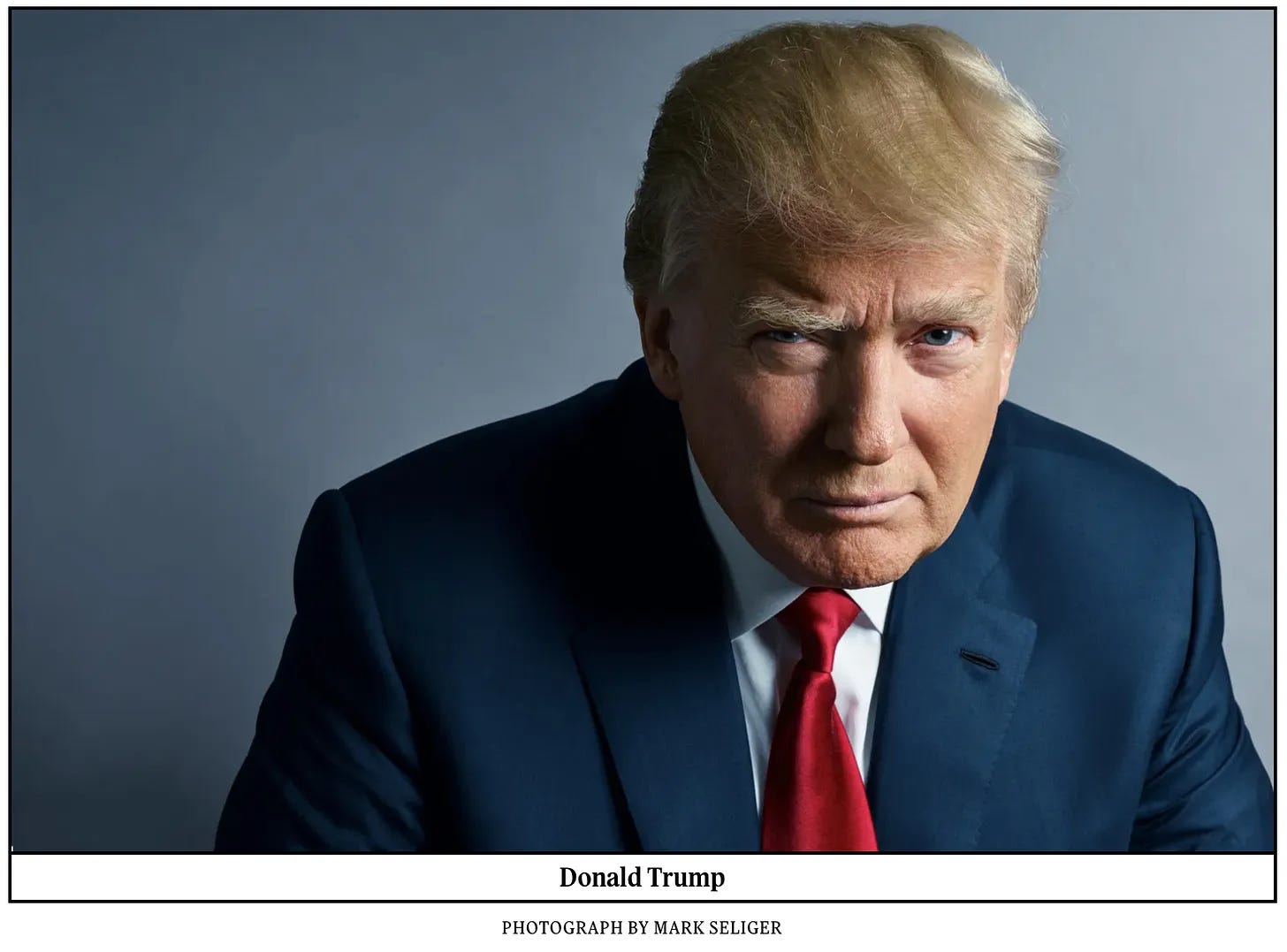
Charles: Alisa Valdes-Rodriguez has written a really smart piece about why we underestimate our vile president at our peril: “He is, within his own operational domain, essentially unrivaled at being evil.”
When Democrats dismiss Donald Trump as too stupid to be effective, they lose. They’ve been losing that bet for a decade, and they will keep losing it for the same reason a person might call a shark stupid for not doing algebra. The shark isn’t trying to do algebra. That’s not what it’s for.
There are different kinds of intelligence in the world. A cat cannot discuss philosophy, but it can do lots of things we can’t. It can jump six times its own height from standing, catch a hummingbird in flight, and twist itself mid-fall to land on its feet. You can’t do that. I can’t do that. We do not call ourselves stupid for lacking gifts that simply fall outside another creature’s metric. We should extend the same analytical honesty to Donald Trump — not to admire him, but to see him clearly, which is something his opponents have catastrophically failed to do.
Trump is, by most conventional measures, a deeply limited man. His reading is reportedly poor. His attention span is narrow. His grasp of history, policy, science, and law is weak at best. At the kind of intelligence most of us value — the capacity for empathy, for genuine human connection, for moral reasoning — he is, by the evidence of his entire life, essentially deficient. But none of that intelligence is required to run the Mafia. Or, as it turns out, the government.
What Trump possesses instead is something rarer and more dangerous than most of his critics have been willing to name: he may be the greatest con artist and mob operator the world has ever produced — quite simply the most effective sociopath to ever walk this earth. Consider the scale of what he has accomplished. He convinced tens of millions of working-class Americans that a Manhattan real estate heir who spent decades extracting wealth from contractors, students, investors, and tenants is their champion against elites. That is a con of staggering audacity — and it has not merely survived exposure, it has fed on it. Every indictment became a fundraising event. Every scandal became evidence of persecution. He somehow engineered a fraud immune to the mechanism that ends all frauds. Is that stupidity? I’d say it’s a form of operational genius. Repugnant, yes. Not something most people would want to do or be proud of. But a kind of genius nonetheless.
The organizational structure around Trump is not merely like organized crime — it is structurally identical to it: loyalty oaths, omertà culture, intermediaries for dirty work, pardons dangled as currency, defectors punished, soldiers rewarded. No Mafia don in history ran that kind of operation at the scale of a nation-state, with a major political party as his instrument. The Gambinos controlled parts of New York. The Cartels each have their little patch of Mexico or Colombia. But Trump? He controls half of America’s political reality, and all of its government at the moment. He captured the judiciary and the house. And he did it by being a con man. The comparison to Genovese is not hyperbole. It is taxonomy.
His critics might object that Hitler, too, was this kind of operator — and they would be right, which is precisely the point. Hitler was also mostly a moron, but with one special, horrible gift. Hollywood has done us a grave disservice with its brooding, thoughtful Nazi officers, staring meaningfully into the middle distance. Screenwriters projected their own fantasy of what powerful evil looks like onto men who were, in most respects, idiots and buffoons — gifted only in the precise ways that mattered for what they were trying to do. Only Charlie Chaplin, working from the music hall tradition, understood that buffoonery and menace are not opposites. His portrait of the dictator in The Great Dictator is psychologically truer than almost anything that followed. Hannah Arendt reached for the same truth at Nuremberg, finding not a monster in the dock but a mediocre bureaucrat — the banality of evil, she called it, to the outrage of people who needed evil to be smarter and more interesting than it is.
Trump is not more interesting than he appears. He is exactly as venal, as shallow, as reflexive as his critics say. But he is, within his own operational domain, essentially unrivaled at being evil. His cunning is largely instinctual rather than strategic, for he, like all other serial killers, lacks a conscience entirely — he wins by smell more than by plan, which is why his operation is chaotic even when it’s effective — but the results speak for themselves. Decades of survival. A second term. A country reorganized around his appetites.
A Big New Trump Balkans Scheme
The Guardian
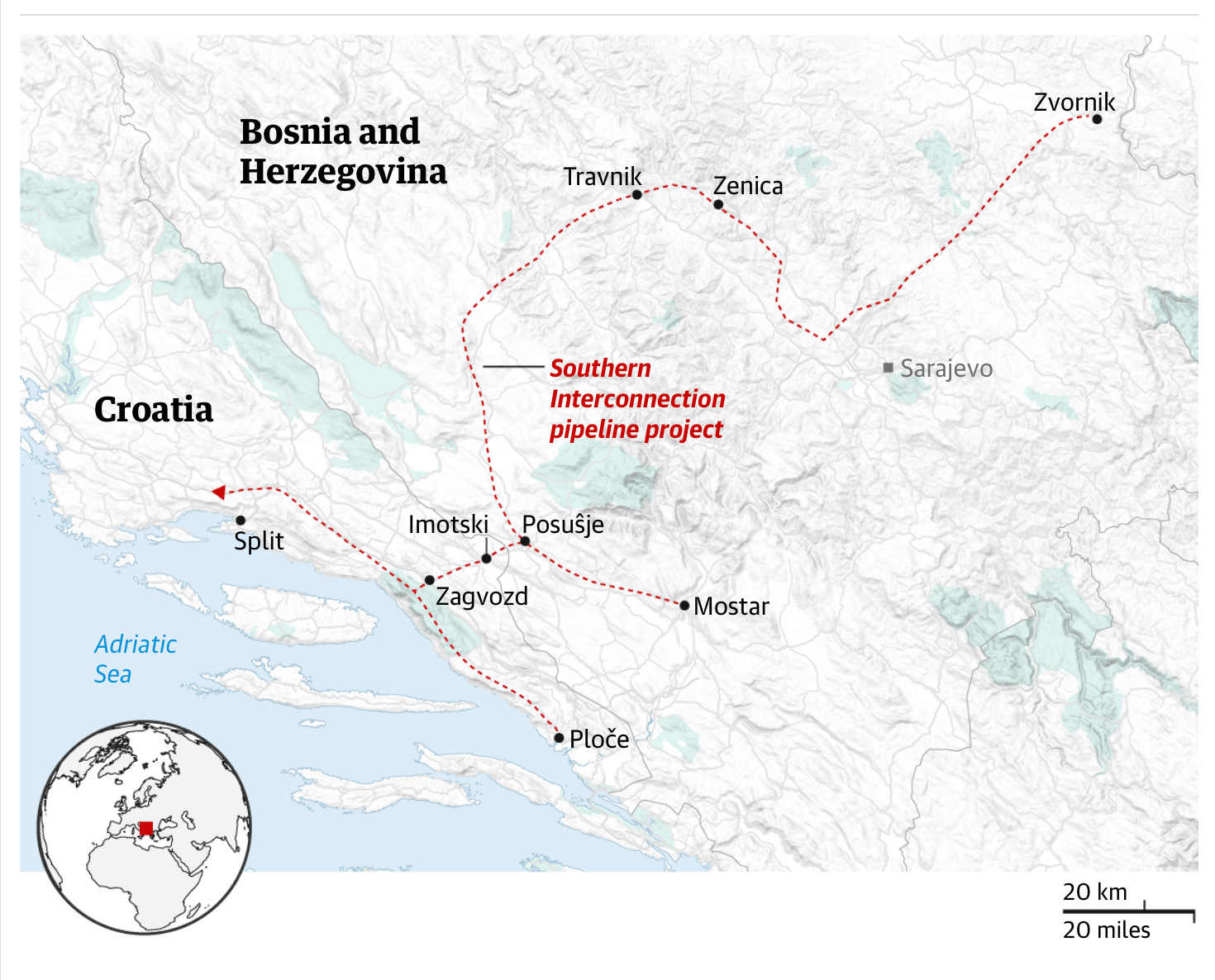
Scott: Why have Jared, Qusay and Uday, and various other members of the Trump entourage been spending so much time in the heart of the Balkans lately? There have been an assortment of real estate deals and PR projects for assorted Russia-linked miscreants and war criminals. But it never really much added up. Now a huge oil and gas pipeline project has surfaced which has the Trump family’s fingerprints all over it. The Guardian reports:
The EU risks a confrontation with Donald Trump after it sought to stall the awarding of a lucrative Balkans pipeline contract to a company fronted by his personal lawyer, documents seen by the Guardian show.
Brussels has clashed with Trump over trade, Ukraine and military spending, but the intervention in the Southern Interconnection pipeline project appears to mark the first time it has challenged a commercial venture by those close to the president.
The pipeline will run through Bosnia and Herzegovina. Under what Bosnian sources say have been months of pressure from US officials, its leaders have been moving quickly to award the contract to a previously little-known company based in Wyoming.
AAFS Infrastructure and Energy was incorporated in November last year and has not disclosed its owners. It is fronted by two leading members of Trump’s campaign to overturn his 2020 election defeat: Jesse Binnall, a lawyer who defended him against allegations of inciting the Capitol riots after his defeat (and who this week filed a libel action against the Atlantic for Kashyap Patel, and Joe Flynn, the brother of the president’s former national security adviser.
Despite lacking any apparent track record, AAFS is planning to invest $1.5bn in the pipeline and other Bosnian infrastructure projects, its local representative has said…
Binnall has said the pipeline is a “priority for the Trump administration”. Asked about the EU’s intervention, he said: “AAFS will never lose sight of what truly matters in this project: delivering energy security and fostering economic development for the people of Bosnia and Herzegovina. We are committed to working closely with all relevant authorities to develop the infrastructure needed to make this vision a reality.”
This entire project aims to provide a corridor for the flow of hydrocarbons beyond the reach of Russia. But not only is the Trump family aligning itself unequivocally with the Kremlin, Michael Flynn quickly emerged as a man in the entourage with the tightest connections to Putin. Brussels, understandably, smells a rat.
Jared Kushner: Trump’s All-Purpose Negotiator
Süddeutsche Zeitung
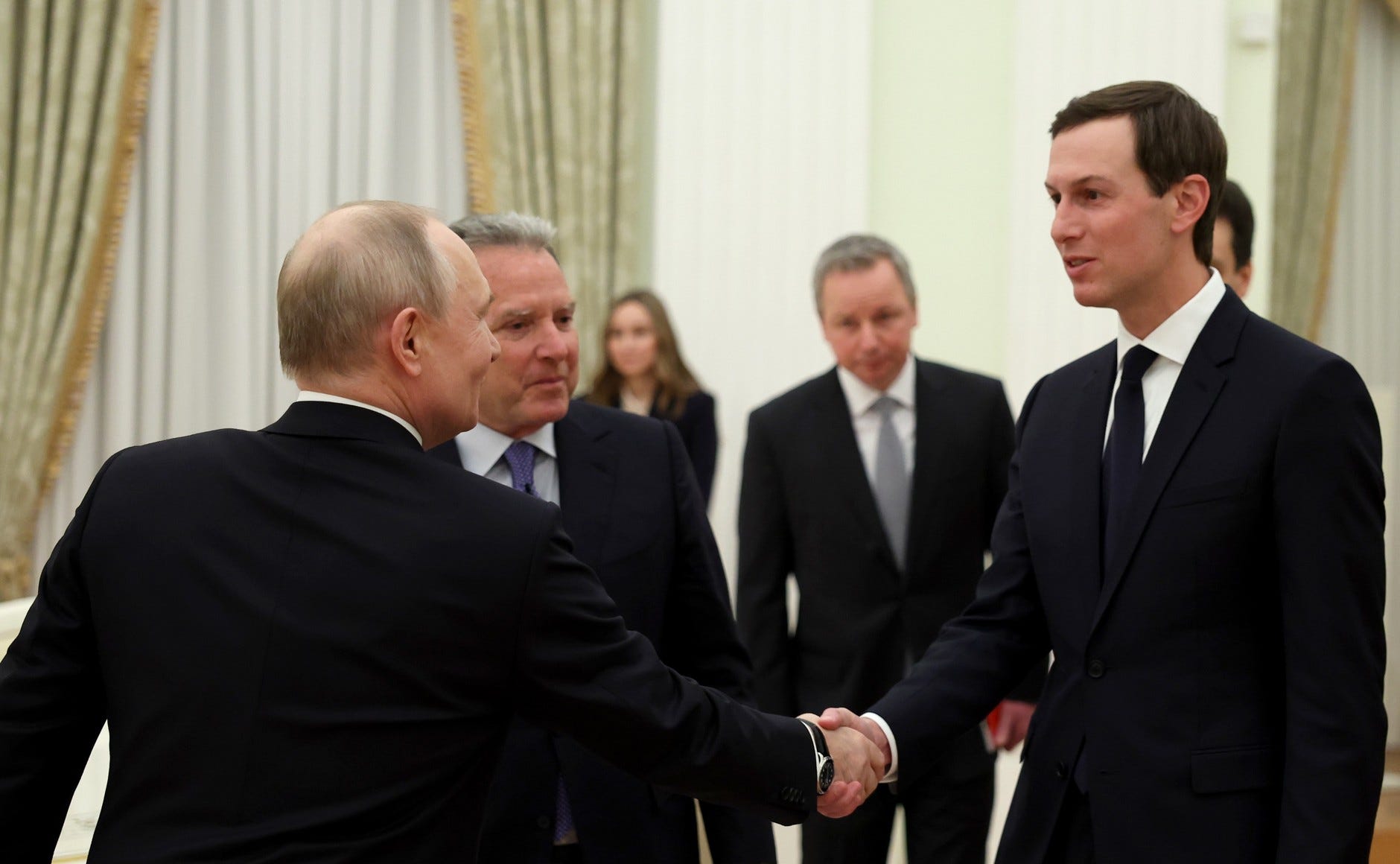
Scott: Never before has a democratically elected leader deployed his own son-in-law the way Trump uses Jared Kushner. He now serves as Trump’s de facto emissary to Putin, Netanyahu, the Saudi Crown Prince Mohammed bin Salman, Zelenskyy, the Iranians and numerous others.
Many of these relationships he explored while he was serving in the first term as a presidential advisor, with an office in the West Wing. Kushner’s legal status in all of this is a careful study in ambiguity designed to maximize power and authority while denying any duty to make disclosures, divestments or to observe ethical standards that forbid self-dealing or acting for private interests.
Yet all of this has triggered no congressional oversight or demand for hearings, and has drawn astonishingly little coverage from US print and broadcast media. A recent study, for instance, shows that fewer than half of all print and broadcast reports about Kushner’s role in negotiations with Iran apprise their audience of the very fundamental fact that Kushner has a formal relationship with another combatant in the war—Saudi Arabia—which is in fact responsible for most of his income. Süddeutsche Zeitung asks how it is possible that a mature democracy like the United States allows something like this to happen without even viewing it as a scandal.
Bombs were already falling in Iran while Jared Kushner sat on a stage in Miami. It was late March, at an international investors’ conference. The moderator wanted to know what he, as a “dealmaker” in the business world, had learned about peace. “I don’t think peace is all that different from the business world,” Kushner said. “Both are puzzles, and I try to view every challenge I face as a puzzle.”
You can watch the video online and see this youthful-looking man—tall, slender, wearing a close-fitting suit, clean-shaven, with a precisely parted hairstyle. His gaze appears, in a strange way, both shy and self-assured at the same time. Kushner is 45 and currently arguably one of the most influential men in America—perhaps even the world.
He seems to be everywhere; he negotiates matters of war and peace in Miami, Moscow, Paris, Berlin, Geneva, Gaza, Jerusalem, and Islamabad—yet he holds no official government office. It was only in February that Kushner was permitted to call himself a “Special Peace Envoy”—a title his father-in-law, Donald Trump, invented specifically for him. Naturally, the son-in-law is now involved in the talks with Iran as well.
At the press conference following the first round of talks between the U.S. and Iran in Pakistan, Kushner recently stood alongside Vice President J.D. Vance and the Special Envoy for the Middle East, Steve Witkoff—an old buddy of Trump’s from the golf course and the New York real estate scene. Vance announced that the negotiations had failed. Now, Iran and the U.S. are set to talk again in Islamabad—even as the Iranians blockade the Strait of Hormuz, the Americans block Iranian ports, and Trump alternates between issuing threats and extending the ceasefire.
So, who exactly is this Jared Kushner, and what is he doing there on Trump’s behalf? From 2017 to 2021, Jared Kushner served as Trump’s senior advisor, while his wife, Ivanka—Trump’s daughter—served as an advisor to the President. In his role as “Senior Advisor to the President,” Kushner was widely regarded at the time as one of the architects of the Abraham Accords, through which Israel, the United Arab Emirates, and other nations normalized their relations in 2020. Following the conclusion of Trump’s first term, Kushner withdrew to private life in Miami, published his memoirs, and declared himself an investor. He remains one to this day—and, moreover, a global statesman.
Speaking from the podium in Miami, Kushner noted that, strictly speaking, he had never actually joined the U.S. government. “Therefore, I remain merely a volunteer—much like other businesspeople who, upon request, agree to lend their support to the government.” This sounds intriguing, particularly when one considers that this “volunteer”—a member of Trump’s own family—ranks among the U.S. President’s key negotiators. For Kushner, this arrangement offers a distinct advantage: as a “volunteer,” he is not bound by the ethics regulations applicable to government employees. Although, as President, Trump didn’t exactly adhere to those rules himself.
Thus, Kushner finds himself seated at the negotiating table alongside Ukrainian President Volodymyr Zelenskyy, German Chancellor Friedrich Merz, NATO Secretary General Mark Rutte, and Russia’s strongman, Vladimir Putin. He was present during the negotiations with Hamas and Israeli Prime Minister Benjamin Netanyahu that resulted in a ceasefire in Gaza and the release of several Israeli hostages held by Hamas. And now, he—along with Vance and Witkoff—is reportedly tasked with reaching an agreement with the Iranians in Pakistan.
Concurrently, Jared Kushner conducts business through his firm, Affinity Partners—sometimes in the very same regions where he has been, or remains, geopolitically active. A significant portion of his firm’s investment capital originates from nations that play a role in these various conflicts—most notably, Saudi Arabia. One moment he is in Russia, the next in Israel or Pakistan—as if the world could not go on without him.
In September 2025, for instance, it became public that Affinity Partners—together with another private equity firm and the Saudi sovereign wealth fund—intended to acquire the video game giant Electronic Arts for $55 billion. A decision from U.S. regulators is still pending. Even those hitting the gym in Munich or Berlin may well be contributing to Kushner’s investments, as Affinity Partners has acquired a stake in the startup eGym.
How did Kushner become so influential? What sway does he hold within the White House? And to what extent do political and private interests intertwine in his dealings?
“Capital in Motion” was the motto of the business summit held in Miami, where Kushner was interviewed in his dual capacity as both the head of Affinity Partners and Trump’s negotiator. The event was organized by a Riyadh-based institute closely affiliated with Saudi Arabia’s sovereign wealth fund, which operates under the control of Mohammed bin Salman. This is the very same Bin Salman who, according to CIA findings, ordered the 2018 assassination of regime critic Jamal Khashoggi—an allegation Bin Salman denies…
In Geneva, Kushner and Witkoff met—one after the other—with Iranians, Ukrainians, and Russians on a single day in February; it was a cross between a marathon and speed dating. On April 20, Ukrainian President Zelenskyy complained on Ukrainian television that the two Americans had flown to Moscow multiple times—even meeting with Putin—yet had never visited Kyiv. He considered this disrespectful. Appearing on the ZDF program *Maybrit Illner*, he described the pair as “pragmatic guys.” He added: “The only problem is that they believe the Russians are winning this war. They are mistaken.”
Kushner and Witkoff, Zelenskyy further complained to Illner, were constantly preoccupied with Iran and had no time for Ukraine; he surmised “that their focus lies in the Middle East.” Experts give Trump’s “hobby diplomats”—Kushner and Witkoff—failing grades in the US-Iran crisis as well. They are “a bust,” Aaron David Miller—who served under several US Secretaries of State in the Middle East—told *Time* magazine. “When it comes to diplomacy, they get an ‘F’.”
And Gaza? “The waterfront property in Gaza could be very valuable,” Kushner remarked at Harvard University in 2024, “if one were to focus on creating livelihoods there.” He proposed temporarily relocating civilians to the Negev Desert, describing the situation in the devastated Palestinian territory as “a somewhat unfortunate situation.”
Then, in January 2026, at the World Economic Forum in Davos, Kushner unveiled the “New Gaza” blueprint—once again with Witkoff by his side. The presentation immediately followed Trump’s introduction of his “Board of Peace,” which features autocrats such as Alexander Lukashenko of Belarus and Nayib Bukele of El Salvador. Naturally, Kushner and Witkoff also sit on the board of this peace council; its chairman is none other than Donald Trump. In the master plan, Gaza looks like Dubai—like a glittering resort on the Mediterranean. It features greenery-clad skyscrapers, lofts, and parks, along with “Coastal Tourism” and a “Transportation Hub”—things that, right now, are likely the furthest thing from anyone’s mind in Gaza. In this new Gaza, there will surely be plenty for the real estate sharks on Trump’s peace council to do—and, above all, to earn. The US President nodded contentedly on stage as his son-in-law and peace envoy praised his “amazing leadership.”
An Assistant Secretary at DHS with Sugar Daddies?
The Daily Mail

Scott: Do Republican sub cabinet officers have more fun, as they supplement their official income with contributions from sugar daddies? The DHS assistant secretary for counterterrorism is Julia Varvaro, 29. Now she has been suspended from her position while an investigation proceeds on the basis of a whistleblower complaint that alleges that Varvaro was a regular on the Seeking.com website, a platform that promises to unite attractive young women with wealthy older men willing to enhance their living standards in exchange for companionship.
The profile, which was under the name “Alessia,” said its owner worked for a government agency and offered “seductive sophistication.”
It used the same photo as Varvaro’s Instagram account and described Alessia as “flirty, fun, and fond of sultry spaces,” as well as “drawn to a masculine man who’s attentive, protective, and quietly playful for mutually beneficial experiences.”
The profile was revealed by Varvaro’s ex-boyfriend, an older executive and divorced father identified by the Daily Mail as Robert B. The two met on a different dating app, Hinge, and he spent $40,000 on her over the course of three months, including first-class trips to Aruba and Italy.
The relationship ended after Robert refused to spend even more on her, according to text messages he shared with the publication. He has since filed a complaint with DHS’s Office of the Inspector General exposing the alleged Seeking.com profile.
A Big Gay Anniversary in Manhattan
Charles: Sixty years ago it was a crime to knowingly serve a gay person a drink in a New York gay bar—because every gay person was by definition “disorderly.”
1996 was three years before the Stonewall riots that marked the birth of the modern gay liberation movement. But there was already enough ‘60’s disruption in the air to convince three gay activists from the Mattachine Society to challenge the law by going into a bar, saying they were gay and demanding to be served. On their 4th try they finally found a bartender who obeyed the law by refusing to serve them, and they finally had a case to take to court to challenge the law.
Dick Leitsch, Randy Wicker, Craig Rodwell, and John Timmons were the heroes of that moment. Back then they explained that their “sip-in” was inspired by the Black Civil Rights Movement’s “sit-ins” of the same era.
Their challenge took place at Julius’ Bar on West 10th Street and Waverrly Place in Greenwich Village, a glorious New York institution which is also the city’s oldest continually-operated gay bar. The headline on the New York Times story about it was a perfect reflection of the status of gay people in the pages of the Grey Lady back then: “3 Deviates Invite Exclusion By Bars.”
In 1967 a New York judge ruled that indecent behavior had to be more than same-sex “cruising,” kissing or touching–and Gays could legally drink in a bar
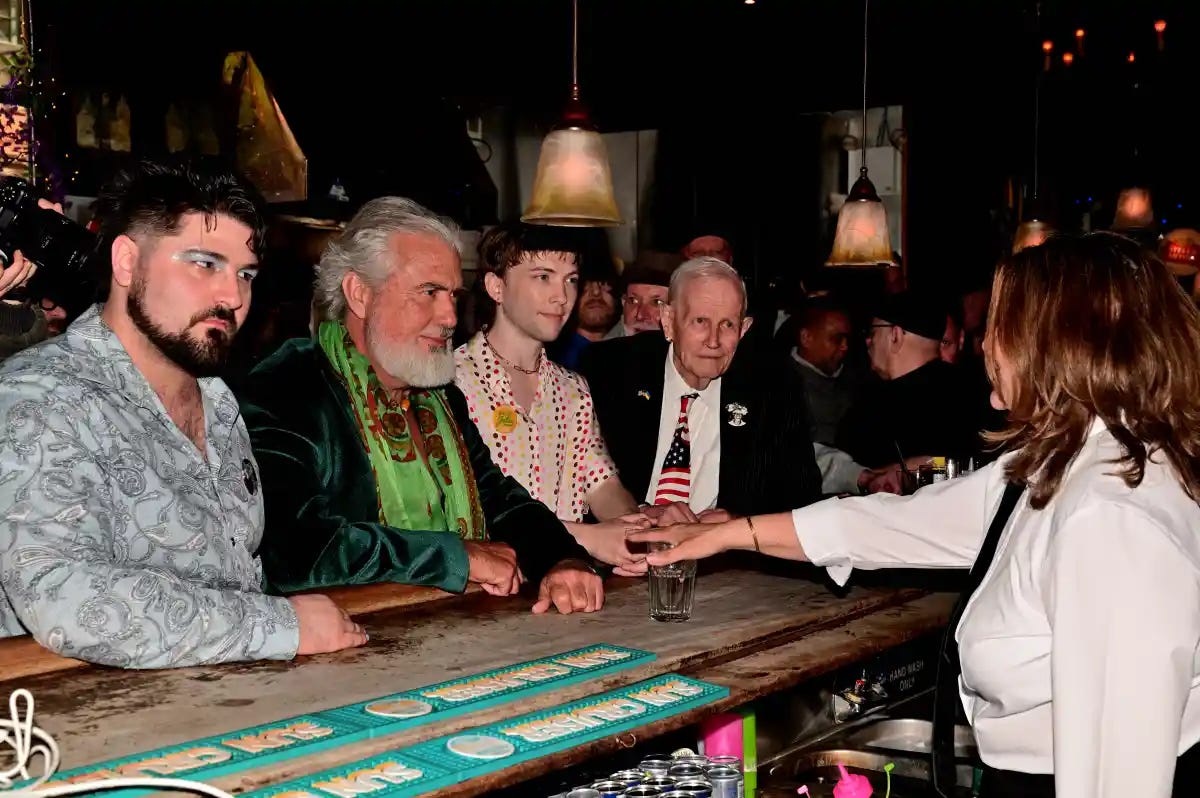
This week Randy Wiicker, now 88, returned to Julius’ to re-enact the moment. The current owner, Helen Buford, who has done a fine job of keeping the bar exactly as it has always been, played the role of the bartender in the modern recreation of the historic moment.
In an interview with Gay City News Wicker explained why what happened sixty years ago was so important: “It wasn’t a sip-in; it was the first time that gay people demanded the right to assemble, to be by themselves. I grew up at a time when they raided gay parties and took people away in paddy wagons just for having a party.”
Today Julius’ remains a model of what every gay institution should be–multi-generational and multi-cultural, a place where everyone feels welcome to sample what is still one of the very best hamburgers in New York City.
The Roberts Racket
The Progressive
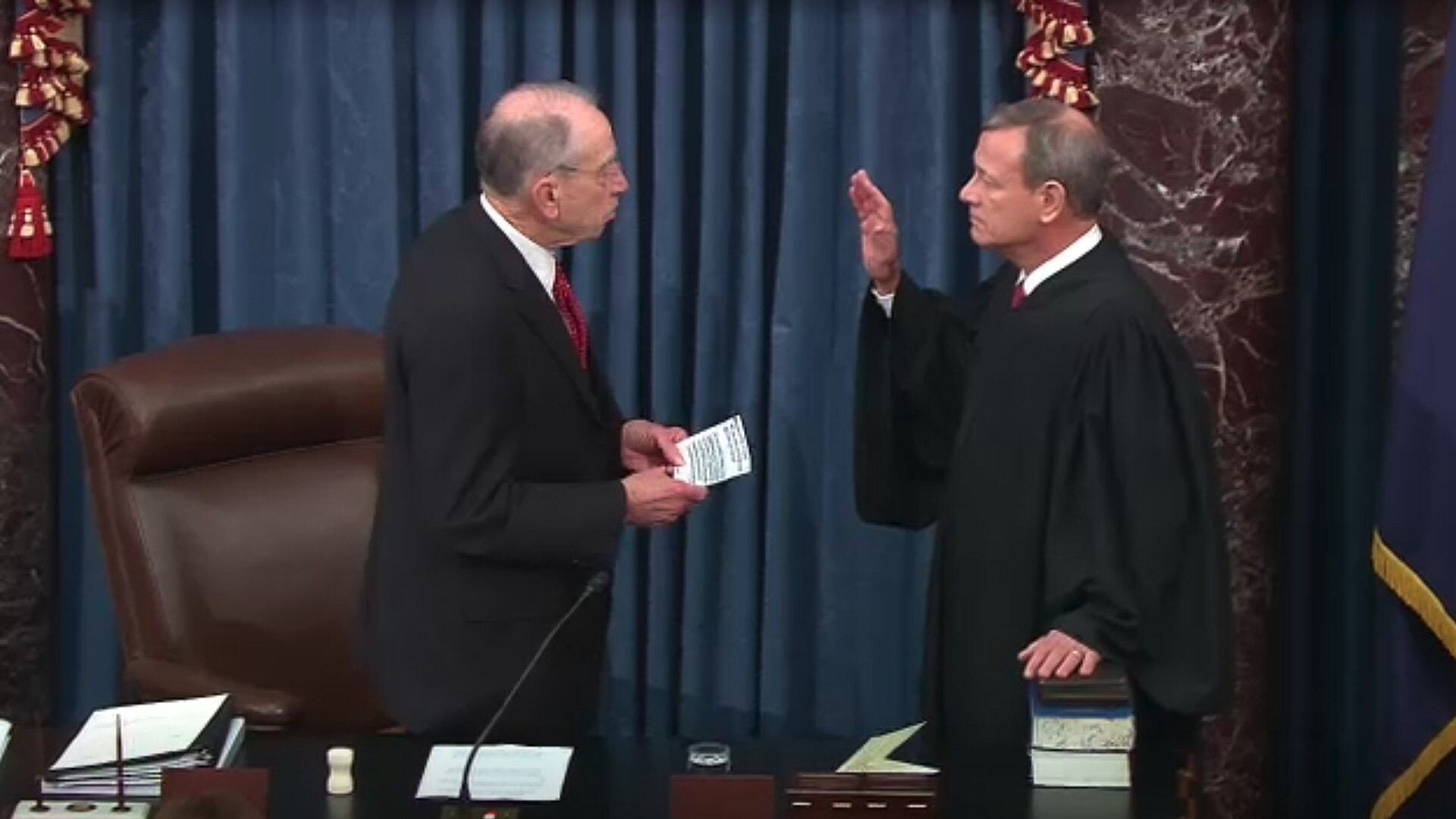
Scott: We now know courtesy of the exposé work of New York Times, which featured rarely seen internal communications, that the supposed mild-mannered traditionalist John Roberts was in fact the architect of the shadow docket that SCOTUS now uses routinely to silence lower courts when they rule against Trump, without furnishing any explanation for their rulings. This furnishes an opportunity to revisit the stories which have now circulated for many years concerning Roberts’ failure to observe minimal ethics standards during his tenure on the Court. As veteran court-watcher Lisa Graves reported in Without Precedent: How Chief Justice Roberts and His Accomplices Rewrote the Constitution and Dismantled Our Rights, Roberts is by far the wealthiest member of the Court, and he derives his wealth unseemly—but indirectly—off the desire of commercial parties to benefit from matters that come before him.
Roberts is by far the richest member of the Court, Graves says, thanks to the [roughly $20 million] his wife has raked in as a legal-placement recruiter—a job she began after her husband became Chief Justice. Neither Roberts nor his wife disclose which lawyers she has helped place into high-powered law firms, notes Graves, “so there is no way to know how much of their lifestyle is effectively being underwritten by lawyers who appear before the Supreme Court or sign on to briefs to the Court.”
In the twenty years that Roberts has been Chief Justice, the Court has permitted corporations and Super PACs to funnel an unlimited amount of funding towards candidates up for election; struck down what had been a Constitutional right to abortion; and greenlighted what Graves calls “illegitimate and undemocratic electoral maps that have all but eliminated incentives to seek compromise, fueling extremism and division.”
Meanwhile, the Roberts Court has largely eviscerated the Voting Rights Act, in part by ending a “preclearance” rule for states and localities with an extensive history of racially discriminatory voting. “The effect of Roberts’s work,” writes Graves, “has been to uphold laws that make it harder for many Black Americans to vote and have their vote meaningfully count.”
On gun violence, the Roberts Court has seized on its every opportunity to do the gun lobby’s bidding. In a 2008 case, District of Columbia v. Heller, it established gun ownership as an individual right rather than a collective one belonging to militias, and upended the District of Columbia’s ability to restrict handgun ownership and require that firearms be stored unloaded or outfitted with trigger locks. In a 2022 decision in the case New York State Rifle & Pistol Association v. Bruen, the Court struck down New York’s long-standing limits on concealed carry of firearms. In 2024 in Rahimi v. the United States, the Court considered using that precedent to uphold the gun ownership rights of a man Graves describes as “an unstable [domestic] abuser with a history of shooting at strangers,” but ultimately declined to do so in that election year. Also last year, the Court struck down a ban on “bump stocks”—devices that convert semi-automatic rifles into de facto machine guns. That ban had been issued in 2017 by President Donald Trump.
On basic justice issues, the Justices seem unmoored. In 2024, the court’s conservative supermajority refused to stay the execution of a Missouri man who, in the declared opinion of his prosecutor, had been wrongfully convicted and was, in fact, innocent. That same year, Roberts penned a decision that partially exonerated some of the rioters who stormed the Capitol on January 6. Mercy is in the eye of the bestower.
Perhaps worst of all, the Roberts Court last year granted Trump broad immunity from criminal prosecution for official acts, which Graves calls “a shocking and atrocious political intervention by political judges to protect a political candidate from their political party from facing the consequences for major crimes that substantial evidence indicated Trump had committed.” It is a ruling that has clearly emboldened Trump to engage in even more outrageous and likely criminal behavior.
It’s clear that Roberts’ conduct would be unethical and cause for his removal from the bench if he were a district court or court of appeals judge. So how does he get away with it? Roberts has played the lead role in assuring that SCOTUS has no meaningful ethics rules, with a standard under which each justice determines his or her own ethics standards—something that runs afoul of basic norms of Anglo-Saxon jurisprudence and invites corruption. He has refused to meet with or appear before Congress to discuss his ethics lapses, largely because he has no apparent defense. His conduct is shameful and easily warrants his removal from the court, and from the list of lawyers authorized to practice before it.
A Profitable Exit for Viktor Orbán
Bloomberg
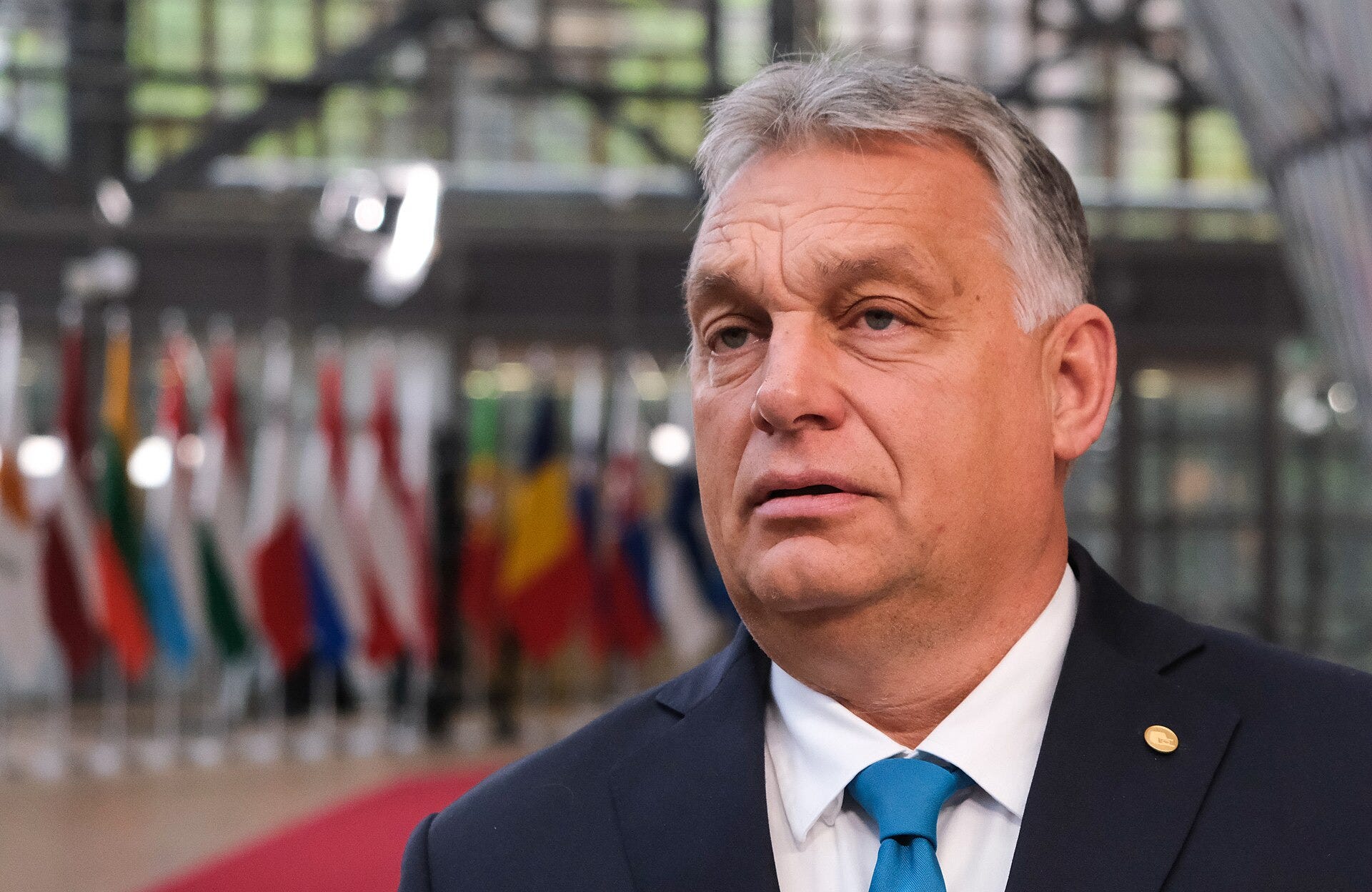
Scott: Many analysts have puzzled over why Viktor Orbán, after painstakingly developing plans to overturn adverse election results, relented so quickly on Election night. Perhaps it was because his loss was simply too crushing for claims of voter fraud to be credible. But now we have an alternative explanation: there was a silver lining in his loss.
Bloomberg reports:
An asset-management fund in the Equilor group of companies part-owned by Hungarian Prime Minister Viktor Orban’s son-in-law profited from financial-market bets on the strongman losing power.
Equilor Asset Management said it had amassed a “significant overweight” stance in government bonds and, right before Hungary’s election on April 12, in local stocks. The wagers paid off as the opposition Tisza party’s landslide victory extended a rally in the country’s assets.
While the ownership structure of the fund-management boutique is opaque, it operates from the same office as Equilor Investment Ltd., a broker controlled by Istvan Tiborcz, the husband of Orban’s oldest daughter. The firms also promote themselves as one group to clients.
“We were inclined to expect that Tisza would be the clear winner and positioned ourselves accordingly,” Attila Szabo, the chief investment officer of Equilor AM, said in a post-election interview at his office.
Large Scale Structure of the Universe

Cecilia Chirenti explains:
This is a map of the universe. The Dark Energy Spectroscopic Instrument (DESI) at Kitt Peak National Observatory, Arizona, has finished its five-year survey. It observed more than 47 million galaxies and quasars and created a 3D map centered on the Earth. Today’s featured image shows a thin slice of these data: the black gaps indicate where our Galaxy obscures distant objects. The feathery web in the inset shows the large scale structure of the universe. Light of the most distant galaxies shown here travelled for 11 billion years to reach the Earth. Galaxies cluster throughout cosmic history under the competing influences of gravity and dark energy, responsible for the accelerated expansion of the universe. Analysis of early DESI results hinted at the possibility that dark energy, described as a cosmological constant by Albert Einstein, may not be constant after all. But we still have to wait for the analysis of the now complete dataset. The nature of dark energy is the biggest mystery of cosmology.
Qusay Lands a $24 mn no-bid DOD Contract
The New Republic
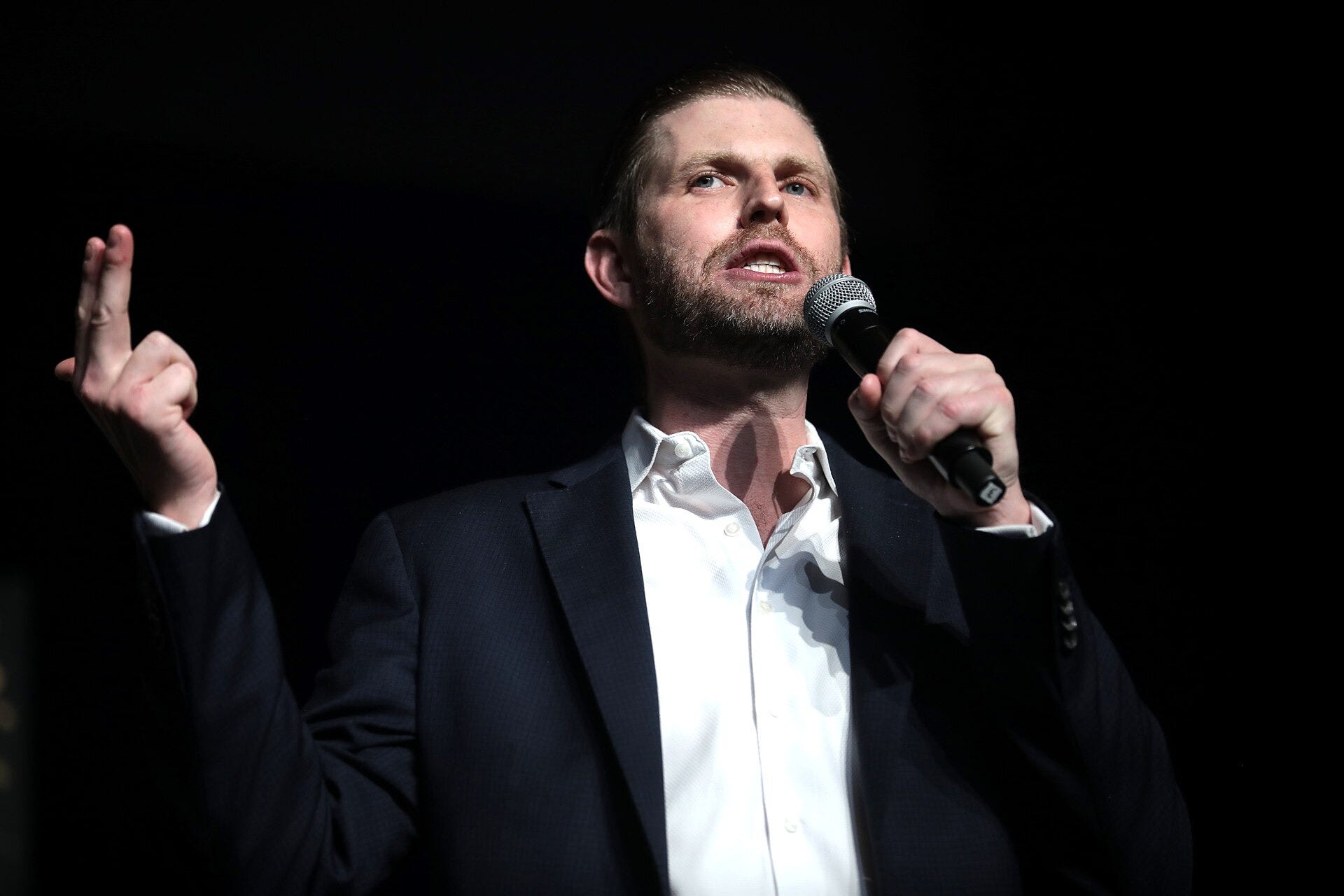
Scott: Qusay is very proud of his ability to secure no-bid contracts from Pete Hegseth, and this week he’s been on a media tour to brag about them.
The New Republic:
Eric Trump appeared on Fox Business Thursday morning, openly celebrating a $24 million defense contract his company won—through business with his father’s administration. The 42-year-old financier appeared on Mornings with Maria to promote Foundation Industries, a technology company building futuristic warfare tools such as a humanoid robot that the company has claimed could replace soldiers on the frontline. Trump, Foundation’s chief strategic adviser and a major financier, appeared alongside company CEO Sankaet Pathak. “We better be winning this race in the United States of America,” the younger Trump told Fox, referring to the international robotics industry. “We’re the greatest economy in the world.”
“When you go up and you interact with these robots, and they fist bump you, they high five you, follow your commands,” he continued. “You bring in A.I. autonomy, it’s going to change industry, it’s going to change military application, it’s going to change hospitality. The uses are unlimited, and I think it’s a very beautiful thing.”
Trump did not get into the details on how his company secured the multimillion government contract. Time magazine reported in March that Foundation had won research contracts from the U.S. Army, Navy, and Air Force that totalled $24 million, and had also obtained an SBIR Phase 3 award, which recognized Foundation as an approved supplier for military procurement.
Your Online Moment of Zen
The Burning of the Houses of Lords and Commons, 16 October 1834
Joseph Mallord William Turner 1935

The Horton-Kaiser Report is edited by Imogen Sayers.