



Happy Thanksgiving!
And for your Thanksgiving Table, Here’s a Squash Soup
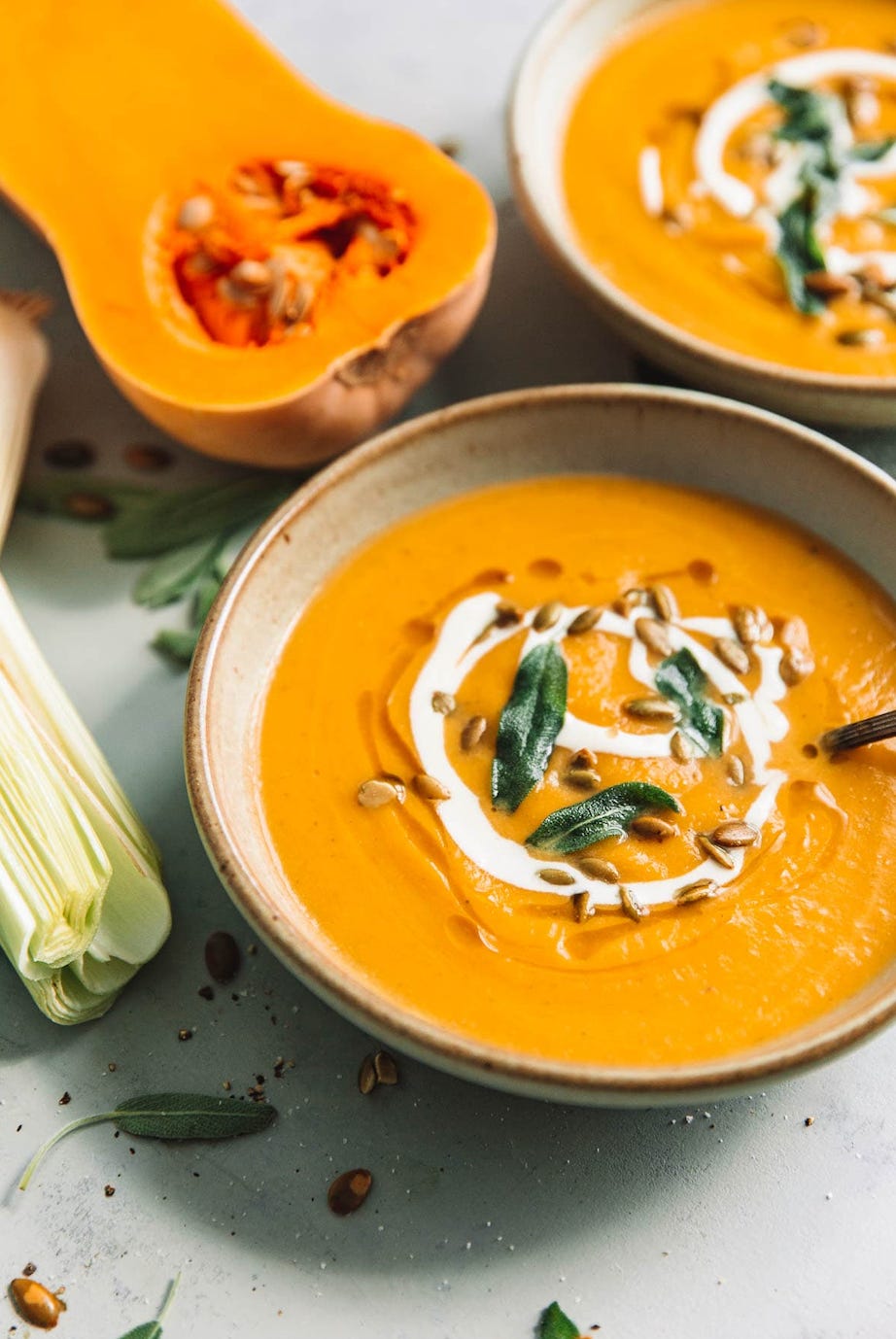
Scott: Squash is one of the great New World offerings to global cuisine, and it has earned a central place on every Thanksgiving table. Here’s a soup recipe that makes the most of squash’s possibilities.
Take three different kinds of squash—red kuri, butternut and acorn. Halve them and toss in a large bowl with salt and olive oil and place face down on a sheet tray. Bake at 325ºF for 40-50 mins until soft. Scoop out the contents, removing and discarding seeds. Sauté onions, celery and carrots in olive oil until tender. Add minced garlic and saute 30 seconds more. Add squash, a good amount of white miso, and chicken or vegetable stock to cover generously. Season with salt. Brown butter in pan and add sage leaves. Add to soup and simmer soup for an hour or so. Add some fried pumpkin seeds before puréeing the mixture. The soup can benefit from a quarter cup of heavy cream or a can of unsweetened coconut milk.
There are many different routes for seasoning squash soup. The traditional American approach would involve a bit of maple syrup, black pepper and traditional pumpkin spices. This is okay, but go light on the spices. In the American southwest, we would use a bit of pan warmed and chopped dried guajillo red or pasilla negro chile, black pepper and sauteed whole cumin seed. Puree it smooth and adjust seasonings and pass through a strainer.
A good garnish is essential. Try sautéed maitake mushrooms with a bit of chopped parsley. The maitake should be sauteed and added just before the soup is served.
Thanks to Graham Dodd of Nosa Restaurant, in Rancho de San Juan, Ojo Caliente, NM, for this recipe.

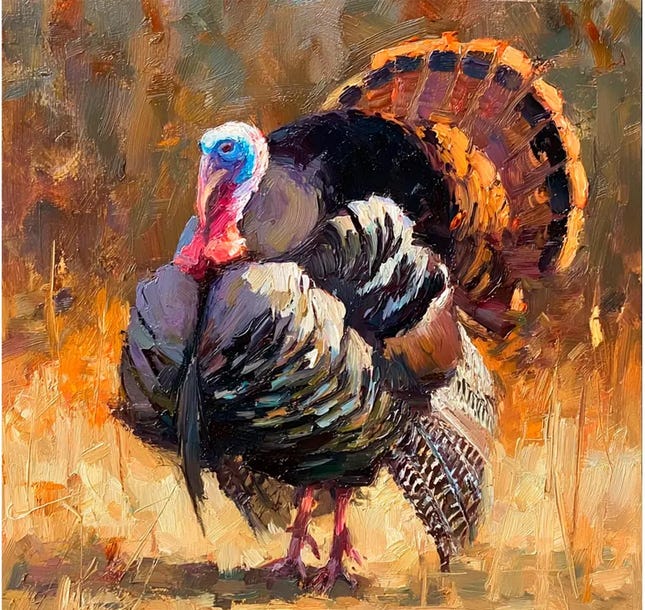
Trump pardons a White House turkey today. Photo: Hannah McKay/REUTERS.
Absolutely brilliant photograph!
After The Main Course and Before Dessert
Charles: In our house every year for the past half century on the 4th Thursday in November I have read Art Buchwald’s translating triumph, Le Jour De Merci Donnant, which he penned in 1952, when he was living in Paris, to explain the singular importance of Thanksgiving to the French.
The great newspaper humorist’s column has been reprinted annually in The Washington Post and many other newspapers ever since.
By Art Buchwald
This confidential column was leaked to me by a high government official in the Plymouth colony on the condition that I not reveal his name.
One of our most important holidays is Thanksgiving Day, known in France as le Jour de Merci Donnant.
Le Jour de Merci Donnant was first started by a group of Pilgrims (Pelerins) who fled from l’Angleterre before the McCarran Act to found a colony in the New World (le Nouveau Monde) where they could shoot Indians (les Peaux-Rouges) and eat turkey (dinde) to their hearts’ content.
They landed at a place called Plymouth (now a famous voiture Americaine ) in a wooden sailing ship called the Mayflower (or Fleur de Mai ) in 1620. But while the Pelerins were killing the dindes, the Peaux-Rouges were killing the Pelerins, and there were several hard winters ahead for both of them. The only way the Peaux-Rouges helped the Pelerins was when they taught them to grow corn (mais). The reason they did this was because they liked corn with their Pelerins.
In 1623, after another harsh year, the Pelerins’ crops were so good that they decided to have a celebration and give thanks because more mais was raised by the Pelerins than Pelerins were killed by Peaux-Rouges.
Every year on the Jour de Merci Donnant, parents tell their children an amusing story about the first celebration.
It concerns a brave capitaine named Miles Standish (known in France as Kilometres Deboutish) and a young, shy lieutenant named Jean Alden. Both of them were in love with a flower of Plymouth called Priscilla Mullens (no translation). The vieux capitaine said to the jeune lieutenant :
“Go to the damsel Priscilla ( allez tres vite chez Priscilla), the loveliest maiden of Plymouth ( la plus jolie demoiselle de Plymouth). Say that a blunt old captain, a man not of words but of action (un vieux Fanfan la Tulipe), offers his hand and his heart, the hand and heart of a soldier. Not in these words, you know, but this, in short, is my meaning.
“I am a maker of war (je suis un fabricant de la guerre) and not a maker of phrases. You, bred as a scholar (vous, qui tes pain comme un tudiant), can say it in elegant language, such as you read in your books of the pleadings and wooings of lovers, such as you think best adapted to win the heart of the maiden.”
Although Jean was fit to be tied (convenable tre emballe), friendship prevailed over love and he went to his duty. But instead of using elegant language, he blurted out his mission. Priscilla was muted with amazement and sorrow (rendue muette par l’tonnement et las tristesse).
At length she exclaimed, interrupting the ominous silence: “If the great captain of Plymouth is so very eager to wed me, why does he not come himself and take the trouble to woo me?” (Ou est-il, le vieux Kilometres? Pourquoi ne vient-il pas aupres de moi pour tenter sa chance?)
Jean said that Kilometres Deboutish was very busy and didn’t have time for those things. He staggered on, telling what a wonderful husband Kilometres would make. Finally Priscilla arched her eyebrows and said in a tremulous voice, “Why don’t you speak for yourself, Jean?” (Chacun a son gout.)
And so, on the fourth Thursday in November, American families sit down at a large table brimming with tasty dishes and, for the only time during the year, eat better than the French do.
No one can deny that le Jour de Merci Donnant is a grande fete and no matter how well fed American families are, they never forget to give thanks to Kilometres Deboutish, who made this great day possible.
Your Online Moment of Zen
Alice’s Restaurant
Written and performed by Arlo Guthrie
Released on Reprise Records, October 1967
The Ultimate Thanksgiving Song
WBAI’s earliest morning hours belonged to disc jockeys Steve Post and Bob Fass. Very late one night in February 1967, Fass’s all-night “radio unnameable” featured a tape by a young male singer whose father was the most venerated figure in folk music. “Alice’s Restaurant,” by Arlo Guthrie, was a beguilingly simple tale that combined a rural arrest for littering with an inspirational visit to the Army’s Whitehall Street induction center in Manhattan—and bound them together with a refrain about a restaurant run by a woman named Alice who lived in a church. In twenty hilarious minutes Arlo made the absurdity of youth logical and the logic of adults absurd; in the process he won a permanent place as one of our indispensable bards. Simultaneously he reclaimed from Bob Dylan that part of his father’s mantle that he knew belonged to Arlo. “You can get anything you want at Alice’s Restaurant” became one of those code phrases that defied translation across the generation gap—likewise the “Group W bench,” that hallowed place in our minds where Arlo was detained while military authorities wrestled with the question of whether he was “moral enough to join the Army, burn women, kids, houses, and villages—after being a litterbug.” As soon as Fass finished playing the tape, the station was inundated by listeners calling for more. He complied as only a noncommercial disc jockey could, replaying “Alice” over and over again all night. Within weeks, other radio stations were also broadcasting the bootleg antiwar hymn. But by the time Arlo got to the Newport Folk Festival in July—despite the proliferation of cryptic “Alice’s Restaurant” buttons—his song remained an almost entirely underground phenomenon. He played it first at a modest Saturday-afternoon workshop for “topical songs.” The following afternoon he repeated it for thirty-five hundred; the response persuaded festival producer George Wein to add it to the evening performance. That night, before ninety-five hundred instant enthusiasts, it became the festival’s climax. Thirty famous folk singers joined Arlo onstage for a refrain that doubled as the music for his coronation. Just ten weeks later, his father, Woody, was dead at fifty-five. The New York Times—which, improbably enough, had launched Bob Dylan’s recording career with a similarly enthusiastic notice—gave Arlo a spectacular send-off. The headline read: NEWPORT IS HIS JUST FOR A SONG Arlo Guthrie Festival Hero With “Alice’s Restaurant” Times music critic John S. Wilson called it “the most unlikely song hit since ‘Yes, We Have No Bananas.’”
“Alice” was finally released on an album two months later. By the end of 1968, there would still be thousands in the movement who had never heard the names of Curtis Gans or Sam Brown or even Allard Lowenstein; but everyone loved Alice and her restaurant.
—1968 in America
Scott and I will be off for the rest of the week to allow our faithful readers to enjoy their turkeys, and to breath deeply, far away from the news.
See you on Monday!
PPS Do you know why the Group W bench is called the Group W bench?
PS We have had an Alice’s Restaurant tradition since one of my talented nephews memorized it many Tdays ago.